
The Angel In The Pool
Facts do not cease to exist because they are ignored. — Aldous Huxley
Our journey has come full circle. We find ourselves back at that pivotal moment for Jimmy, a scene that has echoed throughout our narrative.
This silence was more than just an awkward pause; it was the detonation of a ticking time bomb, as poignantly captured by Dr. Daniel B. Wallace. That moment not only sowed doubt in Jimmy’s heart but also redefined our quest for clarity.
John 5 Bible lesson angel troubled waters

This was more than a mere challenge between two colleagues. It was a watershed moment, a profound awakening to the complexities and nuances of biblical textual history.
As Jimmy’s fingers traced the pages, seeking a verse that wasn’t there, the reality dawned upon him – the Bible, his source of truth and guidance, wasn’t as straightforward as he had assumed.
This realization wasn’t just personal but a microcosm of a broader, more significant journey of understanding that many believers and seekers of truth embark upon.
And now, we shift our focus to the setting of John 5:4, the pivotal narrative that ignited Jimmy’s path of questioning and deconstruction.
For you, dear reader, this exploration promises to be a journey toward greater understanding and curiosity.
The Set Up
Pool of Bethesda healing miracle controversy
The scene is set in the bustling heart of Jerusalem during a Jewish festival near the Sheep Gate at the pool of Bethesda “Now there is in Jerusalem by the Sheep Gate a pool, in Aramaic called Bethesda, which has five roofed colonnades.
In these lay a multitude of invalids—blind, lame, and paralyzed”. This locale, more than just a body of water, holds a profound cultural and religious significance, especially during the Jewish festivals.
Architecturally notable for its five covered colonnades, Bethesda stands as a symbol of hope and despair intertwined.
It is here that a multitude of society’s most afflicted gather – the blind, the lame, and the paralyzed.
Each one harbors a hope for healing; they lie under the shelter of the colonnades, creating a tapestry of human needs and expectations.
This setting is not just a backdrop; it’s a poignant representation of the era’s social and religious complexities and a focal point of deep-seated beliefs in miraculous interventions.
Explanation of John 5:3-4 and the angel at Bethesda pool

Amidst this backdrop arises an evident question: Why was this pool such a magnet for the masses? It appears the missing verse holds the key.
The answer is vital, not just for our understanding but for Jimmy’s redemption. If he had been armed with the knowledge we’re about to explore, Jimmy could have met Frank’s challenge head-on.
Now, as we unravel the deeper layers of the story around Bethesda and its missing verse, we’re not only seeking answers but also equipping Jimmy and readers like you.
Let’s journey together, diving into the depths of this mystery, ensuring that should another Frank ever question our Jimmy, he’ll be ready.
But I Like This One Better
Indeed, on the surface, this missing verse appears to offer a rational explanation for the somewhat perplexing scenario set around the Bethesda pool.
It neatly ties together the loose ends, explaining why the multitude of people gathered there and why the water’s stirring was so significant.
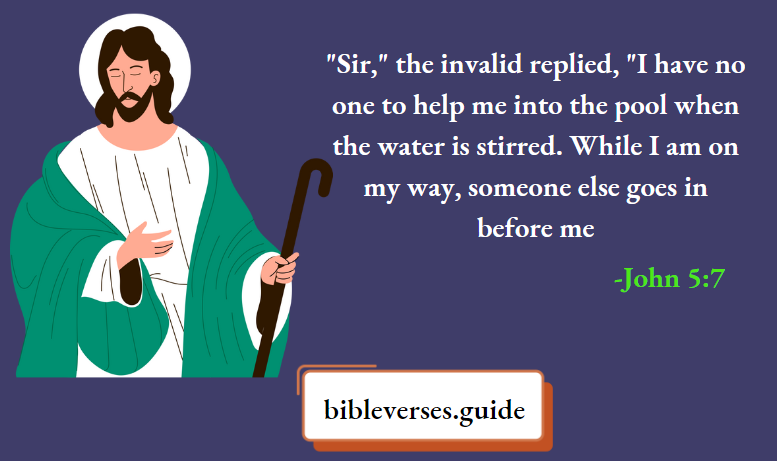
It also sheds light on the plight of the invalid man who laments, “…Sir, I have no one to put me into the pool when the water is stirred up, and while I am going another step down before me”.
The missing verse provides a coherent narrative: it clarifies the man’s presence, the importance of the stirring waters, and the ensuing rush of people eager to enter the pool during this miraculous moment.
Without this verse, the story might appear somewhat enigmatic, lacking crucial background information.
Some argue that retaining it in the Bible is essential to preserve this context and prevent confusion.
Biblical interpretation of the pool of Bethesda healing story
But, as we delve deeper, we’re confronted with a familiar dilemma, one that echoes the narrative of Eve in the garden.
The mere fact that something might enhance clarity does not necessarily establish its originality and, thus, its status as God’s inspired word.
So, what compelling evidence leads textual scholars to assert that this verse may not be part of the original text?
Let’s explore the layers of this mystery and unearth the reasons behind this scholarly conclusion.
The Evidence
Absence From the Most Authoritative Manuscripts: The verse is conspicuously absent from many of the esteemed and widely-regarded manuscripts. Notably, the Latin Vulgate, an essential text in the Christian textual tradition, does not include it.
Manuscript Annotations: At least 20 manuscripts annotate this verse with an Obelus or Asterisk. Such markings indicate early copyists’ suspicions about the verse’s authenticity, suggesting that it might not be original or warranted closer scrutiny.
Deviation From Johannine Language: The verse’s linguistic style is distinct from the usual Johannine tone, hinting at a different author. Of these, the last four terms are particularly remarkable, as they do not appear anywhere else in the entire New Testament.
Presence of Variant Readings: Among the manuscripts that do include this verse, there is a variety of readings. This lack of consistency suggests that the verse was possibly a later insertion.
Without a solid, longstanding tradition, its form and content varied from manuscript to manuscript as multiple versions circulated and were copied several times.
Compound Evidence
Reading this, you might be scratching your head, wondering, “Is it really that black and white? Perhaps we’re still waiting to find those old manuscripts that contain this verse. What if those ancient scribes were a little quick to mark this verse with symbols of doubt?
And isn’t it possible that John, for some reason, chose to use a unique set of words just for this specific section? Plus, if there were accidental omissions early on, scribes trying to fix it later could have led to the varied versions we see.”
It’s human nature to seek explanations, especially when what we’re hearing challenges our understanding. If we stretch our imagination, we can probably develop an alternate theory for each piece of evidence presented.
But let’s look at the big picture: the missing verse in critical old manuscripts, those doubt-filled marks, the out-of-character writing style, and the different ways the verse appears in various copies.
When you pile all this evidence on the scale, it tips pretty heavily in one direction. The chances that this verse was part of the original story seem slim.
If we were placing bets on whether John originally penned this verse, would you really put your money on it?
Many suggest that early Christians intentionally removed this verse, but these theories often lack concrete backing. The most plausible explanation is that the verse wasn’t originally in John’s gospel.
This absence of context for why sick individuals gathered at the pool might have troubled some Christians, prompting them to bridge this gap.
This scenario recalls the reflections we explored in a previous chapter, drawing from Eve’s actions in the Garden of Eden.
Bible story of angel healing water
As discussed, Eve’s choices underscore the dangers of altering God’s words. This emphasizes that we shouldn’t add to the Bible simply for our comfort or alleged logic.
The presence of invalids at the pool might be attributed to the popular beliefs of that time. People at that time may have genuinely believed the pool had miraculous healing properties. But widespread belief doesn’t necessarily mean it’s true.
If we accept every verse as God’s inspired word without proper scrutiny, we risk misrepresenting God’s intentions and teachings.
In other words, insisting on including a verse despite evidence to the contrary could lead us to make potentially false claims about God. We might even suggest the opposite of what God intended.
Jesus’s choice to heal the invalid could be a deliberate act to show that true healing comes from God alone, not mere superstitions.
Angel at the pool of Bethesda theological explanation
Conclusion
It serves as a poignant reminder of Jimmy’s struggle with the missing verses, and how, despite his genuine faith, he was left grappling with unsettling uncertainties.
Such moments underscore the necessity for discernment and careful interpretation when engaging with scripture. It is crucial to approach these texts with a willingness to understand and an openness to learn.
Just as Jimmy encountered unforeseen challenges in his faith journey, the complexities of the Bible can sometimes lead us to unexpected revelations.

As we draw this chapter to a close, the timeless wisdom of Proverbs resonates with profound relevance: “Every word of God proves true; he is a shield to those who take refuge in him.
Do not add to his words, lest he rebuke you and you be found a liar”. Such counsel beckons us to tread thoughtfully and reverently through the sacred corridors of scripture.
Here, we’ll see another instance where traditions and external influences might have shaped the biblical text.
Baptism, a deeply significant sacrament in Christianity, has been a point of contention for centuries. Acts 8:37 presents us with a valuable lesson about the impact of tradition on scripture and the need for a thorough examination.
