
Book 5 The Book Of Deuteronomy
Who wrote the book of Deuteronomy: Moses When was it written: Between 1446 B.C. and 1406 B.C.
Why Was Deuteronomy Written:
- Reminds the Israelites of God’s goodness
- Reminds the Israelites of the laws God gave them
- Reminds the Israelites of God’s love for them and his boundless grace and mercy
- Prepares Israel for crossing over the Jordan into the Promised Land
- Prepares the people for Joshua to assume the role of leader of all of Israel
The book of Deuteronomy is one of the most beautifully written books in the Bible. The book of Deuteronomy is basically a recap of Leviticus and Numbers, but the thing that sets Deuteronomy apart from its predecessors is the emotion and heart that practically jumps off the page and into your heart.
Read and Learn More Bible Study For Beginners
Deuteronomy is the final book of the Bible written by Moses. It is his last work —written shortly before he died. In reading Moses’ words you can feel the intensity of Moses’ desire to leave the people he had invested so very much of himself in on solid spiritual ground.
He knew how quick they were to turn their backs on God. They had done so time and time again and he knew they would do it again. But Moses also knew how very much God loved them and how very much he wanted them to be his wholly devoted people.
So as his final act as their leader, Moses penned this book; reminding them of who they were and begging them to never forget all God had done for them and wanted to do for them in the future.
- A recount of the battles Israel fought on their way to the Promised Land
- A reminder that Moses would not be allowed to cross over into Canaan
- Moses reminds the people of the Ten Commandments and incidents of their disobedience
- A Re-reading of the Law by Moses
- Moses’ farewell speech
- Moses’ blessing to the Israelites
- The Death of Moses
To this point, we have approached our overview of the Bible by looking at ‘key events’ in order to give you a solid historical foundation to build on. From this point on, however, we will be looking at each book more from the perspective of the message it contains.
God’s message to us. It is a message conveying God’s commands, expectations, and desires for us—his people. It is a message that reminds us of his supremacy, holiness, and power. It is a message of prophecy and the fulfillment of prophecy.
It is the message of the Gospel of salvation through Jesus, the doctrine and purpose of the Church, a warning against living apart from God, and the hope of eternity in heaven for all who accept Jesus as LORD.
Moses wrote Deuteronomy after the Israelites left Horeb. According to the first chapter of Deuteronomy the Israelites were spread out over a larger area of land than they had been since the Exodus. They were no longer living as close together—or as close as several hundred thousand people can.
They were living in the mountains, the Negev (which is the southern desert region of what is now the country of Israel), and along the coast of Canaan and Lebanon as far as the Euphrates River.
The first few two-and-a-half chapters are a recap of the previous months— their defeat of the Amorite kings and the division of the land among some of the tribes of Israel. This land was also to serve as a waiting or holding area for the women, children, and livestock while the Israelites took over the land of Canaan in the not-so-distant future.
Near the end of the third chapter, however, Moses stops to share a bit of his heart in regard to not being allowed to enter the Promised Land. We read in 3:23-28 that Moses pleaded with God to let him enter the land if only just to see it—to see the place he had given so much of himself to bring a bunch of ungrateful, whiny people to.
But God says no. In fact, he essentially tells Moses to stop bugging him about it—that ‘no’ means no. God does, however, consent to let Moses see the land without going in. He instructs Moses to go to the top of Mount Pisgah and look in all directions in order to see the land of Canaan.
This Is An Interesting Part Of The Text For Two Reasons:
1: We see once again that Moses wasn’t afraid to dispute God’s decision. He had done so numerous times, beginning at the burning bush when he tried to convince God he wasn’t the right man for the job. Moses had also argued on behalf of the Israelites on more than one occasion when God wanted to wipe them out.
2: God is less willing to give in to Moses for Moses’ sake than he is for the sake of the Israelites.
In thinking about God’s refusal to change his mind, our first thoughts generally tend to go toward the ‘side’ of God being too harsh. Why forgive the Israelites so many times but not Moses? This mindset, however, is incorrect.
God forgave Moses, but forgiveness isn’t a pass to get what you want. Moses still had to be disciplined for his sin—just as the Israelites were disciplined for theirs.
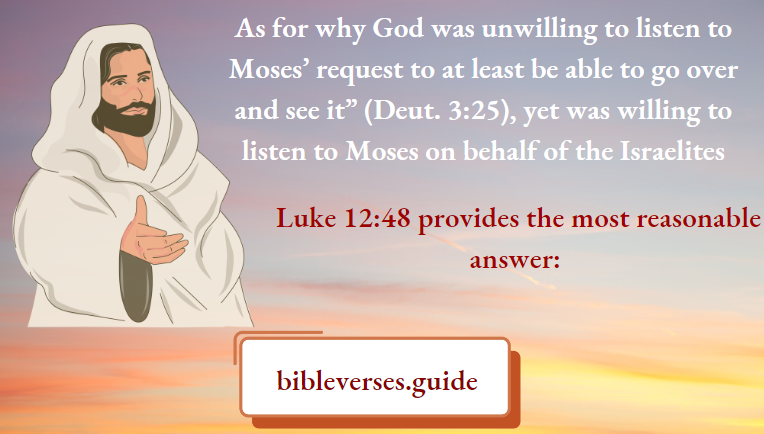
From everyone who has been given much, much will be demanded; and from the one who has been entrusted with much, much more will be asked.”
Ultimately, however, we need to understand that God has the power and authority to do as he sees fit and it is our responsibility as his children to respect his demands and his desires and to obey in faith and because of love.
After sharing this part of his heart with us, Moses continues to remind the Israelites (and us) what the Law is about—that it is about developing and maintaining an intimate relationship with God our Creator and Redeemer.
But rather than just reciting the Law, Moses expounds on it by telling the people why and how they should obey as well as the blessings and consequences of doing (or not doing) so.
Obedience Commanded
Moses instructs the people to obey God’s laws so they can enjoy peace, prosperity, and protection that results from doing so.
Idolatry Forbidden
At this point, Israel has already defiled itself by adopting the idols of the Amorites as their gods along with worshipping God. Moses warns the people to get back on track. His warnings are severe, but they are out of genuine concern for the people. They are also prophetic.
We see Moses’ concern for the people in verses twenty through twenty-four when he reminds them that God’s jealousy is all-consuming. He reminds them of some of the disciplines they have already endured as a result of being unfaithful. He even reminds them of the fact that God is disciplining him (Moses) “.. .because of you….”.
Moses’ prophetic statements are found in verses twenty-five through thirty- one. He warns them that when they fail to teach their children to faithfully adhere to the Law, God will scatter them to the far ends of the earth and take away their status as God’s chosen people. Moses’ prophecy is immediately followed by the promise of redemption upon repentance.
From Generation To Generation
The passing down of the Law from generation to generation is of great importance throughout the book of Deuteronomy. It begins in chapter six, where Moses shares God’s command to teach their children the Law. God commands the Israelites to teach their children at home when they are walking when they are sitting, and through example.
Fear The LORD
Chapters six through thirteen are warnings against taking God for granted— for not giving him the reverence and awe he demands and is due. Warnings against allowing anything to assume a place of greater importance in their lives (and ours) are also given, as is the warning to fear God’s anger.
God’s anger is an aspect of his character that often bothers people. How can God be both loving and angry, they want to know. The answer is this: God’s anger is because of his love for us.
God knows what awaits us in our disobedience and what sin brings to our lives, so he becomes angry when we align ourselves with these things. Yes, that anger often results in discipline, but shouldn’t it? Shouldn’t disobedience result in disciplinary action?
Personal And Social Responsibilities
Clean and unclean foods, tithing, debt management, the judicial system, the feasts and holidays to be observed, rules of warfare, the handling of family relationships…all of these were covered under the Law and Moses took the time to remind the people of how they were to conduct themselves.
Exclusivity
Chapter twenty-three of the book of Deuteronomy addresses another issue of God’s character that some like to take issue with. It is the ‘issue’ of exclusivity. The first part of the chapter clearly states that there are some people God will not allow into ‘the assembly’; meaning they are not welcome into the nation (people group) of Israel. That’s right—not welcome.
The reason is both simple and sound. Purity. God was having enough trouble keeping the Israelites on track. Allowing them to add to the problem by inviting idol worship into their presence went against everything God is.
God cannot be in the presence of sin, so to allow them to bring these practices into the Tabernacle would have completely displaced God from his own house of worship. This could not be. In putting laws of exclusivity into place God was protecting his people.
These laws were also meant as a warning for us today—a warning that has gone unheeded. The results of ignoring God’s warnings to not add or subtract from worshipping him and him only can be seen in our society and sadly in many of our churches today. And as a result, we are a society causing considerable displeasure, sadness, and anger in God.
Curses And Blessings
According to God’s instructions, Moses and the Levites (priestly tribe) warn the Israelites against breaking God’s laws by telling they will be cursed by God if they break some specific laws.
The laws that come with curses include:
- Dishonoring your parents
- Moving a neighbor’s boundary stone
- Having sex with an animal
- Having sex with family members other than your wife
- Murder
- Cheating widows, orphans, and the homeless
In contrast to curses, God also promises blessings galore for faithful obedience. Some of the blessings God instructs Moses and the Levites to announce to the people include:
- Productive crops
- Success and victory over their enemies
- Healthy babies
- Prosperity in all things
A New Leader For The People
After reminding the Israelites of God’s love and commitment to them and their responsibility to honor that commitment with faithful obedience, Moses announced to all of Israel that Joshua would be the one to lead them across the Jordan River and into the Promised Land.
Moses was 120 years old at this point. His age, along with the fact that God would not permit him to enter the land, were the reasons he gave the people for the change in leadership. In turning over the role of leadership to Joshua, Moses was alerting the people that the time for entering into the Promised Land was drawing near.
A new leader for a new life. Moses’ humility, patience, and dauntless perseverance were exactly the qualities needed to get the people to this point. But going into the Promised Land was going to require a leader with the stamina, a fighting spirit teamed with the wisdom that comes only from putting God first, and the ability to keep everyone focused on the task at hand. And God knew Joshua was the man for the job.
Moses’ Farewell Address
Moses’ final days were drawing near. God told him his death was imminent, but not before Moses performed a few final tasks as the leader of Israel.
- Moses gave the written Law to the priests and directed them to read the entire Law to an assembly of all of Israel every seven years during the Feast of Tabernacles.
- Moses had a final conversation with God regarding the future of Israel. God told Moses they would reject him (God) and that his patience would come to an end—that the Israelites would be destroyed.
- Moses wrote a ‘song’ telling the story of his life and read it to the entire assembly of the Israelites.
- Moses blesses the people tribe by tribe.
- Moses dies and is buried by God himself. No one knows where Moses is buried, most likely because God did not want Moses’ grave to become a shrine. When Moses died the Bible states that in spite of his age, his strength and eyesight were those of a young man. The Bible also states that there was never a man like Moses prior to his birth, nor one like him since.
Key Verses In Deuteronomy
Every book of the Bible provides us with words of wisdom, instruction, comfort, encouragement, admonishment, warning, promise, and hope. Let’s look at some of what the book of Deuteronomy has to offer.

“Hear, O Israel: The LORD our God, the LORD is one. Love the LORD your God with all your heart and with all your soul and with all your strength. These commandments that I give you today are to be upon your hearts.
Impress them on your children. Talk about them when you sit at home when you walk along the road, when you lie down, and when you get up.

“If you fully obey the LORD your God and carefully follow all his commands I give you today, the LORD your God will set you high above all the nations on earth.” Deuteronomy 28:1
“The LORD himself goes before you and will be with you; he will never leave you nor forsake you. Do not be afraid; do not be discouraged.” Deuteronomy 31:8
“You were shown these things so that you might know that the LORD is God; besides him, there is no other.” Deuteronomy 4:3 5
“Do not follow other gods, the gods of the peoples around you; for the LORD your God, who is among you; is a jealous God and his anger will burn against you; and he will destroy you from the face of the land.” Deuteronomy 6:14-15
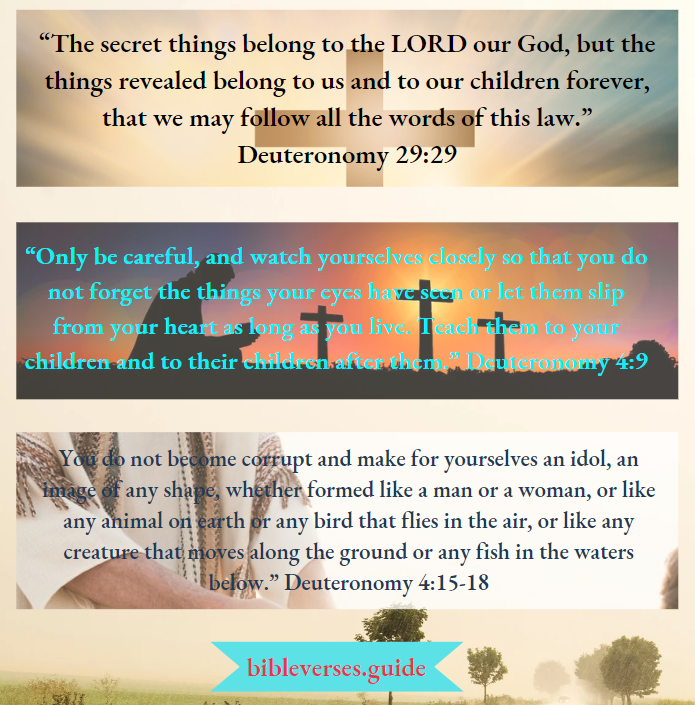
“You saw no form of any kind the day the LORD spoke to you at Hereby out of the fire.