Psalm 34:18

Psalm 34:18 Context

Psalm 34 was written by David, who was the king of the nation of Israel. It’s categorized as a psalm of thanksgiving, offering gratitude to God for something he’s done.

David wrote this passage after avoiding being captured by Abimelech, the leader of an opposing empire.

David had been avoiding Abimelech and had spent much time alone, on the run, hiding in desolate caves and forests.

Psalm 34:18 meaning for the brokenhearted

Psalm 34:18 Meaning

In Psalm 34:17, David writes that “the righteous cry out, and the LORD hears them.” In verse 18, the Lord saves those who are crushed in spirit.

Both verses show that David wasn’t afraid of surrender or humility, especially in times of danger or anguish.
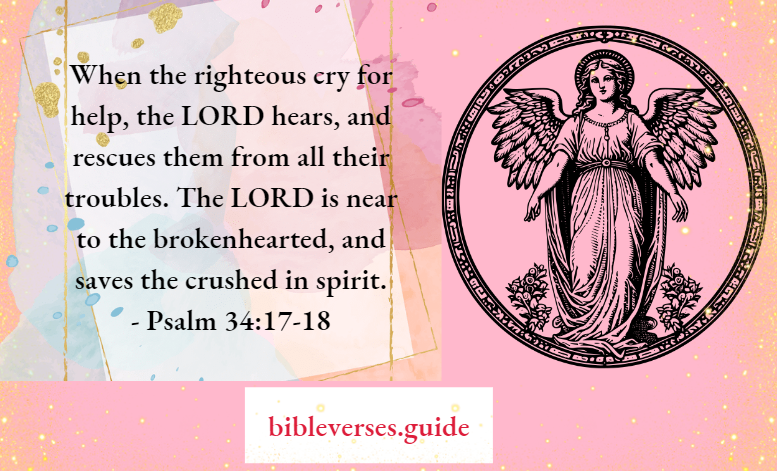
Psalm 34-17-18

Psalm 34:18 NLT comfort for grief

He cried out and trusted the Lord would save him and restore his spirit. For most of us, crying out goes against our natural desire to appear like we have control over a situation.

Psalm 34:18 Application

The good news of Psalm 34 is that God desires to rescue us from whatever we’re facing.

When David declares that God “saves those who are crushed in spirit,” he dispels any notions readers may have that David is talking only about physical danger.

The psalm assures us that God promises to meet us not just in the middle of danger but also in the middle of pain.

If you’ve given up hope and can’t do much else, God has not forgotten you. Call on the Lord, who knows what it means to suffer deeply and who longs to lift your spirit with his presence and nearness.

“Come, everyone who is thirsty, come to the water; and you without silver, come, buy, and eat! Come, buy wine and milk without silver and without cost!”

Bible verse about God healing a broken spirit
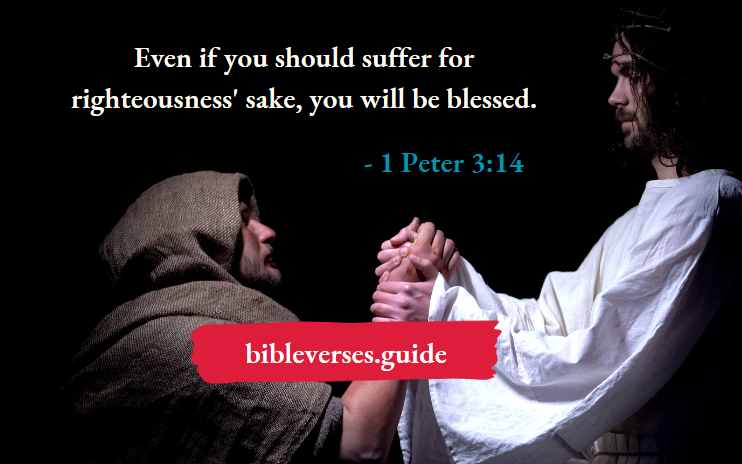
1 Peter 3:14

1 Peter 3:14 Context

First Peter is a letter written by the apostle Peter to the Christians in several cities of modern-day Turkey.

Peter was one of Jesus’ closest friends during his earthly ministry, and after Jesus’ resurrection, he became one of the most prominent leaders of the early church. The focal point of the letter is Jesus Christ himself.

1 Peter 3:14 NLT meaning and explanation

1 Peter 3-14

Understanding 1 Peter 3:14 about suffering

1 Peter 3:14 Meaning

We’ve all suffered for wrong things we’ve done. When you’re a kid, you might get punished for lying or talking back, or fighting with your brother or sister.

But have you ever suffered for doing what is right? That happens too, but it’s so much harder to take. It’s unjust, and injustice has a special sting to it.

In this chapter, Peter talks about many practical things. He begins by discussing husband and wife relationships and how men and women should conduct themselves.

But then he makes a shift to talking about suffering. Namely, how to suffer well. We are told to be humble and rather than repay evil with evil, we are to repay evil with blessing.

How is such a thing possible? It goes against our very nature. Indeed, it does, which is why we must take on the nature of Christ.

But we also must keep in mind—if the world loves us and everyone is on our side, we’re likely doing something wrong.

The world hated Christ, and it will hate his followers as well. The verse for the day tells us that you are blessed when you suffer for good.

Why? Because you are within the will of God. All of this might mean very little if we didn’t have this promise just a couple of verses earlier:

“For the eyes of the Lord are on the righteous and his ears are attentive to their prayer, but the face of the Lord is against those who do evil” (v. 12). God is watching and is on your side.

1 Peter 3:14 Bible verse about fear

1 Peter 3:14 Application

Is there anyone in your life who means you harm? Or perhaps a cultural system or belief that is working against you despite the fact that you’re trying to fight for what is right? Take courage.

God is watching and you are blessed. Pray for strength, peace, and humility.

“Delight yourself in the LORD, and he will give you the desires of your heart.”

1 Peter 3:14 commentary and devotional

Psalm 37:4 ESV

Psalm 37:4 ESV Context

David wrote Psalm 37 as an acrostic poem; that is, each stanza of this song begins with a letter of the Hebrew alphabet. It’s important to note that it is a teaching psalm, directed at man, not God.

Perhaps this style was used as a memorization tool, something easy to recall in one’s own heart when remembering the Lord’s ways.

Psalm 37:4 ESV meaning and explanation

Psalm 37-4

Psalm 37:4 ESV delight yourself in the Lord meaning

Psalm 37:4 ESV Meaning

In the first third of Psalm 37, David is offering counsel and encouragement for the afflicted people of God.

He is answering the problem of evil in the world and specifically addressing the idea that evildoers seem to flourish.

It is a common thing for the righteous to become anxious when we see evil prosper. Those who have followed the Lord are indeed familiar with the sting of watching unbelievers appear to be happy in their sins.

“Why is that?” we ask ourselves. While we, who are committed to obedience, wait to feed on his faithfulness, the unrighteous seem to succeed.

Psalm 37:4 ESV Bible verse about desires of your heart

Psalm 37:4 ESV Application

The verses just before this one tell us that the wrongdoers will fade and wither like grass. Their satisfaction is temporary just as man’s life is temporary. It is God who is eternal and who offers eternal life.

This long-term view is an important concept to keep in mind. We don’t live to satisfy our earthly desires; we live to follow our Father, who provides for our needs and wants as he sees fit.

This verse is redirecting our attention from those around us who don’t know or follow God’s ways to remember to delight in the Lord instead.

When we look to him, expecting what he offers us—truth, goodness, faithfulness, as seen in the verse just before this one—then he shall give us the desires of our heart.

As followers of our loving God, by now we’ve realized that his ways are higher than the world’s. When we look to him, and desire him, he resets our priorities to align with his own.

Peace comes to our hearts and minds when we refocus our gaze on our just Father, instead of the evil around us. He allows us the ability to delight, and he satisfies us there.

“There is no fear in love. But perfect love drives out fear because fear has to do with punishment. The one who fears is not made perfect in love.”

Psalm 37:4 ESV commentary and devotional insights

1 John 4:18

1 John 4:18 Context

The book of 1 John was written to encourage and assure the local church after some in the church began to drift away from God’s truth.

These leaders became false teachers who tried to convert others to their way of thinking. John wrote these three letters to speak the truth about who Jesus was and why he came.

1 John 4:18 meaning and explanation

1 John 4-1

1 John 4:18 NLT Bible verse about love and fear

1 John 4:18 Meaning

In Dante’s epic poem The Divine Comedy, he talks about love being the power that runs the universe. Good things are motivated and caused by love.

Bad things are some type of perversion of love. Love is the center of all things, and nothing happens without it.

The focus of the passage that today’s verse comes from is also love. We are told to love one another because love comes from God. Indeed, God is love.

These three words— “God is love”—may be among the most powerful words ever uttered. If we truly understand what love is, understanding these words will change us.

So how are we supposed to define love? The passage tells us that it’s based on his sacrificing his Son for us. Love is sacrifice. Love is a willingness to suffer for another.

That sort of love—that sacrificial kind that is willing to suffer for the beloved—has no room for fear. If God loved us enough to send his Son, what is there to be afraid of? Surely not God! He suffered for us.

God is above all, and nothing is more powerful than he. So that leaves us with no options left. Fear and love just don’t mix.

But the passage doesn’t leave us there—it calls us to higher things. If this is how God loves us, we must love others similarly. That is a high calling indeed.

Bible verse meaning “perfect love casts out fear”

1 John 4:18 Application

When you think of love, do you think of sacrifice? Thank God for his sacrifice on your behalf.

Then meditate on how the most powerful being in the universe was willing to suffer for you.

Pray that God helps you catch a glimpse of this love and that it will wipe away your fear.

“It is useless for you to work so hard from early morning until late at night, anxiously working for food to eat; for God gives rest to his loved ones.”

1 John 4:18 commentary and devotional insights

Psalm 127:2 NLT

Psalm 127:2 NLT Context

Psalm 127 is often recognized by the first verse, “Unless the Lord builds a house . . . ” which refers to Jesus being the foundation of all of our pursuits.

Unless we place Jesus at the center of our activities, our “house-building” won’t be successful and we will work in vain. Verse 2 takes this wisdom further by advising us to rest and allow Jesus to provide.

Psalm 127:2 NLT meaning and explanation

Psalm 127-2

Psalm 127:2 NLT commentary and reflection

Psalm 127:2 NLT Meaning

Although in this context the word house is synonymous with family, the principles apply to other areas of life. We know that we need a strong foundation in Jesus.

This is the best way for us to build anything that we seek in life. But what about how hard we work toward our own goals— our own labor? Verse 2 says that it is useless for us to work hard for long hours anxiously.

Anxiously implies that we rely on ourselves rather than on Jesus to provide.

Difficult and lengthy work doesn’t ensure our prosperity or security, especially if we haven’t centered our work on the Lord.

The last part of verse 2 promises rest from the Lord. Rest from your labor also means rest in the knowledge that Jesus freely gives provision. Jesus will provide for your needs, and he’ll bless you with rest.

Our culture thrives on the busyness of life with people wearing their activities like a badge of honor. Rest has become an elusive thing of the past. However, rest is a gift, “for God

gives rest to his loved ones.” Jesus doesn’t want us anxiously overworking. He longs to give us stillness, calmness, and sleep, which are necessary for our health and for our souls.

Psalm 127:2 NLT explained in simple terms

Psalm 127:2 NLT Application

The next time you’re tempted to push yourself beyond capacity, examine your motives.

Do you have a deadline that you’re working to meet, or are you fearful that you won’t have enough or be enough unless you trudge forward?

If it’s the latter, confess your doubts to the Lord and commit to signing off as often as possible.

Stick to a daily quiet time with Jesus and see how the consistency shifts your mindset. Lastly, find pockets of peace in your weeks and let the tranquility seep in and restore your soul.

“For we know that if the tent that is our earthly home is destroyed, we have a building from God, a house not made with hands, eternal in the heavens.”

Psalm 127:2 Bible verse meaning God gives rest

Job 1:20–21

Job 1:20–21 Context

The book of Job presents the story of a righteous man whom God allows to be tested by Satan. His property is destroyed, children are killed, and health fails.

While friends gather to comfort him—with mixed results—Job maintains his faith (despite struggles), and in the end, God blesses him once again.

Job 1:20‑21 meaning and explanation

Job 1-20-21

Job 1:20‑21 NLT Bible verse commentary

Job 1:20–21 Meaning

According to many pastors and scholars, the main theme of Job is “theodicy,” which is the question of why there is evil if God is good.

Job suffered greatly, but why? According to chapter 1, it was because he was righteous. He was “blameless” and “upright” and honored God with sacrifices.

Job mourned his losses, as well as he should. But he also blessed God’s name. He realized that if we’re going to accept good things from God, we also need to accept the bad.

So why did God let him be attacked by Satan? The answer, it turns out, never comes. What we discover by the end of the book is that God doesn’t owe us an answer.

We are only assured that he is watching, and nothing happens that he doesn’t allow. But the formula of why bad things happen to good people is never shown.

Thankfully, even though we never get a complete answer to why God does the things he does, we do get a satisfactory conclusion. God blesses Job.

By the end of the book, he has more than he’d ever had before. Is that guaranteed in this life? No. But our lives don’t end here on earth.

We can rest in the fact that God is just, he loves us, and in the end, he will bless his people.

Job 1:20‑21 Bible verse meaning God’s sovereignty

Job 1:20–21 Application

Have things happened to you that you just don’t understand? Have you been punished for doing the right thing and obeying God? This is unjust, and it’s all right to mourn.

But it is also good to praise him in the suffering. God deserves your praise, through the good times and the bad. But it is also for your own good.

It reminds you that God is in charge and is bigger than your circumstances and that in the end, he will bless his children.

“If I go and prepare a place for you, I will come back and take you to be with me so that you also may be where I am.”

Job 1:20‑21 worship and response to loss explained

Romans 8:31

Romans 8:31 Context

Paul wrote this letter to the churches of Rome, explaining the revelation of God’s judgment through the law and saving grace through Christ’s redemptive work on the cross.

While addressing theological questions and concerns of the early church. Paul discusses that we are dead to sin, alive to Christ, living by the Spirit, and a part of future glory to be revealed.

Romans 8-31

Romans 8:31 Meaning

Our suffering is “not worth comparing with the glory that will be revealed in us” (v. 18). God predestined us and called us. Therefore, no snare of the enemy will ever succeed because he works it for his glory.

The chapter continues to declare we are more than conquerors, and nothing is able to separate us from the love of God. So who can be against us if the all-knowing God of the universe is for us?

The chapter goes on to ask, “Who will bring any charge against those whom God has chosen?” The everlasting love of the Creator God is on our side and working all things for the good.

Romans 8:31 meaning and explanation

Therefore, the enemy will not prevail. We know the end of the story and the victory Jesus has already won.

Romans 8:31 Application

God is greater than our daily temptation and larger than the opposition we face; we have ultimate victory in Christ.

It can be easy to want the approval of humanity or believe that everything should go our way. But that is not what the Bible says.

Trials and tribulations will come, but we have the promises of God to stand on. This verse is one of those promises.

Death, betrayal, job loss, fear, sickness, a mistake—all of these things God can work for good. It can produce good fruit, it can open new doors, and it can bring glory to the Father. Isn’t that good news?

Romans 8:31 commentary on God’s support

Our God is for us. He is the conductor of the orchestra, and the painter of the masterpiece. The God of the universe is for us. He is not trying to trick you; he is for you.

He is not condemning you; he is for you. He has not forgotten you; he is for you. No matter what tomorrow brings, you can rejoice, because he is for you.

“Even though I walk through the darkest valley, I will fear no evil, for you are with me; your rod and your staff, they comfort me.”

Psalm 61:2 ESV

Psalm 61:2 ESV Context

The 150 chapters of the Psalms are attributed to seven different writers, with close to half of them (including chapter 61) attributed to David.

Psalm 61 includes both pleas for help and declarations of worship and starts with a note that it was meant to be sung with stringed instruments.

Psalm 61:2 ESV meaning and explanation

Psalm 61-2

What does Psalm 61:2 ESV mean about God’s refuge

Psalm 61:2 ESV Meaning

David begins chapter 61 with a plea of desperation, asking God to hear his cries. In verse 2 he says he is calling out “from the end of the earth,” indicating he feels alone and isolated from God.

He asks God to bring him “to the rock that is higher than I.” A rock is both a symbol of strength and immovability—something that easily contradicts how David is feeling—as well as a symbol of safety.

In a flood, higher ground is of course preferable, as is higher ground when under attack from an enemy army, since higher ground allows for more visibility of the enemy and less accessibility for capture.

Simply put, a higher rock is strong and safe. In saying that God is “the rock that is higher,” David is admitting the inherent gospel truth that God is strong and he, David, is not.

He needs the Lord to help him, for he cannot succeed on his own. This theme continues into verse 3, where David speaks of the Lord as his “refuge” and “strong tower against the enemy.”

David ends the chapter by saying that the Lord “heard my vows” (61:5) and sings praises to the Lord. David gives us a glimpse of a God who gives us safety and rest in our weakness.

Psalm 61:2 ESV Bible verse commentary

Psalm 61:2 ESV Application

Hope can be gleaned from coming to the same realization that David came to—that he, as a human, is weak, but that the Lord is powerful and able to give us the safety and rest he couldn’t achieve on his own.

While it may initially feel discouraging to realize that we can’t do it (after all, that is not a sentiment often used in encouraging greeting cards), the truth is that God can, and that instills hope.

God is not human. God is not weak. He hears and answers our cries.

We don’t need to strive so hard to be self-sufficient when the chaos threatens to overwhelm us, but we can rest in the truth that God is infinitely more capable than we are.

“What, then, shall we say in response to these things? If God is for us, who can be against us?”

Psalm 61:2 ESV prayer for strength and shelter

John 14:3

John 14:3 Context

The Gospel of John was written by the apostle John, one of the first followers of Jesus. He was with Jesus from the early days of Jesus’ ministry through the time of his ascension into heaven.

John tells us that Jesus comforted the disciples with the words of John 14:3 just after the Last Supper on the night before he was crucified.

John 1:43 meaning and explanation

John 14-2-3

John 1:43 Bible verse meaning “Follow Me”

John 14:3 Meaning

This would have reminded the disciples of Jewish wedding customs.

After a man and woman became betrothed, the man went to his father’s house to add a room for him and his future bride to live in.

He was gone for several months, or even years, in order to “prepare a place” for her. When the room was ready, he returned, they were married, and he took her to his father’s house.

In several places, the Bible compares Christ and the church to a bride and bridegroom.

Just like a Jewish bridegroom, Jesus has gone to prepare a place for us, and when he returns, he will take us to be with him.

We don’t know how long it will be until he returns, but we can trust that he will.

And when he does, we will go with him to heaven, which is an actual physical place where all the pain and difficulties of this world will be behind us.

Jesus tells us not to let our hearts be troubled, but to trust him (John 14:1). He will do what he has promised to do.

What does John 1:43 mean about discipleship

John 14:3 Application

Brides in Jesus’ day didn’t know when their bridegrooms would return for them, and we don’t know when Jesus will return for us. But we can trust that he will return, and we must be ready when he does.

When we experience difficulties here on earth, we can take comfort in knowing that no matter what happens, our struggles here won’t last.

One day Jesus will return to take us with him, and we’ll leave all our earthly troubles behind.

If we choose to remember that the Lord is preparing a place for us where we can be with him for eternity, we can focus on our future rather than our problems.

“God will wipe away every tear from their eyes; there shall be no more death, nor sorrow, nor crying. There shall be no more pain, for the former things have passed away.”

John 1:43 explained in simple words

Isaiah 35:4 ESV

Isaiah 35:4 ESV Context

Isaiah was a prophet who provided wisdom and vision to the people of Judah and Israel. At this point in time, Israel had been out of the promised land for nearly seven hundred years.

The people of Israel had developed a civil war between themselves and became divided into two nations—Israel (to the north) and Judah (to the south).

Prior to the beginning of Isaiah’s ministry as a prophet, the Northern nation had gone through eighteen different kings, all of whom had rebelled against the Lord.

The Southern nation wasn’t much better, having eleven kings who were almost as rebellious as the others.

When Isaiah enters the story, Israel is about to be overrun by Assyria, and Judah is facing threats from the surrounding nations.

Isaiah 35:4 ESV meaning and explanation

Isaiah 35-4

Isaiah 35:4 Bible verse explained for anxious hearts

Isaiah 35:4 ESV Meaning

In Isaiah 34 he announces a terrible judgment that is coming to the nations of Israel and Judah. The people of Judah had lost their temple, their land, and their sovereignty.

Everything that gave them a sense of direction and purpose is completely lost. They are feeling distant from God.

And right in the middle of that despair, there is a message of hope—Isaiah 35. In verse 2, Isaiah states that the dry desert will soon blossom, and it will blossom with abundance, joy, and singing.

Creation will rejoice as it’s restored! God has the power to transform creation, and he has the power to transform us too.

We can never be too far gone that God won’t invite us back to him. We can never be so broken that he can’t restore us.

Isaiah 35:4 ESV commentary and devotional insights

Isaiah 35:4 ESV Application

For those feeling lost and far from home, for those facing a hard situation or circumstance, it’s easy to forget who God is and the power he has in our lives.

We see in Isaiah 35 that God cares deeply about an entire nation and for the trembling hearts of his people.

As you read through Isaiah and the rest of Scripture, you will come to understand that God DOES invite us back to him and DOES offer restoration to our lives.

Just like the people of Israel and Judah, we do not need to fear, because we have God on our side. Be strong, fear not! Salvation comes from the Lord, and he has come to save us!

“So we say with confidence, ‘The Lord is my helper; I will not be afraid. What can mere mortals do to me?’”

Isaiah 35:4 ESV meaning “Be strong; fear not”