A Divine Blessing

A Divine Blessing

It had been a long and difficult journey. For forty years, the Israelites had wandered in the scorching deserts of the Middle East as they searched for the new homeland God had promised them.

Moses, their divinely ordained leader, claimed he was following God’s orders. But over the past four decades, there had been many times when he looked more lost than everyone else.

By the time the Israelites got to Mount Sinai, the holy mountain where Moses received the Ten Commandments from God, they numbered more than one million souls (Num. 1:46).

To commemorate their efforts thus far, God gave them a special blessing.
Numbers 6-24-26

God communicated these verses recorded in Numbers to Moses, who passed them on to his brother, Aaron, and Aaron’s sons, who served as the Hebrews’ first priests.

Aaron and his brothers then communicated God’s blessing to the people.

After years spent in captivity in Egypt and years more spent wandering in the desert, the people received this divine blessing as a welcome relief.

The Bible is a book of many blessings. Some of them come directly from the mouth of God. Many others are human blessings.

But the one thing they all have in common is that they are designed to confer a sense of grace and inspiration to the person receiving the blessing.
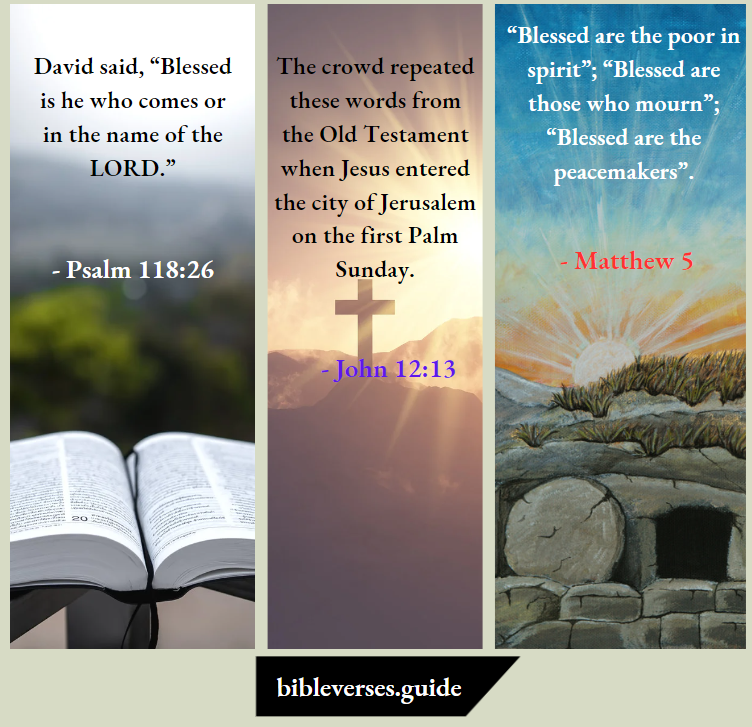
Blessed is he who comes or in the name of the LORD

Many of us have lost touch with the ancient practice of blessing others, even though we certainly need to be blessed as much as earlier people did.

If someone sneezes, you might hear another person say, “Bless you,” but many of us go through much of our lives without receiving blessings from or giving them to the people around us.

If you want to change that, try blessing loved ones or family members whenever you meet. This can take the form of an unspoken prayer for them, or it can be a brief but sincere comment: “God bless you.”

Just about anyone or anything can be blessed, and the blessings can be offered in either informal or formal ways. Many people seek the prayers and blessings of friends before starting a new venture, such as a new job or a move to a distant city.

In such cases, blessings can be a powerful source of comfort and reassurance. Some churches have more formal services for blessing a new house or new office space.

In such cases, a priest visits the site and leads the occupants through a prescribed ritual.

Once a year, many Anglican and Episcopal churches host a blessing of the animal’s services to honor the legacy of St. Francis of Assisi, the Italian saint who had a deep love for creation.

In your own life, you may even want to try blessing the co-worker or boss who annoys you or the driver who cuts in front of you on the highway.

This may seem like a lot of work at first, but once you get in the swing of things, blessing others—and being blessed yourself—will become a bigger part of your life.

And like the Israelites, you will find the kind words a healing salve during a tough journey.

Thank you, God, for blessing us, and helping me to be a blessing to others.


A Prowling Predator

A Prowling Predator

The image in this verse of a roaring lion was particularly meaningful to friends of mine years ago in Ft. Lauderdale, Florida.

One sunny, south Florida day, Tom and Nancy’s (not their real names) little boy, David, was playing on the sidewalk in front of their home.

They lived in a beautiful neighborhood with only one problem: the people across the street from them harbored a lion behind tall, stucco walls.

He was caged and supposedly unable to harm anyone. The legal system was moving slowly to force the removal of this wild creature from a residential neighborhood, but those efforts were too late for David.

Somehow the lion escaped from his cage, scaled the wall, and ambled across the street toward David and his older brother, Bobby.

The lion circled David and let out a roar. Bobby ran into the house, screaming for his parents.

Tom and Nancy ran outside and faced the horror of seeing David’s head and shoulders trapped inside the lion’s mouth.

Without thinking about either danger or impossibility, Tom gripped the lion’s jaws and pried them open.

1 Peter 5-8

David’s limp body fell out of the lion’s mouth and amazingly, the beast lost interest and walked back home.

David was rushed to the hospital and while being wheeled into the operating room, he asked his mom to sing “Jesus Loves Me” to him.

David survived, and everyone who heard about the event marveled at Tom’s ability to open the jaws of a lion.

Tom knew he didn’t do that on his own and fully acknowledged the power of God to intervene in a miraculous way to save David’s life.

That day Tom accepted Christ into his heart with unspeakable thankfulness.

Few of us will have as graphic an example of the devil stalking about the streets of our hometowns, but we can all acknowledge the presence and power of evil in our world.

Certainly, we who are Americans tasted evil on that fateful day when we watched so many thousands of people lose their lives in the attacks on the World Trade Center.

But Satan doesn’t always come with such a definition. Subtle devices are his specialty.

He uses discouragement, distraction, busyness, greed, selfishness, and a host of other means to wield his power.

The good news is that his power is limited. While Scripture reveals the power of the evil one, it also testifies that God’s power is greater.

This verse tells us to be “self-controlled and alert.” With protection against temptation and awareness of Satan’s wiles, we do not need to fear the power of the roaring lion.

Like Tom, we can experience supernatural strength in overcoming evil with good.

Father, we are so aware of evil when it comes in graphic ways, but we are sometimes unaware of the more subtle moves of the evil one. Help us to discern good from evil and protect us always.


Called And Equipped

Called And Equipped

It was a tough assignment God gave Moses, a shy, quiet man who was having a tough time imagining himself as a public speaker, military commander, or charismatic political leader.

Pharoah had kept the nation of Israel—the people of God’s own heart—prisoners in Egypt for years.

They were enslaved and oppressed. But God had seen the sorrows of their lives and the backbreaking labor they endured. He had heard their cries and heartfelt prayers for help.

Now, finally, God planned to deliver them from Egypt and take them to “a land flowing with milk and honey” (Exod. 3:8).

The only thing needed was a willing human collaborator. For some unknown reason, God chose Moses.

Exodus 4-11-12

Moses listened as God explained his assignment. Moses would go to Pharaoh, the world’s most powerful leader, and command him to set the Israelites free.

Then Moses would lead thousands upon thousands of people across the barren desert to the place God had chosen for them.

O Lord, I have never been eloquent

Growing tired of Moses’ objections and lack of faith, God responded, “Who gave man his mouth?” He then comforted Moses with the following assurance: “I will help you speak and will teach you what to say.”

Have you ever sensed God calling you to do something that you felt was beyond your strength or abilities?

Maybe your divine assignment wasn’t as daunting as Moses’. Perhaps it was something as simple as a tug at your heart telling you to help a street person instead of going out of your way to avoid him.

Or perhaps your assignment came during a coffee break at the office when a co-worker talked about the grief a recent loss caused and you felt moved to offer words of comfort and spiritual insight.

Our divine assignments don’t always have to be big and complicated. It’s easy to place a phone call to a friend the evening before she has a doctor’s appointment, but the comfort you can provide may help her sleep soundly that night.

In other cases, we can best serve others by listening to what they have to say. The gift of listening is something we all possess, but most of us are too busy talking most of the time instead of really trying to hear what others have to say.

Divine assignments can also arise from our life experiences. Once you have gone through a particular trial and emerged safe and sound on the other side, you have a unique ability to provide inspiration and guidance to those who face similar challenges.

Exodus 4-13

But there are some assignments that nobody but you can carry out. They won’t always be easy, but as God reminded Moses, he will give us the help we need in order to carry out what he has called us to do.

Father, here I am. Use me to do your will, and give me the strength I need to do it.


Children Of Faith

Children Of Faith

My daughter Lara and I recently enjoyed a full day of shopping while I was visiting her in California.

Her three toddlers, Lisa and twins Nathan and Cole, alternated taking turns in the double stroller and walking next to us.

We stopped in a jewelry store so Lara could show me a beautiful necklace in the shape of a cross that she was hoping would be a birthday present from her husband, Craig.

Lisa was sitting in the front of the stroller, peering into the jewelry case and listening to Lara’s conversation with the saleslady.

Lara gently draped the gold chain of the necklace over her fingers and let the cross dangle.

“That’s a cross!” four-year-old Lisa exclaimed. “Mommy, that’s a cross!”

3 John 4

“I know, honey,” Lara said.

“That’s what Jesus came to do, he came to do that, Mom,” Lisa said, now standing on the footrest of the stroller as if in a pulpit all her own.

I smiled at Lara and felt tears rise up in my eyes as I witnessed the fruit of parents teaching their children the truth.

We now have seven grandchildren and relish so many wonderful times with them and their obvious Christian upbringing.

It is difficult to think of anything more joyful than watching the truth spill out of them.

They are fully normal kids with their fair share of mischievousness, but they also soak up God’s truth.

In this verse, John was writing to Gaius, a Christian in one of the churches of the province of Asia.

John was apparently referring to converts or believers in his care. He had had word that Gaius was walking in truth and delighted in that good news.

God, in his providence, imparts truth in many ways: through his Word, through his presence in the Holy Spirit, and through the words of pastors and teachers.

And he uses all of us as his vehicles to impart truth to those close to us.

How wonderful it is that the Word of God has the power to change lives, even when delivered in the routine of parenting. I used very little formality when teaching my children biblical truth.

I just tried to live in front of them what I talked to them about. As is usually the case in parenting, I didn’t know just how much of what I said stuck.

It seems that a good deal of it did. Of course, they had many other godly influences in their lives, but I know that some of the truth they now live came from our time together as a family.

Whether we have children or not, we all have the means to impart truth. And then sometimes we are blessed to enjoy the fruit of our labor.

Father, it is such a joy to see others walk in truth. We thank you for using us to help impact others with your Word.


The Choice Is Yours

The Choice Is Yours

Life is full of choices, as anyone can see by taking a brief trip to a fast-food restaurant.

Would you like your burger well done or rare? Sesame seed or sourdough bun? Hot sauce or mild sauce? As for the fries, would you like regular fries or curly cheese fries?

Similar choices confront you at the grocery store. Simply trying to choose a breakfast cereal can turn into a complex decision-making process that requires a selection from among hundreds of varied choices.

Even watching television involves making choices. Decades ago, there were three major broadcast channels.

Today, most cable services offer dozens of choices, and some satellite dish systems offer hundreds.

Sociologists have a term that describes our current abundance of options for everything from food to TV to spiritual paths and “lifestyle options.”

They say twenty-first-century people suffer from an affliction called “overchoice.”

Deuteronomy 30-19-20

Some choices aren’t very important. There may be two or more different routes you can take when you’re traveling to the store or the kids’ school, but you’ll reach your destination sooner or later, whichever way you go.

In other cases, the decisions we make have important and possibly even life-changing consequences.

Some TV shows are entertaining and possibly even thoughtful. Others are mind-numbing, soul-stunting ex¬ercises in crassness and exploitation.

Perhaps the most important choices we will ever face are those recurring issues where we must choose between life and death, blessings and curses.

Will the way you punish your child teach him to honor and obey authority, or will it cause resentment and rebellion?

Will the way you run your business be a testimony to your depen¬dence on God, or will it be a declaration of your complete dedication to looking out for yourself?

Will your decisions about everything from the fate of unborn children to the health of the environment reflect your concern with life, or will you unconsciously be using your God-given free will to support a culture of death?

The options are clear and the consequences—unlike those at fast-food restaurants—are significant. Now it’s up to us.

God, thank you for the gift of free will. Help me use it wisely by making the right choices.


Being Like Children

Being Like Children

This past summer we enjoyed a reunion back on the East Coast with members of our extended family.

Steve and I shared a beach house with our two daughters, their husbands, and seven children from both families plus a few others.

We all talked about how to have a good time and not get on each other’s nerves, and how to give the six boys and one girl room to be kids and enjoy themselves.

Steve and I had a laid-back role as the older couple, not directly responsible for anyone and able to enjoy everyone. We knew it would be chaotic and noisy and that toys would be everywhere.

Let’s just relax and let the good times happen, we told ourselves. And so we did.

It was an absolutely wonderful week. The children all got along with each other and the adults were less uptight than they were at home.

Luke 18-16

We went to the beach most days and built sand castles and collected shells. At least one person always had a little one to keep track of since we were near the water’s edge.

The children were safe and at the same time had the space time and energy to really relish life.

Sometimes one of them would become engrossed in digging for creatures, and he’d want the solitude to do it alone.

At other times several of them would play with buckets and shovels and create their own imaginary constructions.

Why does the kingdom of heaven belong to those who are like little children? I think it must mean that we will all be most completely who God intended us to be without the inhibitions of adulthood.

We will be less guarded, knowing that we are safe in God’s care. We won’t have to be like everyone else but will be free to express ourselves in unique ways.

Since the Bible tells us there will be no more tears in heaven (Rev. 21:4), it must mean that we will laugh in the reckless way that children laugh.

They giggle with delight and double over with peals of joy.

There must be a lot of power that infuses our souls when we get to heaven to open up some of us to godly abandonment. Just to be free and childlike sounds like a tall order for many of us.

And I think God wants us to experience more of this godly abandon here on earth.

On a vacation, we can experience life without the responsibilities and restraints of daily life.

But what if we could be who God intended us to be all the time, not just on vacation?

Maybe if we infused our souls with the nurture of God’s love more frequently, we’d experience more fulfillment, laughter, and childlike peace.

God’s nurture comes from worship, time with him, time with other believers, prayer and just thinking about how much God loves us, and how much he wants to hold us the way we hold the little people in our lives.

And when the sun goes down and little people wind down they cuddle safely in the arms of those who love them.

I can’t think of much that is more peaceful than rocking a baby or an active toddler who gives in to sleepiness.

Father, thank you for the hope children give us that we will all laugh again in the innocence of our younger days. Help us to be more relaxed in your love.


We Know The Final Victor

We Know The Final Victor

Dallas Cowboys football team was playing. He talked about his excitement over their games and what a fan he was.

He would have someone tape the game for him when he was away, and then he could watch it when he got home. Most of the time, he would hear the final score before he got home.

Still, while watching the game he’d get engrossed in the plays as if they were happening in the present moment.

If the Cowboys were behind, Dr. Hendricks talked of being worried . . . until he remembered the final score (for games they had won, of course).

Revelation 1-1

Even when it looked really bad, he could hold on to the fact that they had already won.

He went on to tell us that he felt that way about heaven. We as believers know the final score. We win.

The Book of Revelation opens up some of the future to us and tells us not only the battles that lie ahead but the final result.

The apocalyptic language of Revelation helps us see events with a new set of eyes. It promises that God’s power will ultimately defeat the forces of evil.

What a gift to know that we have the victory won, especially when times are difficult.

John received a glimpse that he shared with us, and we can hold on to it as all the information we need until the time as we know it ends.

Father, thank you for revealing to us the final battle results. Thank you for being with us in our suffering and for giving us a picture of life’s events from a heavenly perspective.

Help us keep that perspective in view.


Hey, You Listen To What I’ ‘m Saying!

Hey, You Listen To What I’ ‘m Saying!

Teach them to your children, talking about them when you sit at home and when you walk along the road, when you lie down, and when you get up.

Write them on the doorframes of your houses and on your gates, so that your days and the days of your children may be many in the land that the LORD swore to give your forefathers, as many as the days that the heavens are above the earth.

If you’ve ever been to New York or Jerusalem, you may have seen devout Orthodox Jews whom you recognized by their long beards, flowing hair, black hats, and dark clothing.

In some cases, you even saw phylacteries—small leather boxes containing pieces of paper with biblical passages written on them.

Orthodox men wear phylacteries strapped to their heads and arms during their weekday morning prayers to remind them of their duties to God and God’s Word.

Deuteronomy 11-18-21

Passages such as this one from Deuteronomy inspire such devotion. This is from Moses’ farewell address to the people of Israel.

Moses had led these people for decades during their wanderings through the desert. Now he was dying, and it was time to pass on some final words of wisdom.

Two of the major themes Moses talked about were God’s love for humanity and humanity’s need to obey God. Moses also challenged people to study and follow God’s Word.

Often when he spoke, Moses was speaking God’s words. In this passage, there was one simple message God wanted to communicate: “Hey, you: listen to what I’m saying and take it seriously.”

Orthodox Jews who wear phylacteries are taking God seriously. So are committed Christians who try to organize their daily lives around the principles the Bible spells out.

The man who does the right thing at work when others encourage him to take an ethical shortcut is fixing God’s Word in his heart.

So is the woman who perseveres in doing good even when she gets no credit for it.

So is the child who obeys her parents even if the commands they give aren’t always fun to carry out.

Life can be so crazy and hectic that people often forget to do what’s right and best.

That’s why God continually reminds us to focus our attention on the one true rule of life and conduct that he, the Creator of the cosmos, authored.

When we hear and obey what God says, our lives will be blessed. When we forget things that are truly important to focus on things that are merely urgent, we go off course.

Okay, God. I’m listening. Tell me what you want me to do and help me do it.


Seekers Will Find

Seekers Will Find

Thinkers who study contemporary spiritual life have declared ours to be a “seeker culture.”

Sociologist Wade Clark Roof interviewed hundreds of people for his book, A Generation of Seekers: The Spiritual Journeys of the Baby Boom Generation.

Roof said many of the 76 million people born between 1946 and 1964 are asking deep questions about the meaning of life and are seeking spiritual answers to these questions.

But unlike their parents, many are looking outside the walls of churches for their salvation.

Some look to close-knit circles of friends that provide the kinds of community and support that many Christians seek in churches.

Others head to the great outdoors, where they experience a sense of closeness to God that they can’t find in even the most majestic cathedrals.

Others see signs of the divine in books, movies, and art. Still, others seek answers in New Age books and an experience of the supernatural in assorted spiritual rituals and nostrums.

Such searching isn’t always successful, but many seekers remain confident that such quests for the sacred are more likely to bring them the experiences they long for than they would ever find in a church.

Matthew 5-6

“Boomers still feel some ‘distance’ from almost every institution, whether military, banks, public schools, Congress, or organized religion,” he wrote.

“For many, having any kind of relationship with a religious institution is problematic.”1

Jesus would have understood today’s spiritual seekers. When he looked at the religious institutions of his own day, he saw a greater emphasis on outward forms of religiosity than on the inner dimensions of spirituality that give life meaning.

Christ saw hypocrisy nearly everywhere he looked. In fact, the word hypocrites turns up more than a dozen times in his teachings found in the Gospel of Matthew.

In Matthew 6, Jesus instructed his followers not to worship like the hypocrites, who stood on the street corners and prayed loudly to impress others with their religiosity.

Instead, when you pray, he said, go into a room by yourself, close the door, and pray quietly to God, who will hear and answer your prayers (v. 6).

In Matthew 23, Jesus launched into a scathing critique of religious hypocrites. “Everything they do is done for men to see,” he said. Then he unleashed a series of condemnations that began with the words “Woe to you.”

Along the way, he referred to scribes and Pharisees—the religious leaders of his day—as “blind guides” (v. 16) and “a brood of vipers” (v. 33), among other colorful terms.

But Jesus wasn’t all doom and gloom. Even though many people used religion as a way to avoid coming into contact with the living God, others had better results.

“Blessed are those who hunger and thirst for righteousness,” he said, “for they will be filled.”

All of us have experienced hunger and thirst. For most of us, there are mild discomforts we feel between meals, snacks, and coffee breaks. But those who have gone longer than normal without food and water really know what hunger and thirst can mean.

Jesus wants us to seek God with the same single-minded determination we would use to seek food if we had gone without it for a week. We are all to be part of a “seeker culture.”

If we do that, he promises that we will find the spiritual nourishment we crave.

Father, thank you for making me hungry for you and helping me continue seeking your truth.


Sheep have The Right Of Way

Sheep have The Right Of Way

Steve, and I headed out of the parking lot at the Dublin airport in our rental car. We knew that driving on the left side of the road would take some adjustment, but the narrowness of the roads was a surprise.

About twenty miles from the airport our dual highway faded away, and we found ourselves on our first highly anticipated Irish country road.

I screamed at Steve to move more to the center as bramble bushes almost whisked against my window.

Of course, he couldn’t move more to the center or he would have hit oncoming cars.

As we rounded a corner, a scene this city girl would never have imagined halted our progress completely.

A flock of sheep meandered along the road, jostling for position as they squeezed out of a gate on our right and turned onto the road ahead of us.

A man at the front of the flock was yelling back to them and his black-and-white dog scurried around the edges of the flock, nudging the sheep to move along.

Psalm 23-1

We inched along behind them for about ten minutes. It was a fascinating sight, and we laughed at the reality of these dirty, smelly animals presiding over a public thoroughfare.

Just as we began to wonder where they were going and how long it would take them to get there, their shepherd opened a gate on the left side of the road. The sheep crowded to rush through to the grassy meadow.

By the time they had all moved from one field to another, lines of backed-up traffic flowed in both directions. The shepherd waved to us smiled and closed the gate behind the last of his flock.

This twenty-first-century encounter with a shepherd brought a smile to my spirit as I thought of the familiar words to the opening verse of the Twenty-third Psalm: “The LORD is my shepherd, I shall not be in want.”

But as I watched the Irish shepherd I realized that I don’t often bring the reality of the Lord as my own Shepherd into my daily life. In the most humble ways, this Irishman cared for his sheep.

And he did it in a way that presumed that everyone understood that the sheep had precedence over the cars on the road.

We are the sheep of our Father. He cares for us in the most basic, as well as the most profound, ways.

Father, thank you for your personal care, as tender as that of a shepherd tending his sheep.