Taking Up Your Cross

Taking Up Your Cross

Here’s how German pastor Dietrich Bonhoeffer summarized the main point of the Christian life: “When Christ calls a man, he bids him to come and die.”1

Bonhoeffer knew exactly what he was talking about. He lived in Germany during the troubled time when Hitler was growing more and more powerful and the dreaded Third Reich was recreating German society in its evil image.

Many pastors supported Hitler, in part because it was easier to be part of the officially approved church. But Bonhoeffer could see what many others didn’t: that Hitler was evil, and that collaboration with the Third Reich would spell doom.

Bonhoeffer was one of the leaders in the Confessing Church Movement, an underground network of churches and seminaries that tried to stay true to the message of the gospel at a time of intense pressure to cave in and compromise.

As time passed and the world came ever closer to the brink of World War II, Bonhoeffer was invited to stay in America instead of returning to the chaos and turmoil of Hitler’s Germany.

But he decided to return and suffer alongside his fellow countrymen.

Mark 8-34-35

Finally, Bonhoeffer joined a plot to assassinate Hitler. The plot was uncovered, and Bonhoeffer was imprisoned in 1943.

Nazis hanged him on April 9, 1945, three days before Allied troops liberated the prison camp where he was killed.

Even before he faced death, Bonhoeffer wrote about taking up the cross in his most famous book, The Cost of Discipleship: “Cheap grace is the deadly enemy of our church,” he wrote. “We are fighting today for costly grace.”

Bonhoeffer went on to give a more detailed description of what he meant by cheap grace: “Cheap grace means grace sold on the market like cheapjacks’ wares.

The sacraments, the forgiveness of sin, and the consolation of religion are thrown away at cut prices.

Grace is presented as the Church’s inexhaustible treasury, from which she showers blessings with generous hands, without asking questions or fixing limits. Grace without price; grace without cost!”

Today, one can find cheap grace in Christians who turn to Jesus seeking what he can do for them, not what they can do for him.

Cheap grace can also be found in sermons that emphasize “God has a wonderful plan for your life” but downplay the costs that come from true commitment.

Cheap grace can also be found when we ask Christ to grant us the power of his resurrection without enduring the pain of his crucifixion. As Bonhoeffer reminded us, “he bids [us] to come and die.”

Jesus, you went to the cross for me. Help me take up my cross and serve you with my life.


Who Are Grumble To God?

Who Are Grumble To God?

Grumbling to God is one of the world’s most popular pastimes.

People grumble to God when the temperature is too hot or too cold, and when it rains or snows too much or too little.

People grumble when the stock market goes down, or even when the “wrong” stocks go up at the “wrong” time.

And imagine how complex things get in the cases of competitions or wars in which one side wins and the other loses.

Whether it’s the Green Bay Packers v. the Pittsburgh Steelers, the Lakers v. the Nets, or the North v. the South in the Civil War, God often hears from roughly equal numbers of people on either side who are disappointed with how things turned out.

The Book of Job is full of grumbling. And who wouldn’t complain if subjected to the kinds of trials and tribulations Job faced?

Job was a godly and prosperous man. But what happened when his prosperity disappeared and unimaginable suffering set in? Did he remain godly, or did he get angry and turn his back on God?

Readers can see for themselves. Job continued to honor God, often in spite of the misguided assistance his friends offered.

Job 38-4

They spent most of their time trying to persuade Job that his own sin brought on the many problems he was facing.

Finally, after thirty-seven chapters of humans’ grumbling and blaming, God stepped in and let readers know what he thought about Job’s predicament.

God made his case by asking a series of probing questions:

Where were you when I laid the earth’s foundation?

Who shut up the sea behind doors?

Have you ever given orders to the morning or shown the dawn its place?

Have the gates of death been shown to you?

What is the way to the abode of light?

Who cuts a channel for the torrents of rain and a path for the thunderstorms?

Do you send the lightning bolts on their way? (Job 38: 4, 8, 12, 17, 19, 25, 35)

In other words, God had a simple message for Job or anyone who would question divine wisdom: “Look, you don’t know what I know.

In fact, you don’t know even half of it. So settle down. Quit your grumbling, and trust me.”

Pain and suffering are powerful feelings. When our bodies are ailing, our minds are troubled, or our loved ones are hurt or killed, it’s difficult to continue trusting God.

God doesn’t tell us to ignore our sufferings or to pretend they don’t exist. He just wants us to remember that he’s God—we aren’t— and grumbling isn’t necessary.

And he wants us to remember that he’s still in charge of the whole wide universe, including the little portion of it where we live.

Forgive me, Father, when I doubt your wisdom and sovereignty. Help me submit my stubborn will to your hands.


If God’s In It, Stand Back!

If God’s In It, Stand Back!

The person speaking these words in Acts 5 was Gamaliel, an honored Pharisee and one of the most famous teachers of the Law. Saul was one of his students (Acts 22:3).

The occasion was the apostles’ (Peter and those with him, Acts 5:29) appearance before the Sanhedrin so the high priest could question them.

In the previous days, the apostles had been healing many people, and their fame was spreading throughout the land.

The number of believers in Jesus multiplied as the apostles preached the gospel.

The Sadducees, priests who controlled the temple, were jealous of the apostles and had them arrested and put in jail.

Imagine the high priest’s and his colleagues’ surprise when they called for the apostles to be brought to them—but the apostles were nowhere in sight.

The doors of the jail remained securely locked and guards were still on watch. But amazingly, the cells were empty.

While the Sanhedrin puzzled over this development, another person came running into the room and told them that the apostles were in the temple courts teaching the people. Guards brought the apostles back to appear before the high priest.

An angel of the Lord had miraculously released the apostles from the jail the night before.

Leave these men alone! Let them go! If their purpose or activity is of human origin, it will fail

Of course, the Sanhedrin didn’t know about the angel and remained perplexed as to how the apostles escaped, only to speak as publicly as they ever had about Jesus.

The Sanhedrin were furious when the apostles spoke boldly about their activities.

Jesus’ followers were open about their continuing plans to tell the people about the Savior and were unafraid of the consequences.

They told the high priest that they must obey God rather than man (Acts 5:29).

The Sanhedrin wanted to put the apostles to death, but Gamaliel warned against such action.

Gamaliel reasoned, “For if their purpose or activity is of human origin, it will fail.

But if it is from God, you will not be able to stop these men; you will only find yourselves fighting against God” (Acts 5:38-39).

This famous Pharisee acknowledged God’s power, even though the apostles were teaching a doctrine that the leaders of the Jewish community had forbidden.

The Sanhedrin released the apostles after having them beaten and telling them, once more, not to speak in the name of Jesus.

Of course, the apostles ignored the command and joyfully continued to tell the people about Jesus.

Gamaliel was right: God was with these men, and no one could stop them.

Father, help us to be bold in our own witness of your truth.


Music To Our Ears

Music To Our Ears

Every fall, choirs and orchestras around the world start rehearsing Handel’s Messiah, one of the most celebrated musical compositions the world has ever heard.

To show their respect for this exceptional work, audiences typically stand for the singing of the “Hallelujah Chorus,” a tradition that began with British royalty.

For many people, the Christmas season would seem empty without a performance of the Messiah. But Handel, a devout Christian, always intended the work to be sung at Easter time.

If you haven’t heard it, the Messiah is a beautiful retelling of the biblical story of Christ, beginning with the ancient prophecies about him and continuing through his death, resurrection, and ascension to heaven.

Handel took the lyrics straight from the Bible, and many of them came from the Book of Isaiah, which contains some of the more interesting prophecies about Jesus.

Even though Isaiah lived some seven centuries before the time of Christ, he accurately predicted much about Jesus’ life and work.

The passage above is taken from Isaiah, and it describes the mission of John the Baptist.

John had a unique assignment. He would baptize Jesus and then announce his arrival to the world.

We get a complete description of John in the third chapter of the Gospel of Matthew, where he is described as a wild-eyed Jewish man who lived in the desert, surviving on a diet of honey and wild locusts.

John and his small group of followers were trying to serve God as best they could, and when Jesus arrived on the scene, they could see that he was the promised fulfillment of centuries worth of pent-up longings and desires.

Over the centuries, Jewish prophets made numerous predictions about the coming Messiah.

He would help people worship God with greater sincerity. He would forgive their sins.

Isaiah 40-3

And he would help bridge the gap that had grown between God and the human race.

Jesus did all of these things, and Handel’s Messiah tells the whole story in a beautiful oratorio that takes nearly three hours to perform.

The good news about Jesus has been changing lives for nearly two thousand years. And even the Messiah itself has had a powerful impact on many people.

According to Roger Bullard’s Messiah: The Gospel Handel’s Oratorio, Handel conducted the work at its debut performance in Dublin, Ireland, in April 1742.

The concert was a benefit for people confined to a debtors’ prison. The money that the first performance raised enabled 142 men to leave the prison as free men.

Handel also set up a trust fund that benefits from the annual performances of the Messiah. The fund still supports a hospital for abandoned children in London.

The next time you hear a choir sing the “Hallelujah Chorus,” I hope the beautiful music will help you think about the profound message of Christ’s incarnation.

Meanwhile, think about the many ways Christ’s life and teaching have had a powerful, transforming impact on so many people for so long. This is truly music to our ears.

Father, thank you for coming to earth to reach people like me. And thanks for inspiring artists like Handel to retell your wonderful story.


A Miracle And A Meal

A Miracle And A Meal

Some biblical miracles almost seem like they were created to light up the screens in movie theaters. Cecil B. DeMille’s

The Ten Commandments won an Academy Award for the special effects it employed to show the parting of the Red Sea and the writing of the Ten Commandments.

Other biblical epics portray some of the more dramatic moments from Jesus’ life: the time he came to his disciples walking on the water; the day he fed five thousand people with a few fish and a few loaves of bread; and his forty days of temptation in the desert.

Here, Matthew gives us a passage that is so tiny and quiet that we almost overlook it.

In these two verses, the miraculous and the mundane happen simultaneously. That’s why you won’t see this passage acted out in any major motion pictures. It’s just too ordinary.

In the preceding chapters, Jesus delivered his Sermon on the Mount, one of the most important sermons ever delivered.

Then in chapter eight and the following chapters, Jesus demonstrated what his new kingdom would look like by performing a variety of miracles.

Matthew 8-14-15

Then, after healing a leper and the servant of a Roman official, Jesus did something we can all relate to. He went to Peter’s house for a time of rest and relaxation.

Perhaps Jesus needed to sit down and rest his tired and weary feet. Maybe it was a cup of water he needed most. Or perhaps he merely wanted a few moments away from the crowds that continued to throng around him and press in on him.

Peter was one of the first men to agree to follow Jesus, but he still had a family.

This brief passage doesn’t give us many details about the family life of the disciples, but I suspect that Peter’s house was a lot like mine and yours: messy, active, and noisy.

But even in the midst of this private domestic scene, Jesus has an opportunity to demonstrate his divine power. Peter’s mother-in-law is laid up with a fever, so Jesus touched her hand and healed her.

If this had been a movie, we would have expected a few angels to hover overhead flapping their wings while the soundtrack’s violins played a crescendo of sound.

Instead, the woman got up and began waiting on Jesus. Perhaps she even cooked him a batch of her favorite cookies.

These two verses are little more than a brief break in the action. Soon, the crowds will be gathering again, and Jesus will be performing more fantastic miracles such as healing the sick and casting out demons.

Movies will always focus on these dramatic scenes, but Jesus’ visit to Peter’s house reveals another side of the Savior.

And this humble domestic episode shows us that God doesn’t love us only in our most “religious” moments, but also when we’re just hanging out in the family room with our family.

Jesus isn’t some otherworldly deity who is insensitive to the daily reality of our lives.

Instead, he comes into our daily lives and trans¬forms the mundane existence into something miraculous.

Jesus, I thank you for coming to earth in human form, and I ask you to transform my daily life into an occasion for the miraculous


Be Courageous

Be Courageous

We collided in the hallway, grabbing at each other with hearts racing.

The blare of the burglar alarm had jolted my daughter Lisa and me out of our beds and toward each other as fear swept up the stairs like a chilling, permeating fog.

Frozen where we’d met, we waited, speechless, each of us trying desperately to quiet our panicked breathing. Nothing—we heard nothing but the incessant wail of the alarm.

After a seeming eternity, I motioned Lisa into my bedroom and over to the phone. We huddled together with eyes glued to the top of the stairs.

I picked up the receiver, and the line was dead—no dial tone, just the vast silence of disconnection.

Had the intruder cut the line? Did a call get through to the monitoring service before the line was severed?

Lisa and I stared at each other, silently acknowledging our fear. Then we both softly whispered to God, “Father, help us.”

Joshua 1-9

The mere acknowledgment that God was near and could hear our prayer calmed our hearts.

The alarm was still ringing and fear was still alive. But we now knew we were no longer alone in our fear.

Calmer, I picked up the receiver again. A dial tone buzzed. Our fears began to subside.

A call had gone through to the alarm monitoring company, and the police soon arrived.

They found no sign of an intruder and assured us that it was just a glitch in the alarm system.

As frightening as that false alarm had been, Lisa and I could only imagine how much worse it would have been if either of us had been truly alone.

How dark and engulfing our fear would have been without the knowledge that God was right there with us.

Joshua faced much more than a potential intruder in his camp. He was about to lead the children of Israel across the Jordan and into the promised land.

He was following in the footsteps of Moses, a great leader now dead.

But God had spoken to him: “Be strong and courageous. Do not be terrified; do not be discouraged, for the LORD your God will be with you wherever you go.”

God’s promise to Joshua is God’s promise to us. The power behind it gives us courage when we are afraid.

It helps us keep going in the face of peril, whether actual or perceived threats to our physical, emotional, or spiritual well-being threaten to destroy our peace.

The power of God’s presence turns even the darkest moments into opportunities to trust him with our very lives.

Whether we tremble in the dark or are moving into new and unknown territory, God goes with us, replacing our terror with trust.

Father, thank you for your continual presence in my life and the courage it gives me to face my deepest fears.


Adopted Into God’s Family

Adopted Into God’s Family

The Jews were God’s chosen people. In Old Testament times only the children of Israel enjoyed the benefits of a covenant relationship with the one true God.

Gentiles were outside of the promises of God and without hope.

Then, through the redemptive blood of Jesus, the uncircumcised became part of God’s family.

This verse holds particular meaning for me, because I was adopted into my own family. I don’t know who my biological parents were, but I know that my adoptive parents loved me with all their hearts.

They loved me not because I was born of them but because I became a part of their family.

I enjoyed all the rights and privileges that their own biological children would have. They never discriminated against me because I was adopted.

The same is true for us. God loves us Gentiles as much as the children of Israel and he folded us into his family at the time of Christ.

It is difficult for us to fully appreciate what that adoption means since most of us have little experience with being foreigners and aliens.

Ephesians 2-19

I have tried, in the past, to imagine what it would have been like to be in an orphanage with no family who wanted me.

That was the fate of many children when I was growing up, but I can’t even fathom how painful that kind of estrangement would have been.

The closest that I’ve come to feeling outside the norm has been when traveling in countries where English is not the national language. I remember my first trip to Germany.

I was with several other people and we had rented a car to drive from Frankfurt to a small town near Dusseldorf.

Even with road maps, we had a challenging time following directions. We often took the wrong exit off the major highways when driving through a town.

Some people tried to be helpful but many just waved us away, unable to understand English. We certainly felt like the foreigners we were.

Much more consequential is the fact that we Gentiles were aliens to the family of God prior to the work of Jesus on the cross.

It’s one thing to be lost on a road in a foreign country and quite another to be a lost soul, without access to the Father.

How amazing that he chose to graft us into his family tree and bestow on us all the blessings of his children.

The power of the cross was for the forgiveness of sins for the Jew and Greek, male and female, all who believe in his name.

Father, we are so grateful that you chose to include all who believe in Jesus as part of your family.


Aglow With God’s Glory

Aglow With God’s Glory

He put a veil over his face and took it off again only when he was in the presence of the Lord.

Moses and God had met together many times before Moses’ face took on such radiance. But this time something was different.

For example, Moses went up to Mount Sinai to meet with God, and “the LORD called to him from the mountain” (v. 3).

Aglow With God’s Glory

Then God told Moses to go back and consecrate the people, for God would show himself to them in the form of a cloud over the mountain.

When God appeared, he displayed his power with a dense cloud, thunder and lightning, and the blast of a trumpet.

The mountain shook, and the people trembled at the overwhelming force before them.

Exodus 19-19

Then he went up the mountain and spoke with God.

When he came back down, he told the people not to approach Mount Sinai, for they could not see God and live.

God once again appeared in the midst of a cloud, with thunder and lightning and the sound of a trumpet. Moses reentered the darkness of the cloud to meet with God.

Moses had more divine encounters, getting closer to God than anyone else and receiving instructions to take back to the people.

God himself inscribes the tablets of the Ten Commandments (Exod. 31:18).

Then in Exodus 33:18, the relationship changed.

Exodus 31-18

The word glory here refers to something that is heavy, impressive, and honored. Moses must have been asking to see God more fully than he already had.

And God agreed in part. God put Moses in the cleft of a rock, covered Moses with his hand, and passed by.

As God moved away, he allowed Moses to see his back … in all God’s glory.

Moses spent forty days and forty nights up on the mountain in the presence of God. It was at the conclusion of these forty days that Moses descended from the mountain and his face was radiant.

The Bible doesn’t tell us exactly what changed between God and Moses that transformed man’s appearance.

But it seems reasonable to assume that the radiance came from Moses’ being in the presence of God’s glory.

And in our own way, we can be transformed by the glory of God, too.

Father, we cannot imagine what it will be like to see you in all your glory, but we thank you that one day we will. We thank you that we will be fully in your presence.


From Religion To God

From Religion To God

Saint Paul would have been fascinated by San Francisco, Boulder, Colorado, or Sedona, Arizona.

Some celebrate these cities and others like them as New Age meccas where spiritually hungry people can constantly compare notes on the latest techniques designed for experiencing the transcendent or the true.

Paul traveled endlessly in his tireless effort to spread the message of Christ. And when he went to a new city, he didn’t hide out in a Christian ghetto where things would be safe.

He felt a burning passion for investigating people’s diverse spiritual interests.

Acts 17-22-23

In Athens, which was a thriving spiritual mecca of the ancient world, he spent part of a day examining the city’s rituals and religious relics.

Acts 17-21

Paul was particularly intrigued with an altar that was inscribed with these haunting words: “TO AN UNKNOWN GOD.”

The next day, Paul spoke to the Areopagus, a group of spiritual seekers.

He wanted to tell these people about Jesus, but he thought it would be better if he warmed up the crowd by first talking about some of their homegrown gods.

He talked about the inscription he had seen on the altar.

Acts 17-28

Then, unlike some preachers, Paul didn’t say that the Athenians were nasty, evil people for having so many gods.

Instead, he began by trying to build a bridge of mutual understanding: “I see that in every way you are very religious.”

God made us with a God-shaped vacuum deep in our souls, but people fill that hole in a variety of ways.

Paul paid due respect to the Athenians’ deep religiosity, but then he turned the tables on them, declaring that their desperate search for God had gotten them only a few miles down a very long road.

“Now what you worship as something unknown I am going to proclaim to you,” he said, and he proceeded to tell them about Jesus.

Those of us today who are trying to talk to others about Jesus should follow Paul’s example. Paul quoted poets of his day, but we could adapt his approach to the realities of our own world.

Most of our city streets don’t have altars to unknown gods, but our cities are home to a diverse mix of religious and spiritual groups.

Perhaps we could learn more about what some of these groups believe in order to talk to their members about how their doctrines agree or conflict with the Christian message.

As for poets, many cities offer regular poetry readings. But we might also want to consider studying pop music and movies for signs of spiritual life.

These media didn’t exist in Paul’s time, but in our time they are some of the most important conveyors of spiritual messages.

Paul spoke from the heart about his Savior, but he also used his head to try to connect with his listeners in a way that would make sense to them.

Father, help me build bridges to the people you want to reach instead of erecting barriers.


Words Hurt

Words Hurt

Sticks and stones may break my bones, but words will never hurt me.” Many of us learned this little ditty as children and tried to believe it when someone said hurtful things to us.

But as this verse in James proclaims, words are powerfully dangerous.

I grew up in a household with an angry father. He could be very loving and giving and then lash out with rhetoric that sent me cringing into my room.

In his later years, I learned of his abusive childhood that, no doubt, contributed greatly to his angry words all through his life.

Even knowing and understanding why my father was so mad so much of the time didn’t lessen the sting of his words. I think I’ve cried more tears over the things he’s said to me than over anything else.

James 3-6

As a result of bearing the brunt of repeated verbal anger, I am very sensitive to how people talk to one another.

My daughters can testify to the strict upbringing they endured as far as how they talked to anyone.

They were not allowed to say “Shut up,” “You’re so stupid,” or a menagerie of other phrases that were related to words that had hurt me as a child.

I heard Maya Angelou, the poet and author, speak at a conference a few years ago. She draws in her audience with her soft-spoken, gracious words of wisdom. Her very manner was poetic and lyrical.

One of her examples about the use of words has stayed with me. She told the audience that she doesn’t allow people who are speaking unkindly about someone else to stay in her home.

If she hears someone speak that way, she asks him or her to leave!

She went on to explain that words, once spoken, can’t be taken back. They are out, living, and stick to the walls of the room like germs.

As I listened to her metaphor I felt as if so many of my father’s words had stuck to the walls of my soul.

They have lost much of their power, but the hurt from them has left scars.

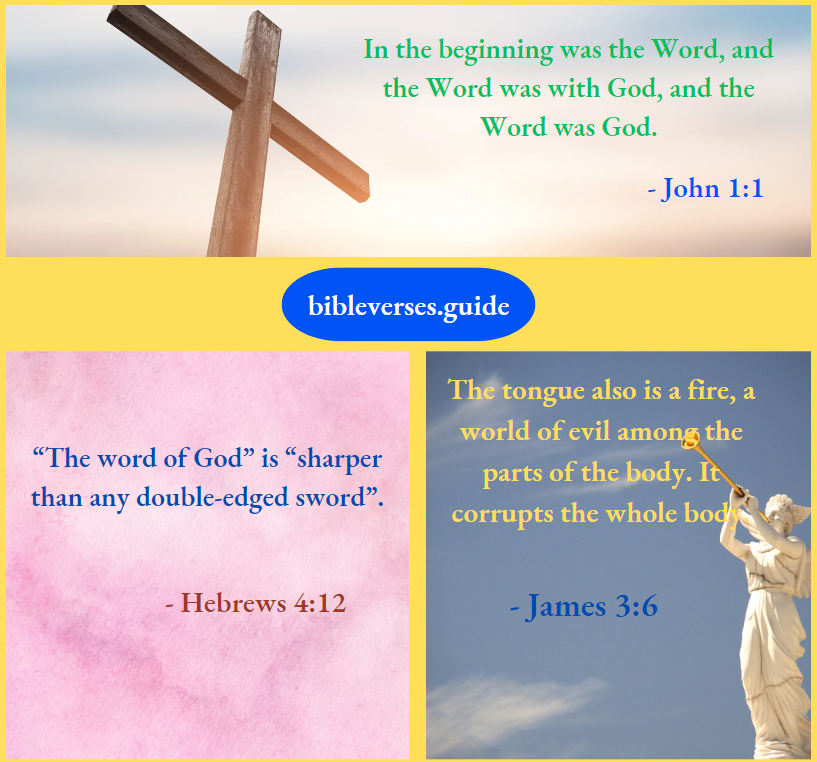
God created us with the ability to speak. Scripture even refers to Jesus as “the Word” (John 1:1) and says (Heb. 4:12).

We have the power to be life-destroyers or life-givers with just the words we speak. It is a tremendous responsibility to take these words from James 3:6 and determine to tame our tongues.

The word of God is sharper than any double-edged sword

Father, thank you for the gift of language and the healing that our words can give to others. Help us always to speak with concern for the impact our words have on others.