A Healing Touch

A Healing Touch

In the crowd was a woman who had been bleeding for twelve years.

In the culture of Israel, a woman who was ceremonially unclean had to live separately from other people and was considered a social outcast. No one was supposed to touch her or anything that she touched.

How lonely and desperate she must have been. Somehow she had concluded if she could just touch the edge of his “cloak” she would be healed. As soon as she tapped his garment her bleeding stopped.

The disciples began to talk about the crowd pushing in on Jesus, but he distinguished that closeness from the touch of the woman because he felt his power go out to her.

The woman came fearfully to Jesus and said that she had brushed against his cloak and was instantly healed.

Can we even imagine how this woman felt? She had been an “outsider” through no fault of her own, suffering not only physically but also emotionally.
A Healing Touch

Then she was instantly healed and the object of her faith was asking for her. She must have been overwhelmed.

Jesus then addressed her with the endearment “daughter.” No¬where else in Jesus’ recorded words does this address appear. He told her and the crowd that her faith had healed her.

This story intrigues me. I wonder what I would have done had I been that woman. Would I have had enough faith in this Jesus to believe that merely touching the edge of his garment would heal me?

Even more, do I have enough faith today to believe that my relationship with Jesus is such that I can “touch” him and experience the fruit of faith?

I have, of course, heard stories of people being scolded for too little faith that results in ills going uncured. And we all know godly saints of the Lord who have died in the throes of disease.

Where is the power of this verse for us?

I think it is in the woman’s faith in her particular circumstance. She was healed and perhaps even more importantly, she went away in peace. The power of faith results in peace, even when circumstances don’t change.

When we approach Jesus in the midst of our crowded worlds and reach out to him, confident that he will respond, we experience his peace. Our faith heals our souls, if not our circumstances.

Father, we are slow to trust you wholeheartedly. Enlarge our belief. Heal our souls. Help us to trust you and reach out to you.


What God Requires

What God Requires

Over the centuries, people have developed an amazing variety of ways of worshiping God.

In Eastern Orthodox churches, incense, and icons help believers make contact with the mysteries of God.

In Catholic churches, the celebration of the Mass helps believers experience the sacramental presence of Christ in their midst.

Protestants worship God with an astounding variety of methods and styles. In many Baptist churches, the emphasis is on sermons that illustrate lessons from the Word of God.

In Pentecostal and charismatic congregations, the congregation gives the Holy Spirit room to work.

Micah 6-8

In many newer churches, people in blue jeans sing contemporary praise choruses that include elements of pop and rock music.

In Micah, one of the final books of the Old Testament, the people wondered what kinds of observance God required when they gathered for worship.

Foremost in their minds was their concern about how to show proper repentance for their many sins.

Micah spoke for the people, asking what God demanded:

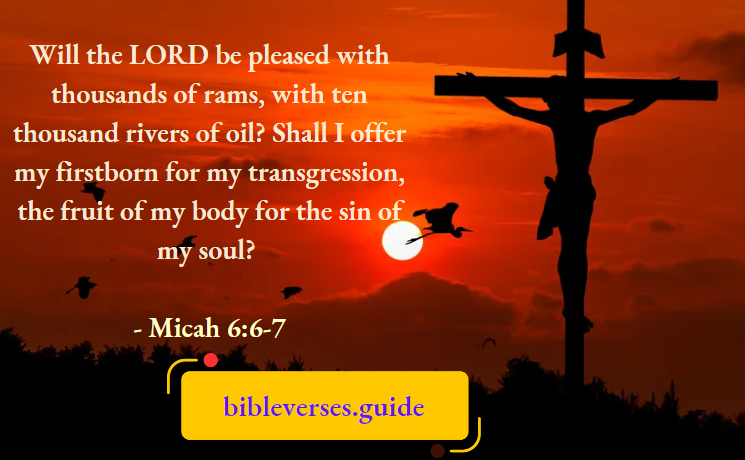
With what shall I come before the LORD and bow down before the exalted God? Shall I come before him with burnt offerings, with calves a year old?

Micah 6-6-7

But God wasn’t concerned primarily with external demonstrations of reverence. Burnt offerings and ritual sacrifices weren’t the things he wanted to see.

Rather, God demanded a deeper commitment.

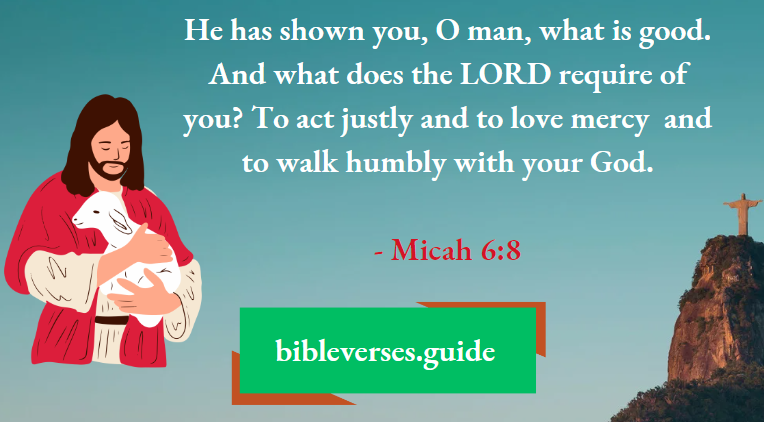
He wanted people to worship him from the depths of their hearts and live their lives in such a way that their daily actions revealed their love for God: “And what does the LORD require of you? To act justly and to love mercy / and to walk humbly with your God.”

God commanded his people to act justly: Don’t cheat your neighbor and then come to my altar to make a sacrifice. Don’t exploit your workers and then come make some kind of superficial religious show.

God also commanded his people to love mercy: When you see someone in need, reach out in love and compassion. When someone is hopeless or weary, provide strength and courage.

Finally, God commanded his people to worship him with humility: Crucify your pride. Lay your ego on the altar. Come before me recognizing that I am God and that you are not

People can worship God in all kinds of ways, but the principles of worship never change. God wants us to live lives of justice, mercy, and humility.

If these virtues take root in your life, God will graciously accept your worship, no matter what outward form it takes.

God, help me be the just and merciful servant you want me to be.


A Focused Life

A Focused Life

Paul wrote this letter to the believers in Corinth after hearing of problems within their community. The church was gifted (1:4-7) but immature and unspiritual (3:1-4).

They suffered from divisiveness in the body, immorality, legal dealings in the pagan courts, and disrespect in participating in the Lord’s Supper.

Given the environment of Corinth, Paul might have been tempted to resort to worldly arguments.

It was a major city of its day. Its location on the narrow isthmus connecting the Greek mainland with the Peloponnese, the southernmost part of Greece, afforded it a dominant place in world trade.

It had two harbors and was the crossroads for travelers and traders.

Corinth was also a cosmopolitan place. Its people placed a high value on wisdom and were interested in the philosophies of Greek scholars.

1 Corinthians 2-2

Corinth was also a religious center with at least twelve temples. One of the most famous was the temple dedicated to Aphrodite, the goddess of love.

Corinth was so widely known for its practice of sexual immorality in the name of religion (related to the worship of Aphrodite) that the practice of sexual immorality was known as “Corinthianizing.”

Paul understood the power of knowing Jesus to turn people from their sin, even in a city so filled with ungodliness.

In 1 Corinthians 1, Paul presented his argument for this power by speaking out against the “wisdom” of men, including the Greek philosophers.

Then in the opening of 1 Corinthians 2, he gave a disclaimer so that no one would think he was trying to persuade them in the same way the Greek philosophers were.

“My message and my preaching were not with wise and persuasive words, but with a demonstration of the Spirit’s power, so that your faith might not rest on men’s wisdom, but on God’s power.”

The truth of the crucifixion and the resurrection confounded the worldly wisdom of the age. The same is true today.

We live in an advanced society that greatly values intellect and wealth.

We are inundated with persuasions to buy more, to be better than the next guy in just about anything, to discover self and indulge it.

It’s tempting to talk about our faith in ways that promise the same kind of presumed satisfaction that the world offers.

But Paul told us that focusing on Jesus and what he did for us is the way to penetrate minds filled with lies.

Paul’s first letter to the Corinthians lifted Christ up high and taught that his wisdom had the power of the Holy Spirit behind it.

Father, we live in a world full of temptations, not unlike those in Corinth. Help us to guard our hearts and focus on Jesus.


A New Command

A New Command

God gave Moses the Ten Commandments, which would be the Law for thousands of years.

These commandments were simple and direct. Among other things, the people of Israel were to have no other gods; they were to avoid robbery, murder, and adultery, and they were to honor their mothers and fathers.

Even though there were only ten commandments, they were difficult to follow. Throughout the Old Testament, God’s people repeatedly broke his laws and experienced the consequences of their actions.

Jesus came to earth to renew God’s covenant, but this time with the entire earth. And Jesus came teaching a new commandment: “Love one another.”

Although this may sound simple, it’s the hardest thing to do, particularly when we understand the commitment needed to follow the second part: “As I have loved you, so you must love one another.”

How did Jesus love us? By coming from heaven to save us, and dying for us on the cross. Following Jesus’ new commandment to love means that we must be willing to lay down our lives for others.

So how have we done in the nearly two thousand years since Christ taught this new commandment? Not very well.

John 13-34-35

People still fight, rob, and steal, and nations still engage in wars against other nations.

Even in churches, the places where one might expect that Jesus’ love would remain supreme, there are political fights and turf battles that seem more petty than some of the struggles outside the church.

In some churches, division over styles of music can lead to all-out “worship wars,” with those who prefer traditional hymns attacking those who prefer more contemporary worship choruses.

In others, disagreements about how money is raised and spent can weaken the bonds of love.

Jesus said, “By this, all men will know that you are my disciples if you love one another.” If that’s the case, people looking at the church may be justified in wondering if those who call themselves Christians are truly his disciples.

So what can we do now to make Christ’s new command a reality in our lives? We can’t erase two millennia of religious infighting and hatred overnight.

But with each new day, we can begin living our lives as if love mattered.

That could involve big things. One powerful example of love was apparent when relatives of victims of the September 11, 2001, attacks on the World Trade Center forgave the terrorists who were responsible for killing nearly three thousand people.

It could involve small things, too. When you’re driving your car down a busy freeway and someone pulls in front of you, can you forgive him for his rudeness and even better yet, pray for him?

At church, living as if love mattered means practicing charity toward those who have different views about music money, or other potentially divisive issues and remembering that God loves all his children equally.

Jesus never said his new command would be easy to follow. But he did teach us that life wouldn’t make any sense without love.

Father, help me love people as you have loved me. Let love overflow in me until it moves me to reach out to others.


We Don’t Look So Good Either

We Don’t Look So Good Either

His name was Don and he was homeless. One of the families in our church had employed Don to do some odd jobs and asked Steve if we had any work for him.

We did have some yard and outside projects that Steve hadn’t gotten to, so we said yes.

I felt good about our decision, and probably a bit self-righteous.

I thought, Won’t he be grateful? At the same time, my heart did hurt whenever I drove past bedraggled men (and once in a while, women) on street corners holding signs asking for a meal or a job.

So it was with mixed feelings of pride at our “goodness” and sincere sorrow for his plight, that Steve went to pick up Don at the parking lot where he slept in a run-down van. He came into the garage with Steve, and I went out to greet him.

Romans 5-8

He was really dirty. His clothes were torn and smelled of sweat and cigarettes.

I shook his hand and saw the red-ringed needle marks. My smile masked my revulsion, but I went back into the house as quickly as I could.

Don worked for us on and off for several months, and I admit that I never felt comfortable around him.

Steve tried to help Don improve; he let him shower at our house, Donate with us, and hear about God’s love for him, Steve worked with him until Don ended up in jail and finally left town.

Don’s sins were so easy to see. He continued to make poor choices and turn down help. He was not easy to love, or even like. But God tells us in this verse that “while we were still sinners, Christ died for us.”

Yes, I think to myself, but we—my family, friends, and I—are not like Don. We are not dirty and drug-ridden. Surely we are easier to love or even die for.

But just as I am puffing myself up by comparison to one less privileged than I am, another verse comes to mind:

Romans 3-23

All have sinned. All of us.

And the amazing truth of God’s love is that he poured it out on us while we were still sinners. Even after accepting his Son, we still make mistakes and commit sins. And he still loves us.

Jesus went willingly to the cross for the love of people like Don and you and me. What Don displayed outwardly, we carry in our hearts.

We are full of unlovely trappings, but God comes in and cleanses us. Every “Don” can be white as snow.

Father, thank you that our salvation is not based on how good we are but on your amazing grace.


Created And Called

Created And Called

Jeremiah was a servant of God who lived six centuries before the time of Christ. Many call him “the weeping prophet” because of the intense, emotional nature of his prophecies of doom and judgment.

Jeremiah had served as a priest before God called him to be a prophet—a person who would tell the people what God was thinking.

And like Moses centuries earlier, Jeremiah initially resisted God’s call. “I do not know how to speak,” he said. “I am only a child” (Jer. 1:6).

God wasn’t moved by his protests. “You must go to everyone I send you to and say whatever I command you” (Jer. 1:7).

God also reassured Jeremiah that this new calling was no spur-of-the-moment thing. “Before I formed you in the womb I knew you,” he said. “Before you were born I set you apart.”

God calls each one of us to do things that no one else on earth can do. He calls few prophets, but he does command us to serve him in the ways we can with the years we have left.

Jeremiah 1-4-5

For some, this means we will be involved in various forms of ministry such as preaching or teaching in a church, serving as a missionary, or working as an elder to guide the life of a church and its members.

Most of us, though, will probably serve God in our varied secular callings.

Whether you own a business, work for others, or labor at raising your children, you have plenty of chances to live out your faith in God.

Regardless of what we do for God, the important thing to remember is that he designed us the way we are. We didn’t make ourselves or create our own lives.

Therefore, it’s right for us to give our lives to God so that whatever we do, we live and act for his glory.

This passage from Jeremiah has been a powerful inspiration for members of the pro-life movement.

The passage makes clear that human life is something that begins before birth, and possibly even before conception.

But the message of this passage is relevant to all of us, not just prophets and pro-life activists.

God is trying to remind us that our lives are in his hands and that he has cared for us since before there was an “us” to care for.

Our lives are part of a vast, seamless web of love and creation that began long before we were born. If we remember this, our lives can be transformed.

Thank you, God, for making me. Now help me serve you in any way I can.


Chosen By Jesus

Chosen By Jesus

Peter and Andrew were two humble fishermen who left everything behind when Jesus called them to follow him.

The Bible doesn’t tell us the reaction of their families or friends to this strange behavior, but we can imagine that they found Peter and Andrew’s sudden departure from their livelihood a bit surprising.

What must have been even more shocking was Jesus’ ability to en-gender such wholehearted devotion. How amazing it must have been to be so drawn to Jesus that you dropped your life’s work and went with him.

And the term “fishers of men” must have seemed terribly odd to those first disciples.

But they went. And as he began to teach, others followed him, too. The disciples were ordinary people who heard him and believed his message. As fish gathered into a net, they came.

The disciples sat at his feet and learned how they, too, could tell others about him and communicate with power.

They must have wondered sometimes why Jesus chose them. They were the most ordinary of men.

Matthew 4-19

In many ways, the disciples were just as we are today. We hear about Jesus, are drawn to him, accept him as our Savior, and then learn that we are to be fishers of men.

I remember the first time I was told that I could be a witness for Jesus. “Not me,” I said.

It isn’t that I was shy, but I was very afraid. I couldn’t imagine someone like me, with no formal training in the Bible, no scholarly background or seminary training, telling others about Jesus with enough skill to change their minds.

But I did learn to fish for men. And I did grow in understanding that what I learned was useless unless the Holy Spirit came into each encounter and touched the heart of the listener.

It is thrilling to grasp that God has chosen ordinary men and women, just like the first disciples, to be instruments of his mercy; to be tools in the saving of souls from the time of the disciples and on into eternity.

The Savior of the world who walked beside the Sea of Galilee and called his early followers walks with us today and calls us into a relationship with him.

He gives us the power to touch the hearts of others and experience the joy of seeing them accept him.

How humbling.

Father, thank you that you draw us, call us, and use us in Your service.

We know you could have chosen other ways to bring the message of salvation to the world, but we are grateful that sometimes you bless us with that privilege.


Raising A Ruckus

Raising A Ruckus

When Saturday Night Live comedian Dana Carvey decided to create a character who parodied uptight religiosity, he called her the Church Lady.

The Church Lady was a grumpy, dowdy-looking woman who excelled at being holier-than-thou and confronted some of the guests on her fictional Church Chat show with comments such as: “Who do you think made you do that, maybe S-A-T-A-N?”

In an interview, Carvey said he based the character on a real woman he remembered from the Lutheran church in San Mateo, California, he attended as a child.

“Even the most pious person, even the most straightforward Christian, has been a victim of hearsay and gossiping by condescending people,” he said. “They’re rampant everywhere, and not just in church.”

Carvey’s family attended church regularly, but not as often as some in the church thought they should. “I imagined people thinking, ‘Well, apparently some of us care a little more about Christ than others!’1,1

Even potluck dinners provided an opportunity for competition and judgmentalism.

2 Samuel 6-14-16

Carvey’s memories inspired a Saturday Night Live episode in which the Church Lady, who had labored over an elaborate casserole, chided a fellow believer who brought lowly Jell-O.

Religious people sometimes confuse their own ideas with God’s commands, and when they do, they place needless emphasis on external behavior and judging others.

David wasn’t that kind of person, as anyone can tell you who has read his heartfelt prayers found in the Book of Psalms.

In the passage from 2 Samuel, David was so overcome with love for God that he praised him with an impromptu dance.

Churches didn’t exist in those days, but apparently, his wife disliked David’s exhibition and “despised” him for it.

David didn’t let the episode bother him. In later passages, he remained a deeply emotional person, both in his relationships with other people and his worship of God.

Worship is a highly individualistic activity. But the single most important thing about worship isn’t the particular form you follow, it is the attitude of your heart and soul.

David praised God as his heart deemed appropriate. If people around him judged him for his devotion, he wasn’t worried.

He knew God would honor his worship and understand the feelings that kindled his expression.

God, help me love you with all my heart and not worry about what people think.


The Wonderful Wisdom Of God

The Wonderful Wisdom Of God

When I think back to my high school and college days in the 1960s, I marvel at how much things have changed.

I had an electric typewriter, which was a luxury, and a set of World Book Encyclopedias. We had no home computers, no laptops, no Internet.

Writing research projects required many hours in the library and in correspondence with other institutions that might provide material pertinent to a subject.

Today, the availability of information is almost limitless.

The Internet has revolutionized the time needed and the material accessible for the completion of projects or the satisfaction of curiosity.

I think the recent advent of technology has caused many of us to be uncomfortable with words and ideas like “unsearchable.”

Romans 11-33

How can anything be intellectually out of reach when the world of information lies beneath our fingertips?

Of course, the intellect alone does not reveal the knowledge of God, and this is another uncomfortable thought for many twenty-first-century people.

Even those of us who believe in him may find ourselves a little irritated with a verse like Romans 11:33.

Our irritation can turn into wonder if we recognize the amazing power that is available to us through faith and the working of the Holy Spirit.

A God who is so wise and rich in knowledge loves us, died for us, and has given us his Spirit. We can rest in his care and trust that what we don’t know won’t hurt us.

I have become comfortable knowing that God is even bigger than I can imagine, something I couldn’t do if I didn’t trust him.

It’s like how I feel when I get on an airplane. I prefer not to see the pilot. I have enough trust to get on board, but I feel more confident if I imagine the pilot to be superhuman and flawless.

I want him to be so perfectly competent that I’m comfortable with trusting him with my life.

This kind of thinking is just mental gymnastics to relieve fear, but the power of the Holy Spirit infuses my confidence that God is bigger than life.

Planes do crash occasionally, but the “depth of the riches / of the wisdom and knowledge of God” remains an attribute that merits my trust in him.

I can grow to know him more and more as I mature in my faith, but I can also stand amazed that all the knowledge in this world doesn’t come close to explaining how awesome he is.

Father, I thank you that you are bigger than we can ever imagine and that you still stoop down and love us unconditionally.


Cathedrals Of The Heart

Cathedrals Of The Heart

Anyone who has ever traveled to Europe has seen beautiful, majestic cathedrals that Christians living in earlier centuries built to honor God.

In such countries as Italy, France, and England, gigantic structures of stone, wood, and glass rise into the sky. Their construction required decades of work and dedication.

When completed, their graceful spires towered over towns and could be seen miles away.

Today, skyscrapers and apartment complexes tower over many modern cities, but cathedrals still have a special power and grace.

Catholic scholar Robert Barron has written a beautiful little book called Heaven in Stone and Glass, which explores the marriage of theology and architecture that led to the creation of the York and Lincoln Cathedrals in England and three French cathedrals: Notre Dame, Chartres, and Le Mans.

Isaiah 66-1-2

“These cathedrals are powerful repositories of the Christian spirit,” he wrote. “In their windows, towers, vaults, naves, roses, labyrinths, altars and facades, these Gothic churches bring the transformative energy of Jesus Christ to bear on our world.”1

Visiting old cathedrals today can be a powerful religious experience. Many were built in the shape of a cross.

Walking down their aisles toward their massive altars, one finds his eyes drawn heavenward by the towering stone columns and the stained glass windows that portray scenes from the Bible and the life of Christ.

But you don’t have to travel to a European cathedral to worship God. Wherever you are right now as you are reading these words can be your own personal cathedral.

A brief walk in a park or even a stroll down a sidewalk can expose you to some of the wonders of God’s handiwork.

But the most important thing isn’t your surroundings. It’s the state of your heart.

As Isaiah told us, the characteristics God esteems in those who would worship him are humility and contriteness of spirit, and a respectful awe for his revealed Word.

Whether you’re in a beautiful cathedral or your messy living room, God wants you to honor and acknowledge him as God.

God, I worship you. You are the Lord of the cosmos. Help me to understand and honor your majesty.