The Book Of John

The Book Of John

Who wrote the Book of John: John

When was it written: Based on what we know of John’s post-resurrection ministry, it was most likely written around 85 A.D.

The gospel of John is an eyewitness account of the events in the life and ministry of Jesus. John was one of the first four disciples Jesus called into full-time ministry; making him privy just about every moment of Jesus’ three-year evangelistic crusade.

John is also known as the disciple that Jesus loved. Among the twelve disciples Jesus chose as his core group of confidants and assistants, he had an even more select group of three—Peter, James, and John.

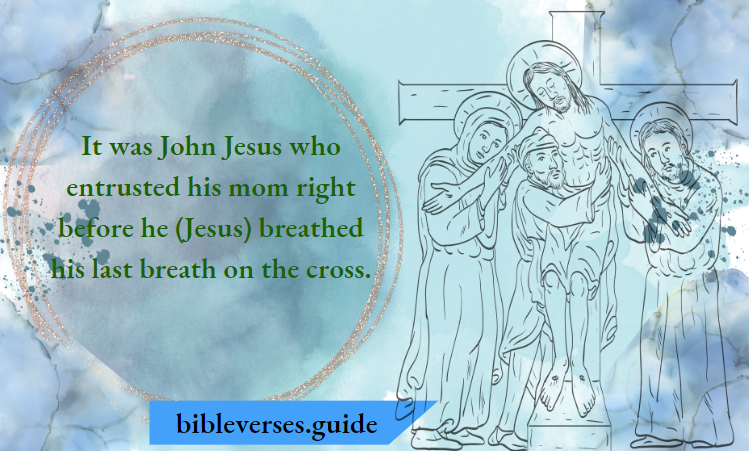
And from those three we see numerous times when it was John Jesus relied on. It was John Jesus who entrusted his mom right before he (Jesus) breathed his last breath on the cross.

Yes, in spite of the fact that Jesus had several brothers (the writer of James and the writer of Jude being two of them), he entrusted his mother to John. But why? What made John so special?

The answer is simple: Family. John was family…Jesus’ first cousin, to be exact. The fact that Jesus, James, and John were first cousins is not specifically stated in scripture like that, i.e. “Jesus, James, and John were cousins”. But the fact presents itself in all four of the gospels when you put them together to see what they say.

Fact #1: We learn early on that James and John are the sons of Zebedee.

Fact #2: The Gospel writers tell us that among the women standing with Mary (Jesus’ mother) at the cross was Mary Magdalene, Mary the mother of James the lessor, and the mother of Zebedee’s children (Matthew). The book of Mark tells us the same thing, only he calls the mother of Zebedee’s children by name—Salome.

Fact #3: Salome and Mary (Jesus’ mother) were sisters. John tells us in recording who was with Mary at the cross that the group of women consisted of Mary, Mary Magdalene, Mary the wife of Cleopas, and Mary’s sister, Salome.

Understanding the relationship between Jesus and James sheds a lot of light on some of the incidents in the Bible surrounding James and his brother, John. For example, knowing that they were related makes it easier to understand how James and John’s mother would have had the ‘audacity’ to approach Jesus to ask a special favor of him for her sons.

She was his aunt. She’d been in his life from the very beginning. She’d watched him grow up— possibly even helped care for him at times.

It also explains why Jesus asked John to watch over Mary after he was gone. He knew Mary and Salome would be together—that Mary would continue to lean on her sister for love and support. It wasn’t anything against his siblings. He just knew John would be seeing after Salome’s well-being, so…

John’s gospel was written for the non-Jewish community— especially the Greeks. His purpose for writing is evangelism plain and simple. John doesn’t focus on presenting evidence of the truth, but rather the spiritual necessity of believing.

John begins his writing by establishing the fact that Jesus is part of the Trinity and that he has always been. This would have been especially important for witnessing to the Greeks due to their attention to and extreme interest in philosophy.

They would have wanted answers not only to who Jesus was and why he came but also to where Jesus came from and who sent him. Following John’s introduction of Jesus and his statement of why he is writing, John delves into the ministry of Jesus in the same way the other three gospels do—with the baptism of Jesus by John the Baptist.

While there are several of Jesus’ miracles and parables mentioned by one or two of the writers of the four gospels but not the others, Jesus’ baptism is at the forefront of all of them— and for good reason.

It was essential for Jesus to set the example for what he was commanding us to do. It was equally important that he begin his ministry with his baptism because our baptism is the beginning of our salvation…our entry into God’s family.

Following Jesus’ baptism John recorded the calling of Jesus’ first six disciples—Simon Peter, Andrew, James, John, Philip, and Bartholomew (Nathanael)—in the same way the other gospel writers did.

Chapter two of the Book of John opens with the account of Jesus’ first miracle—changing the water into wine at the wedding feast in Cana.

John is the only one to record this miracle, but we know it is Jesus’ first miracle (in contrast to the miracles the other disciples recorded in conjunction with the calling of the first disciples) because John states that it is Jesus’ first miracle.

John’s credibility in being the only one to record Jesus’ first miracle is valid due to the fact that because he was one of the first called, he was there from the onset.

The last sentence in this passage of scripture says, “He thus revealed his glory, and his disciples put their faith in him.” Sometimes this statement leaves people wondering how this is different from them leaving everything behind to follow Jesus.

Why had they started following Jesus if they hadn’t yet put their faith in him?

The best way to explain this is to share something from the blog, “A Bit of Salty Grace” https://abitofsaltygrace.blogspot.com/2016/06/faith-is-like- chocolate.html.

The writer compares faith with eating chocolate by saying that the first time a child eats chocolate they do so on the advisement of someone they trust. In other words, their faith is in the person. But after they taste the chocolate, their faith is transferred to the chocolate—to always taste as sweet and yummy as it did the time before.

The disciples initially went with Jesus because they were willing to take him up on his offer when he told them to come and see for themselves who he was and what he was about.

But when they saw what he had done at the wedding feast, as well as the signs they had seen and heard about prior to that (God speaking after his baptism and the unexpected catch of fish, for example), their desire to follow Jesus was the result of faith, not curiosity.

Now that we’ve established the flow of their spiritual growth, let’s keep moving through the book of John by listing the highlights of Jesus’ ministry as recorded in each chapter.

Chapter 3: Nicodemus, who was a Pharisee and leader of the Jewish council, came to Jesus in the night because he believed, but feared the repercussions he would face from the other Jewish leaders.

Jesus explains rebirth through immersion to Nicodemus

“For God so loved the world that he gave his one and only Son, that whoever believes in him shall not perish but have eternal life.

” Nicodemus’ ‘secret faith’ saved Jesus from the Pharisees a couple of times prior to his arrest and crucifixion (God’s timing rather than man’s) and it was Nicodemus that worked with Joseph of Arimathea to properly care for Jesus’ body rather than allow it to be mauled and broken.

While this doesn’t excuse us from hiding our faith or not sharing it, we should learn from Nicodemus that there are times when a quiet but resolute faith is more effective and appropriate.

Chapter 4: Jesus’ encounter with the Samaritan woman at the well solidifies the truth that Jesus’ gift of salvation is for everyone.

Chapters 5-6: John records several of Jesus’ miracles—acts of compassion and mercy, as well as miracles meant to validate his identity in order to help his disciples understand him more fully.

Chapters 7 through 10 contain several of Jesus’ sermons and John’s recollections of how adamant the Jewish leaders were in getting rid of Jesus. We also gain insight into Jesus’ earthly personality.

Yes, he was still the perfect, flawless, sinless Son of God, but he didn’t hesitate to put the Pharisees on the spot by putting their false accusations back on them. Jesus was at times sarcastic and he showed no patience for those who were bent on trying to malign him or his father, God.

Chapter 11 opens with the death and resurrection of Jesus’ friend, Lazarus. Jesus used Lazarus’ death to display God’s power and glory. Jesus allowed Lazarus to die for the purpose of being able to resurrect him so that those present would know there was nothing he and God could not do.

NOTE: It is important to note the difference between Lazarus being raised from the dead and Jesus being raised from the dead.

The difference is this: Lazarus’ resurrection was temporary. He died again. Jesus, however, was resurrected for all eternity. The subject of death ends the eleventh chapter, as well, by telling us that after hearing about the miracle of Lazarus being brought back to life, the Jewish leaders joined forces with their enemies, the Roman government, to take Jesus down.

They would stop at nothing to kill Jesus. Jesus knew what was happening, so at this point, he withdrew from the ministry and the general public. Instead, he spent most of his final days with the disciples; preparing them for the time he would no longer be with them.

Chapters 12 through 16: Jesus was preparing to die, but before he did, he would share one last Passover meal with his disciples in Jerusalem. Entering the city was a joyous occasion for Jesus. He was greeted by songs and shouts of joy and praise by the people.

Sadly, however, many of these same people would be shouting “Crucify him!” a few short days later. Following Jesus’ return to Jerusalem, we read his instructions and encouragements to his disciples.

He tells them he is going to die soon and that one of their group will betray him.

He humbly washes the disciples’ feet, predicts Peter’s denial, comforts them in their sadness over their grief of losing him, promises them the Holy Spirit, gives them a sermon on remaining faithful, and explains to them that their grief will turn to joy when they see and understand all that is about to take place.

The one thing noticeably missing from John’s account of the last evening he spent with Jesus before the cross is the institution of communion. He is the only one of the writers of the four gospels to leave it out. Why? No one knows, but all the other details of the evening are there and in perfect harmony with the other three gospel writers.

Chapters 17 and 18: Jesus’ time of prayer in the garden, his arrest, his so-called trial before the high priest, and Peter’s denial of knowing Jesus three times—just as Jesus said it would happen.

Chapter 19: Jesus was handed over to Pilate, an official of the Roman government. Pilate found no reason to convict Jesus. He’d done nothing wrong in the eyes of the Roman government. But not wanting to appear weak in the eyes of the people, Pilate caved to them and sentenced Jesus to death on the cross.

Pilate only thought he was ultimately responsible. We know that whether it was Pilate or Caesar himself who sentenced Jesus, it was only because God said it was to be so, that Jesus died on the cross.

The events leading up to the cross and the actual time Jesus spent on the cross are recorded by John in a way that only Jesus’ closest friend could tell it. John’s account of those final hours is filled with emotion. John speaks of fulfilled prophecy (vs. 23-24).

He reveals that some of Jesus’ last thoughts are about his mother, whom he asks John to watch out for. Jesus burial by Joseph of Arimathea and Nicodemus, who were both religious leaders who had quietly followed and believed in Jesus, now stepped forward to claim Jesus’ body for burial to fulfill yet another prophecy.

Chapter 20: Jesus is alive!

Chapter 21: John is the only one of the gospel writers to record this particular miracle Jesus gave to seven of his disciples following his resurrection. Jesus once again provided fish after no fish had been caught.

They were overjoyed to see Jesus, as it was only the third time they had seen him since his resurrection (vs. 14). But it is the situation immediately following the catch of fish and breakfast on the seashore that is most important.

Bible with subheadings title it “Peter’s reinstatement”. Following Peter’s denial of Jesus three times, he was deeply grieved and ashamed. How could he do that to Jesus? To the Son of the living God?! You know his excitement over seeing Jesus had to be coupled with embarrassment and anxiety over what Jesus would say or do.

But Jesus didn’t say a word about it—not directly, anyway. Instead, in verses 15 through 19, Jesus asks Peter three times if he (Peter) loves him (Jesus), to which Peter always responds by saying, “Yes”.

Jesus then counters by telling Peter to feed his sheep; meaning to take the message of the gospel of salvation to anyone and everyone who will listen. What a beautiful testimony of God’s mercy and forgiving nature!
John ends with one of the most important verses within the pages of the Bible

No, I say this because the words of John 21:25 sum up the magnitude of who Jesus was while he was living here on earth.

Let these words soak into your heart and mind so that you can try to grasp the truth of just how amazing, big, and wonderful our Savior, Jesus, is: “Jesus did many other things as well. If every one of them were written down, I suppose that even the whole world would not have room for the books that would be written.”

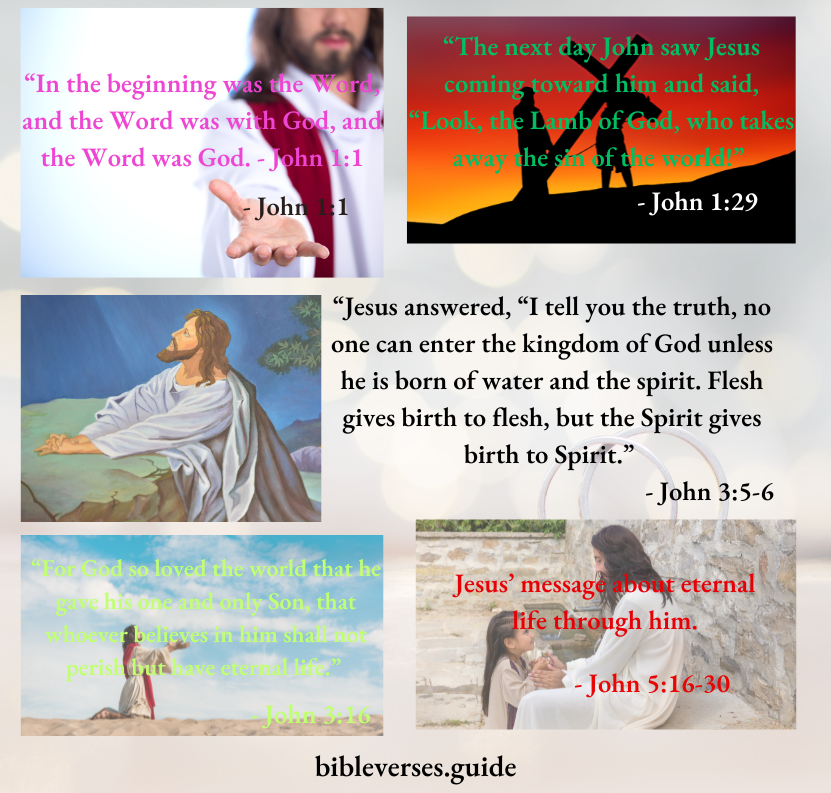
Every book of the Bible provides us with words of wisdom, instruction, comfort, encouragement, admonishment, warning, promise, and hope. Let’s look at some of what the Book of John has to offer.
Book of John

“I tell you the truth, no servant is greater than his master nor is a messenger greater than the one who sent him. Now that you

Key Verses In John

The Book Of Key Verses In John


Bible verse About Marriage

Bible verse About Marriage

1.1 Corinthians 13:2-7

”If I have the gift of prophecy and can fathom all mysteries and all knowledge, and if I have a faith that can move mountains, but do not have love, I am nothing. If I give all I possess to the poor and give over my body to hardship that I may boast, but do not have love, I gain nothing.

2.1 Corinthians 13:4

Love is patient, love is kind. It does not envy, it does not boast, it is not proud. It does not dishonor others, it is not self-seeking, it is not easily angered, and it keeps no record of wrongs. Love does not delight in evil but rejoices with the truth. It always protects, always trusts, always hopes, always perseveres.” (NIV)

Meaning: This Bible verse is among the most famous love quotes ever since it describes the beautiful characteristics of love and marriage. It emphasizes that no matter how gifted you are if you don’t have love you are nothing.

3. Colossians 3:14-17

And over all these virtues put on love, which binds them all together in perfect unity. Let the peace of Christ rule in your hearts, since as members of one body you were called to peace. And be thankful. Let the message of Christ dwell among you richly as you teach and admonish one another with all wisdom through psalms, hymns, and songs from the Spirit, singing to God with gratitude in your hearts.

And whatever you do, whether in word or deed, do it all in the name of the Lord Jesus, giving thanks to God the Father through him.” (N1V) Meaning: It’s important to love God as much as you love your spouse and your neighbor. This particular Bible verse emphasizes how love combines every virtue together to form a perfect unity. Put God in your marriage.

4. Genesis 2:18-24

“Then the Lord God said, “It is not good that the man should be alone; I will make him a helper fit for him.” Now out of the ground the Lord God had formed every beast of the field and every bird of the heavens and brought them to the man to see what he would call them. And whatever the man called every living creature, that was its name. The man gave names to all livestock and to the birds of the heavens and to every beast of the field.

But for Adam, a helper fit him was not found. So the Lord God caused a deep sleep to fall upon the man, and while he slept took one of his ribs and closed up its place with flesh. And the rib that the Lord God had taken from the man he made into a woman and brought her to the man.

Then the man said, ‘This at last is bone of my bones and flesh of my flesh; she shall be called Woman because she was taken out of Man. r Therefore a young man shall leave his father and his mother and hold fast to his wife, and they shall become one flesh.” (ESV)

Meaning: A marital bond is so intimate that “two become one”. The union of two human beings yearning for community and finding it in one another is the great climax of this creation story.

5. Matthew 19:4-6

Haven’t you read,1 he replied, ‘that at the beginning the Creator ‘made them male and female,’ and said, ‘For this reason, a man will leave his father and mother and be united to his wife, and the two will become one flesh’? So they are no longer two, but one flesh. Therefore what God has joined together, let no one separate.”‘ (NIV) Meaning: As two become one from God, you will be unified emotionally, spiritually, and physically.

Always talk to your partner about whatever decision you are making. “‘Haven’t you read,1 he replied, ‘that at the beginning the Creator ‘made them male and female,’ and said, ‘For this reason, a man will leave his father and

6. Song of Solomon 3:4

“I have found the one whom my soul loves.” (ESV) Meaning: You will have unity with your spouse. And always choose your partner

7. Genesis 1:27-28

“So God created man in his own image, in the image of God he created him; male and female he created them. And God blessed them. And God said to them, ‘Be fruitful and multiply and fill the earth and subdue it, and have dominion over the fish of the sea and over the birds of the heavens and over every living thing that moves on the earth.11’ (ESV) Meaning: The marriage community is a sacred reflection of the family of God. God’s relationship with Jesus is the blueprint of the ideal husband and wife relationship and the wish for that faith to be spread widely across the globe.

8. Ecclesiastes 4:9

“Two are better than one because they have a good return for their labor: If either of them falls down, one can help the other up.” (NIV) Meaning: Having someone to lean on through good and bad times is a sacred gift. In decision-making, asking your partner is better than doing it alone.

Matthew 19-4-6

9. Ecclesiastes 4:12

“Though one may be overpowered, two can defend themselves. A cord of three strands is not quickly broken.1′ (NIV) Meaning: A cord of three strands refers to both the Holy Trinity — the Father, the Son, and the Holy Spirit — as well as, marriage: two spouses in unity with God.

10. Mark 10:9

Therefore what God has joined together, let no one separate.’1 (NIV) Meaning: As marriage under God decrees that you are one, let no mere mortal separate your sacred union

11. Isaiah 62:5

For as a young man marries a young woman, so shall your sons marry you, and as the bridegroom rejoices over the bride, so shall your God rejoice over you.” (ESV) Meaning: This verse highlights the intensity of God’s grace, compassion, patience, mercy and love

12. Ephesians 4:2-3

Be completely humble and gentle; be patient, bearing with one another in love. Make every effort to keep the unity of the Spirit through the bond of peace.” {NIV) Meaning: Patience is key when it comes to keeping the peace and maintaining a happy marriage. This quote serves as a romantic reminder to treat your spouse with love and respect.

13. 1 Peter 4:3

Above all, love each other deeply, because love covers over a multitude of sins.11 (NIV) Meaning: This famous Bible verse about marriage emphasizes the true power of love, one of life’s greatest blessings

14. Romans 13:8

“Owe no one anything, except to love each other, for the one who loves another has fulfilled the law.” (ESV) Meaning: This marriage Bible verse is about the importance of faithfulness

15. Isaiah 54:10

“Tor the mountains may depart and the hills be removed, but my steadfast love shall not depart from you, and my covenant of peace shall not be removed,1 says the Lord, who has compassion on you.” (ESV) 14. Romans 13:8 Meaning: This marriage scripture conveys the importance — and intertwinement — of love and faith.

16. Psalm 143:8

“Let the morning bring me word of your unfailing love, for I have put my trust in you.1’ (NIV) Meaning: Falling in love may seem scary at first, but as any married couple will tell you, it’s well worth the risk. Trusting another person wholeheartedly is an incredible thing, and this Bible verse eloquently expresses just that.

1.1 Corinthians 16:14

“Let all that you do be done in love.” (ESV)

2. Psalm 85:10-11

Psalm 85-10-11


3. Song of Solomon 8:6-7 (Song of Songs 8:6-7)

Set me as a seal upon your heart, as a seal upon your arm, for love is strong as death, jealousy is fierce as the grave. Its flashes are flashes of fire, the very flame of the Lord. Many waters cannot quench love, neither can floods drown it. If a man offered for love all the wealth of his house, he would be utterly despised.1′ (ESV)

4. Psalm 143:8

“Let me hear in the morning of your steadfast love, for in you I trust. Make me know the way I should go, for to you lift up my soul.” (ESV)

5. 1 John 4:11-18

“Dear friends, since God so loved us, we also ought to love one another. No one has ever seen God; but if we love one another, God lives in us and his love is made complete in us. This is how we know that we live in him and hein us: He has given us his Spirit. And we have seen and testify that the Father has sent his Son to be the Savior of the world. If anyone acknowledges that Jesus is the Son of God, God lives in them and they are in God

And so we know and rely on the love God has for us. God is love. Whoever lives in love lives in God, and God in them. This is how love is made complete among us so that we will have confidence on the day of judgment: In this world, we are like Jesus. 18 There is no fear in love. But perfect love drives out fear because fear has to do with punishment. The one who fears is not made perfect in love.” (NIV)

6. John 15:12

John15-12

7. 1 Corinthians 13:13

”And now these three remain faith hope and love. But the greatest of these is love.” (NIV)

8. Song of Solomon 4:9 (Song of Songs 4:9)

“You have captivated my heart, my sister, my bride; you have captivated my heart with one glance of your eyes, with one jewel of your necklace.” (ESV)

9. Proverbs 10:12

“Hatred stirs up conflict, but love covers over all wrongs.” (NIV)

10. John 13:34

“A new commandment I give to you, that you love one another: just as I have loved you, you also are to love one another.” (ESV)

Good Bible Verses For A Relationship

Beyond what the Bible says about marriage, God has a lot to say about relationships as well. From friendships to dating and engagement, these Bible verses about relationships can be a source of encouragement for people, no matter what those partnerships look like.

1. Hebrews 10:24-25

Hebrews 10-24-25

2. Ruth 1:16-17

But Ruth said, ‘Do not urge me to leave you or to return from following you. For where you go 1 will go, and where you lodgeI will lodge. Your people shall be my people, and your God my God. Where you die I will die, and there will 1 be buried. May the Lord do so to me and more also if anything but death parts me from you.'” (ESV)

3. Ephesians 4:32

MBe kind and compassionate to one another, forgiving each other, just as in Christ God forgave you.” (NIV)

4. James 1:19-20

“Know this, my beloved brothers: let every person be quick to hear, slow to speak, slow to anger; for the anger of man does not produce the righteousness of God.” (ESV)

5. Philippians 4:4-9

“Rejoice in the Lord always. I will say it again: Rejoice! Let your gentleness be evident to all. The Lord is near. Do not be anxious about anything, but in every situation, by prayer and petition, with thanksgiving, present your requests to God. And the peace of God, which transcends all understanding, will guard your hearts and your minds in Christ Jesus

Finally, brothers and sisters, whatever is true, whatever is noble, whatever is right, whatever is pure, whatever is lovely, whatever is admirable —if anything is excellent or praiseworthy — think about such things. Whatever you have learned or received or heard from me, or seen in me — put it into practice And the God of peace will be with you.” (NIV)

6. Titus 1:8

but hospitable, a lover of good, without a lack of self-control, upright, holy, and disciplined.” (Abbreviation, ESV)

Scriptures On Commitment

1.1 Thessalonians 5:11

“Therefore encourage one another and build one another up, just as you are doing.’1 (ESV)

2. Proverbs 3:3-4

“Let love and faithfulness never leave you; bind them around your neck, write them on the tablet of your heart. Then you will win favor and a good name in the sight of God and man.” (NIV)

3. 1 John 4:20

“If anyone says, ‘I love God/ and hates his brother, he is a liar; for he who does not love his brother whom he has seen cannot love God whom he has not seen.’1 (ESV)

4. 2 Timothy 4:7

“I have fought the good fight, I have finished the race, 1 have kept the faith.11 (ESV)

5. Acts 2:42

“And they devoted themselves to the apostles 1 teaching and the fellowship, to the breaking of bread and the prayers.” (ESV)

6. Galatians 6:8-9

“For the one who sows to his own flesh will from the flesh reap corruption, but the one who sows to the Spirit will from the Spirit reap eternal life. Let us not become weary in doing good, for at the proper time we will reap a harvest if we do not give up.11 (NIV)

7. Philippians 3:13-14

“Brothers, I do not consider that I have made it my own. But one thing 1 do: forgetting what lies behind and straining forward to what lies ahead, I press on toward the goal for the prize of the upward call of God in Christ Jesus.” (ESV)

8. Proverbs 16:3

“Commit to the Lord whatever you do, and he will establish your plans. If (N1V)

Thank you for reading!


Acts Of The Apostles – Acts Chapter 28

Acts Of The Apostles- Acts Chapter 28

  1. And when they escaped, then they knew that the island was called Melita.
  2. And the barbarous people showed us no little kindness: for they kindled a fire, and received us, everyone, because ofthe present rain, and because of the cold.
  3. And when Paul had gathered a bundle of sticks, and laid them on the fire, there came a viper out of the heat and fastened on his hand.
  4. And when the barbarians saw the venomous beast hang on his hand, they said among themselves, No doubt this man is a murderer, whom, though he hath escaped the sea, yet vengeance suffereth not to live.
  5. And he shook off the beast into the fire and felt no harm.
  6. Howbeit they looked when he should have swollen, or fallen down dead suddenly: but after they had looked a great while, and saw no harm come to him, they changed their minds, and said that he was a god.
  7. In the same quarters were possessions of the chief man of the island, whose name was Publius; who received us, and lodged us three days courteously.
  8. And it came to pass, that the father of Publius lay sick of a fever and of a bloody flux: to whom Paul entered in, and prayed, and laid his hands on him, and healed him
  9. So when this was done, others also, which had diseases on the island, came, and were healed:
  10. Who also honored us with many honors; and when we departed, they laded us with such things as were necessary.
  11. And after three months we departed in a ship of Alexandria, which had wintered in the isle, whose sign was Castor and Pollux.
  12. And landing at Syracuse, we tarried there for three days.
  13. And from thence we fetched a compass, and came to Rhegium: and after one day the south wind blew, and we came the next day to Puteoli:
  14. Where we found brethren and were desired to tarry with them seven days: and so we went toward Rome
  15. And from thence, when the brethren heard of us, they came to meet us as far as Appii forum, and The three taverns: whom when Paul saw, he thanked God, and took courage.
  16. And when we came to Rome, the centurion delivered the prisoners to the captain of the guard: but Paul was suffered to dwell by himself with a soldier that kept him.
  17. And it came to pass, that after three days Paul called the chief of the Jews together: and when they came together, he said unto them, Men and brethren, though I have committed nothing against the people or customs of our fathers, yet was I delivered prisoner from Jerusalem into the hands of the Romans.
  18. Who, when they had examined me, would have let me go, because there was no cause of death in me.
  19. But when the Jews spake against it, I was constrained to appeal unto Caesar; not that I had ought to accuse my nation of.
  20. For this cause therefore have 1 called for you, to see you, and to speak with you: because that for the hope of Israel I am bound with this chain
  21. And they said unto him, We neither received letters out of Judaea concerning thee, neither any of the brethren that came showed or spake any harm of thee.
  22. But we desire to hear of thee what thou thinkest: for as concerning this sect, we know that everywhere it is spoken against.
  23. And when they had appointed him a day, there came many to him into his lodging; to whom he expounded and testified the kingdom of God, persuading them concerning Jesus, both out of the law of Moses and out of the prophets, from morning till evening.
  24. And some believed the things which were spoken, and some believed not.
  25. And when they agreed not among themselves, they departed, after that Paul had spoken one word, Well spake the Holy Ghost by Esaias the prophet unto our fathers,
  26. Saying, Go unto this people, and say, Hearing ye shall hear, and shall not understand; and seeing ye shall see, and not perceive:
  27. For the heart of this people is waxed gross, and their ears are dull of hearing, and their eyes have they closed; lest they should see with their eyes, and hear with their ears, and understand with their heart, and should be converted, and I should heal them.
  28. Be it known therefore unto you, that the salvation of God is sent unto the Gentiles, and that they will hear it.
  29. And when he had said these words, the Jews departed and had great reasoning among themselves.
  30. And Paul dwelt two whole years in his own hired house, and received all that came in unto him,
  31. Preaching the kingdom of God, and teaching those things which concern the Lord Jesus Christ, with all confidence, no man forbidding him.

Read and Learn More The Act Of The Apostles

Acts 28 Last Chapter 28 – Multiple Choice Questions

Question 1. What is the name of the island that the ship crashes on? (Acts 28:1)

  1. Corfu
  2. Chios
  3. Malta
  4. None of the above

Answer: 3. Malta

“And when they were escaped, then they knew that the island was called Melita [Malta].” (28:1)

Question 2. How do the inhabitants of the island receive the shipwrecked sailors, soldiers, and prisoners? (Acts 28:2}

  1. They are divided as to how to deal with the shipwrecked crew
  2. They are antagonistic and tell them that they have
  3. to leave as soon as possible
  4. They don’t encounter the inhabitants of the island
  5. None of the above

Answer: 4. They don’t encounter the inhabitants of the island

“And the barbarous people showed us no little kindness: For they kindled a fire, and received us everyone because ofthe present rain, and because of the cold.” (28:2)

Question 3. “And when Paul had gathered a bundle of sticks, and laid them on the fire….11 What happens next to Paul? (Acts 28:3)

  1. A snake jumps out ofthe sticks and bites Paul
  2. A voice comes out ofthe fire, speaking encouraging words
  3. Julius takes Paul aside and asks him to tell him about Jesus Christ
  4. All of the above
  5. None ofthe above

Answer: 1. A snake jumps out ofthe sticks and bites Paul

‘And when. Paul had gathered a bundle of sticks and laid them on the fire, there came a viper out ofthe heat, and fastened on his hand.” (28:3)

Question 4. How do the Maltans react to what has happened to Paul? (Acts 28:4)

  1. They say that Paul must be a murderer and that he is getting retribution
  2. They say that Paul must take an antidote, which they offer to himself
  3. They say that they don’t know how to help Paul
  4. None of the above

Answer: 1. They say that Paul must be a murderer and that he is getting retribution

Acts 28 Last Chapter Analysis

“And when the barbarians saw the venomous beast hang on his hand, they said among themselves, ‘No doubt this man is a murderer, whom, though he hath escaped the sea, yet vengeance suffereth not to live.’” (28:4)

Question 5. What happens to Paul? (Acts 28:5)

  1. He gets very sick and nearly dies, but after a few weeks, he recovers
  2. His arm gets very puffy, but he is not greatly affected by it
  3. Nothing
  4. None of the above

Answer: 3. Nothing

Acts 28-5

Question 6. “Howbeit they looked when he should have swollen, or fallen down dead suddenly: But after they had looked a great while, and saw no harm come to him….” How do the Maltans react to the fact that Paul has not gotten sick from the bite? (Acts 28:6)

  1. They say that he must work with the powers of darkness
  2. They say that he is a god
  3. They are afraid of him and refuse to come near him
  4. All of the above
  5. None of the above

Answer: 2. They say that he is a god

Publius And Paul’S Healing Acts 28

“Howbeit they looked when he should have swollen, or fallen down dead suddenly: But after they had looked a great while, and saw no harm come to him, they changed their minds, and said that he was a god.” (28:6)

Question 7. “In the same quarters were possessions ofthe chief man of the island, whose name was: who received us, and lodged us three days courteously.” (Acts 28:7)

  1. Demetrius
  2. Publius
  3. Antarchus
  4. None of the above

Answer: 2. Publius

Acts 28-7

Question 8. Whom do they find is sick on the island? (Acts 28:3)

  1. Publius’ wife
  2. Publius’ mother-in-law
  3. Publius1 son
  4. All ofthe above
  5. None of the above

Answer: 5. None of the above

“And it came to pass, that the father of Publius lay sick of a fever and of a bloody flux….” (28:8)

Publius And Paul’S Healing Acts 28

Questions 9. What happens next? (Acts 28:8)

  1. Publius asks Paul to heal his father
  2. Julius asks Paul to heal Publius’ father
  3. Publius’ father becomes a Christian and is healed after baptism
  4. All ofthe above
  5. None of the above

Answer: 4. All ofthe above

“And it came to pass, that the father of Publius lay sick of a fever and of a bloody flux: To whom Paul entered in, and prayed, and laid his hands on him, and healed him.” (28:8)

Question 10. What happens after Paul heals Publius’ father? (Acts 28:9)

  1. The Maltans attempt to worship Paul as a god
  2. Publius tries to get Paul to marry his daughter and to stay with them
  3. All those Maltans who were sick came to Paul for healing
  4. All of the above
  5. None of the above

Answer: 3. All those Maltans who were sick came to Paul for healing

“So when this was done, others also, which had diseases in the island, came and were healed…”(28:9)

Question 11. How long do they stay in Malta? (Acts 28:11)

  1. Three months
  2. One month
  3. Six months
  4. None ofthe above

Answer: 1. Three months

“And after three months we departed in a ship of Alexandria, which had wintered in the isle, whose sign was Castor and Pollux.” (28:11)

Publius And Paul’S Healing Acts 28

Questions 12. How is Paul received in Rome? (Acts 28:14-15)

  1. No one knows who he is, and he gets placed in a prison cell
  2. He is received warmly by the brethren that are there
  3. Those in Rome who have heard of Paul distrust him
  4. None of the above

Answer: 2. He is received warmly by the brethren that are there

“Where we found brethren and were desired to tarry with them seven days: And so we went toward Rome. And from thence, when the brethren heard of us, they came to meet us as far as Appii forum, and The three taverns: Whom when Paul saw, he thanked God, and took courage.” (28:14-15)

Question 13. Where is Paul kept in Rome? (Acts 28:16)

  1. He is kept in a prison cell
  2. He is kept under house arrest
  3. He is allowed to walk freely as long as he doesn’t leave the city
  4. None of the above

Answer: 2. He is kept under house arrest

“And when we came to Rome, the centurion delivered the prisoners to the captain of the guard: But Paul was suffered to dwell by himself with a soldier that kept him.” (28:16)

Acts 28 Last Chapter Analysis

Question 14. What is the first thing that Paul does in Rome? (Acts 28:17)

  1. He tries to get an audience with Caesar Augustus
  2. He gathers together all the disciples that are in Rome
  3. He baptizes Julius and his family
  4. All of the above
  5. None of the above

Answer: 5. None of the above

“And it came to pass, that after three days Paul called the chief of the Jews together: And when they came together, he said unto them, ‘Men and brethren, though I have committed nothing against the people or customs of our fathers, yet was I delivered prisoner from Jerusalem into the hands of the Romans'” (28:17)

Paul’s Arrival In Rome Scripture

Question 15. When he first speaks to the Jews in Rome, what does Paul want to make sure they understand? (Acts 28:17-19)

  1. That he is innocent of the charges brought against him by the Jews in Jerusalem
  2. That he is willing to die for the gospel of Jesus Christ
  3. That he has not spoken ill ofthe Jews to the Romans
  4. All of the above
  5. None of the above

Answer: 3. That he has not spoken ill ofthe Jews to the Romans

“Men and brethren, though I have committed nothing against the people or customs of our fathers, yet was I delivered prisoner from Jerusalem into the hands ofthe Romans. Who, when they had examined me, would have let me go, because there was no cause of death in me. But when the Jews spake against it, I was constrained to appeal unto Caesar; not that I had ought to accuse my nation of. ” (28:17-19)

Questions16. What do the Jews in Rome tell Paul? (Acts 28:21)

  1. That they have received letters and accusations from Jerusalem against him, but that they are willing to hear his side ofthe story
  2. That they have not received any letters or accusations from Jerusalem against him
  3. That they have received letters and accusations from Jerusalem against him, and that they are unwilling to hear his side of the story
  4. None of the above

Answer: 2. That they have not received any letters or accusations from Jerusalem against him

Acts 28-21

Questions 17. What else do the Jews in Rome tell Paul? (Acts 28:22)

  1. They would like to hear what Paul has to say
  2. That he should not expect any help from them
  3. That they will help him in any way that they can
  4. None of the above

Answer: 1. They would like to hear what Paul has to say

“But we desire to hear of thee what thou thickest: For as concerning this sect, we know that everywhere it is spoken against,” (28:22)

Question 19. How do the Jews in Rome react to Paul’s words regarding Jesus Christ? (Acts 28:24)

  1. They receive them with gladness and are baptized
  2. They call Paul a blasphemer and try to stone him
  3. They are impressed with his oratorical skills, but cannot believe what he says about Christ
  4. None of the above

Answer: 4. None of the above

“And some believed the things which were spoken, and some believed not.” (2S:24)

Questions 20. “And Paul dwelt _____in his own hired house, and received all that came in unto him, preaching the kingdom of God, and teaching those things which concern the Lord Jesus Christ, with all confidence, no man forbidding him.” (Acts 28:30)

  1. Five whole years
  2. Eight whole months
  3. Two whole years
  4. None ofthe above

Answer: 3. Two whole years

“And Paul dwelt two whole years in his own hired house and received all that came in unto him….” (28:30)


Bible Study Guide For Beginners Chapters

Chapter 1

Chapter One starts off by introducing/identifying John as the writer (verse 4). Just prior to that John states that what he is about to write was revealed to him by an angel and that he has a solid reputation for being a dedicated leader of the Church and a man known for his honesty.

His reason for saying these things is to ‘prove’ the validity of what he is about to say. John also tells readers that those who hear it and take it to heart will be blessed because the end is coming.

The angel then addresses John as if he was writing a letter. He addresses John and prepares John to get ready to hear directly from God as God addresses seven churches in the province of Asia (minor). The seven churches addressed in the letter were seven actual churches in existence during that time.

While they weren’t the only churches that had been established, the seven that were addressed were all dealing with different spiritual problems or areas of concern. These problems still exist in our churches, making each ‘speech’ relevant and useful to this day.

After the angel gets John’s attention and informs him of what is about to take place, God himself speaks to John, saying, I am the Alpha and the Omega, who is, and who was, and who is to come, the Almighty.” (1:8)

God then instructs John to write down what God tells him and to send it to the seven churches he lists. These instructions are literal and not difficult to understand. God told John to write and John wrote. John wrote, but not before he turned to see who was speaking to him.

Verses 12 through 17 of chapter 1 are John’s description of who he saw (1:17-18). It is important to note that he used the word ‘like’ several times in that description. For example, when John said he had eyes like blazing fire, he didn’t mean God’s eyes were actually a blazing fire.

He means they were intense and piercing. And when John said God’s voice was like the sound of rushing water, he didn’t mean it was inaudible and ‘whooshing’. He meant it was powerful and forceful.

John was obviously humbled and even a bit afraid of being in the presence of God, but God told him he had no reason to be afraid. He then told John it was time to get to work…

Chapter 2

Ephesus

Praises the church of Ephesus for standing up to false teachings and not allowing them to permeate the church or distract from the truth of the Gospel. The church in Ephesus has, however, become a bit stagnant and ‘dry’.

It appears they are falling into the habit of just going through the motions of Christianity rather than making it their passion and heart’s desire. God warns them against letting this go any further and encourages them to get back on track.

Smyrna

God comforts the people of Smyrna by telling them that he is aware of their lack of material possessions and of the persecution and suffering they are going through.. and that he hasn’t forgotten them. He tells them that things are going to get worse before they get better, but that when ‘better’ comes, it will be more than they could have imagined or hoped for.

Pergamum

God praises the church for being so steadfast—even though it has cost several of them their lives. He is grateful for their faith and their perseverance. But, God says, some of the Christians in Pergamum have allowed this mindset of compromise to taint their relationship with him.

They have turned a blind eye to sexual immorality and some forms of idol worship. Some are even participating in these sinful practices. God warns them to get back on track and devote themselves wholly to him before it is too late.

Thyatira

God once again begins his message to the church by complimenting them on their faithful perseverance. Or rather he compliments those who actually are remaining faithful and assures them they have nothing to fear as long as they remain faithful.

He then goes on to reprimand them for allowing a prostitute named Jezebel who is calling herself a prophetess in order to perform sexual acts with the men of the church. God says he has given her time to repent, but that his patience is gone.

She, along with her family and anyone who has had sex with her, will suffer severely. God does, state, however, that if those who are guilty of sexual sins with Jezebel repent, and if their repentance is genuine, he will spare them from suffering.

Chapter 3

Sardis

The church in Sardis is dying a spiritual death. They have the attitude that they’ve done their part and are now just going through the motions. This is not the way it is supposed to be. Christianity isn’t something we do. It is who we are from the day we confess Jesus as Savior and are baptized into him until the day we die. God warns the people of Sardis not to forget this.

Philadelphia

The church is commended for its faith and commitment to keeping God’s commands. Because of this, God tells the church in Philadelphia that he will spare them from great suffering and testing. He tells them that if they will continue to hold fast to the truth as they have and were currently doing, they would be abundantly blessed.

Laodicea

The church of Laodicea is not one God is pleased with. They are bland. Idle. Lukewarm. So because of their lukewarm¬ness, God says he is going to spit them out of his mouth; meaning he will not bless them or be in their presence. The people there have prospered and are putting their faith in material wealth and possessions.

They depend on their own wisdom and abilities rather than God’s. God goes on to say, though, that he still loves them and that if they repent and genuinely turn back to him, he will welcome them back with open arms.

NOTE: Do you see the relevancy of God’s messages to the seven churches? Are these still not the very things we need to guard against today? Are we still not called to be completely and wholly obedient to all of God’s commands?

Chapter 4

John is given just a small glimpse of heaven. His description is once again filled with comparisons (like this or that). John’s description also contains, however, direct or literal descriptions of things—things like a radiant rainbow encircling God’s throne and heavenly beings who continually sang praises to God (4:3-8).

While these things seem strange or even alien-like to us, what does it matter? Our faith leads us to believe that heaven is beyond our imagination, so why would we read this and think otherwise?

Chapter 5

In this chapter, John tells us how overcome he was with emotion when he experienced another small piece of heaven. What John sees and reveals to us is a foretelling of what is to come on the day of judgment. Jesus, the sacrificial lamb who died for our sins; is the only one worthy of opening the scroll described earlier in the chapter.

As for what is on the scroll, we don’t know. Most theologians compare it to a deed of trust for property—the ‘deed’ that declares God the creator and master of the universe. This makes sense due to the fact of what John sees next— countless angels and creatures singing praises to God.

What follows in verse 13 of this chapter is what definitively tells us that what. But it will happen.

Bible For Beginners

Chapter 6

The imagery of the six seals opened by Jesus (the Lamb) and described by John is one of the visions God gave him for the purpose of writing this letter. The fact that John had these visions should not confuse or mystify anyone. God gave Daniel visions from which he prophesied.

God gave Joseph the ability to interpret the dreams/visions Pharaoh had. Peter had a vision in which God used creative imagery as a means to tell Peter he needed to share the message of the Gospel with the Gentile nations. So why not use visions to remind us of God’s unmatchable holiness and power and to give us a hint of what heaven will be like?

The seals clearly represent different world events, so to speak. The first most likely represents the fact that God is the supreme and all-powerful master of the universe. Images of war, peace, death, grief, famine, and even an image of those who remain faithful are seen. And finally, the sixth seal is clearly a vision of the second coming of Christ and the destruction of the earth.

Chapter 7

John’s vision of the seals continues without the opening of the seventh seal. Instead, an angel stops the destruction taking place to allow for a preview of the day of judgment for all mankind, dead or alive.

John describes how 144,000 people were to be sealed— 12,000 from each of the twelve tribes of Israel. This number has been the root of a considerable amount of debate and disagreement over the centuries. Is it a literal number? If so; have those people already been chosen? If so, then what’s the use? If not, then…?

As you can see when looking at it from that perspective, AND to look at the Bible in its entirety (including the verses immediately following this section) the number 144,000 is most likely not a literal number, but rather a number that signifies perfection or completion, i.e. 12,000 from 12 tribes. This means that God’s chosen people will have finally come full circle and return to him.

It is impossible to logically believe that the number is literal—that only 144,000 will spend eternity in heaven because in verse nine, John’s vision reveals that countless people from every tribe of every nation are also standing before the throne of God singing his praises and worshipping him.

This is not something a multitude of people condemned to hell for all eternity would be doing. Add to that the numerous verses in the Bible that speak of God’s patience in waiting for more to be saved and the command given to us by Jesus that says we are to spread the Gospel to all the earth so that as many as possible can be saved.

The vision described in chapter seven ends with an elder or angel in heaven asking John if he knows who the white-robed people are. He then answers his own question by telling John they are the saved—the ones who have remained faithful to a) their dying day or b) Christ’s return. They are the ones who will spend eternity in heaven, where…

“Never again will they hunger; never again will they thirst. The sun will not beat upon them, nor any scorching heat. For the Lamb at the center of the throne will be their shepherd; he will lead them to springs of living water. And God will wipe away every tear from their eyes.” (7:16-17)

Chapter 8

This chapter talks about the opening of the seventh seal followed by a period of silence, which was then followed by four trumpet blasts. Each trumpet blast was followed by devastating events on Earth. An earthquake, thunder, hail, water turning to blood, horrendous forest fires, violent waters, violent deaths…

But these things were nothing, John was told, compared to the misery that would come after the blasts from the final three trumpets.

NOTE: The fact that there were seven trumpets is just another indication of the importance of the number seven. Seven is God’s number of completion. For example: God created the world in seven days. He rested on the seventh day.

Chapter 9

The fifth and sixth trumpet blasts were followed by images of devastation that Satan and his minions would be allowed to inflict on the earth before its final destruction and the day of judgment.

This chapter is filled with ‘like’ phrases, i.e. “…they wore something like….” “…hair like…” “… the sound of their wings was like….”

These phrases indicate imagery—not actual acts taking place. God knows that these word pictures are the most effective means he has in depicting just how dreadful things will be. The evil, destruction, death, and devastation described in chapter nine are figurative in regards to how it happened (fiery horses with lion’s heads and scorpions with tails that tormented people).

It is, however, literal from the perspective of how emotionally, physically, and spiritually painful it will be.

The most tragic words spoken in chapter nine are found in verses eleven and twelve. They tell us that in spite of all the pain and suffering, there will still be people who refuse to stop worshipping demons and idols.

They will continue murdering, stealing, committing sexually immoral acts, and all kinds of other evil. They will refuse to repent. They will choose eternal suffering over eternal joy.

Chapter 10

In this chapter, John tells us that there were things he heard that he was instructed to omit from his writing. John gave no indication of what these things were, which is just one more piece of evidence as to the genuineness of his faith and his obedience.

Chapter 11

John’s vision in chapter eleven reminds us that God’s family consists of both Jews and Gentiles who recognize Jesus as the Savior of the world. This chapter is filled with references to Old Testament prophets, references to Sodom and Egypt which allude to the fact that the world is evil and overrun with idol worshippers, and references to Christ’s death, burial, and resurrection.

All of these things are referred to as the ‘second woe’, with the third and final woe to come… the blast of the seventh trumpet followed by the second coming of Christ.

Included in the coming of Christ is unabashed praise for God, the Almighty.

Chapter 12

The signs that appeared in heaven were not actual events that were taking place, but rather signs or scenes being- played out before John’s eyes. You might even call them dramatic reenactments.

The first six verses seem to be a dramatization of Jesus’ birth and the events that followed, i.e. Herod searching for the Baby Jesus to kill him and God sending Mary, Joseph, and their newborn son, Jesus, to Egypt (the desert) to live until the danger had passed.

NOTE: It is estimated that the family stayed in Egypt for about three years, which is close to the 1,260 days mentioned in verse 6.

Jesus’ birth definitely brought out the absolute worst in Satan. Prior to Jesus’ birth, he had little trouble getting people to fall into temptation. It was somewhat easy to lure them away from the Old Law and to plant seeds of doubt in their minds that the prophets of so long ago were telling the truth about a coming Messiah.

But the arrival of Jesus on earth in human form once again caused Satan to go into ‘overdrive’. He was again called on his arm of demons to go to all-out war against God.

The description John gives us of a dragon trying to devour a child and the rage he displays is gruesome. But this is undoubtedly God’s perspective of what took place. The all-knowing, all-seeing God of the universe sees beyond outward appearances.

He sees straight into the hearts and minds of everyone—including Satan; making what John saw a dramatization of what these events looked like from the inside out.

As for the numbers (12 stars, 7 heads, 10 horns), there are all sorts of speculations as to what they mean or represent. Quite honestly it doesn’t really matter. This is one of those things we can’t really understand. But since our acceptance of salvation doesn’t hinge on our knowing, I am of the opinion that it isn’t worth wondering about or stressing over.

Beginning in verse 7, John begins telling us how Satan came to be. It is important to note that this is not a sign or a vision. He is telling us of an actual event. It is as if he has asked God or the angel talking to him the questions, “Why does Satan exist?” and “Where did Satan come from?”

In short, Satan was an angel created by God before the creation of the earth. Satan, along with some other angels who wanted to be equal to or greater than God (Isaiah 14), waged war against Michael the archangel (highest ranking angel) and those angels who remained faithful to God.

Satan lost. He and his angels were banished to earth where he was given power to lead people away from God.

For most people, this is by far the most perplexing aspect of God’s character. Why didn’t he just do away with Satan?

Why did he allow Satan to remain? Why did God give him the power to “…lead the whole world astray….”?

While this is something obviously only God can answer for sure, the general consensus is that:

Allowing Satan to remain is God’s way of executing free among mankind. While it is his heart’s desire that we submit to him in faithful obedience, he wants it to be our choice rather than an absolute or involuntary act.

God’s love for his angels, even Satan, is such that he wanted to give Satan the opportunity to repent. But because he didn’t, his punishment is hell, because we know that God cannot and will not tolerate disobedience and blasphemy.

Spending eternity in hell is the worst possible punishment God could inflict on Satan. The time Satan is allowed to have power over the world is nothing compared to what eternity will be.

Following John’s explanation of how Satan came to be, his attention is then turned back to the visions of Satan’s pillaging of the earth. Seeing Satan at work from God’s perspective is both sad and frightening and should make us more keenly aware of our need to resist Satan and cling to God.

Chapter 13

There are two beasts described in chapter 13. The first is Satan, who blasphemes God, who wages war against anyone who follows Jesus, and who has been given authority (power) over the inhabitants of the earth. Those whose name is not found in the Lamb’s book of Life (saved through the acceptance of Jesus’ gift of salvation) worship this beast.

NOTE: It is important to note that Satan was given the authority he has; meaning it came from someone higher than him. That someone, of course, is God.

The other beast is the beast of the earth—false teachers. This beast (the false teachers) acts on behalf of the first beast (Satan). The beast that is false teachers is a deceiver. It appears to be good; even doing miraculous works at times. But it is not. It is of Satan.

The final portion of chapter 13 is arguably the most controversial in the entire Bible. Beginning in verse 16, the beast of the earth (false teachers) forces everyone to receive a mark on their hand or forehead. It is a mark that is the name of the beast or the number of his name. And then in verse 18, the last sentence tells us that man’s number is 666.

Much speculation has gone into the meaning of the number 666. Is it going to be a worldwide event? Is it something that will happen on the day of judgment to differentiate between the saved and the unsaved?

Has it already happened, i.e. the Holocaust? Was it something that was taking place in the Roman Empire? Or is it even an actual mark? Is the mark a figure of speech?

The answer is this: God only knows.

That’s enough for me and it should be enough for us all. Instead, we should focus on the first part of verse 18 which says, “This calls for wisdom….” The ‘this’ John is talking about is being aware of the beast, standing firmly against the beast, and refusing to allow the beast to invade your heart, soul, and mind.

Wisdom and knowledge are power and in this case, they are also the difference between joy and suffering for all eternity.

Chapter 14

Chapter fourteen brings quite a change of scenery. John isn’t seeing heaven or imagery depicting God’s perspective of things. John is seeing the future of an actual place—Mt. Zion. In viewing Mt. Zion John also sees things coming down from heaven—another indication that John is being given a supernatural view of an actual place.

John’s vision is also quite different in the fact that it is peaceful. No beast. No war. This would indicate that what he sees is what happens after the way—a war we already know the outcome of. God will be victorious over Satan.

The 144,000 are mentioned again as being redeemed because of their purity and faithfulness. They are singing a new song (a victory song). Who are these 144,000? We truly don’t know. They might be the remnant of Israel restored to Jerusalem. And if they are, so be it. Did God not promise over and over to restore them to greatness? Are they not his chosen people?

Who they are should not concern us because in reading further into the chapter we once again see God’s angels harvesting the earth; separating the faithful from the unfaithful. In other words, it shouldn’t matter to us what our status is in heaven. Only that we are residents should matter.

Chapters 15 And 16

These two chapters provide us with ‘visual aids’ as to what God has planned for the final stages of the end times.

John tells us there will be seven plagues put upon the earth. We are told what the plagues will be and that the people of the earth will never have seen anything like them.

We can read through the plagues as described in chapter 16 and compare them to things happening in our world today. But then they could do that several generations—even a century or more ago.

Yet here we are still waiting.

The point to be made is that while we are to be expectantly waiting for Christ’s return, we shouldn’t be analyzing current events in order to try to determine when that day might be. No, we are to be living with joyful expectations knowing that because of our obedience to Christ, we have nothing to fear. It should be enough for us to know that he is coming back and not worry about the when.

Chapters 17 And 18

In this chapter, an angel explains several things to John about the beast (Satan) and gives sin the embodiment of a woman—a prostitute.

The angel continues by explaining that those whose names are not found in the Lamb’s book of Life are going to be astonished and perplexed when they see what has become of the beast—how he has been brought down and that they, too, are going to share his destiny (hell).

Chapter 18 sees John meeting another angel. John is now in the present again. No visions. No imagery. ‘Just’ angels speaking the truth as instructed by God. This angel describes the fall of Babylon and what it was like for the people who experienced it.

In doing so the angel is also warning Christians that the same thing is going to happen to the Roman Empire because of its godless leadership and way of life.

Remember…John is writing this to warn the Christians scattered throughout the Roman Empire to resist the ideas of compromising between worshipping God only and emperor worship. So in sharing the angel’s message with them, John is telling them to “Come out of her…so that you will not receive any of her plagues….” (18:4)

These two chapters are just as relevant for us today as they were for the Christians back then. Sadly the Church has allowed worldly views, i.e. sin, to become benign, harmless, just the way things are. We have allowed ourselves to water down the truth and the commands of God to make life easier for us. We’ve conformed to the world instead of reforming it —which is exactly what the angle and John are warning us against.

Chapter 19

The coming of Jesus Christ! John is allowed to see into the future—-what it will be like when Jesus comes to finish what he started the night he was born in that dark, dank, stable.

The choir of angels and the songs of praise were overwhelming to John. He fell at the feet of the angel to give praise, but the angel immediately refused to accept John’s praise by reminding him (John) that they were fellow servants of Jesus Christ and that he was not worthy of John’s praise.

John then describes Jesus’ appearance and seeing Satan, his demons, and the beast of the earth being thrown into a lake of burning sulfur, where they will spend eternity.

Chapter 20

This chapter continues with John’s continued vision of the second coming and judgment. He speaks about a period of one thousand years in which Satan is locked up and powerless over the earth. It is almost utopia-like.

During this time John says that those who died because of their faith in Christ were raised from the dead and lived with him for thousands of years.

After the thousand years have passed, Satan is going to be released onto the earth again for a short time before being thrown back into hell for good.

There is much discussion as to when this thousand years is going to take place. Will it be after Jesus’ initial return and prior to the final judgment and destruction of the world? Is it taking place now or in the future before Jesus actually makes his appearance?

After Satan is locked back into the Abyss, everyone who was dead from the time the world began to whatever day it is God chooses for this to take place, will be raised back to life and stand before God to be judged. Those who were faithful will be saved. Those who were not will be thrown into the lake of fire which is the second death. (20:12-15)

These questions have come from preconceived notions and as a result of not taking the Bible in its entirety. But when you read John’s words, and look at the book of Revelation as a whole, you will see that the events in chapters 19 and 20 are all part of the second coming.

Jesus appears and his name is the WORD OF GOD (19:11-13)

The beast is captured and locked in the Abyss for 1,000 years. The name given to the beast is Satan. (19:19-20 and20:l-3)

Christian martyrs are raised from the dead—something that we are told will not happen until Christ’s return. (20:4-6)

Chapter 21

Chapter 21 opens with John seeing heaven and earth pass away and is given instructions to be sure and write down what he is about to see. It is also during this time that those who are still living on earth when all of this takes place will be judged (21:6-8). And then life as we have known it for centuries is over. Eternity has begun.

John is then given what has to have been the most magnificent of all his visions. John sees heaven! His description doesn’t do it justice, we know, but it whets our appetite for wanting to be there. But if you will notice, the description doesn’t answer the question everyone asks: “What will we do in heaven?”

It is my personal opinion that we will do many things in heaven. God is far too creative and has far too good of an imagination for it to be anything but exciting and good. But whatever we do we can be sure that praising God for his amazing grace, goodness, and love will be a part of it.

Chapter 22

This final chapter of the book of Revelation opens with John’s last little look at heaven. Following these few verses Jesus speaks to John telling him that he is coming soon and that those who keep the words of this prophecy (the one just given to John) will be blessed for all eternity.

John ends the book by reiterating that what he has written is true and that what he says he saw he actually saw. What he says he heard he actually heard. And lastly, John implores us to remain faithful unto death so that we can spend eternity in the holy city described in this letter. The city of heaven.


Book Of Revelation

The Book Of Revelation

Who wrote the book of Revelation: John When was it written: About 95 A.D.

The book of Revelation is many things. It is a book of prophecy, a book of analogies, a book containing literal descriptions, a book of warnings and chastisements, and a book of promises.

Yet if you were to ask almost anyone, Christian or non-Christian, the first words that come to mind when they think about the book of Revelation are the words confusion or mysterious.

The Reasons People Feel This Way About The Book Of Revelation Include:

  • Fear of the unknown
  • Guilt
  • A lack of knowledge about the rest of the Bible
  • Preconceived notions
  • Improper teaching
  • A lack of faith that is comfortable with the fact that we don’t need to know everything about the end times and the day of judgment
  • The inability to accept that the book is both literal and figurative

John wrote the book of Revelation to record the things God disclosed (revealed) to John by way of an angel or messenger. John wrote the book of Revelation while a prisoner on the Island of Patmos. He was a prisoner of the Roman Government under the leadership of Emperor Domitian.

Domitian was an egotistical man who strongly enforced the practice of emperor worship; meaning anyone who didn’t worship the Roman emperor was sent to prison or killed.

By the time John was banished to Patmos, he was in his nineties, the only remaining disciple/apostle who had been an eye-witness to Jesus’ ministry and had already survived being doused with hot oil for refusing to obey Domitian’s laws for emperor worship.

Age, persecution, and intense physical suffering weren’t enough to squelch John’s love for Jesus and his dedication to fulfilling the great commission (Matthew 28:18-20).

Putting all of these things together made John the logical choice in God’s mind to reveal this one final prophecy. Who better than John was there to receive such an important message?

At the time John received these revelations his thoughts were most likely not about us—the coming generations. His thoughts were with the Christians spread throughout the Roman Empire.

More than a few were proposing that the Church make some concessions with the government by acknowledging the Emperor as someone worthy of praise along with God. Their reasoning for entertaining such a compromise was obviously meant to be a measure of self-preservation and a means by which they could avoid persecution, prison, or even death.

Now while some may feel the people were justified in their actions—possibly even quoting scripture about obeying the laws of the land and such, this type of compromise cannot be. Why? Because:

Age, persecution, and intense physical suffering weren't enough to squelch John's love for Jesus

Thus says the Lord, the King of Israel, and his Redeemer, the Lord of hosts: “I am the first and I am the last; besides me, there is no god. -Isaiah 44:6

Tell us, then, what you think. Is it lawful to pay taxes to Caesar, or not?” But Jesus, aware of their malice, said, “Why put me to the test, you hypocrites? Show me the coin for the tax ” And they brought him a denarius.

The Book Of Revelation

So you see there is no justification for putting anyone or anything above God or even equal to him. God rules the world and on the day of his choosing, he will present himself to us so that we can stand before him to give an account of our lives and be judged.

We will be judged and pronounced saved or unsaved. And that is the message John wanted to send to the Church. It was a message that said, “Don’t give up! Don’t lose sight of what is going to take place. Don’t forfeit your eternal destiny for temporary relief.”

Now that you have a little more background of the book’s origin, let’s begin looking at the book itself. First of all, I want to say that this is by no means a comprehensive or all-inclusive commentary of Revelation. Secondly, it is not an unveiling of a great mystery being solved, i.e., I don’t have all the answers.

And the reason I don’t have all the answers is simple: no one does. There are simply some things we won’t know until we are there—living the day of judgment and the eternity that follows.

Lastly, we are going to take the Book of Revelation at ‘face value’. By that I mean I am going to point out or clarify those things that are literal and ask that you accept the things that are figurative on faith.


Book Of Jude

The Book Of Jude – Contending for the Faith

Who wrote the book of Jude: Jude; the brother of Jesus When was it written: 65 A.D.

Jude Who Was Also Called Judas

Book Of Jude Introduction

Jude, one of the lesser-known figures in the New Testament, is significant for his transformation from skepticism to faith in Jesus Christ. Initially, Jude did not accept Jesus as the Messiah, grappling with the reality that his brother could be divine. This skepticism is echoed in the experiences of his brother James, who also struggled with belief during Jesus’ earthly ministry. Jude’s eventual acceptance of Jesus came after the resurrection, marking a pivotal moment in his spiritual journey.

Book Of Jude –  Background and Relationship to Jesus

Technically, Jude, along with Simon, James, Joseph, and some unnamed sisters, were half-siblings of Jesus since they shared the same biological mother, Mary. Joseph was only Jesus’ earthly father. Like their brother James, who wrote the New Testament book of James, Jude did not readily accept his oldest brother as the Messiah. The familiarity of their relationship likely contributed to his doubts; how could someone he had grown up with—played with and squabbled with—be the Savior? Jude’s skepticism reflects a common struggle among those close to Jesus. He questioned why their parents didn’t treat Jesus differently if he was indeed who he claimed to be. All these questions played a significant role in Jude’s journey to faith and salvation.

Book Of Jude – Journey to Faith

We don’t know exactly when Jude accepted the truth about Jesus, but we know he did. Acts 1:14 indicates that he was part of a select group that joined the remaining disciples after Jesus’ resurrection and ascension. They gathered to pray for wisdom and guidance on how to move forward without Jesus’ physical presence. Despite his initial doubts, Jude’s faith in Jesus as the Son of God became deep and sincere. His concern for the spiritual well-being of his brothers and sisters in Christ is evident in every sentence he writes.

Book Of Jude – Purpose of Jude’s Letter

Jude wrote this letter to one or more congregations scattered around the Roman Empire. It was not uncommon for letters to be addressed to multiple churches due to logistical reasons. As an elder leader in the early Church, Jude aimed to encourage believers who had already been baptized into Christ. His opening statement reveals his passion for evangelism and preaching the Good News of salvation. However, instead of focusing solely on salvation, Jude’s letter aimed to remind readers to remain steadfast in their faith amid threats from false teachers.

Book Of Jude – Contending for the Faith

False teachers have attempted to undermine the Church since its inception on Pentecost. Their tactics may change over time, but their goal remains constant: to malign the holiness of God and Jesus Christ. The false teachers Jude was combating promoted a dangerous message that God’s grace allowed for a license to sin—suggesting that believers could sin freely, seek forgiveness, and repeat this cycle without consequence. Jude’s letter serves as both a warning against such teachings and an encouragement for believers to contend earnestly for their faith. He emphasizes that maintaining doctrinal integrity is essential for a healthy church community.

Book Of Jude – Key Themes in Jude’s Writing

  • Contending for the Faith: Jude calls believers to actively defend their faith against heretical teachings.
  • Warning Against False Teachers: He vividly describes characteristics and consequences of false teachers.
  • Encouragement for Believers: Jude reassures his audience of their identity as called and preserved by God.

The Book Of Jude

We know from Hebrews 10:26,1st John 3:6, and Romans 6:1 that this way of thinking is not God’s way of thinking. Grace is not a license to sin and Jude wanted to make sure the early Christians didn’t forget this essential truth.

What We Learn From The Book Of Jude

  • We are to hold our brothers and sisters in Christ accountable for their actions and we should expect the same from them on our behalf. (1:3)
  • Grace is NOT a license for sin and immorality. (1:4)
  • False teachers are sneaky and deceptive. (1:4)
  • God punishes those who willfully and deliberately disobey him. (1:5-7)

Apostasy and False Teachers

There is a day of judgment coming and those who are not in Christ will be banished to everlasting darkness (hell). (1:6)

We are not to verbally or physically attack false teachers. Our duty is to put them out of the church and to discredit their teachings by living and teaching the truth. (1:9-10)

The prophets and Jesus himself warned us that we would have to deal with false teachers and be on guard against them. (1:14-19)

The only way we will be able to stand against the false teachers is to let the Holy Spirit guide and direct us. (1:19)

We are to be merciful and patient with those new to the faith and those who experience feelings of doubt. We are to patiently, yet firmly lead them to a more secure place in their faith. (1:22)

 Book Of Jude Conclusion

Jude’s transformation from doubt to devotion exemplifies a powerful narrative of faith. His epistle addresses immediate concerns within the early church while providing timeless guidance for Christians today on maintaining doctrinal integrity and spiritual vigilance. His life and writings continue to inspire believers to contend earnestly for their faith amidst adversity.


The Book Of 2nd John And The Book Of 3rd John

The Book Of 2nd John

Who wrote the book of 2nd John: John the disciple

See also the introduction to the gospel of John and 1st John for more information about who he was.

When was it written: Most likely around 90 A.D.

John wrote this second letter about the same time he wrote his first letter to Christians around the known world.

In this letter, John continues his emphasis on love by reminding us that Christ’s love for us is the ultimate example of love and that we are called by God to love one another in the same way Jesus loves us.

He stresses that for Christians love is not an option. It is a command.

John’s other main concern addressed in this brief book of the Bible is for Christians to watch out for false teachers.

The Book Of 2nd John And The Book Of 3rd John

And because the early church (the first two centuries or so) depended primarily on missionaries and traveling evangelists, it was actually quite easy for these false teachers to deceive their way into groups of Christians learning, worshipping, and growing together.

Because John:

Was an eyewitness to the life and ministry of Jesus

Was an active participant in the life and ministry of Jesus

Was completely ‘sold out’ for Jesus and the truth that is Christianity

he was passionate about making sure he did everything possible to prevent Christians around the world from being lured away from the truth.

Interesting Note: The letter that is the book of 2nd John has fewer chapters and verses than any book in the Bible (one chapter and thirteen verses). The book of 3rd John, however, is actually the shortest book in the Bible because in spite of the fact that it has one chapter and fourteen verses, it has fewer words.

What We Learn From The Book Of 2nd John

The truth of the Gospel will never change. (1:2)

A reminder of what love is and that we are to love. (1:5-6)

Warnings against the false teachers who do not acknowledge Jesus Christ as the Son of God or acknowledge that he came in the flesh and lived a perfect and sinless life that ultimately ended here on earth as a sacrifice for our sins. (1:7)

Warnings not to let the false teachers (antichrists) be responsible for leading us away from God and ultimately robbing us of our salvation. (1:8-11)

The Book Of 3rd John

Who wrote the book of 3rd John: John the disciple

See also the introduction to the gospel of John and 1st John for more information about who he was.

When was it written: Most likely around 90 A.D.

This final letter from John which makes up the New Testament book of 3rd John was written near the same time as his first two letters. Unlike the previous two letters, however, this third letter is specifically addressed to one of the faithful leaders of the Church—Gaius.

John’s purpose in writing Gaius is three-fold. One: He encourages Gaius to continue in his faithfulness to God and to the Christians in the province of Asia.

Two: He thanks Gaius for being such a solid believer and for upholding the message of truth in spite of the fact that a leader in one of the other churches in Asia Minor was doing whatever he could to discredit John and those like him (meaning those who taught the truth of the Gospel). The man’s name we learn, was Diotrephes.

Diotrephes was a rogue preacher/teacher—much like more than a few televangelists in our century. These are men who allowed the notoriety, power, material wealth, sexual sins, and other sins of this world to lure them away from the truth and into false piety and teaching.

Diotrephes had allowed many of these same things to happen to him. His greed for power and control over his congregation had caused him to become extremely dictatorial—so much so that he was excommunicating people (kicking them out) who held to the true message of the Gospel and who welcomed missionaries sent by John and other church leaders.

John’s devotion to the Church and to the spreading of the Gospel made it impossible for him to sit on the sidelines and let this happen. But due to distances, the time it took to travel, and other logistical issues, John couldn’t deal with Diotrephes alone.

Gaius provided the help he needed and his letter to Gaius provides us the help we need to combat similar issues today.

What We Learn From The Book Of 2nd John

We should take joy in knowing that our brothers and sisters in Christ outside our local congregation are doing well. We also need to view these verses as God’s encouragement to us to develop and enjoy relationships with our brothers and sisters in Christ beyond the local congregation. (1:3-4)

We are to extend hospitality to others—especially those who devote themselves to preaching and teaching God’s Word (missionaries). (1:8)

The ungodly actions and attitude of Diotrephes are explained and John tells Gaius that he plans to deal with it. (1:9-10)

A distinction is made between the Godly and the ungodly. Those who do good are Godly. Those who aren’t are ungodly. (1:11)

NOTE: To “…do good….” goes far beyond just doing a few good deeds or even doing good deeds on a regular basis. The ‘good deeds’ John speaks of here means to obey God’s commands in all things.

John indicates that Diotrephes is basically a good man —that he simply needs to be held accountable for his actions and brought back to the truth. (1:12)

In reading John’s words of warning and chastisement, we once again see that God will not tolerate disobedience or disrespect but that forgiveness and restoration are lovingly offered to those who are truly repentant.

The Book Of 1st John

Fellowship With The Father – The Book Of 1st John

Who wrote the book of 1st John: John the disciple

When was it written: Most likely around 90 A.D.

In order to refresh your memory of who John was, I am repeating a portion of the introduction to the book of the Gospel of John:

John was one of the first four disciples Jesus called into full-time ministry; making him privy just about every moment of Jesus’ three-year evangelistic crusade. John is also known as the disciple that Jesus loved.

Among the twelve disciples Jesus chose as his core group of confidants and assistants, he had an even more select group of three—Peter, James, and John. And from those three we see numerous times when it was John Jesus relied on.

The Book Of 1st John

Yes, in spite of the fact that Jesus had several brothers (the writer of James and the writer of Jude being two of them), he entrusted his mother to John. But why? What made John so special?

The answer is simple: Family. John was family…Jesus’ first cousin, to be exact. The fact that Jesus, James, and John were first cousins is not specifically stated in scripture like that, i.e. “Jesus; James, and John were cousins”. But the fact presents itself in all four of the gospels when you put them together to see what they say.

Fellowship With Jesus

Fact #1: We learn early on that James and John are the sons of Zebedee.

Fact #2: The Gospel writers tell us that among the women standing with Mary (Jesus’ mother) at the cross was Mary Magdalene, Mary the mother of James the lessor, and the mother of Zebedee’s children (Matthew). The book of Mark tells us the same thing, only he calls the mother of Zebedee’s children by name—Salome.

Fact #3: Salome and Mary (Jesus’ mother) were sisters. John tells us in recording who was with Mary at the cross that the group of women consisted of Mary, Mary Magdalene, Mary the wife of Cleopas, and Mary’s sister, Salome.

Unlike Jesus’ siblings (among them, New Testament writers James and Jude), John had been with Jesus from the start of his ministry. Like Peter, he had heard, seen, lived, experienced, and spoken the truth. It was as much a part of him as his right arm. And it was because of this that John wrote this letter and the two that follow.

At the time of his writing Christians were still undergoing a tremendous amount of persecution. They were also under attack from the Gnostics. If you will remember from earlier reading, the Gnostics:

Believe Jesus was nothing more than a good man whose life is worthy to be emulated.

Believe we live more than one mortal life so there is no resurrection of the physical body.

God came from humans and is a glorified human. To say that God has always been is to say he is not real because everything has to have a beginning.

We have the capacity to be equal with God.

The body and all things made of matter are evil, but the spirit is entirely good.

Faith is a choice, but there is no condemnation in walking away from God.

John’s primary focus in this first letter was to expose the lies of the Gnostics and reassure Christians of the hope and truth of salvation and the second coming of Christ.

Christian Fellowship – What We Learn From The Book Of 1st John

  • He reiterates that he is an eye-witness to the truth and that the truth was, is, and forever will be the same. (1:1-4)
  • God is light and in him, there is no darkness, or evil (sin). When we walk (five) in that light all darkness (sin) will be exposed. (1:5-7)
  • We are all sinners in need of the Savior and when we confess our sins before Christ he will forgive us and purify us; making us right with God. But if we claim to be without sin, we are lying and calling God a liar, as well. (1:9-10)
  • We are to try to live our lives as free of sin as possible; trying to emulate Jesus in all things. But when we do fall short (and we will) we have the comfort of knowing that forgiveness is ours for the asking. (2:1-6)
  • Hate has no place in the hearts and minds of Christians. (2:9-11)
  • We are to live in the world, but not embrace or love the world’s view of happiness, money, pleasure, and God. The world was created by God, but it is full of evil and we are not to participate in that evil. (2:15-16)
  • Those who choose God over the world (good over evil) will live forever with God. (2:17)

The antichrist: who is it? What is it? Where is it? (chapter 2)

Live in such a way that you can stand before God with confidence and assurance on the day of judgment. (2:28)

God’s love is immeasurable and we are blessed to be called his children. (3:1)

As a child of God, we are to live in sin. We will sin, but that is not the same as living in sin; repeatedly and continually doing what God has commanded us not to. Those who continually live in sin cannot be part of God’s family. Those who claim to live in Christ MUST walk as Jesus did. (3:4-10)

We shouldn’t be surprised when the world displays its hate for us because of our faith. (3:13)

Once again we are told to love one another. We are also given examples of what love ‘looks’ like. The ultimate example, of course, is the love Jesus displayed in giving his own life as a sacrifice for our sins.

After reminding us of this, John clearly states that we, too, should be willing to give our lives for our brothers/sisters in Christ. Love also shares material wealth and possessions with those in need without hesitation or resentment. He says that true love as God has called us to love is much more than just words. It is demonstrated and lived out. (3:16-18)

God knows everything and can see into the deepest, most secret places in our hearts and minds. (3:20)

When we live according to God’s commands, he will give us whatever we ask for because he knows that anything we ask for will be pleasing to him and his will for our lives. (3:23-24)

We are not to automatically believe everything we hear or are taught—even in church. We are to test the spirits, which means we are to compare or measure everything we are taught to see how it lines up with the Bible.

False teachers and antichrists are literally everywhere. We need to know the difference so we aren’t drawn away from the truth, thus putting our salvation in jeopardy. (4:1-6)

One more reminder to love each other as God loves us is given. We are told that even though we cannot see God we know he lives in us when we are capable and willing to extend to others the love he extends to us.

We also learn that when we experience the love of God and when we exhibit the love, we have nothing to fear. Nothing, (chapter 4)

  • God recognizes us as his children when we carry out his commands. (5:2)
  • Only those who believe that Jesus is the Son of God will overcome the world (sin). (5:5)

Fellowship With The Father

The literal translation of this verse says “…he who is believing…” This directly implies that the belief is not just a thought tucked into the back of one’s mind, but rather an active faith. To believe is to live according to your beliefs.

In other words, simply saying you believe that Jesus is God’s son is not enough. Your actions have to reflect what you say. And if your actions reflect what you say, you will be living a life of faithful obedience in all things God has commanded us to do.

A brief explanation of the trinity. (5:6-12)

When we live a life that reflects our belief that Jesus is the Son of God, we have the confidence of knowing we will spend eternity in heaven. We also have the confidence of the promise that whatever we ask for according to God’s will, will be given to us. (5:13-15)

  • We are to pray for and try to help lead anyone who goes astray back to the LORD. (5:16)
  • There is one sin that is unforgivable by God. (5:17)

We know from other passages of scripture (Matthew 12:31-32) that the sin John is speaking of here is blasphemy, which means to deny the existence of the Holy Spirit.

We cannot continue to live a sinful lifestyle if we want to be considered God’s child and inherit salvation. (5:18-20)

We are to keep ourselves free from (away from) idols of any kind. (5:21) NOTE: Idols are not limited to statues of things presumed to be gods or goddesses. Money, food, sex, drugs, material possessions, our career, our reputation, and even other people can become idols in our lives.

Simply speaking, an idol is anything you put more value, time, effort, and energy into than you do God and your relationship with him.


The Book Of 2nd Peter

The Book Of 2nd Peter

Who wrote the book of 2nd Peter: Peter When was it written: 66 A.D
.
Peter wrote this second letter to the same people he was writing to in 1st Peter—Christians scattered throughout the Roman Empire (Asia Minor).

Peter’s primary focus in this second letter is to warn his brothers and sisters in Christ against false teachers.

Peter had been one of Jesus’ constant companions throughout his ministry here on earth. Peter knew the truth because he had:

Learned the truth by the very one who IS the truth

Seen the truth in witnessing the miracles and signs of Jesus

Seen the truth in witnessing the death, burial, and resurrection of Jesus

Experienced the truth of Jesus’ sacrifice by being forgiven and reinstated as a disciple and apostle following his denial of knowing Jesus

The Book Of 2nd Peter

Spoken the truth when Jesus asked Peter who he believed Jesus to be

Spoken the truth on the Day of Pentecost, which was the birthday of the New Testament Church

Shared the truth with countless others throughout the known world

Lived the truth in his establishment and overseeing of the Church and its various congregations

Died for the truth as a Christian martyr at the hands of Nero —crucified like Christ had been, but hanging upside down because he would not ‘raise himself to Christ’s level’ by being nailed to the cross in the exact same way Jesus had.

Peter’s passion for the truth was the fuel that fed his energy and devotion to ensuring the truth persisted and prevailed in the Church.

He would give his very life to make sure that happened.

What We Learn From The Book Of 2nd Peter

Our faith is valuable and precious. There is nothing comparable to it. (1:1)

God is the provider of everything we need in this life. (1:3)

promises, which are the promises we base our faith on, save us from corruption and make it possible for us to achieve moral excellence. (1:4)

Faith on its own is not really faith. Real faith is demonstrated and complimented by goodness, knowledge, self-control, perseverance, kindness, and love. All of these put together ‘equal’ godliness. (1:5-7)

When we live faithfully, demonstrating godly character, we produce ‘good fruit’ for the kingdom of God here on earth.

We are productive and effective in sharing the message of the Gospel through our words, deeds, and attitudes. We are a reflection of who Jesus is. (1:8)

Those who call themselves Christians, but fail to live productive lives for the kingdom are described as ungrateful and blind to the gift of salvation. (1:9)

Even though we may be firmly established and rooted in the truth of God’s Word, we need to continually study to gain even more wisdom and knowledge of the same. We can never know too much about the Bible or be too close to God.

By continuing to grow in knowledge and wisdom of God’s Word we are better equipped to fend off any false teachings that are presented to us. (1:12-16)

False teachers will be present in this world until the day Jesus returns. Some will blatantly and boldly deny the holiness and sovereignty of the LORD. Other false teachers will worm their way into the church.

They will use deceitful, seemingly-correct teachings to lure people away from the truth. They will also create divisions in the Church when some choose to follow these teachings. (2:1-3)

We are warned that God will have no mercy on false teachers. They will receive the same punishment the angels who rebelled against him did…hell, (chapter 2) NOTE: This passage of scripture is an important one in the fact that it describes the full nature of God.

All too often people are content to keep God in a nice, neat little box labeled LOVE. They choose to see him as nothing more than a glorified Santa Claus or genie in a lamp. But when things go bad, they are quick to deny his being. “A loving God would never do that,” they say.

So which is it? God is love, but love in its purest form includes justice. Think about it…how loving would you think God is if he tolerated evil? The evil that would negatively affect your life?

Our concept of time is entirely different from God’s. To God a day like a thousand years. But know this: Jesus is going to return. We don’t know when, but it will happen. (3:8)

God is just and will punish the evil and those who don’t accept Jesus as Savior, but he is patiently waiting for as many as possible to be saved. (3:9)

When Jesus comes back there will be no doubt in our minds about what is taking place. (3:10)

We need to live in readiness for the day of Jesus’ return and the final judgment. (3:11-15)

The Book Of 1st Peter

The Book Of 1st Peter

Who wrote the book of 1st Peter: Peter When was it written: 64 A.D.

The book of 1st Peter is written to Christians scattered throughout the known world of that day; specifically Pontus, Galatia, Cappadocia, Asia, and Bithynia, which with the exception of Asia, were all located in what is now Turkey.

This area, which was part of the vast Roman Empire, was the ‘hotbed’ of Christianity.

Yes, it is true that the Church was established in Jerusalem on the Day of Pentecost, but if you will recall in the book of Acts (chapters 5, 8, and 11), persecution at the hands of Jewish leaders, extremists, including Saul (who later became Paul), and the Roman government caused many early Christians to scatter.

This scattering resulted in small groups of dedicated and faithful Christians spreading the message of the Gospel throughout the communities where they settled. And by the grace and guiding hand of God, it spread like wildfire.

The fact that the Gospel was spreading and the Church was growing did not mean the opposition and persecution ended when they left Jerusalem, though. The early Christians experienced hardships and trials because of their faith no matter where they were.

Thus, Peter, being one of, if not the most influential leader of the early Church, wrote this letter to Christians everywhere as a reminder or pep talk to stay the course.

The Book Of 1st Peter

He goes on to say, however, that they don’t need to worry or be fearful of these things because God is in control and is watching over them.

Peter also reminds readers of God’s holy and gracious nature and that we are to imitate these things as we wait for the day of Christ’s return.

Peter’s letters (1st and 2nd Peter) are direct and to the point. He doesn’t mince words, but then we wouldn’t expect him to.

This is Peter we are talking about. When Jesus reinstated Peter in the last chapter of the book of John, Peter decided right then and there (if not before) that he wasn’t going to ever make the mistake of letting Jesus down again. This doesn’t mean Peter was perfect and sinless for the rest of his life. We are all sinners in need of the Savior.

What it does mean, however, is that Peter took his role of transferring from a disciple (one who was being taught) to an apostle (one who was teaching) very seriously.

Peter’s writing demonstrates his dedication and desire to share the Good News of the Gospel and to help others avoid being separated from Christ. He had experienced the dark hopelessness of separation for only a brief time, but it was long enough to know that he wanted to save anyone and everyone he could from going there.

So while Peter’s directness can often be blunt, that’s okay. We need that so that we don’t fall into the temptation of twisting and contorting God’s Word to justify our desires and appease our conscience. We need to know that there are things God has commanded us to do—that yes means yes and no means no.

Peter isn’t afraid to tell us these things. Are we afraid to listen and obey?

What We Learn From The Book Of 1st Peter

Peter calls readers ‘strangers in the world’; meaning we are to intentionally strive to avoid getting caught up in worldly pleasures, thought processes, and justifications. We are to see the world as God sees it and live life according to God’s standards. (1:1)

We have been chosen to be saved by the blood of Jesus and live in obedience to him. (1:2) NOTE: Being chosen by God does NOT mean that only a select few can and will be saved. Being chosen is an all-encompassing term.

We, as in the entire human race, were chosen over all other creatures God created to be like him and to spend eternity with him. Because of sin, however, we have to choose whether or not that happens.

Our hope for rebirth (eternal life) has been made possible by the death, burial, and resurrection of Jesus. (1:3-4)

A reminder of what faith is and the value of it. (1:7-9)

A reminder that the purpose of the prophets was to prepare the way for Jesus. Jesus was the fulfillment of their messages. (1:10-12)

We are to be holy, self-controlled, and obedient to God, and we are to rely on his grace. This is not something we can feel or be in the mood for, though. It is a mindset. We have to decide to be these things.

In other words, faith is not a feeling or an emotion. Faith is a decision. We must decide…make the choice to be holy and turn away from evil desires, which are feelings. (1:13-16)

God will judge each of us fairly. (1:17)

We are to live with a reverent fear of God’s judgment—a fear that is utter respect for his holiness, power, and authority. This fear and respect should come as a result of gratitude and the knowledge that we were redeemed by the sacrificial blood of Jesus’ own body. Jesus…the one and only Son of God who is naturally his and not adopted as we are. (1:18-19)

Our salvation should inspire and drive us to be like Jesus; loving others as he does and treating them as we want to be treated. (1:22)

This world and everything in it will disappear, but the Word of the LORD stands forever. (1:24)

We are to rid ourselves of every bit of malice, deceit, hypocrisy, envy, and slander. (2:1)

We are to strive toward spiritual maturity. (2:2-3)

We are to be active in our faith. We are to see ourselves as a living, breathing part of the Church. (2:4-6)

is the foundation of the Church—the solid rock on which it stands. Jesus is also the stone over which unbelievers stumble and fall. (2:7-8)

Peter reminds us that though we (Gentiles) were not members of God’s chosen people, Israel, we are now God’s children and recipients of his mercy, love, and grace. (2:9-10)

We are to live as strangers (there’s that word again) in this world. We are to resist and run from the evil desires Satan tempts us with. We are to live in such a way that

No one can justly accuse us of wrong and

People will automatically see Jesus in us—even if they don’t realize Jesus is who/what makes the difference. (2:11-12 and 15)

We are to submit to all authorities (law enforcement and government). (2:13-14)

We are NOT to use our freedom in Christ as an excuse for breaking the law or covering up evil. (2:16)

We are to show respect and love to everyone. We are also to fear God, and submit to our employers. (2:17-18)

We aren’t to worry about, hold grudges against, or rebel against those who treat us unfairly or harshly. Instead of taking matters into our own hands, we are to hand them over to God. When we do we can rest assured that God will bless us and deal harshly with those who mistreat us. (2:18-20)

Rather than being surprised or upset when we are ridiculed and persecuted, we should expect it and even consider it an honor to be recognized as a Christian. (2:21)
We are reminded of how and why Jesus suffered on the cross. (2:21-24)

We are Jesus’ sheep and he is the shepherd and overseer of our souls.

NOTE: To be Jesus’ sheep is quite a compliment. Why? Because in spite of what most people think, sheep are NOT dumb, stupid, or whatever synonym you might want to use. Sheep are trusting, compliant, and creatures of habit.

They want to be led. They want to be taken care of and they trust and even expect the shepherd to always be there to tend to their needs. And THIS is exactly what Jesus wants from us.

We are again reminded of God’s command to wives to be submissive to their husbands. Wives of unbelieving husbands are also to submit in hopes that they will come to know Christ as Savior because of their actions and faith. (3:1-2)

The true beauty of a woman is NOT found in her outward appearance—clothes, makeup, hairstyles, and jewelry. The true beauty of a woman comes from her inner self—an inner self that is gentle and has a calm, serene, and discreet spirit. (3:3-5)

Husbands are to treat their wives with TLC and respect. In doing so they are fulfilling a God-commanded spiritual duty. Christian men who do not treat their wives in this manner place an obstruction or hindrance between their prayers and God. (3:7)

Women are the weaker sex. NOTE: This is not a criticism or meant to be derogatory. It is a fact. Women are, generally speaking, less muscular and their bodies are built to bear up under pregnancy and childbirth rather than continuous, hard physical labor. Women and men are also wired differently mentally and emotionally.

This doesn’t make one right and one wrong. It makes us different—equipped to excel at different things. So in giving men the responsibility to watch over women and respect them as the “…weaker partner….” God is not slamming us. He is giving us an extra dose of TLC. (3:7)

Once again we are told to get along with one another. We are told to live in harmony, to be sympathetic, compassionate, loving, and humble. We aren’t to repay evil with evil or insults with insults, but rather overcome evil with good and extend kindness to those who insult or hurt you as a means of

Setting a Christ-like example and

Receiving a blessing from God for doing good. (3:8-9)

Most of the time we won’t be harmed for doing what is right and good, but if we are, God will bless us for it. (3:13)

Jesus is to be the LORD of everything in our life. We are also supposed to be ready, willing, and able to answer questions concerning who Jesus is and why we claim him as LORD and Savior. (3:15-17)

Jesus Christ is the ultimate and only sacrifice that can save us from our sins. Accepting Jesus as Savior happens when we are baptized into Christ for the forgiveness of our sins for the purpose of washing away our old self in exchange for a new and good conscience toward God.

This “…new conscience…” is reflected by living obediently so that we can receive our reward, which is a home in heaven for all eternity. (3:18-22)

We should be willing to suffer for Christ and the Church since he suffered for us. (4:1)

We will all have to give an account of our lives on the day of judgment. (4:5-6)

We are to live as if each day is our last—prayerfully and with a clear conscience. We are to love one another, show hospitality to one another, and use our God-given talents and abilities to serve the Church, serve others, and minister to those in need. In other words, we are to live 24/7 for Christ and like Christ. (4:7-11)

Peter once again reminds us that any suffering, persecution, or ridicule we receive because of our faith is nothing to be ashamed of or afraid of. He says we should see it as a blessing and that God will bless us even more when we endure it with grace, dignity, and continued faith. (4:12-19)

Elders are to be shepherds/leaders of the congregation. They are to serve willingly, faithfully, and humbly. (5:1-4)

Young men in the church are to be respectful and submissive; learning from the older men so that they will be ready to take their place when the time comes. (5:5)

We are to humble ourselves before God; putting all our cares, worries, and fears in his capable and loving hands. (5:6-7)

We are to be always ready to resist the devil. We should be constantly on guard against him; watching for his devious schemes. We are also told in these verses that the best way to do this is to know the truth of God’s Word and know it well. (5:7-9)