Higher Power

Higher Power

Whenever travel requires me to take an evening air flight, I make sure I reserve a window seat. That way, I can look out the window into the darkened night and watch cities and towns pass by below.

When the plane takes off the runway, I watch the airport facilities grow smaller.

As the plane picks up altitude, I can see cars stopped at traffic lights. Sometimes I can distinguish schools from churches from apartment complexes.

It’s even more fun when I can see a nighttime baseball game, bright floodlights illuminating the small diamond and the tiny players.

Once the plane has reached its cruising altitude some five miles above the earth, it’s much more difficult to pick out many details.

Still, I can see the outlines of cities and towns, along with an occasional highway.

The final twenty minutes of a flight once again reveal human civilization’s vast scope and technological achievement.

Isaiah 55-8-9

I often look out the little window of my plane, amazed at the breadth and diversity of all I see spread out below me.

Cities and streets that often look so congested and dirty when seen up close can seem awe-inspiring from a distance.

Sometimes I even say to myself, You know, we human beings are really pretty darn smart!

But God has a view of human life that’s even loftier than the one I enjoy when I’m flying.

As God looks down on the entire world from heaven, he has a slightly different perspective on things from mine.

God appreciates much of what humanity has done with the gifts and abilities he has lavished on us. At the same time, he’s less excited about some of what he sees.

He created us to live together on the earth and experience some of the love that is at the core of his nature.

But too often, competition and strife characterize human affairs—both on the global scale and in our dealings with our neighbors.

God created humans to live in a sense of balance with the natural world. But sadly, our civilizations often plunder the earth and leave portions of it uninhabitable for future generations.

God set the earth in the sky where the sun lit it by day and the moon by night. But now, our own electric lights often blot out the beauty and majesty of God’s creation.

There’s still much to admire in humanity and in what it has created. But that’s not the entire story. God stands above all we do, providing a continual reminder of what true glory is.

God, thank you for all of creation. Help me to see beyond this world to the glory and majesty of your nature.


An Audience Of One

An Audience Of One

Whenever a trash-talking pop singer or self-important movie star bad-mouths God, the American way, mother-hood, or apple pie, politicians almost trample each other in their stampede to find the nearest television news crew and declare their undying devotion to all things noble and true.

And at campaign time, when votes are on the line, candidates crawl out of the woodwork to appear at churches, parades, civic events, concerts, and workplaces to portray themselves as ten times more concerned about average guys and gals than their political opponents.

It’s not just politicians who like to be seen as being good. When billionaire philanthropists give big checks to well-known charities, they make sure photographers are there to capture the act.

And when a corporate leader opens a new plant and hires more workers, he invites the local paper to the ribbon-cutting ceremony.

Matthew 6-1

Even some church people can fall prey to the temptation to put performance over substance.

In decades past, people who spent Monday through Saturday ignoring fashion would wear their Sunday best to go to church.

While there’s less emphasis on the dress at many contemporary churches, some people still feel an overpowering need to be upfront in teaching, preaching, singing, praying, or praising the Lord.

There’s nothing wrong with doing good things. And there’s nothing wrong with being seen doing good—as long as that’s not the main reason you’re doing it.

Be careful, said Jesus. If you do things primarily to fill your own hunger for personal affirmation or public approval, that’s all the reward you will get.

Matthew 6-2,5

When we do things merely so others will see us, we short-circuit God’s eternal desire that his children would do good deeds for him.

If we perform only for the crowd’s applause, Jesus has a warning for us: “I tell you the truth, they have received their reward in full” (Matt. 6:5).

One of the most saintly people of recent years was a tiny but tireless woman named Mother Teresa.

Born into a wealthy family, she left it all behind to serve the poorest of the poor in the slums of Calcutta, India.

Her parents tried to pressure her into finding some other kind of work, but Teresa chose to remain true to her calling, even though it meant being cut off from her family and losing her share of a substantial inheritance.

We’ve all heard the phrase “upwardly mobile.” But Mother Teresa’s ministry followed the opposite trajectory: she was wholeheartedly “downwardly mobile.”

Instead of courting the favor of the famous or the powerful, she sought to do nothing more than to be a servant to impoverished people who tried to survive at the bottom of India’s highly stratified socioeconomic ladder.

Of course, the people she and her sisters helped were thankful, but Teresa deflected their praise, encouraging them to thank God rather than her.

Naturally, Mother Teresa’s work attracted plenty of attention.

Reporters from around the world repeatedly tried to interview her, but she typically turned down most of these opportunities.

Some people thought she was crazy, but unlike pop stars and politicians, she knew she wouldn’t find her true reward in the glare of the spotlights.

Instead, she made her life into a performance intended for an audience of one. And she rested in the assurance that God had accepted her sacrifice and was cheering her on from heaven.

Father, help me to do more things for only your eyes and approval.


Honoring God’s Name

Honoring God’s Name

I stood in front of the traveling Vietnam Memorial. Several dozen other people moved quietly along the granite columns filled with names.

Sam Harrell, Doug Johnson, and Paul Martindale—they were all names of young men who had been in helicopter flight school with my first husband, Jack, and all three had been killed in Vietnam.

How fitting to remember these war dead in this simple but pro¬found way. The name of each man who gave his life in Vietnam is etched in stone for all to see.

The mere mention of a person’s name can evoke a lifetime of memories in the hearts of those who knew that person. We can see the person in our mind’s eye and feel his or her presence.

Psalm 20-7

If our human names carry this much weight, how much more so the name of the Lord? His name not only identifies who he is, but it carries his power in it.

That power transcends the limitations of time and space and moves in supernatural ways on our behalf.

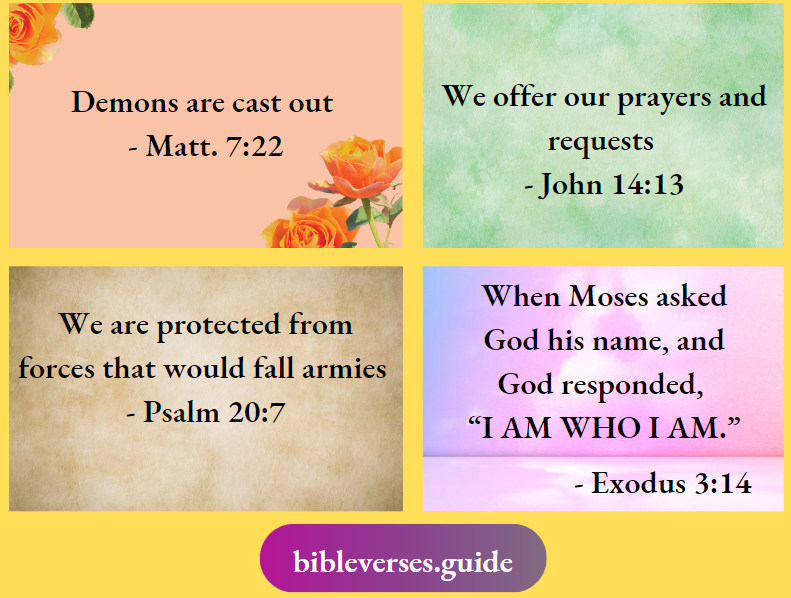
In Psalm 20:7 David compared the power of the name of the Lord with the power the military usually relied upon in times of war.

In this text, an army would have been in sorry shape without chariots and horses, and yet the name of the Lord was even more powerful than those human means.

It is challenging to communicate the importance of God’s name in Scripture, but one of God’s most declarative statements appears.

Honoring God’s Name

The verb here comes from the Hebrew word kayak, which may imply “I am he who is,” or “I am he who exists.”

The original Hebrew combination of letters that signified the name of God was YHWH. The Israelites considered this word too sacred even to pronounce.

When reading God’s name, they combined the vowels in the Hebrew word for “My Lord” and the consonants YHWH to form the word Jekovak.

In Hebrew names carried great significance and were not mere labels. So the words used for God’s name conveyed his divinity and the great importance of who he was.

His name is so powerful for us that the mention of it calls God himself to our aid.

Father, we cannot even comprehend the power your name implies. Thank you that we have full access to it to you.


Salt And Light For A Dull And Darkened World

Salt And Light For A Dull And Darkened World

You are the salt of the earth. But if the salt loses its saltiness, how can it be made salty again? It is no longer good for anything, except to be thrown out and trampled by men.

You are the light of the world. A city on a hill cannot be hidden. Neither do people light a lamp and put it under a bowl.

Salvation through Christ is the highest purpose of our entire existence. But life doesn’t end there. Instead, coming to know Christ is just the beginning of a new life we live for a higher purpose.

Matthew 5-13-16

God doesn’t give grace solely for our selfish enjoyment. It’s not something we should hoard and hide away. Rather, salvation is a divine gift we receive so that we may help give it to others.

Christ explained this concept in terms his listeners could understand stand.

Today, the compound known as sodium chloride is a readily available and inexpensive substance we use to add flavor to our food. But in the time of Christ, salt was a precious commodity that people used to preserve meat and food.

At times in the distant past, they traded an ounce of salt for an ounce of gold. Long ago, people established caravan routes that crossed the ancient world to trans¬port salt from place to place.

Sometimes, as traders were transporting salt across long distances, other substances would adulterate it, or rain or a sudden flood would ruin it.

When this happened, it no longer had any value. Its preservative value was lost, and traders would throw it away.

Today, light is always as near as the closest light switch. Thanks to plentiful electricity and the development of ever-brighter bulbs, people can illuminate their homes, businesses, and ballparks at all hours of the night or day.

But suppose you turn on a light in a closet, then close the door and forget about it. The light is still burning, but nobody can see or benefit from its light.

When Christ told his followers that they were salt and light, he meant that they were supposed to have a transforming impact on the society around them.

Like salt, they were to preserve the good in society, preventing it from rotting and going bad. Like light, they were to illuminate the darkness, enabling people to see the truth and follow it.

God’s gifts are wonderful things to enjoy, but our enjoyment is not the bottom line.

Christ saved us so that we could help him save others. Only when we act as salt and light in our world will we accomplish this urgent assignment.

Father, help me to be salt and light in this needy world.


Open The Door

Open The Door

Isaiah 59-1-2

One of the most famous paintings of Christ shows him standing in a garden facing a large, wooden door.

Jesus is dressed in flowing robes, his long, curly hair cascading over his shoulders. There’s a look of eager anticipation in his eyes.

But there’s something funny about the door. It has no handle, keyhole, or other means of opening it. That’s because the painter was trying to illustrate the message of one of the most powerful verses of the New Testament.

Revelation 3-20

This may sound like an invitation to a meal, but Jesus has more on his mind here than dinner and dessert.

The same man who used terms like living water to explain the work of the Holy Spirit also meant more by the word food than might seem obvious at first.

John, who wrote the Book of Revelation, shows us what Jesus meant in the fourth chapter of his Gospel, where Jesus tells a Samaritan woman, “My food is to do the will of him who sent me and to finish his work.”

So when Jesus says he will come and eat with us, it probably means he will be sharing more than food with us. It means he will be sharing his life, which will enable us better to do his will.

Jesus wants us to open the door and invite him into our lives, but he’s a gentleman. He’s not going to barge in if we don’t really want him there. We need to ask him in.

The Book of Isaiah explores a similar theme. It describes God’s repeated attempts to reach out to the people of Israel.

It’s a sad and depressing story. Time after time, God rescued the people from their latest blunders.

Then, after a period of soul-searching and repentance, the people asked God to forgive them.

They rededicated themselves to faith and righteous living and promised that nothing like that would ever happen again.

But within a few pages or paragraphs, they were up to their old shenanigans once again. They turned their backs on God and experienced the natural consequences of such disobedience.

This goes on for sixty-six chapters. By the time I finish reading Isaiah, I feel a mix of frustration and hope.

There’s frustration because the book powerfully shows how stupid and mule-headed human beings can be. But there’s hope because God keeps trying new things to get our attention once again.

Some people question whether or not God exists, and at least part of their rationale comes from the fact that things on planet Earth never seem to get much better.

Sure, technology improves, but human nature stays the same, embroiling the globe in conflict and wars.

But such recurring problems shouldn’t be a cause for doubting God.

Rather, we should praise God for his steadfast commitment to us in the face of so much opposition and disobedience.

God’s arm isn’t short. He isn’t deaf to our cries. The problem is us and our repeated preference for our own ways over God’s way.

Only when we realize that and open the door to Jesus will we see the face of God in all its glory?

Father, please come into my life and make yourself at home in my heart.


Made Clean In God’s Sight

Made Clean In God’s Sight

On one of our adventures to Ireland, Steve and I traveled over eight miles of rough seas to explore the ancient monastic island of Skellig Michael.

Waves splashed over the side of the boat and drenched us. My wool hat was flattened to my head and salt stung my chapped lips.

When we stepped onto the rocky hills of Skellig Michael, I was cold but anxious to get started hiking and exploring.

We had about two hours to wander and climb on this breathtaking island that is home to monastic ruins dating back as much as fifteen hundred years.

I did the wandering and Steve did the climbing. But wherever either of us went, the ground was muddy.

Our hiking boots kept our feet dry, but the grooved bottoms of the boots were caked with muck.

As soon as we landed back on the mainland, we headed for the nearest pub to try and dry off a little and get some of the junk off our boots. It was a useless endeavor. We were a mess.

We drove back to our bed-and-breakfast, eager for a hot shower and clean clothes. It took a lot of scrubbing to get the salt out of my hair and off my face.

Jude 1-24-25

The next day I picked the dried mud out of the crevices of my boots with a knife, but my wool cap was a total loss. It was loaded with salt and grime and no amount of scrubbing would save it.

I think of this passage in Jude when I remember how filthy Steve and I were on this adventure.

We are all full of filth on the inside. Even when we look our cleanest, our hearts harbor the vestiges of sin. God calls us to be perfect (Matt. 5:48), and no amount of scrubbing on our part will accomplish that perfection.

The crevices of our souls, like the crevices on my hiking boots, are full of the mud of life lived in a fallen and dirty world.

Someone has said that the ground at the foot of the cross is level, meaning that we have all sinned and are all filthy. It matters not what sins we have committed.

Even those of us with the least amount of filth are as guilty as those with the most. The “knife” that might have been used to “clean” us was used, instead, on Jesus as he hung on the cross.

None of us are clean as we stand before God, resting on our own efforts. But we don’t rest on our own efforts. As this verse declares, we rest on him who presents us “without fault.”

Father, what a miracle that your Son paid our debt for us, and now we are clean before you.


Wisdom Bigger Than Our Own

Wisdom Bigger Than Our Own

Words featured in a song in the children’s video Josh and the Big Wall declare that walking around a wall looks like a pretty dumb idea.

Characters in these videos are personified as vegetables and fruit, and the singers in this scene are peas dressed as Canaanite guards with Roman helmets on their heads.

They are standing on top of the wall of Jericho and singing down to the Israelites who are portrayed as marching peas and pickles.

Josh, played by a cucumber, and his followers have told the guards that God told them to march around the wall, which would cause it to fall.

The pea-guards are not impressed or worried and tell Josh and his people to go ahead and march all they want.

Joshua 6-5

Of course, in the end

of the video, the wall comes tumbling down and the pea-guards find themselves tangled in the rubble. They run off in fear and God’s forces win the battle.

Whimsical as this children’s video seems, it communicates a message: the world often sees the followers of God as unsophisticated and intellectually deficient.

1 Cor. 1-25

A number of years ago I attended a debate between a creationist and an evolutionist. Both men had a string of academic credentials after their names and sounded very convincing.

The audience seemed to be filled with people who knew or admired one of the two men. They divided their applause equally between the two debaters.

As we filed out of the auditorium I overheard several people commenting on the stupidity of Christians.

It seemed that even the credentials and scholarly presentation of the Christian debater couldn’t convince these skeptics.

With all the world’s information available to us, we may still seem like the little veggie army marching around Jericho.

People who do not know God will probably continue to tell us our “brains are very small,” but God’s power has overcome the world.

Ultimately, though, the walls of disbelief will fall down and he will reveal himself for who he really is.

Father, thank You that your wisdom is greater than any worldly wisdom and that you give us strength to follow you even when criticized.


A Living Sacrifice

A Living Sacrifice

Before the time of Jesus, people who wanted to worship God did so by making the offerings and sacrifices God had commanded.

Large portions of the Old Testament Books of Leviticus, Numbers, and Deuteronomy spell out the detailed procedures the Israelites used to bring an offering or sacrifice to the altar found in Israel’s temple.

Jesus both upheld and radically transformed God’s ancient sacrificial system.

Romans 12-1

He visited the temple during Passover and participated in the Passover meal. But then he himself became a sacrificial lamb, dying for us and our sins on the cross.

In saying these words, Jesus indicated that he had completed the sacrifice God had demanded of him.

But as Paul pointed out in the passage from Romans, the crucifixion of Christ didn’t mean the end of sacrifices.

John 19-30

Instead, God now wants all of us to live in such ways that our lives are moment-to-moment “living sacrifices.”

Paul told us to offer our bodies, but this does not mean that we will be ritually killed and burned on a smoking altar. Rather, it means that we should give our lives to God for his use and service.

A person who does this offers a word of kindness and mercy to someone who needs it. He forgives those who hurt and demeaned him.

He gives to others even when he doesn’t feel like it or when he would rather have someone give to him. He makes himself available for God’s use even though his daily schedule is already full of more tasks than he can accomplish.

Today, many churches have become battlegrounds in what some writers have called the “worship wars.” Some people prefer to sing hymns and recite classic Christian statements like the Apostles’ Creed.

Others prefer singing contemporary praise choruses and keeping church services low-key and informal.

Paul had a different point of view. As he told us, offering ourselves to God as living sacrifices is an “act of worship” that pleases God. It is the most important kind of worship.

Luke 23-46

God may not require that you and I suffer and die on a cross. But he does require that we offer up our lives to him in worship so he can use them for his glory.

Father, much of the time I think only about what I want and what will make me happy. But help me develop a different attitude. I want my life to be a living sacrifice to you.


Pathway To Heaven Or Highway To Hell

Pathway To Heaven Or Highway To Hell

Enter through the narrow gate. For wide is the gate and broad is the road that leads to destruction, and many enter through it. But small is the gate and narrow the road that leads to life, and only a few find it.

Matthew 7:13-14

Poets, authors, and musicians have incorporated the image of the road into their work for centuries.

From John Bunyan’s The Pilgrim’s Progress to the Beatles’ “Long and Winding Road,” highways and byways have played an important supporting role in art and popular culture.

Jesus used the metaphor of the road, too. But he said only a few people choose the right road in life. The rest are headed full-speed down a big, broad superhighway to hell.

Was Jesus having a bad day or feeling unusually pessimistic when he delivered these sobering comments?

Many people would like to believe that everyone is going to heaven. Well, not everyone; can take out people like Hitler and Stalin. And maybe the guy who invented karaoke.

All of the others get a free pass to heaven, in our minds, thanks to their good works, or because we like them, or because we can’t bear the thought of their going to hell.

Jesus doesn’t like the thought of anyone going to hell, either. He came to earth and gave his life on the cross so that wouldn’t have to happen. But as he said in the passage above, there are basically two ways to go in life, and most people choose the wrong one.

How could this be the case if God loves everyone? Theologians have wrestled with this question for centuries. Many conclude that the fact that God loves all of us doesn’t mean all of us will love him back.

Jesus explained some of this in his parable of the sower and the seed (Matthew 13). A farmer went out one day to sow some seed. Some of the seed fell on the path where the birds came and ate it.

Some fell on bad soil where it started growing, then died off. Some fell in the thorns, which choked its growth. And some fell on fertile soil, where it took root and produced a bumper crop.

Jesus told that parable to a large crowd of people, but later, he gave a more detailed explanation to his disciples. The seed, he said, represents the message of the kingdom.

“When anyone hears the message about the kingdom and does not understand it the evil one comes and snatches away what was sown in his heart,” said Jesus.

“This is the seed sown along the path. The one who received the seed that fell on the rocky places is the man who hears the word and at once receives it with joy.

But since he has no root, he lasts only a short time. When trouble or persecution comes because of the word he quickly falls away.”

Jesus never explained his comments about the two roads, but if he had, it might have gone something like this: Many people get in their cars and go out for a drive.

Some have no clear destination in mind and spend their lives wandering throughout the world.

Others know where they would like to go but get lost or distracted along the way. Only a few people make it to their ultimate destination.

This may not be a very “positive” message. You won’t see Jesus’ comments about the narrow road on a colorful greeting card. But not everything God says makes us happy. It needs only to be true.

God, help me stay on the narrow path to you and not get sidetracked on the wide way.


Dancing Again

Dancing Again

(LOIS) grew up about thirty miles south of Philadelphia, the location of the original American Bandstand TV show.

The dances we saw on Bandstand one week showed up on our school dance floor the next week.

Three years out of high school I married one of the best dancers in the class, Jack Mowday, and we clicked our heels together for the next thirteen years.

Then in December of 1979, the dancing stopped. Our daughters Lisa and Lara and I got Jack a ride in a hot-air balloon as a Christmas present.

Two of his close friends and business associates, Glenn Berg and Rick Rhine, as well as a balloon operator, went along with him.

Psalm 30-11

The girls and I, along with Glenn’s wife, Gail, and Rick’s fiancee, Kathy, rode in our station wagon and followed the balloon in flight.

It was a beautiful day and the guys waved happily as they sailed along. We lost sight of the balloon behind some trees and when it reappeared, a blaze was growing out of the side of the basket.

We knew immediately that the men and the pilot were in terrible trouble as the flames licked up over the edge of the basket and into the small pas¬senger space.

All four people were killed that day, and my life changed forever. But God carried us in miraculous ways.

The truth of his promises became a reality for me and my daughters, and we experienced grace far beyond our imagination.

While pain and loneliness were sometimes consuming, so was the peace of God. I learned that peace and pain coexist and breathe hope into the darkest of nights.

But even when I felt God’s arms of love embrace me, I doubted that I would ever be truly happy again, and I was sure that my spirit would never be able to dance with the joy I’d known when Jack was alive.

One of my great comforts during those early days of grief came from copying verses on index cards and carrying them with me.

I’d read them when waiting in the car for the girls to get out of school or at a dentist’s office.

Sometimes the words would seem flat, and God would seem distant. Nights were the most difficult times; the hours dragged until the sun shone again.

But then those dark times grew less frequent. The words of the verses touched me in a healing way and my heart felt full again. My spirit danced.

Many of the verses I wrote on these cards came from the Psalms. The language and poetry of the Psalms lend themselves to creating a place of peace in the reader’s heart.

I also love to read the Psalms in the King James Version of the Bible, but you may find more comfort in another version.

A few of my favorite verses are:

The Lord Was With Joshua, And His Fame Spread Throughout The Land

I don’t live down the road from American Bandstand anymore, and I don’t dance anywhere but in my family room on very rare occasions.

But I can dance. The wailing has ended, the sackcloth of grief is gone and he has “clothed me with joy.”

Father, when pain is great we sometimes despair. How faithful you are to heal our wounds and bring our spirits back to places of joy.