
The Book Of Revelation
Who wrote the book of Revelation: John When was it written: About 95 A.D.
The book of Revelation is many things. It is a book of prophecy, a book of analogies, a book containing literal descriptions, a book of warnings and chastisements, and a book of promises.
Yet if you were to ask almost anyone, Christian or non-Christian, the first words that come to mind when they think about the book of Revelation are the words confusion or mysterious.
The Reasons People Feel This Way About The Book Of Revelation Include:
- Fear of the unknown
- Guilt
- A lack of knowledge about the rest of the Bible
- Preconceived notions
- Improper teaching
- A lack of faith that is comfortable with the fact that we don’t need to know everything about the end times and the day of judgment
- The inability to accept that the book is both literal and figurative
John wrote the book of Revelation to record the things God disclosed (revealed) to John by way of an angel or messenger. John wrote the book of Revelation while a prisoner on the Island of Patmos. He was a prisoner of the Roman Government under the leadership of Emperor Domitian.
Domitian was an egotistical man who strongly enforced the practice of emperor worship; meaning anyone who didn’t worship the Roman emperor was sent to prison or killed.
By the time John was banished to Patmos, he was in his nineties, the only remaining disciple/apostle who had been an eye-witness to Jesus’ ministry and had already survived being doused with hot oil for refusing to obey Domitian’s laws for emperor worship.
Age, persecution, and intense physical suffering weren’t enough to squelch John’s love for Jesus and his dedication to fulfilling the great commission (Matthew 28:18-20).
Putting all of these things together made John the logical choice in God’s mind to reveal this one final prophecy. Who better than John was there to receive such an important message?
At the time John received these revelations his thoughts were most likely not about us—the coming generations. His thoughts were with the Christians spread throughout the Roman Empire.
More than a few were proposing that the Church make some concessions with the government by acknowledging the Emperor as someone worthy of praise along with God. Their reasoning for entertaining such a compromise was obviously meant to be a measure of self-preservation and a means by which they could avoid persecution, prison, or even death.
Now while some may feel the people were justified in their actions—possibly even quoting scripture about obeying the laws of the land and such, this type of compromise cannot be. Why? Because:
Thus says the Lord, the King of Israel, and his Redeemer, the Lord of hosts: “I am the first and I am the last; besides me, there is no god. -Isaiah 44:6
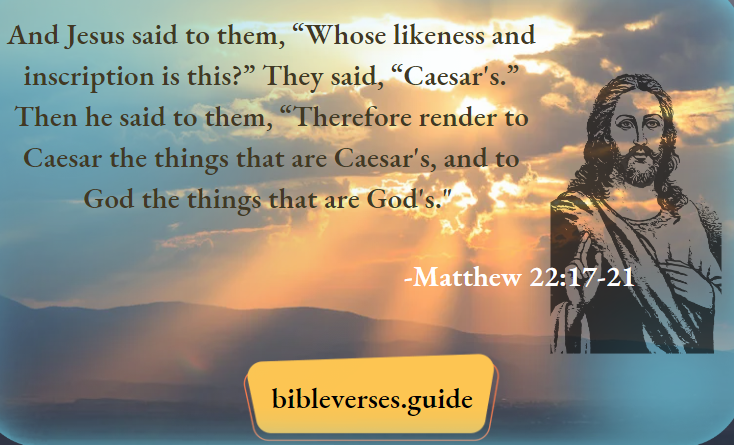
Tell us, then, what you think. Is it lawful to pay taxes to Caesar, or not?” But Jesus, aware of their malice, said, “Why put me to the test, you hypocrites? Show me the coin for the tax ” And they brought him a denarius.

So you see there is no justification for putting anyone or anything above God or even equal to him. God rules the world and on the day of his choosing, he will present himself to us so that we can stand before him to give an account of our lives and be judged.
We will be judged and pronounced saved or unsaved. And that is the message John wanted to send to the Church. It was a message that said, “Don’t give up! Don’t lose sight of what is going to take place. Don’t forfeit your eternal destiny for temporary relief.”
Now that you have a little more background of the book’s origin, let’s begin looking at the book itself. First of all, I want to say that this is by no means a comprehensive or all-inclusive commentary of Revelation. Secondly, it is not an unveiling of a great mystery being solved, i.e., I don’t have all the answers.
And the reason I don’t have all the answers is simple: no one does. There are simply some things we won’t know until we are there—living the day of judgment and the eternity that follows.
Lastly, we are going to take the Book of Revelation at ‘face value’. By that I mean I am going to point out or clarify those things that are literal and ask that you accept the things that are figurative on faith.