How to Identify and Challenge OCD Triggers: Strategies for Regaining Control

Chapter 8 Overcoming OCD Triggers And Compulsions

Within this chapter, you will discover valuable strategies and insights designed to help you regain control over your life. We begin by identifying and challenging triggers, learning to recognize patterns, and reframing how we perceive our thoughts. Next, we delve into developing healthy coping mechanisms that empower us to manage our emotions and resist overwhelming urges. Further, we discuss reducing rituals and compulsions by breaking free from their grip and creating adaptive behaviors.

Lastly, we address coping with anxiety in the face of obsessive thoughts, adopting tools to kindly acknowledge them without succumbing to distress. Through these transformations, embark on your path toward liberation from OCD.

Read and Learn More OCD Management Made Simple: Top Strategies and Insights

Identifying And Challenging Triggers In OCD

People with OCD often experience severe anxiety and distress, disrupting their daily life. One crucial aspect of managing OCD is identifying and challenging the triggers that provoke obsessions and compulsions.

Understanding the specific triggers that contribute to OCD symptoms can help individuals gain control over their anxiety and compulsive behaviors.

Identifying these factors often requires self-awareness, reflection, and patience, as each person’s experience with OCD is unique. Here are some common ways to identify triggers.

1. Keep a journal: Monitoring day-to-day activities, emotions, thoughts, and encounters may reveal patterns or trends in OCD symptoms. Ensuring detailed documentation can help identify when obsessive thoughts or compulsive actions occur most frequently.

2. Retrace your steps: When experiencing an onset of OCD symptoms, pause and consider any changes in routine or environment that may have precipitated the episode

3. Seek professional help: Mental health professionals trained in treating OCD can provide valuable guidance on recognizing triggers.

4. Support groups: Joining support groups can offer valuable insight into how other people with OCD deal with similar challenges and provide suggestions on identifying triggers unique to individual experiences.

Overcoming OCD Triggers And Compulsions Common Ways To Identify Triggers

Once triggers have been identified, developing strategies to challenge or counteract them becomes vital in managing OCD effectively. Some recommended approaches include:

1. Cognitive Behavioral Therapy (CBT): CBT is a psychotherapeutic approach to identify dysfunctional thought processes and replace them with healthier alternatives. A cornerstone of CBT for treating OCD is understanding how obsessions trigger compulsions and learning to challenge or resist those urges.

2. Exposure and response prevention (ERP): This technique involves intentionally confronting the fears, obsessions, or situations that cause anxiety in a controlled and prolonged manner. Over time, this can help desensitize individuals to their triggers and reduce the compulsive actions they provoke.

3. Mindfulness and grounding techniques: Practicing mindfulness and grounding exercises can help regain focus in the present moment while challenging obsessive thoughts. Techniques such as deep breathing, visualization, or repeating positive affirmations may provide relief from intrusive thoughts.

4. Establish healthy routines: Engaging in regular physical activity, eating well-balanced meals, maintaining a consistent sleep schedule, and incorporating relaxation techniques can contribute to overall well-being. These habits can increase resilience toward stress and help counteract the impact of triggers.

5. Create a coping toolbox: Identify personalized coping strategies that work best for individual needs when experiencing OCD symptoms. This toolbox could include journaling, drawing, contacting a trusted friend or family member, or engaging in relaxing hobbies.

6. Set boundaries with media consumption: News stories or content may trigger increased anxiety and obsessive thoughts in some individuals with OCD. Limiting exposure to negative media or setting designated periods for consuming news can help reduce discomfort.

7. Stay connected with your support system: Building and maintaining strong relationships with friends, family, and mental health professionals is essential for emotional support during challenging times.

8. Practice self-compassion: Recognize that living with OCD can be difficult and treat oneself kindly during stress or setbacks. Challenging triggers effectively takes time, effort, and patience. Although it may initially appear daunting, implementing these strategies can gradually improve OCD symptoms and overall quality of life.

While identifying and challenging triggers is vital to managing OCD independently, seeking professional help remains a critical component of rehabilitating the mind and body affected by this complex condition. Licensed therapists trained specifically to treat OCD will be equipped with ample resources and expertise to assist patients in making steady progress toward recovery.

Additionally, connecting with local or online support groups can contribute invaluable insights from others who have suffered similar experiences with OCD. These gatherings provide avenues to learn new coping strategies, discuss individual progress, share successes, and find solace in knowing that many others are grappling with comparable challenges.

While practicing self-awareness and implementing personalized strategies can help mitigate symptoms, seeking professional help remains indispensable in pursuing wholehearted recovery. With persistence and patience, individuals suffering from OCD can reclaim control of their lives and emerge stronger.

Developing Healthy Coping Mechanisms

Developing healthy coping mechanisms for managing OCD can help individuals lead more balanced and fulfilling lives. This section will discuss the importance of building healthy coping mechanisms for OCD and provide some examples that might be helpful.

A healthy coping mechanism is a way of responding to a stressful or difficult situation that helps you maintain or restore psychological well¬ being. For individuals with OCD, whose lives are often fraught with intrusive thoughts and compulsions, healthy coping mechanisms can be invaluable in managing their condition.

One example of a good coping mechanism for people with OCD is the practice of mindfulness meditation. Mindfulness meditation involves focusing on your breath, body, or any other present-centered experience while gently guiding your attention away from intrusive thoughts.

Through regular mindfulness meditation ,individuals with OCD can learn to become more aware of their thoughts without becoming overwhelmed.

Another useful coping strategy for OCD sufferers is exposure and response prevention therapy (ERP). Generally conducted under the guidance of a mental health professional, ERP is a process whereby individuals gradually confront their obsessive fears while refraining from engaging in their associated compulsions.

For example, someone afraid of germs might be encouraged to touch a doorknob without washing their hands afterward. With time and consistent practice, ERP effectively reduces OCD symptoms.

Developing a support network is another essential aspect of managing OCD. Those suffering from OCD may find it helpful to involve not only friends and family but also mental health professionals or support groups specifically designed for people with OCD.

Sharing one’s experiences with others who can understand the challenges posed by the disorder can lead to increased feelings of empathy and connection and provide valuable insight into how others have found success in managing their symptoms.

Exercise has also been shown to help reduce the symptoms of OCD. Engaging in regular physical activity can release endorphins, which are chemicals that affect mood positively. A consistent exercise routine can help improve self-esteem, reduce stress and increase social interaction – all factors that can help individuals with OCD manage their symptoms more effectively.

Cognitive-behavioral therapy (CBT) is another successful therapeutic technique in treating OCD. CBT focuses on identifying and challenging the irrational belief patterns that fuel OCD symptoms.

For example, someone with intrusive thoughts about accidentally causing harm may work with their therapist to question whether these thoughts are a true reflection of reality or simply a product of their anxiety.

Through this exploration, individuals with OCD can develop more rational and adaptive thought processes, leading to decreased obsessive-compulsive behaviors.

One more helpful coping mechanism for people with OCD is relaxation techniques. These might include deep breathing exercises, progressive muscle relaxation, or guided imagery. Practicing these techniques regularly can help individuals with OCD better manage their anxiety and reduce the intensity of their compulsive behavior.

Journaling is another beneficial coping strategy for those struggling with OCD. Writing about one’s experiences and feelings can provide a way to gain insight into the triggers and patterns that contribute to the development of obsessive thinking and compulsive behavior.

By regularly recording one’s thoughts and emotions in a journal, individuals with OCD can better understand their internal world and develop more effective ways of coping with their symptoms.

Developing healthy coping mechanisms is a crucial part of successfully managing obsessive-compulsive disorder. By implementing these coping mechanisms, individuals with OCD can work towards reducing their symptoms and improving their overall quality of life.

Reducing Rituals And Compulsions

Cognitive Behavioral Therapy (CBT) is a well-researched and effective approach to treating OCD. It addresses the thought patterns that cause anxiety and the resulting compulsive behaviors. In particular, it highlights the significance of Exposure and Response Prevention (ERP) in managing compulsions.

ERP is a technique whereby individuals confront their fears by repeatedly exposing themselves to anxiety-provoking situations or thoughts that typically evoke compulsive behaviors. By doing so, they learn to resist the urge to perform the ritual or compulsion, eventually weakening its hold on them.

Example 1: Hand-washing Compulsion

person with OCD might have an excessive fear of germs, leading to frequent hand-washing rituals. ERP would involve intentionally touching something deemed “contaminated” without washing their hands afterward. Over time, the individual will adapt to the discomfort and learn that their feared consequences do not occur even if they do not perform the ritual.

Example 2: Checking Compulsion

Another common compulsion in OCD involves repeatedly checking things such as door locks or stove burners due to fears of harm or danger. An example of ERP for this compulsion would involve resisting the urge to double-check if a door is locked. Gradually, individuals will gain confidence in their initial actions and reduce the need for reassurance through checking.

The following strategies can support individuals in reducing rituals and compulsions:

1. Normalize intrusive thoughts: Recognize that everyone experiences unwanted thoughts, but people with OCD often give these thoughts undue significance. Individuals can better resist compulsions by realizing these thoughts are not necessarily threatening.

2. Challenge irrational beliefs: Analyze the thoughts underlying the compulsive behaviors, identify any irrational or unrealistic beliefs, and replace them with more balanced thinking. For example, instead of assuming that touching a doorknob will result in a severe illness, understand the likelihood of this happening is minimal.

3. Practice mindfulness and relaxation techniques: Cultivating mindfulness can help individuals stay present, non-judgmentally observing their thoughts and feelings without becoming overwhelmed. Relaxation techniques such as deep breathing or progressive muscle relaxation can help manage anxiety, reducing the need for compulsions.

4. Set achievable goals: Be realistic about what can be accomplished in a given time frame and break goals down into manageable steps.

5. Seek professional support: A mental health professional trained in treating OCD can provide additional guidance and support tailored to individual needs.

6. Develop a support network: Sharing one’s experiences with trusted friends or family members or joining an OCD support group can facilitate a sense of understanding and connection, making it easier to cope with the challenges of reducing rituals and compulsions.
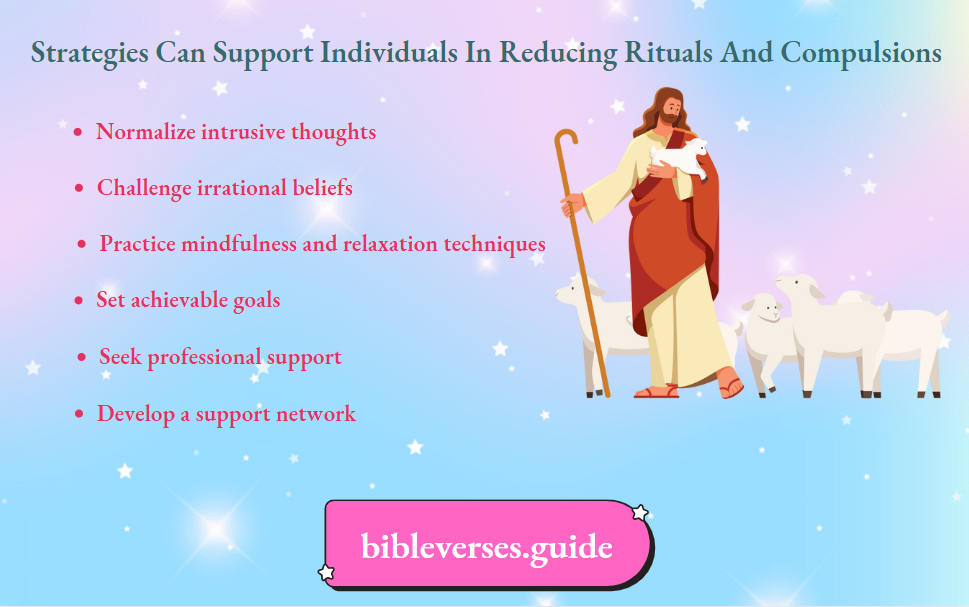
Overcoming OCD Triggers And Compulsions Strategies Can Support Individuals In Reducing Rituals And Compulsions

Although reducing rituals and compulsions in OCD is undoubtedly challenging, research shows that applying strategies like ERP combined with CBT can be highly effective in managing symptoms. Persistence in confronting anxiety-provoking situations, reframing irrational beliefs, and seeking professional guidance is critical to successfully reducing rituals and compulsions. By regaining control over their life and committing to recovery, individuals with OCD can considerably improve their mental health and overall well-being.

Coping With Anxiety In The Face Of Obsessive Thoughts

Dealing with anxiety is no small feat, especially when obsessive thoughts cast a looming shadow over daily life. The constant loop of uncontrollable and intrusive thoughts can be incredibly distressing, leading to heightened anxiety or even panic attacks. However, there are various methods to help manage and cope with these challenging situations.

1. Mindfulness and Meditation: Incorporating mindfulness practices into your daily routine can help ground you in the present moment and train your mind to be more present. By focusing on your breathing or engaging in guided meditations, you can develop the ability to gently acknowledge anxious thoughts without getting caught up in them. Moreover, mindfulness exercises encourage self-compassion and patience as you confront your obsessive thoughts.

2. Cognitive Behavioral Therapy (CBT): CBT is an evidence-based therapeutic approach that helps individuals identify and challenge maladaptive thought patterns responsible for causing distress. By altering negative thinking habits, CBT empowers you with tools to break the cycle of obsessive thoughts and counteract anxiety-inducing narratives. Working with a qualified therapist is the best way to reap the benefits of CBT.

3. Support Network: Surrounding yourself with supportive friends and family members can significantly impact your ability to cope with anxiety and obsessive thoughts. Reaching out for help might initially feel intimidating, but fostering open communication lines enables those close to you to understand your struggles better and offer appropriate support.

4. Maintain a Regular Routine: Creating structure through a consistent daily routine provides stability amidst the unpredictability of anxious thought patterns. A regular schedule helps anchor you while building positive habits that contribute to improved mental health in the long run.

5. Physical Exercise: Physical activity can immediately relieve anxiety while improving overall well-being. Exercise naturally releases endorphins a group of chemicals that act as natural mood elevators, helping to counteract anxiety’s effects. Finding the best exercise for you depends on your preferences and capabilities but can include walking, running, swimming, or practicing yoga.

6. Healthy Diet: Eating a well-balanced diet ensures your body receives all the necessary nutrients to function optimally. A healthy diet can improve mood and energy levels, providing better tools for navigating obsessive thoughts and anxiety. It is essential to prioritize nutrient-dense foods like fruits, vegetables, whole grains, lean proteins, and a healthy balance of fats.

7. Adequate Sleep: Sleep is crucial for proper brain function and emotional well-being. Establishing a regular sleep routine and getting the recommended seven to nine hours per night can significantly impact your ability to cope with anxiety. Good sleep hygiene habits —such as reducing screen time before bed, maintaining a consistent sleep schedule, and creating a relaxing bedtime routine—can promote restful sleep.

8. Limiting Caffeine and Alcohol Intake: Both caffeine and alcohol are known to exacerbate anxiety. Limiting or eliminating the intake of these substances may help reduce symptoms of obsessive thoughts by preventing the exacerbation of anxiety or mood fluctuations

9. Engage in Relaxation Techniques: Deep breathing exercises, progressive muscle relaxation, or guided imagery can help you feel calm when intrusive thoughts threaten to overwhelm you. Over time, these relaxation techniques can be practiced and refined so that you have tools readily available during high anxiety.

10. Acceptance: Finally, recognizing that obsessive thoughts are a part of your experience can help promote a sense of acceptance rather than fighting against them continually. Sitting with these thoughts without feeding into their emotional charge allows you to gradually distance yourselffrom their impact.

 

7 Proven Mindfulness Strategies to Regain Control Over OCD

Chapter 9 Embracing Mindfulness And Mental Wellness

Mindfulness practices, such as meditation and deep breathing, can help calm intrusive thoughts and create a sense of peace within the mind. This mental rest provides the necessary space to recognize and detach from the repetitive patterns that OCD creates.

Nurturing mental wellness also involves developing self-compassion, understanding one’s limitations, and setting realistic expectations for personal growth. By integrating activities that promote self-care, like exercise, healthy eating, and adequate sleep, those struggling with OCD can feel more balanced and better equipped to manage their disorder.

In this chapter, we embark on embracing mindfulness and prioritizing mental wellness. We’ll explore techniques such as practicing mindfulness for OCD management, enabling you to regain control over your thoughts and emotions. You’ll discover the transformative power of small yet impactful habits by incorporating self-care into daily routines.

We’ll also delve into the role of exercise and nutrition, emphasizing their significance in nurturing a sound mind. Finally, we’ll expand our horizon by exploring holistic approaches to OCD, and alternative practices that can empower you to reclaim your mental wellbeing.

Read and Learn More OCD Management Made Simple: Top Strategies and Insights

Practicing Mindfulness For OCD Management

Mindfulness is cultivating awareness and acceptance of the present moment without judgment. By intentionally directing attention to the present moment, individuals can learn to observe their thoughts and feelings without getting immersed in them.

Incorporating mindfulness into daily life has shown promising results in treating anxiety, depression, and various stress-related disorders, including OCD.

The following are examples of how mindfulness practices can be applied for effective OCD management:

1. Mindful breathing: Focusing on the breath is one of the simplest ways to practice mindfulness. Breathing exercises allow individuals with OCD to anchor themselves in the present moment by paying attention to their inhalation and exhalation cycles.

This act of grounding can help reduce the intensity of intrusive thoughts and anxiety that often accompany an obsession. Deep belly or diaphragmatic breathing has been found to be particularly helpful in creating a sense of relaxation.

2. Botanical walks: Engaging in outdoor activities that require focused attention can help disrupt obsessive thought patterns. For instance, walking outside while consciously observing plants, trees, and flowers helps one immerse oneself in nature. This activity offers an opportunity to practice mindfulness and can positively impact overall well¬ being by reducing stress levels.

3. Body scan meditation: A body scan meditation focuses on different body parts sequentially, from head to toe. This mindfulness technique helps cultivate a deeper awareness of physical sensations within the body and encourages individuals with OCD to develop greater self-compassion.

By bringing attention to their bodily sensations, one may also become more attuned to internal cues associated with their obsessions and compulsions, which can be useful in managing OCD symptoms.

4. Mindful eating: People living with OCD can benefit from adopting mindful eating practices that involve paying close attention to their meals without distractions. Eating mindfully entails savoring each bite, chewing thoroughly, and fully engaging with the textures and flavors of food. This practice allows individuals to develop healthier relationships with food and can help break the cycle of obsessive thoughts related to eating rituals.

5. Thought labeling: As intrusive thoughts arise, individuals with OCD can benefit from a mindfulness practice called thought labeling. This technique involves acknowledging and mentally naming an intrusive thought as it surfaces (e.g., ‘This is an obsession” or “This is anxiety”) without judgment. By recognizing and labeling intrusive thoughts, one is better equipped to detach from these recurring thought patterns and reduce the distress they may cause.

6. Progressive muscle relaxation (PMR): For OCD sufferers experiencing tension due to anxiety or stress, PMR can help alleviate physical discomfort. This technique involves systematically tightening and releasing specific muscle groups while focusing on the relaxation sensation following each contraction. PMR has been shown to promote relaxation while improving awareness of how the body responds to stress or anxiety.

7. Loving-kindness meditation: Cultivating self-compassion through loving-kindness meditation is another useful tool in managing OCD symptoms. This mindfulness practice involves directing feelings of love, kindness, and understanding toward oneself and others around them.

By fostering positive emotions, loving-kindness meditation helps support mental health by promoting greater self-acceptance and emotional resilience.

Mindfulness-based practices offer an array of tools that can help individuals with OCD manage their symptoms more effectively. By regularly engaging in mindful activities such as breathing exercises, walking in nature, body scan meditations, and progressive muscle relaxation, OCD sufferers can foster greater self-awareness and develop new coping mechanisms to break the cycle of obsessions and compulsions.

While mindfulness may not cure OCD, it is a valuable adjunct to traditional treatments like cognitive-behavioral therapy in supporting mental health and resilience.

Embracing Mindfulness And Mental Wellness

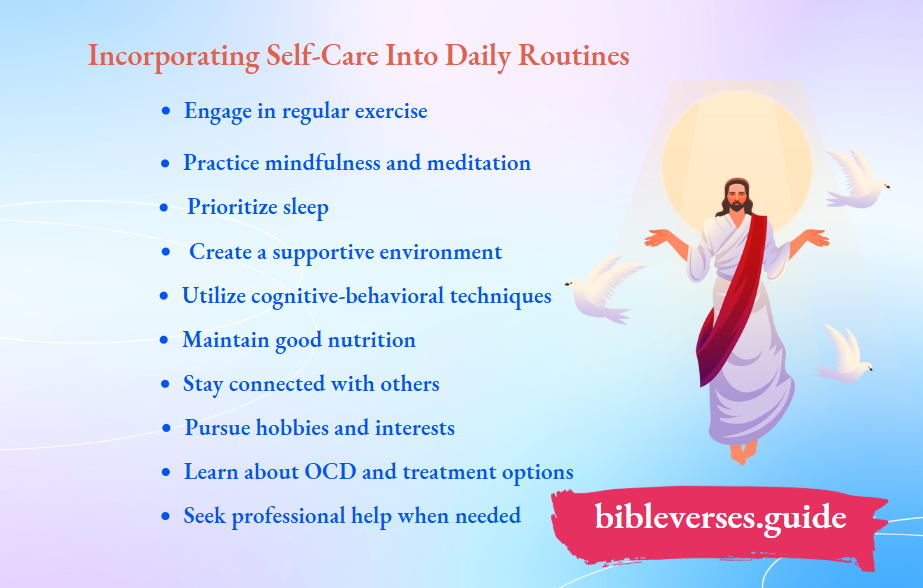
Incorporating Self-Care Into Daily Routines

Self-care is taking care of oneself physically, emotionally, and mentally. Incorporating self-care into daily routines not only helps individuals manage OCD symptoms but also contributes to a better quality of life. Here are some practical examples of self-care strategies for OCD management:

1. Engage in regular exercise: Exercise is well known for its positive effects on mental health, and studies have shown that it can be particularly beneficial for people with OCD. Regular physical activity can help improve mood, reduce anxiety, and boost overall well-being. Try incorporating 30 minutes of moderate exercise such as brisk walking, jogging, yoga, or swimming most days of the week.

2. Practice mindfulness and meditation: Mindfulness involves non-judgmentally paying attention to the present moment. Practicing mindfulness and meditation can help individuals with OCD become aware of their thoughts without getting caught up in them. Schedule daily minutes for mindfulness exercises like breath awareness or body scan meditation.

3. Prioritize sleep: A good night’s sleep is crucial for mental health and overall well-being. People with OCD may struggle with sleep due to anxiety or engaging in rituals late at night. Prioritizing sleep by creating a relaxing bedtime routine, setting a consistent sleep schedule, and ensuring a comfortable sleep environment can help improve sleep quality and reduce OCD symptoms.

4. Create a supportive environment: A well-organized and clutter-free environment can help minimize compulsion triggers and reduce stress for people with OCD. Set aside time regularly to declutter and organize your living space. Consider enlisting the help of a professional organizer if needed.

5. Utilize cognitive-behavioral techniques: Cognitive-behavioral therapy (CBT) is an evidence-based psychological treatment for OCD. Learning and employing CBT techniques, such as thought restructuring, exposure, and response prevention, can help manage OCD symptoms. Seek guidance from a mental health professional trained in CBT for the most effective results.

6. Maintain good nutrition: Eating balanced meals is essential for overall health and well¬ being. A nutrient-rich diet can improve mood, energy levels, and cognitive function, improving OCD management. Daily, consume various fruits, vegetables, whole grains, lean protein, and healthy fats.

7. Stay connected with others: Social support plays a vital role in mental health maintenance. Strong relationships with friends and family can provide emotional support and accountability for self-care practices. Schedule regular phone calls or get-togethers with loved ones to stay connected.

8. Pursue hobbies and interests: Engaging in activities that bring joy and relaxation can help distract from intrusive thoughts and provide an alternative focus for attention. Examples include painting, gardening, playing an instrument, or cooking new recipes. Dedicate time each week to pursuing hobbies or exploring new interests.

9. Learn about OCD and treatment options: Understanding the disorder can help individuals feel more empowered in their recovery journey. Seek out reputable sources of information like books, online resources (such as the International OCD Foundation), and support groups to educate yourself about OCD and its management.

10. Seek professional help when needed: It’s important to recognize when additional support is necessary for managing OCD symptoms. A qualified mental health professional experienced in treating OCD can help individuals develop strategies tailored to their unique needs.

Incorporating self-care strategies into daily routines is an effective way to manage OCD symptoms and improve overall well-being. By practicing routines like regular exercise, mindfulness, and maintaining social connections, individuals can reduce the distress caused by OCD and better navigate life with this challenging condition.

Incorporating Self-Care Into Daily Routines

The Role Of Exercise And Nutrition In Mental Wellness

Mental wellness is a crucial component of overall health, affecting every aspect of life, including relationships, productivity, and happiness. A growing body of evidence suggests that exercise and nutrition are essential in promoting and maintaining mental wellness.

This article will discuss the importance of exercise and nutrition in mental well-being, citing recent research and outlining recommendations for a healthy lifestyle Exercise has long been known for its physical benefits, such as increased strength, endurance, and flexibility.

However, studies have highlighted the significant mental health benefits of regular physical activity in recent years. Exercise has been shown to help alleviate symptoms of depression and anxiety, improve mood and cognition, increase self-esteem, and promote better sleep quality. Several mechanisms are at work to produce these positive effects.

First, exercise stimulates the release of endorphins- neurotransmitters that act as natural painkillers and mood elevators – in the brain. These chemicals contribute to the so-called ”runner’s high,” a euphoria often experienced after vigorous exercise.

Second, exercise promotes the growth of new nerve cells (neurogenesis) and their connections within the brain (neuroplasticity). This enhances cognitive function and overall brain health. Additionally, regular physical activity can help mitigate the harmful effects of stress on mental health.

Exercise provides an effective outlet for releasing tension and pent-up emotions while lowering stress hormones such as cortisol. Moreover, it can improve one’s capacity to cope with future stressful situations by fostering psychological resilience.

While the mental health benefits are evident across various forms of exercise – aerobic exercises, resistance training, or mind-body activities such as yoga – it is essential for individuals to choose activities they enjoy and commit to a consistent routine for maximum impact.

Nutrition is another critical factor influencing mental wellness. The human brain requires a wide variety of nutrients to function optimally.

A diet rich in these necessary nutrients can significantly impact mood, cognition, and overall mental well-being. Research indicates a strong link between certain nutrients and improved mental health.

For example, omega-3 fatty acids, commonly found in oily fish such as salmon and sardines, are crucial for maintaining brain cell membrane integrity and proper signaling between neurons. These fats have been shown to help reduce the risk of depression and may also help alleviate symptoms of bipolar disorder.

B vitamins – particularly B6, B9 (folate), and B12 – play vital roles in producing neurotransmitters such as serotonin, dopamine, and norepinephrine. Low levels of these neurotransmitters have been linked to mood disorders like depression and anxiety. Consuming foods rich in B vitamins (e.g., whole grains, lean meats, legumes, dairy products) can improve concentration, cognitive performance, and overall well-being.

Nutrient-dense diets based on whole foods are immensely beneficial to mental wellness. Various colorful fruits and vegetables provide essential vitamins and minerals that bolster brain function while offering antioxidants to protect against oxidative stress.

Similarly, lean proteins (e.g., chicken, turkey, tofu) supply amino acids necessary for producing mood-regulating neurotransmitters. On the other hand, a diet high in processed foods (such as refined carbohydrates and added sugars) can negatively impact mental health outcomes. These foods can cause rapid fluctuations in blood sugar levels that may contribute to mood swings or feelings of fatigue.

Exercise and nutrition are powerful tools for promoting mental wellness. By prioritizing regular exercise and maintaining a balanced diet of whole foods rich in essential nutrients, one can promote better mental health outcomes for improved quality of life.

Exploring Holistic Approaches To OCD

Holistic approaches to OCD aim to address the condition’s underlying causes and improve overall mental, emotional, and physical well-being. Considering various aspects of an individual’s life, these interventions emphasize a whole-person approach incorporating lifestyle changes, complementary therapies, and integrative practices.

1. Lifestyle Changes: A healthy lifestyle that includes balanced nutrition, regular exercise, adequate sleep, stress management, and avoiding harmful substances can play an essential role in improving one’s OCD symptoms. For instance:

  • Proper nutrition: Consuming a balanced diet that includes lean proteins, complex carbohydrates, healthy fats, vitamins, minerals, and adequate water intake can create an optimal environment for brain function and neurotransmitter balance. – Exercise: Regular physical activity has been shown to decrease anxiety levels, and improve mood and cognition by increasing serotonin and endorphin levels.
  • Sleep hygiene: Establishing a consistent sleep schedule with sufficient hours of rest can alleviate symptoms of anxiety and depression linked to OCD.

2. Mindfulness-Based Stress Reduction (MBSR): MBSR is a structured program that has been found effective in reducing stress, depression, and anxiety. MBSR techniques involve mindfulness meditation and body awareness practices to develop self-awareness through present-moment focus. By observing one’s thoughts non-judgmentally and fostering self-compassion, those with OCD can gradually loosen the grip of their obsessions and compulsions.

3. Yoga: As a holistic mind-body practice, yoga is known to promote relaxation, reduce stress, and enhance mental clarity. Studies have shown that practicing yoga can modulate the stress response and improve mood by increasing the production of gamma-aminobutyric acid (GABA) in the brain, which has been linked to reduced anxiety levels and OCD symptom improvement.

4. Acupuncture: A traditional Chinese medicine practice that involves the insertion of thin needles at specific points on the body to unblock energy pathways (meridians) and restore balance. Acupuncture is effective in reducing anxiety symptoms, including those linked with OCD. While the exact mechanism of action remains unclear, acupuncture is believed to stimulate the release of endorphins and alter the brain’s serotonin and norepinephrine levels.

5. Herbal Supplements: Natural remedies such as valerian root, St. John’s wort, passionflower, kava kava, and lavender can have calming effects on the nervous system and modulate neurotransmitter levels. However, it is important to note that some herbal supplements can interact with medications or worsen certain conditions. Therefore, consult a healthcare professional before using these remedies for OCD treatment.

6. Biofeedback: This technique involves learning how to control physiological functions such as heart rate, muscle tension, or skin temperature through feedback provided by electronic monitoring devices. By observing their body’s responses to stressors, individuals with OCD can learn relaxation techniques to counteract these reactions and better manage anxiety symptoms.

7. Energy Therapies: Reiki, qigong, and other energy therapy claim to balance life force energy (qi) within the body to promote overall health and well¬ being. While data on these methods’ effectiveness for treating OCD is limited, some individuals may find them helpful as part of a comprehensive care plan centered on relaxation and stress reduction.

By integrating lifestyle changes, stress reduction techniques, and complementary therapies, individuals with OCD may obtain a sense of well¬ being and improved symptom management. It is crucial to consult with a healthcare professional before embarking on a holistic treatment plan and ensure that it complements rather than contradicts ongoing therapies.


10 Powerful Ways to Celebrate Progress and Build Resilience in Overcoming OCD

Chapter 10 Moving Forward With Hope And Resilience

Overcoming OCD

Overcoming OCD requires dedication, hope, and resilience. It aids individuals battling OCD towards a healthier, more balanced life. The consistent effort to observe thoughts without judgment and build healthy habits eventually paves the way for long-lasting change. In this inspiring chapter, witness how celebrating progress and achievements reinforces one’s dedication to growth and overcoming challenges.

Embrace uncertainty and acceptance as powerful tools in evolving mental fortitude. Unearth the capacity to find meaning and purpose beyond the constraints of OCD, enabling an enriched, fulfilling existence. Alongside these principles, we explore the importance of embracing a life of resilience and recovery.

Together, these sections illuminate the path toward a brighter future where hope and resilience pave the way for overcoming OCD’s persistent grasp.

Read and Learn More OCD Management Made Simple: Top Strategies and Insights

Celebrating Progress And Achievements or Celebrating progress in OCD recovery

Overcoming the challenges posed by OCD requires immense effort, determination, and support from the affected individual and their loved ones. Celebrating progress is an integral part of this journey, as it helps to reinforce positive behaviors, boost self-esteem, and generate motivation. Here, we will discuss several ways to celebrate progress and achievements during one’s journey of overcoming OCD.

1. Acknowledge efforts and small victories: One of the key aspects of celebrating progress with OCD is acknowledging the efforts made by the individual and the small victories they achieve along the way. Whether resisting a compulsion for a few minutes or facing a trigger without anxiety every step forward deserves recognition.

2. Reflect on personal growth: Making a habit of regular self-reflection can be incredibly beneficial in celebrating progress. By identifying areas of improvement and maintaining a record of achievements, individuals with OCD can track their personal growth over time.

This enables them to recognize patterns in their behavior, reinforce their sense of control over their symptoms, and acknowledge the effort they have invested in treatment.

3. Set realistic goals: Progress in battling OCD may often seem slow, so setting achievable goals is crucial to helping individuals stay motivated. These goals should be tailored to each person’s unique experience, considering factors such as symptom severity, resources available for support, and individual preferences.

4. Share experiences: Sharing one’s experiences with others who understand the challenges of living with OCD can offer comfort, support, and encouragement. Support groups, online forums, or therapy groups can provide a safe space for individuals to share their stories, celebrate their accomplishments, and learn from others’ experiences.

5. Embrace self-compassion: Practicing self¬ compassion is crucial to celebrating progress with OCD. Recognizing that setbacks and difficulties are a normal part of the recovery process can reduce guilt and shame while emphasizing the importance of self-care and nurturing throughout treatment.

6. Reward achievements: Rewards can be essential in reinforcing positive behaviors and celebrating victories. Individuals with OCD must treat themselves when they reach a goal or milestone during their recovery journey. These rewards can be as simple as enjoying a favorite dessert or engaging in a beloved activity.

7. Recognize the role of supporters: Family members, friends, and mental health professionals play a significant role in an individual’s journey toward overcoming OCD. Acknowledging their valuable contributions can help strengthen support networks and promote a sense of empowerment among those involved in the recovery process.

8. Focus on overall well-being: It’s important to remember that managing OCD involves more than just addressing obsessions and compulsions; it also requires maintaining one’s overall mental and physical well-being. This includes practicing self-care and fostering healthy lifestyle habits, such as regular exercise, eating nutritious food, maintaining social connections, and ensuring adequate sleep.

9. Consider creative outlets: Expressing achievements or struggles through creative outlets can provide individuals with OCD a powerful means of self-expression while celebrating their progress. Options may include journaling, art, dance, music, or other creative outlets that offer catharsis and enjoyment.

10. Maintain perspective: Lastly, it is essential to maintain perspective on one’s progress with OCD. Recovery may often be slower than hoped for or consist of ups and downs; however, each step forward represents strength against adversity and personal growth.

Celebrating progress and achievements with OCD is crucial to maintaining motivation, fostering self-esteem, reinforcing positive behaviors, and ultimately supporting individuals on their journey toward a healthier, happier life. By acknowledging small victories and efforts, practicing self-compassion, setting realistic goals, sharing experiences, and nurturing both physical and mental well-being throughout treatment, individuals living with OCD can experience meaningful growth and recovery.

Moving Forward With Hope And Resilience Celebrating Progress And Achievements

Embracing Uncertainty And Acceptance

As individuals with OCD struggle to navigate life, learning to embrace uncertainty and practice acceptance can help them regain control, reduce their symptoms, and improve their overall well¬ being. Uncertainty is a fundamental aspect of human existence.

We cannot predict the future or control every aspect of our lives, which is inherently uncomfortable for many people. However, for those with OCD, the fear of uncertainty becomes debilitating as an insatiable need for certainty and control drives their compulsive behaviors.

To better manage their condition, individuals with OCD must recognize the importance of embracing uncertainty and begin to challenge their thoughts and behaviors actively.

One way individuals can start embracing uncertainty is by learning to tolerate the discomfort it brings. For someone with OCD, challenging this discomfort might involve intentionally putting themselves in situations where they feel uncertain or anxious.

By exposing themselves to these new experiences, they can slowly develop a higher tolerance for uncertainty over time.

Another effective tool for managing OCD symptoms is incorporating mindfulness practices into daily life. Mindfulness involves focusing on the present moment without judgment or expectation, which can help create a sense of stability amidst the chaos of intrusive thoughts and compulsions.

By becoming more in tune with the present moment, individuals with OCD can better understand how their thoughts stem from their fear of uncertainty and recognize when these thoughts start influencing their actions.

Cognitive-behavioral therapy (CBT) is another crucial component in embracing uncertainty and practicing acceptance for those struggling with OCD. This evidence-based approach focuses on identifying and changing unhealthy thought patterns that perpetuate feelings of anxiety and fear. Through CBT,individuals can learn to identify irrational thoughts, challenge them, and ultimately replace them with healthier alternatives

Embracing uncertainty also involves accepting the reality of OCD as part of one’s life journey. Although accepting such a challenging condition may seem daunting, doing so can create a sense of empowerment and self-compassion, allowing individuals to view their symptoms as manageable challenges rather than insurmountable burdens.

To practice acceptance, individuals can remind themselves that everyone faces adversity and that experiencing OCD does not define their worth or identity.

In addition to embracing uncertainty and practicing acceptance, individuals with OCD can benefit from cultivating a strong support system. Having loved ones who understand the challenges faced by those living with OCD can provide emotional solace and guidance in

times of difficulty. Additionally, support groups and online communities exist specifically for those dealing with OCD, offering an opportunity to connect with others who share similar experiences.

While embracing uncertainty and practicing acceptance may not be easy for those living with OCD, the benefits of doing so can lead to significant improvements in mental health and daily functioning. By committing to facing their fears, challenging unhealthy thoughts, and relying on support systems, individuals with OCD can regain control over their lives and work towards a brighter future

Finding Meaning And Purpose Beyond OCD

Although the manifestations of OCD can vary, the commonality between those affected is the significant impact on daily functioning, well-being, and overall quality of life. Amid these challenges, there lies a journey to find meaning and purpose beyond OCD.

One key aspect of this journey towards self-discovery is understanding that their condition does not solely define a person with OCD. By recognizing that there is more to oneself than intrusive thoughts and compulsions, individuals can see their intrinsic worth and develop an identity beyond their diagnosis.

This shift in perspective allows people to take a more proactive role in managing their symptoms and embracing their true selves.

Self-help for OCD

To embark on this path of self-discovery and purpose, pursuing personal interests, hobbies, and passions is essential. Exploring new activities opens up possibilities for finding fulfillment outside the confines of OCD.

As individuals discover what genuinely brings them joy, they can dedicate time to these pursuits despite obsessions and compulsive behaviors. Investing energy into something meaningful has been shown to improve mood and increase resilience against adversity

Another vital step towards uncovering meaning beyond OCD involves forging connections with others with similar experiences. Support from peers who understand what living with OCD entails can be instrumental in navigating challenges associated with the condition.

Sharing stories, coping mechanisms, and providing reassurance can create empowering bonds that foster healing through empathy and community. Additionally, engaging in social activities can help combat feelings of isolation often accompanying OCD.

Finding purpose can also involve giving back to others struggling with mental health conditions like OCD. Many people find great satisfaction in helping others navigate their journey to wellness, often using their insights and experiences to provide guidance, encouragement, or a listening ear.

This can take many forms, from volunteering at a treatment center or mental health organization to facilitating a support group or simply being available for friends or family in need. By sharing one’s journey and providing support to others, individuals with OCD can find both a sense of purpose and solidarity

It is crucial not to underestimate the value of professional help in the search for meaning beyond OCD. Collaborating with therapists specializing in treating the disorder can guide those affected toward new perspectives, coping strategies, and self-awareness.

Through therapy programs such as Cognitive-Behavioral Therapy (CBT) or Exposure and Response Prevention (ERP), individuals can tackle the root causes of their compulsions and develop techniques to manage their symptoms more effectively.

Incorporating mindfulness practices into daily routines can also be beneficial in discovering meaning. By learning how to stay present at the moment and observe thoughts without judgment, OCD sufferers can cultivate greater awareness and understanding of their condition.

Mindfulness techniques such as meditation, deep breathing exercises, or progressive muscle relaxation can help alleviate stress and anxiety related to obsessions and compulsions.

Lastly, developing a holistic self-care routine that prioritizes physical, emotional, and spiritual well¬ being can pave the way for finding meaning beyond OCD. Establishing healthy habits like regular exercise routines, balanced diets, proper sleep schedules, and incorporating relaxation techniques can create an environment for self-discovery beyond managing symptoms

Embracing A Life Of Resilience And Recovery

For individuals struggling with OCD, breaking free from the compulsive cycle can be difficult and enduring. However, by embracing a life centered on resilience and recovery, it is possible to not only overcome the challenges posed by this disorder but also to lead a fulfilling and purposeful life beyond OCD. Resilience is the ability to adapt and bounce back in adversity.

It is the cornerstone of overcoming OCD and other mental health challenges, as it enables individuals to recognize their patterns of thought and behavior and develop coping mechanisms to counteract them.

Building resilience involves cultivating a range of skills, tools, and resources that will empower people struggling with OCD to successfully navigate their journey toward recovery.

One essential component of developing resilience in the face of OCD is fostering self-awareness. This means being mindful of one’s thoughts and feelings, allowing for a greater understanding of how compulsions manifest themselves.

Through mindfulness practices such as meditation or journaling, individuals with OCD can become more attuned to their internal experiences, making it easier to identify triggers and respond constructively.

OCD recovery strategies

Another key strategy for overcoming OCD involves challenging the distorted thinking patterns that underpin the disorder.

Often, those with OCD feel pressured to perform compulsions due to irrational beliefs or perceived consequences if they do not comply.

Cognitive-behavioral therapy (CBT) is an evidence-based approach that successfully addresses these thought patterns. By working with a trained professional specializing in CBT, sufferers learn techniques for replacing irrational thoughts with healthier alternatives.

Exposure and response prevention (ERP) is another therapeutic technique for treating anxiety disorders like OCD.

This method involves gradually exposing individuals to feared situations and teaching them to resist compulsion.

Conclusion Over time, the fear and anxiety associated with a specific stimulus decrease, providing hope and evidence that they can manage their symptoms effectively. Aside from therapy, self-help methods can greatly benefit individuals with OCD.

Resilience in Mental Health

A strong support system is crucial for recovery – loved ones and mental health professionals can provide empathy encouragement, and an understanding of the unique struggles faced by those with this disorder.

Additionally, connecting with others who share similar experiences through support groups or online forums offers invaluable insights, empathy, and a network of people who understand the journey.

In addition to cultivating resilience through therapeutic interventions and social connections, the recovery process must incorporate lifestyle changes that promote overall mental well-being.

This includes incorporating regular exercise into one’s daily routine, as physical activity has been shown to reduce stress and improve mood. A well-balanced diet, sufficient sleep, and engaging in enjoyable activities are essential for maintaining mental and emotional health.

Stress management is another crucial skill for individuals seeking to overcome OCD. Developing effective coping strategies allows those with this disorder to respond more adaptively to triggers or situations that may exacerbate symptoms in healthy ways.

Techniques such as deep breathing exercises or progressive muscle relaxation can help manage stress levels and maintain a sense of equilibrium during challenging moments.

Importantly, individuals must hold themselves accountable during their journey toward recovery while also practicing self-compassion towards themselves during the inevitable setbacks they may encounter. Acknowledging progress and celebrating even small victories can bolster motivation for continued efforts toward recovery.

Finally, life beyond OCD involves overcoming obsessions and compulsions and rediscovering one’s passions, goals, and dreams outside of the disorder. It is essential for individuals reclaiming their lives from OCD not just to focus on mitigating symptoms but to allow themselves to envision thriving fully in their universe.

Exodus 40 The Tabernacle Erected: God’s Glory Fills The Temple

Exodus 40 The Tabernacle Erected: God’s Glory Fills The Temple

Exodus 40:1 And the LORD spake unto Moses, saying,

Exodus 40:2 On the first day of the first month shalt thou set up the tabernacle of the tent of the congregation.

Exodus 40:3 And thou shalt put therein the ark ofthe testimony, and cover the ark with the vail.

1 Chronicles1 Kings1 SamuelMark
2 KingsGenesisDeuteronomyJudges
EphesiansExodusGalatiansLeviticus
ProverbsSong of Soloman2 SamuelPhilippians

Exodus 40:4 And thou shalt bring in the table, and set in order the things that are to be set in order upon it; and thou shalt bring in the candlestick, and light the lamps thereof

Exodus 40:5 And thou shalt set the altar of gold for the incense before the ark of the testimony and put the hanging of the door to the tabernacle.

Exodus 40-6

Exodus 40:7 And thou shalt set the laver between the tent of the congregation and the altar, and shalt put water therein.

Exodus 40:8 And thou shalt set up the court round about, and hang up the hanging at the court gate

Exodus 40:9 And thou shalt take the anointing oil, and anoint the tabernacle, and all that is therein, and shalt hallow it, and all the vessels thereof: and it shall be holy.

Exodus 40:10 And thou shalt anoint the altar of the burnt offering, and all his vessels, and sanctify the altar: and it shall be an altar most holy.

Exodus 40:11 And thou shalt anoint the laver and his foot, and sanctify it.

Exodus 40:12 And thou shalt bring Aaron and his sons unto the door of the tabernacle ofthe congregation, and wash them with water.

Read and Learn More Exodus: Trusting God in the Journey of Uncertainty

Exodus 40:13 And thou shalt put upon Aaron the holy garments, and anoint him, and sanctify him; that he may minister unto me in the priest’s office.

Exodus 40:14 And thou shalt bring his sons, and clothe them with coats:

Exodus 40:15 And thou shalt anoint them, as thou didst anoint their father, that they may minister unto me in the priest’s office: for their anointing shall surely be an everlasting priesthood throughout their generations.

Exodus 40:16 Thus did Moses: according to all that the LORD commanded him, so did he.

Exodus 40:17 And it came to pass in the first month in the second year, on the first day of the month, that the tabernacle was reared up.

Exodus 40:18 And Moses reared up the tabernacle, and fastened his sockets, and set up the boards thereof, and put in the bars thereof, and reared up his pillars.

Exodus 40-19

Exodus 40:20 And he took and put the testimony into the ark, and set the staves on the ark, and put the mercy seat above upon the ark

Exodus 40:21 And he brought the ark into the tabernacle, and set up the vail of the covering, and covered the ark ofthe testimony; as the LORD commanded Moses.

Exodus 40:22 And he put the table in the tent ofthe congregation, upon the side of the tabernacle northward, without the veil.

Exodus 40:23 And he set the bread in order upon it before the LORD; as the LORD had commanded Moses.

Exodus 40:24 And he put the candlestick in the tent of the congregation, over against the table, on the side ofthe tabernacle southward.

Exodus 40:25 And he lighted the lamps before the LORD; as the LORD commanded Moses.

Exodus 40:26 And he put the golden altar in the tent of the congregation before the vail:

Exodus 40:27 And he burnt sweet incense thereon; as the LORD commanded Moses.

Exodus 40:28 And he set up the hanging at the door ofthe tabernacle.

Exodus 40:29 And he put the altar of burnt offering by the door of the tabernacle ofthe tent ofthe congregation, and offered upon it the burnt offering and the meat offering; as the LORD commanded Moses

Exodus 40:30 And he set the laver between the tent of the congregation and the altar, and put water there, to wash withal.

Exodus 40:31 And Moses and Aaron and his sons washed their hands and their feet thereat.

Exodus 40-32

Exodus 40:33 And he reared up the court round about the tabernacle and the altar, and set up the hanging of the court gate. So Moses finished the work.

Exodus 40:34 Then a cloud covered the tent of the congregation, and the glory of the LORD filled the tabernacle.

Exodus 40:35 And Moses was not able to enter into the tent ofthe congregation, because the cloud abode thereon, and the glory of the LORD filled the tabernacle.

Exodus 40:36 And when the cloud was taken up from over the tabernacle, the children of Israel went onward in all their journeys:

Exodus 40:37 But if the cloud were not taken up, then they journeyed not till the day that it was taken up.

Exodus 40:38 For the cloud of the LORD was upon the tabernacle by day, and fire was on it by night, in the sight of all the house of Israel, throughout all their journeys.

Exodus 39 The Priestly Garments Completed: Clothed In Holiness

Exodus 39 The Priestly Garments Completed: Clothed In Holiness

Exodus 39:1 And of the blue, and purple, and scarlet, they made cloths of service, to do service in the holy place, and made the holy garments for Aaron; as the LORD commanded Moses

Exodus 39:2 And he made the ephod of gold, blue, and purple, and scarlet, and fine twined linen.

Exodus 39:3 And they did beat the gold into thin plates, and cut it into wires, to work it in the blue, and in the purple, and in the scarlet, and in the fine linen, with cunning work.

1 Chronicles1 Kings1 SamuelMark
2 KingsGenesisDeuteronomyJudges
EphesiansExodusGalatiansLeviticus
ProverbsSong of Soloman2 SamuelPhilippians

Exodus 39:4 They made shoulder pieces for it, to couple it together: by the two edges was it coupled together.

Exodus 39:5 And the curious girdle of his ephod, that was upon it, was of the same, according to the work thereof; of gold, blue, and purple, and scarlet, and fine twined linen; as the LORD commanded Moses

Exodus 39:6 And they wrought onyx stones inclosed in ouches of gold, graven, as signets are graven, with the names of the children of Israel.

Exodus 39-7

Exodus 39:8 And he made the breastplate of cunning work, like the work ofthe ephod; of gold, blue, and purple, and scarlet, and fine twined linen.

Exodus 39:9 It was foursquare; they made the breastplate double: a span was the length thereof, and a span the breadth thereof, being doubled

Exodus 39:10 And they set in it four rows of stones: the first row was a sardius, a topaz, and a carbuncle: this was the first row.

Read and Learn More Exodus: Trusting God in the Journey of Uncertainty

Exodus 39:11 And the second row, an emerald, a sapphire, and a diamond.

Exodus 39:12 And the third row, a ligure, an agate, and an analyst.

Exodus 39:13 And the fourth row, a beryl, an onyx, and a jasper: they were inclosed in ouches of gold in their inclosings.

Exodus 39:14 And the stones were according to the names of the children of Israel, twelve, according to their names, like the engravings of a signet, every one with his name, according to the twelve tribes

Exodus 39:15 And they made upon the breastplate chains at the ends, of wreathen work of pure gold,

Exodus 39-16

Exodus 39:17 And they put the two wreathen chains of gold in the two rings on the ends of the breastplate.

Exodus 39:18 And the two ends ofthe two wreathen chains they fastened in the two ouches, and put them on the shoulder pieces ofthe ephod, before it.

Exodus 39:19 And they made two rings of gold, and put them on the two ends of the breastplate, upon the border of it, which was on the side of the ephod inward.

Exodus 39:20 And they made two other golden rings, and put them on the two sides of the ephod underneath, toward the forepart of it, over against the other coupling thereof, above the curious girdle of the ephod.

Exodus 39:21 And they did bind the breastplate by his rings unto the rings of the ephod with a lace of blue, that it might be above the curious girdle of the ephod, and that the breastplate might not be loosed from the ephod; as the LORD commanded Moses.

Exodus 39:22 And he made the robe ofthe ephod of woven work, all of blue.

Exodus 39:23 And there was a hole in the midst of the robe, as the hole of a habergeon, with a band round about the hole, that it should not rend.

Exodus 39:24 And they made upon the hems of the robe pomegranates of blue, and purple, and scarlet, and twined linen.

Exodus 39:25 And they made bells of pure gold, and put the bells between the pomegranates upon the hem of the robe, round about between the pomegranates;

Exodus 39:26 A bell and a pomegranate, a bell and a pomegranate, round about the hem of the robe to minister in; as the LORD commanded Moses.

Exodus 39:27 And they made coats of fine linen of woven work for Aaron, and for his sons,

Exodus 39:28 And a miter of fine linen, and goodly bonnets of fine linen, and linen breeches of fine twined linen,

Exodus 39:29 And a girdle of fine twined linen, and blue, and purple, and scarlet, of needlework; as the LORD commanded Moses.

Exodus 39-30

Exodus 39:31 And they tied unto it a lace of blue, to fasten it on high upon the mitre; as the LORD commanded Moses

Exodus 39:32 Thus was all the work of the tabernacle of the tent of the congregation finished: and the children of Israel did according to all that the LORD commanded Moses, so did they.

Exodus 39:33 And they brought the tabernacle unto Moses, the tent, and all his furniture, his taches, his boards, his bars, and his pillars, andÿ his sockets,

Exodus 39:34 And the covering of rams’ skins dyed red, and the covering of badgers’ skins, and the vail of the covering,

Exodus 39:35 The ark ofthe testimony, and the staves thereof, and the mercy seat,

Exodus 39:36 The table, and all the vessels thereof, and the shewbread,

Exodus 39:37 The pure candlestick, with the lamps thereof, even with the lamps to be set in order, and all the vessels thereof, and the oil for light,

Exodus 39:38 And the golden altar, and the anointing oil, and the sweet incense, and the hanging for the tabernacle door, 39:39 The brazen altar, and his grate of brass, his staves, and all his vessels, the laver, and his foot,

Exodus 39:40 The hangings of the court, his pillars, and his sockets, and the hanging for the court gate, his cords, and his pins, and all the vessels of the service of the tabernacle, for the tent of the congregation,

Exodus 39-41

Exodus 39:42 According to all that the LORD commanded Moses, so the children of Israel made all the work.

Exodus 39:43 And Moses did look upon all the work, and, behold, they had done it as the LORD had commanded, even so had they done it: and Moses blessed them.

Exodus 38 The Altar Of Burnt Offering: A Place Of Atonement

Exodus 38 The Altar Of Burnt Offering: A Place Of Atonement

Exodus 38:1 And he made the altar of burnt offering of shittim wood: five cubits were the length thereof, and five cubits the breadth thereof; it was foursquare; and three cubits the height thereof.

Exodus 38:2 And he made the horns thereof on the four corners of it; the horns thereof were of the same: and he overlaid it with brass.

1 Chronicles1 Kings1 SamuelMark
2 KingsGenesisDeuteronomyJudges
EphesiansExodusGalatiansLeviticus
ProverbsSong of Soloman2 SamuelPhilippians

Exodus 38:3 And he made all the vessels of the altar, the pots, and the shovels, and the basons, and the fleshhooks, and the firepans: all the vessels thereof made he of brass.

Exodus 38:4 And he made for the altar a brazen grate of network under the compass thereof beneath unto the midst of it.

Read and Learn More Exodus: Trusting God in the Journey of Uncertainty

Exodus 38:5 And he cast four rings for the four ends of the grate of brass, to be placed for the staves.

Exodus 38:6 And he made the staves of shittim wood, and overlaid them with brass.

Exodus 38:7 And he put the staves into the rings on the sides ofthe altar, to bear it withal; he made the altar hollow with boards

Exodus 38-8

Exodus 38:9 And he made the court: on the south side southward the hangings of the court were of fine twined linen, a hundred cubits:

Exodus 38:10 Their pillars were twenty, and their brazen sockets twenty; the hooks of the pillars and their fillets were of silver.

Exodus 38:11 And for the north side the hangings were a hundred cubits, their pillars were twenty, and their sockets of brass twenty; the hooks of the pillars and their fillets of silver.

Exodus 38:12 And for the west side were hangings of fifty cubits, their pillars ten, and their sockets ten; the hooks of the pillars and their fillets of silver.

Exodus 38:13 And for the east side eastward fifty cubits.

Exodus 38:14 The hangings of the one side ofthe gate were fifteen cubits; their pillars three, and their sockets three.

Exodus 38:15 And for the other side of the court gate, on this hand and that hand, were hangings of fifteen cubits; their pillars three, and their sockets three.

Exodus 38:16 All the hangings of the court round about were of fine twined linen.

Exodus 38:17 And the sockets for the pillars were of brass; the hooks of the pillars and their fillets of silver; and the overlaying of their chapiters of silver; and all the pillars ofthe court were filleted with silver.

Exodus 38:18 And the hanging for the gate of the court was needlework, of blue, and purple, and scarlet, and fine twined linen: and twenty cubits was the length, and the height in the breadth was five cubits, answerable to the hangings of the court.

Exodus 38:19 And their pillars were four, and their sockets of brass four; their hooks of silver, and the overlaying of their chapiters and their fillets of silver.

Exodus 38:20 And all the pins of the tabernacle, and of the court round about, were of brass.

Exodus 38-21

Exodus 38:22 And Bezaleel the son Uri, the son of Hur, of the tribe of Judah, made all that the LORD commanded Moses.

Exodus 38:23 And with him was Aholiab, son ofAhisamach, ofthe tribe of Dan, an engraver, and a cunning workman, and an embroiderer in blue, and in purple, and in scarlet, and fine linen.

Exodus 38:24 All the gold that was occupied for the work in all the work of the holy place, even the gold of the offering, was twenty and nine talents, and seven hundred and thirty shekels, after the shekel ofthe sanctuary.

Exodus 38:25 And the silver of them that were numbered of the congregation was a hundred talents, and a thousand seven hundred and threescore and fifteen shekels, after the shekel of the sanctuary:

Exodus 38:26 A bekah for every man, that is, half a shekel, after the shekel of the sanctuary, for every one that went to be numbered, from twenty years old and upward, for six hundred thousand and three thousand and five hundred and fifty men.

Exodus 38:27 And of the hundred talents of silver were cast the sockets of the sanctuary, and the sockets of the vail; a hundred sockets of the hundred talents, a talent for a socket.

Exodus 38:28 And of the thousand seven hundred seventy and five shekels he made hooks for the pillars and overlaid their chapiters, and filleted them.

Exodus 38-29

Exodus 38:30 And therewith he made the sockets to the door of the tabernacle of the congregation, and the brazen altar, and the brazen grate for it, and all the vessels of the altar,

Exodus 38:31 And the sockets of the court round about, and the sockets of the court gate, and all the pins of the tabernacle, and all the pins ofthe court round about.

Exodus 37 The Ark Of The Covenant: God’s Presence Among His People

Exodus 37 The Ark Of The Covenant: God’s Presence Among His People

Exodus 37:1 And Bezaleel made the ark of shittim wood: two cubits and a half was the length of it, and a cubit and a half the breadth of it, and a cubit and a half the height of it

Exodus 37:2 And he overlaid it with pure gold within and without, and made a crown of gold to it round about.

Exodus 37-3

Exodus 37:4 And he made staves of shittim wood, and overlaid them with gold.

Exodus 37:5 And he put the staves into the rings by the sides of the ark, to bear the ark.

1 Chronicles1 Kings1 SamuelMark
2 KingsGenesisDeuteronomyJudges
EphesiansExodusGalatiansLeviticus
ProverbsSong of Soloman2 SamuelPhilippians

Exodus 37:6 And he made the mercy seat of pure gold: two cubits and a half was ‘I the length thereof, and one cubit and a half the breadth thereof.

Exodus 37:7 And he made two cherubims of gold, beaten out of one piece made he them, on the two ends ofthe mercy seat;

Read and Learn More Exodus: Trusting God in the Journey of Uncertainty

Exodus 37:8 One cherub on the end on this side, and another cherub on the other end on that side: out of the mercy seat made he the cherubims on the two ends thereof.

Exodus 37:9 And the cherubims spread out their wings on high, and covered with their wings over the mercy seat, with their faces one to another; even to the mercy seatward were the faces ofthe cherubims.

Exodus 37:10 And he made the table of shittim wood: two cubits was the length thereof, and a cubit the breadth thereof, and a cubit and a half the height thereof:

Exodus 37:11 And he overlaid it with pure gold, and made thereunto a crown of gold round about.

Exodus 37-12

Exodus 37:13 And he cast for it four rings of gold, and put the rings upon the four corners that were in the four feet thereof.

Exodus 37:14 Over against the border were the rings, the places for the staves to bear the table.

Exodus 37:15 And he made the staves of shittim wood, and overlaid them with gold, to bear the table.

Exodus 37:16 And he made the vessels which were upon the table, his dishes, and his spoons, and his bowls, and his covers to cover withal, of pure gold

Exodus 37:17 And he made the candlestick of pure gold: of beaten work made he the candlestick; his shaft, and his branch, his bowls, his knops, and his flowers, were of the same:

Exodus 37:18 And six branches going out of the sides thereof; three branches of the candlestick out of the one side thereof, and three branches of the candlestick out of the other side thereof:

Exodus 37:19 Three bowls made after the fashion of almonds in one branch, a knop, and a flower; and three bowls made like almonds in another branch, a knop, and a flower: so throughout the six branches going out of the candlestick.

Exodus 37:20 And in the candlestick were four bowls made like almonds, his knops, and his flowers: 37:21 And a knop under two branches of the same, and a knop under two branches of the same, and a knop under two branches ofthe same, according to the six branches going out of it.

Exodus 37:22 Their knops and their branches were ofthe same: all of it was one beaten work of pure gold.

Exodus 37:23 And he made his seven lamps, and his snuffers, and his snuff dishes, of pure gold.

Exodus 37:24 Of a talent of pure gold made he it, and all the vessels thereof.

Exodus 37:25 And he made the incense altar of shittim wood: the length of it was a cubit, and the breadth of it a cubit; it was foursquare; and two cubits was the height of it; the horns thereof were ofthe same.

Exodus 37-26

Exodus 37:27 And he made two rings of gold for it under the crown thereof, by the two corners of it, upon the two sides thereof, to be placed for the staves to bear it withal.

Exodus 37:28 And he made the staves of shittim wood, and overlaid them with gold.

Exodus 37:29 And he made the holy anointing oil, and the pure incense of sweet spices, according to the work of the apothecary.

Exodus 36 The Tabernacle Built: God’s Vision Takes Shape

Exodus 36 The Tabernacle Built: God’s Vision Takes Shape

Exodus 36:1 Then wrought Bezaleel and Aholiab, and every wise hearted man, in whom the LORD put wisdom and understanding to know how to work all manner of work for the service of the sanctuary, according to all that the LORD had commanded.

Exodus 36:2 And Moses called Bezaleel and Aholiab, and every wise hearted man, in whose heart the LORD had put wisdom, even every one whose heart stirred him up to come unto the work to do it:

1 Chronicles1 Kings1 SamuelMark
2 KingsGenesisDeuteronomyJudges
EphesiansExodusGalatiansLeviticus
ProverbsSong of Soloman2 SamuelPhilippians

Exodus 36:3 And they received of Moses all the offering, which the children of Israel had brought for the work of the service of the sanctuary, to make it withal. And they brought yet unto him free offerings every morning.

Exodus 36:4 And all the wise men, that wrought all the work of the sanctuary, came every man from his work which they made;

Exodus 36-5

Exodus 36:6 And Moses gave commandment, and they caused it to be proclaimed throughout the camp, saying, Let neither man nor woman make any more work for the offering of the sanctuary. So the people were restrained from bringing

Exodus 36:7 For the stuff they had was sufficient for all the work to make it, and too much.

Exodus 36:8 And every wise hearted man among them that wrought the work of the tabernacle made ten curtains of fine twined linen, and blue, and purple, and scarlet: with cherubims of cunning work made he them.

Read and Learn More Exodus: Trusting God in the Journey of Uncertainty

Exodus 36:9 The length of one curtain was twenty and eight cubits, and the breadth of one curtain four cubits: the curtains were all of one size.

Exodus 36:10 And he coupled the five curtains one unto another: and the other five curtains he coupled one unto another.

Exodus 36:11 And he made loops of blue on the edge of one curtain from the selvage in the coupling: likewise, he made in the uttermost side of another curtain, in the coupling of the second.

Exodus 36-12

Exodus 36:13 And he made fifty taches of gold, and coupled the curtains one unto another with the taches: so it became one tabernacle.

Exodus 36:14 And he made curtains of goats’ hair for the tent over the tabernacle: eleven curtains he made them.

Exodus 36:15 The length of one curtain was thirty cubits, and four cubits was the breadth of one curtain: the eleven curtains were of one size.

Exodus 36:16 And he coupled five curtains by themselves, and six curtains by themselves.

Exodus 36:17 And he made fifty loops upon the uttermost edge of the curtain in the coupling, and fifty loops made he upon the edge of the curtain which coupleth the second.

Exodus 36:18 And he made fifty taches of brass to couple the tent together, that it might be one.

Exodus 36:19 And he made a covering for the tent of rams’ skins dyed red, and a covering of badgers’ skins above that.

Exodus 36:20 And he made boards for the tabernacle of shittim wood, standing up.

Exodus 36:21 The length of a board was ten cubits, and the breadth of a board was one cubit and a half.

Exodus 36:22 One board had two tenons, equally distant one from another: thus did he make for all the boards of the Tabernacle

Exodus 36:23 And he made boards for the tabernacle; twenty boards for the south side southward:

Exodus 36:24 And forty sockets of silver he made under the twenty boards; two sockets under one board for his two tenons, and two sockets under another board for his two tenons.

Exodus 36:25 And for the other side of the tabernacle, which is toward the north corner, he made twenty boards,

Exodus 36:26 And their forty sockets of silver; two sockets under one board, and two sockets under another board.

Exodus 36:27 And for the sides of the tabernacle westward he made six boards.

Exodus 36:28 And two boards made he for the corners of the tabernacle in the two sides.

Exodus 36:29 And they were coupled beneath and coupled together at the head thereof, to one ring: thus he did to both of them in both the corners.

Exodus 36:30 And there were eight boards; and their sockets were sixteen sockets of silver, under every board two sockets.

Exodus 36:31 And he made bars of shittim wood; five for the boards of the one side of the tabernacle,

Exodus 36:32 And five bars for the boards of the other side of the tabernacle, and five bars for the boards of the tabernacle for the sides westward

Exodus 36:33 And he made the middle bar to shoot through the boards from the one end to the other.

Exodus 36:34 And he overlaid the boards with gold, and made their rings of gold to be placed for the bars, and overlaid the bars with gold.

Exodus 36:35 And he made a vail of blue, and purple, and scarlet, and fine twined linen: with cherubims made he it of cunning work.

Exodus 36-36

Exodus 36:37 And he made a hanging for the tabernacle door of blue, and purple, and scarlet, and fine twined linen, of needlework;

Exodus 36:38 And the five pillars of it with their hooks: and he overlaid their chapiters and their fillets with gold: but their five sockets were of brass.

Exodus 35 The People’s Offering: Willing Hearts For God’s Work

Exodus 35 The People’s Offering: Willing Hearts For God’s Work

Exodus 35:1 And Moses gathered all the congregation of the children of Israel together, and said unto them, These are the words which the LORD hath commanded, that ye should do them.

Exodus 35:2 Six days shall work be done, but on the seventh day there shall be to you a holy day, a sabbath of rest to the LORD: whosoever doeth work therein shall be put to death.

1 Chronicles1 Kings1 SamuelMark
2 KingsGenesisDeuteronomyJudges
EphesiansExodusGalatiansLeviticus
ProverbsSong of Soloman2 SamuelPhilippians

Exodus 35:3 Ye shall kindle no fire throughout your habitations upon the sabbath day.

Exodus 35:4 And Moses spake unto all the congregation of the children of Israel, saying, This is the thing which the LORD commanded, saying,

Exodus 35:5 Take ye from among you an offering unto the LORD: whosoever is of a willing heart, let him bring it, an offering of the LORD; gold, and silver, and brass,

Read and Learn More Exodus: Trusting God in the Journey of Uncertainty

Exodus 35:6 And blue, and purple, and scarlet, and fine linen, and goats’ hair,

Exodus 35:7 And rams’ skins dyed red, and badgers’ skins, and shittim wood,

Exodus 35:8 And oil for the light, and spices for anointing oil, and for the sweet incense,

Exodus 35:9 And onyx stones, and stones to be set for the ephod, and for the breastplate.

Exodus 35:10 And every wise hearted among you shall come, and make all that the LORD hath commanded;

Exodus 35:11 The tabernacle, his tent, and his covering, his taches, and his boards, his bars, his pillars, and his sockets,

Exodus 35:12 The ark, and the staves thereof, with the mercy seat, and the vail of the covering,

Exodus 35:13 The table, and his staves, and all his vessels, and the shewbread,

Exodus 35:14 The candlestick also for the light, and his furniture, and his lamps, with the oil for the light,

Exodus 35:15 And the incense altar, and his staves, and the anointing oil, and the sweet incense, and the hanging for the door at the entering in of the tabernacle,

Exodus 35:16 The altar of burnt offering, with his brazen grate, his staves, and all his vessels, the laver and his foot,

Exodus 35:17 The hangings of the court, his pillars, and their sockets, and the hanging for the door of the court,

Exodus 35:18 The pins of the tabernacle, and the pins of the court, and their cords,

Exodus 35:19 The cloths of service, to do service in the holy place, the holy garments for Aaron the priest, and the garments of his sons, to minister in the priest’s office.

Exodus 35:20 And all the congregation of the children of Israel departed from the presence of Moses.

Exodus 35-21

Exodus 35:22 And they came, both men and women, as many as were willing hearted, and brought bracelets, and earrings, and rings, and tablets, all jewels of gold: and every man that offered offered an offering of gold unto the LORD.

Exodus 35:23 And every man, with whom was found blue, and purple, and scarlet, and fine linen, and goat’s hair, and red skins of rams, and badgers’ skins, brought them.

Exodus 35:24 Everyone that did offer an offering of silver and brass brought the LORD’S offering: and every man, with whom was found shittim wood for any work ofthe service, brought it.

Exodus 35:25 And all the women that were wise hearted did spin with their hands, and brought that which they had spun, both of blue, and of purple, and of scarlet, and of fine linen

Exodus 35:26 And all the women whose heart stirred them up in wisdom spun goats’ hair.

Exodus 35:27 And the rulers brought onyx stones, and stones to be set, for the ephod, and for the breastplate;

Exodus 35:28 And spice, and oil for the light, and for the anointing oil, and for the sweet incense.

Exodus 35-29

Exodus 35:30 And Moses said unto the children of Israel, See, the LORD hath called by name Bezaleel the son of Uri, the son of Hur, of the tribe of Judah;

Exodus 35:31 And he hath filled him with the spirit of God, in wisdom, in understanding, and in knowledge, and in all manner of workmanship;

Exodus 35:32 And to devise curious works, to work in gold, and in silver, and in brass,

Exodus 35:33 And in the cutting of stones, to set them, and in carving of wood, to make any manner of cunning work.

Exodus 35:34 And he hath put in his heart that he may teach, both he and Aholiab, the son of Ahisamach, ofthe tribe of Dan.

Exodus 35:35 Them hath he filled with the wisdom of heart, to work all manner of work, of the engraver, and of the cunning workman, and of the embroiderer, in blue, and in purple, in scarlet, and in fine linen, and of the weaver, even of them that do any work, and of those that devise cunning work.

Exodus 34 The Renewal Of The Covenant: God’s Grace And Mercy

Exodus 34 The Renewal Of The Covenant: God’s Grace And Mercy

Exodus 34:1 And the LORD said unto Moses, Hew thee two tables of stone like unto the first: and1 will write upon these tables the words that were in the first tables, which thou brakest.

Exodus 34:2 And be ready in the morning, and come up in the morning unto mount Sinai, and present thyself there to me in the top of the mount.

1 Chronicles1 Kings1 SamuelMark
2 KingsGenesisDeuteronomyJudges
EphesiansExodusGalatiansLeviticus
ProverbsSong of Soloman2 SamuelPhilippians

Exodus 34:3 And no man shall come up with thee, neither let any man be seen throughout all the mount; neither let the flocks nor herds feed before that mount.

Exodus 34:4 And he hewed two tables of stone like unto the first; and Moses rose up early in the morning, and went up unto mount Sinai, as the LORD had commanded him, and took in his hand the two tables of stone.

Exodus 34-5

Exodus 34:6 And the LORD passed by before him, and proclaimed, The LORD, The LORD God, merciful and gracious, longsuffering, and abundant in goodness and truth,

Exodus 34:7 Keeping mercy for thousands, forgiving iniquity and transgression and sin, and that will by no means clear the guilty; visiting the iniquity of the fathers upon the children, and upon the children’s children, unto the third and to the fourth generation.

Exodus 34:8 And Moses made haste and bowed his head toward the earth, and worshipped.

Exodus 34:9 And he said, If now I have found grace in thy sight, O LORD, let my LORD, I pray thee, go among us; for it is a stiffnecked people; and pardon our iniquity and our sin, and take us for thine inheritance.

Read and Learn More Exodus: Trusting God in the Journey of Uncertainty

Exodus 34:10 And he said, Behold, I make a covenant: before all thy people I will do marvels, such as have not been done in all the earth, nor in any nation: and all the people among which thou art shall see the work of the LORD: for it is a terrible thing that I will do with thee.

Exodus 34:11 Observe thou that which I command thee this day: behold, I drive out before thee the Amorite, and the Canaanite, and the Hittite, and the Perizzite, and the Hivite, and the Jebusite

Exodus 34:12 Take heed to thyself, lest thou make a covenant with the inhabitants of the land whither thou goest, lest it is for a snare in the midst of thee

Exodus 34:13 But ye shall destroy their altars, break their images, and cut down their groves

Exodus 34:14 For thou shalt worship no other god: for the LORD, whose name is Jealous, is a jealous God.

Exodus 34:15 Lest thou make a covenant with the inhabitants of the land, and they go a whoring after their gods, and do sacrifice unto their gods, and one call thee, and thou eat of his sacrifice;

Exodus 34-16

Exodus 34:17 Thou shalt make thee no molten gods.

Exodus 34: I8 The feast of unleavened bread shalt thou keep. Seven days thou shalt eat unleavened bread, as 1 commanded thee, in the time of the month Abib: for in the month Abib thou earnest out from Egypt.

Exodus 34:19 All that openeth the matrix is mine; and every firstling among thy cattle, whether ox or sheep, that is male.

Exodus 34:20 But the firstling of an ass thou shalt redeem with a lamb: and if thou redeem him not, then shalt thou break his neck. All the firstborn of thy sons thou shalt redeem. And none shall appear before me empty.

Exodus 34:21 Six days thou shalt work, but on the seventh day thou shalt rest: in earing time and in harvest thou shalt rest

Exodus 34:22 And thou shalt observe the feast of weeks, of the first fruits of wheat harvest, and the feast of ingathering at the year’s end.

Exodus 34:23 Thrice in the year shall all your menchildren appear before the LORD God, the God of Israel.

Exodus 34:24 For I will cast out the nations before thee, and enlarge thy borders: neither shall any man desire thy land, when thou shalt go up to appear before the LORD thy God thrice in the year.

Exodus 34:25 Thou shalt not offer the blood of my sacrifice with leaven; neither shall the sacrifice ofthe feast ofthe passover be left unto the morning

Exodus 34:26 The first of the first fruits of thy land thou shalt bring unto the house of the LORD thy God. Thou shalt not seethe a kid in his mother’s milk.

Exodus 34:27 And the LORD said unto Moses, Write thou these words: for after the tenor of these words I have made a covenant with thee and with Israel.

Exodus 34:28 And he was there with the LORD forty days and forty nights; he did neither eat bread nor drink water. And he wrote upon the tables the words ofthe covenant, the ten commandments.

Exodus 34:29 And it came to pass, when Moses came down from Mount Sinai with the two tables of testimony in Moses’ hand, when he came down from the mount, that Moses wist not that the skin of his face shone while he talked with him.

Exodus 34:30 And when Aaron and all the children of Israel saw Moses, behold, the skin of his face shone; and they were afraid to come nigh him.

Exodus 34-31

Exodus 34:32 And afterward all the children of Israel came nigh: and he gave them in commandment all that the LORD had spoken with him in Mount Sinai.

Exodus 34:33 And till Moses had done speaking with them, he put a vail on his face.

Exodus 34:34 But when Moses went in before the LORD to speak with him, he took the vail off, until he came out. And he came out, and spake unto the children of Israel that which he was commanded.

Exodus 34:35 And the children of Israel saw the face of Moses, that the skin of Moses’ face shone: and Moses put the vail upon his face again, until he went in to speak with him.