Luke 4: Temptation, Mission, And The Power Of The Messiah

Luke 4: Temptation, Mission, And The Power Of The Messiah

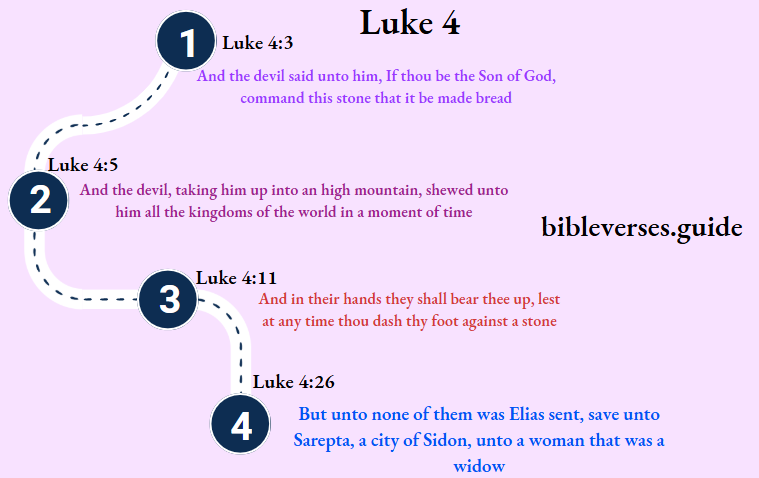
Luke 4:1 And Jesus being full ofthe Holy Spirit returned from Jordan, and was led by the Spirit into the wilderness,

Luke 4:2 Being forty days tempted of the devil. And in those days he did eat nothing: and when they were ended, he afterward hungered.

Luke 4:4 And Jesus answered him, saying, It is written, That man shall not live by bread alone, but by every word of God.

Luke 4:6 And the devil said unto him, All this power will I give thee, and the glory of them: for that is delivered unto me; and to whomsoever I will I give it.

Luke 4:7 If thou therefore wilt worship me, all shall be thine.

Luke 4:8 And Jesus answered and said unto him, Get thee behind me, Satan: for it is written, Thou shalt worship the Lord thy God, and him only shalt thou serve.

Luke 4:9 And he brought him to Jerusalem, and set him on a pinnacle of the temple, and said unto him, If thou be the Son of God, cast thyself down from hence:

Luke 4:10 For it is written, He shall give his angels charge over thee, to keep thee:

Luke 4

Luke 4:12 And Jesus answering said unto him, It is said, Thou shalt not tempt the Lord thy God.

Luke 4:13 And when the devil had ended all the temptation, he departed from him for a season.

Luke 4:14 AndJesus returned in the power ofthe Spirit into Galilee: and there went out a fame of him through all the region round about.

Luke 4:15 And he taught in their synagogues, being glorified of all.

Luke 4:16 If And he came to Nazareth, where he had been brought up: and, as his custom was, he went into the synagogue on the sabbath day, and stood up for to read.

Luke 4:17 And there was delivered unto him the book of the prophet Esaias. And when he had opened the book, he found the place where it was written,

Luke 4:18 The Spirit of the Lord is upon me, because he hath anointed me to preach the gospel to the poor; he hath sent me to heal the brokenhearted, to preach deliverance to the captives, and recovering ofsight to the blind, to set at liberty them that are bruised,

Luke 4:19 To preach the acceptable year of the Lord.

Luke 4:20 And he closed the book, and he gave it again to the minister and sat down. And the eyes of all them that were in the synagogue were fastened on him.

Luke 4:21 And he began to say unto them, This day is this scripture fulfilled in your ears.

Luke 4:22 And all bare him witness and wondered at the gracious words which proceeded out of his mouth. And they said, Is not this Joseph’s son?

Luke 4:23 And he said unto them, Ye will surely say unto me this proverb, Physician, heal thyself: whatsoever we have heard done in Capernaum, do also here in thy country.

Luke 4:24 And he said, Verily I say unto you, No prophet is accepted in his own country.

Luke 4:25 But I tell you of a truth, many widows were in Israel in the days of Elias when the heaven was shut up three years and six months when great famine was throughout all the land;

Luke 4:27 And many lepers were in Israel in the time of Eliseus the prophet; and none of them was cleansed, saving Naaman the Syrian.

Luke 4:28 And all they in the synagogue, when they heard these things, were filled with wrath,

Luke 4:29 And rose up, and thrust him out ofthe city, and led him unto the brow of the hill whereon their city was built, that they might cast him down headlong.

Luke 4:30 But he passing through the midst of them went his way,

Luke 4:31 And came down to Capernaum, a city of Galilee, and taught them on the sabbath days. 32 And they were astonished at his doctrine: for his word was with power.

Luke 4:33 If And in the synagogue there was a man, which had a spirit of an unclean devil, and cried out with a loud voice,

Luke 4:34 Saying, Let us alone; what have we to do with thee, thou Jesus of Nazareth? art thou come to destroy us? I know thee who thou art; the Holy One of God.

Luke 4:35 And Jesus rebuked him, saying, Hold thy peace, and come out of him. And when the devil had thrown him in the midst, he came out of him and hurt him not.

Luke 4:36 And they were all amazed, and spake among themselves, saying, What a word is this! for with authority and power he commandeth the unclean spirits, and they come out.

Luke 4:37 And the fame of him went out into every place of the country round about.

Luke 4:38 And he arose out of the synagogue, and entered into Simon’s house. And Simon’s wife’s mother was taken with a great fever, and they besought him for her.

Luke 4:39 And he stood over her and rebuked the fever, and it left her: and immediately she arose and ministered unto them.

Luke 4:40 Now when the sun was setting, all they that had any sick with divers diseases brought them unto him; and he laid his hands on every one of them and healed them.

Luke 4:41 And devils also came out of many, crying out, and saying, Thou art Christ the Son of God. And he rebuking them suffered them not to speak: for they knew that he was Christ.

Luke 4:42 And when it was day, he departed and went into a desert place: and the people sought him, and came unto him, and stayed him, that he should not depart from them.

Luke 4:43 And he said unto them, I must preach the kingdom of God to other cities also: for therefore am I sent.

Luke 4:44 And he preached in the synagogues of Galilee.

Luke 3: Repentance, Baptism, And The Path To Christ

Luke 3: Repentance, Baptism, And The Path To Christ

Luke 3:1 Now in the fifteenth year of the reign of Tiberius Caesar, Pontius Pilate being governor of Judaea, and Herod being tetrarch of Galilee, and his brother Philip tetrarch of Ituraea and of the region of Trachonitis, and Lysanias the tetrarch of Abilene,

Luke 3:2 Annas and Caiaphas being the high priests, the word of God came unto John the son of Zacharias in the wilderness.

Luke 3:3 And he came into all the country about Jordan, preaching the baptism of repentance for the remission of sins;

Luke 3:4 As it is written in the book of the words of Esaias the prophet, saying, The voice of one crying in the wilderness, Prepare ye the way of the Lord, make his paths straight.

Luke 3:5 Every valley shall be filled, and every mountain and hill shall be brought low, and the crooked shall be made straight, and the rough ways shall be made smooth;

Luke 3:6 And all flesh shall see the salvation of God.

Luke 3:7 Then said he to the multitude that came forth to be baptized of him, O generation of vipers, who hath warned you to flee from the wrath to come?

Luke 3:8 Bring forth therefore fruits worthy of repentance, and begin not to say within yourselves, We have Abraham to our father: for I say unto you, That God is able of these stones to raise up children unto Abraham.

Luke 3:9 And now also the axe is laid unto the root of the trees: every tree therefore which bringeth not forth good fruit is hewn down, and cast into the fire.

Luke 3:11 He answereth and saith unto them, He that hath two coats, let him impart to him that hath none; and he that hath meat, let him do like wise.

Luke 3

Luke 3:13 And he said unto them, Exact no more than that which is appointed you.

Luke 3:14 And the soldiers likewise demanded of him, saying, And what shall we do? And he said unto them, Do violence to no man, neither accuse any falsely; and be content with your wages.

Luke 3:15 And as the people were in expectation, and all men mused in their hearts of John, whether he were the Christ, or not;

Luke 3:16 John answered, saying unto them all, I indeed baptize you with water; but one mightier than I cometh, the latchet of whose shoes I am not worthy to unloose: he shall baptize you with the Holy Spirit and with fire:

Luke 3:17 Whose fan is in his hand, and he will throughly purge his floor, and will gather the wheat into his garner; but the chaff he will burn with fire unquenchable.

Luke 3:18 And many other things in his exhortation preached he unto the people.

Luke 3:19 But Herod the tetrarch, being reproved by him for Herodias his brother Philip’s wife, and for all the evils which Herod had done,

Luke 3:20 Added yet this above all, that he shut up John in prison.

Luke 3:21 Now when all the people were baptized, it came to pass, that Jesus also being baptized, and praying, the heaven was opened,

Luke 3:22 And the Holy Spirit descended in a bodily shape like a dove upon him, and a voice came from heaven, which said, Thou art my beloved Son; in thee I am well pleased.

Luke 3:23 And Jesus himself began to be about thirty years of age, being (as was supposed) the son of Joseph, which was the son of Heli,

Luke 3:24 Which was the son of Matthat, which was the son of Levi, which was the son of Melchi, which was the son of Janna, which was the son of Joseph,

Luke 3:25 Which was the son of Mattathias, which was the son of Amos, which was the son of Naum, which was the son of Esli, which was the son of Nagge,

Luke 3:26 Which was the son of Maath, which was the son of Mattathias, which was the son of Semei, which was the son of Joseph, which was the son of Juda,

Luke 3:27 Which was the son of Joanna, which was the son of Rhesa, which was the son of Zorobabel, which was the son of Salathiel, which was the son of Neri,

Luke 3:29 Which was the son of Jose, which was the son of Eliezer, which was the son of Jorim, which was the son of Matthat, which was the son of Levi,

Luke 3:30 Which was the son of Simeon, which was the son of Juda, which was the son of Joseph, which was the son of Jonan, which was the son of Eliakim,

Luke 3:31 Which was the son of Melea, which was the son of Menan, which was the son of Mattatha, which was the son of Nathan, which was the son of David,

Luke 3:32 Which was the son of Jesse, which was the son of Obed, which was the son of Booz, which was the son of Salmon, which was the son of Naasson,

Luke 3:33 Which was the son of Aminadab, which was the son of Aram, which was the son of Esrom, which was the son of Phares, which was the son of Juda,

Luke 3:34 Which was the son of Jacob, which was the son of Isaac, which was the son of Abraham, which was the son of Thara, which was theson of Nachor,

Luke 3:35 Which was the son of Saruch, which was the son of Ragau, which was the son of Phalec, which was the son of Heber, which was the son of Sala,

Luke 3:36 Which was the son of Cainan, which was the son of Arphaxad, which was the son of Sem, which was the son of Noe, which was the son of Lamech,

Luke 3:37 Which was the son of Mathusala, which was the son of Enoch, which was the son of Jared, which was the son of Maleleel, which was the son of Cainan,

Luke 2: The Savior Is Born And God’s Plan Unfolds

Luke 2: The Savior Is Born And God’s Plan Unfolds

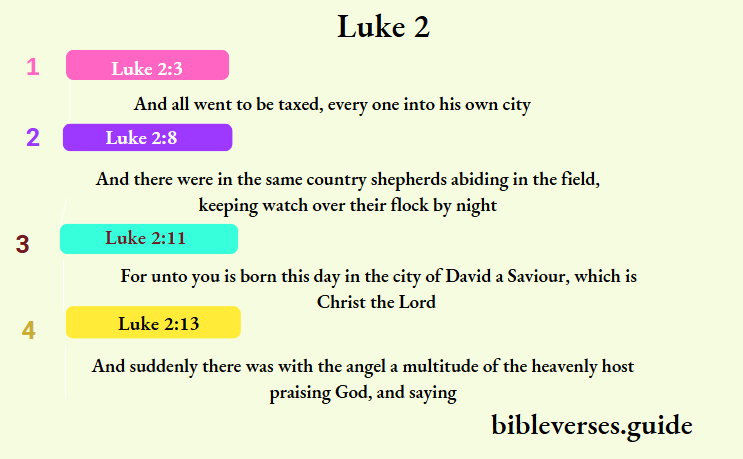
Luke 2:1 And it came to pass in those days, that there went out a decree from Caesar Augustus, that all the world should be taxed

Luke 2:2 (And this taxing was first made when Cyrenius was governor of Syria.)

Luke 2:4 And Joseph also went up from Galilee, out of the city of Nazareth, into Judaea, unto the city of David, which is called Bethlehem; (because he was of the house and lineage of David:)

Luke 2:5 To be taxed with Mary his espoused wife, being great with child.

Luke 2:6 And so it was, that, while they were there, the days were accomplished that she should be delivered.

Luke 2:7 And she brought forth her firstborn son, and wrapped him in swaddling clothes, and laid him in a manger; because there was no room for them in the inn.

Luke 2:9 And, lo, the angel of the Lord came upon them, and the glory of the Lord shone round about them: and they were sore afraid.

Luke 2:10 And the angel said unto them, Fear not: for, behold, I bring you good tidings of great joy, which shall be to all people.

Luke 2:12 And this shall be a sign unto you; Ye shall find the babe wrapped in swaddling clothes, lying in a manger.

Luke 2

Luke 2:14 Glory to God in the highest, and on earth peace, goodwill toward men.

Luke 2:15 And it came to pass, as the angels were gone away from them into heaven, the shepherds said one to another, Let us now go even unto Bethlehem, and see this thing which is come to pass, which the Lord hath made known unto us

Luke 2:16 And they came with haste, and found Mary, and Joseph, and the babe lying in a manger.

Luke 2:17 And when they had seen it, they made known abroad the saying which was told them concerning this child.

Luke 2:18 And all they that heard it wondered at those things which were told them by the shepherds.

Luke 2:19 But Mary kept all these things and pondered them in her heart.

Luke 2:20 And the shepherds returned, glorifying and praising God for all the things that they had heard and seen, as it was told unto them.

Luke 2:21 And when eight days were accomplished for the circumcising of the child, his name was called JESUS, which was so named of the angel before he was conceived in the womb.

Luke 2:22 And when the days of her purification according to the law of Moses were accomplished, they brought him to Jerusalem, to present him to the Lord;

Luke 2:23 (As it is written in the law of the Lord, Every male that openeth the womb shall be called holy to the Lord;)

Luke 2:24 And to offer a sacrifice according to that which is said in the law of the Lord, A pair of turtledoves, or two young pigeons.

Luke 2:25 And, behold, there was a man in Jerusalem, whose name was Simeon; and the same man was just and devout, waiting for the consolation of Israel: and the Holy Spirit was upon him.

Luke 2:26 And it was revealed unto him by the Holy Spirit, that he should not see death, before he had seen the Lord’s Christ.

Luke 2:27 And he came by the Spirit into the temple: and when the parents brought in the child Jesus, to do for him after the custom of the law,

Luke 2:28 Then took he him up in his arms, and blessed God, and said,

Luke 2:29 Lord, now lettest thou thy servant depart in peace, according to thy word:

Luke 2:30 For mine eyes have seen thy salvation,

Luke 2:31 Which thou hast prepared before the face of all people;

Luke 2:32 A light to lighten the Gentiles and the glory of thy people Israel.

Luke 2:33 And Joseph and his mother marvelled at those things which were spoken of him.

Luke 2:34 And Simeon blessed them and said unto Mary his mother, Behold, this child is set for the fall and rising again of many in Israel; and for a sign which shall be spoken against;

Luke 2:35 (Yea, a sword shall pierce through thy own soul also,) that the thoughts of many hearts may be revealed.

Luke 2:36 And there was one Anna, a prophetess, the daughter of Phanuel, of the tribe of Aser: she was of a great age, and had lived with an husband seven years from her virginity;

Luke 2:37 And she wets a widow of about fourscore and four years, which departed not from the temple, but served God with fastings and prayers night and day.

Luke 2:38 And she coming in that instant gave thanks likewise unto the Lord, and spake of him to all them that looked for redemption in Jerusalem.

Luke 2:39 And when they had performed all things according to the law of the Lord, they returned into Galilee, to their own city Nazareth.

Luke 2:40 And the child grew, and waxed strong in spirit, filled with wisdom: and the grace of God was upon him.

Luke 2:41 Now his parents went to Jerusalem every year at the feast ofthe passover.

Luke 2:42 And when he was twelve years old, they went up to Jerusalem after the custom of the feast.

Luke 2:43 And when they had fulfilled the days, as they returned, the child Jesus tarried behind in Jerusalem; and Joseph and his mother knew not of it.

Luke 2:44 But they, supposing him to have been in the company, went a day’s journey; and they sought him among their kinsfolk and acquaintance.

Luke 2:45 And when they found him not, they turned back again to Jerusalem, seeking him.

Luke 2:46 And it came to pass, that after three days they found him in the temple, sitting in the midst of the doctors, both hearing them, and asking them questions.

Luke 2:47 And all that heard him were astonished at his understanding and answers.

Luke 2:48 And when they saw him, they were amazed: and his mother said unto him, Son, why hast thou thus dealt with us? behold, thy father and I have sought thee sorrowing

Luke 2:49 And he said unto them, How is it that ye sought me? wist ye not that I must be about my Father’s business?

Luke 2:50 And they understood not the saying which he spake unto them.

Luke 2:51 And he went down with them, and came to Nazareth, and was subject unto them: but his mother kept all these sayings in her heart.

Luke 2:52 And Jesus increased in wisdom and stature, and in favour with God and man.

Luke 1: Trusting God’s Promises And Embracing His Plan

Luke 1: Trusting God’s Promises And Embracing His Plan

Luke 1:1 Forasmuch as many have taken in hand to set forth in order a declaration of those things which are most surely believed among us,

Luke 1:2 Even as they delivered them unto us, which from the beginning were eyewitnesses and ministers of the word;

Luke 1:3 It seemed good to me also, having had perfect understanding of all things from the very first, to write unto thee in order, most excellent Theophilus,

Luke 1:5 THERE was in the days of Herod, the king of Judaea, a certain priest named Zacharias, of the course of Abia: and his wife was of the daughters of Aaron, and her name was Elisabeth.

Luke 1:6 And they were both righteous before God, walking in all the commandments and ordinances of the Lord blameless.

Luke 1:7 And they had no child, because that Elisabeth was barren, and they both were now well stricken in years.

Luke 1:8 And it came to pass, that while he executed the priest’s office before God in the order of his course,

Luke 1:10 And the whole multitude of the people were praying without at the time of incense.

Luke 1:12 And when Zacharias saw him, he was troubled, and fear fell upon him.

Luke 1:13 But the angel said unto him, Fear not, Zacharias: for thy prayer is heard; and thy wife Elisabeth shall bear thee a son, and thou shalt call his name John.

Luke 1:14 And thou shalt have joy and gladness, and many shall rejoice at his birth.

Luke 1:15 For he shall be great in the sight of the Lord, and shall drink neither wine nor strong drink; and he shall be filled with the Holy Spirit, even from his mother’s womb.

Luke 1:16 And many of the children of Israel shall he turn to the Lord their God.

Luke 1:17 And he shall go before him in the spirit and power of Elias, to turn the hearts of the fathers to the children, and the disobedient to the wisdom of the just; to make ready a people prepared for the Lord.

Luke 1

Luke 1:19 And the angel answering said unto him, I am Gabriel, that stand in the presence of God; and am sent to speak unto thee, and to shew thee these glad tidings.

Luke 1:20 And, behold, thou shalt be dumb, and not able to speak, until the day that these things shall be performed because thou believest not my words, which shall be fulfilled in their season.

Luke 1:21 And the people waited for Zacharias and marvelled that he tarried so long in the temple.

Luke 1:22 And when he came out, he could not speak unto them: and they perceived that he had seen a vision in the temple: for he beckoned unto them, and remained speechless.

Luke 1:23 And it came to pass, that, as soon as the days of his ministration were accomplished, he departed to his own house.

Luke 1:24 And after those days his wife Elisabeth conceived, and hid herself five months, saying,

Luke 1:25 Thus hath the Lord dealt with me in the days wherein he looked on me, to take away my reproach among men.

Luke 1:26 And in the sixth month the angel Gabriel was sent from God unto a city of Galilee, named Nazareth,

Luke 1:27 To a virgin espoused to a man whose name was Joseph, of the house of David; and the virgin’s name was Mary.

Luke 1:28 And the angel came in unto her, and said, Hail, thou that art highly favoured, the Lord is with thee: blessed art thou among women.

Luke 1:29 And when she saw him, she was troubled at his saying, and cast in her mind what manner of salutation this should be.

Luke 1:30 And the angel said unto her, Fear not, Mary: for thou hast found favour with God.

Luke 1:31 And, behold, thou shalt conceive in thy womb, and bring forth a son, and shalt call his name JESUS.

Luke 1:32 He shall be great and shall be called the Son of the Highest: and the Lord God shall give unto him the throne of his father David:

Luke 1:33 And he shall reign over the house of Jacob forever; and of his kingdom there shall be no end.

Luke 1:34 Then said Mary unto the angel, How shall this be, seeing I know not a man?

Luke 1:35 And the angel answered and said unto her, The Holy Spirit shall come upon thee, and the power of the Highest shall overshadow thee: therefore also that holy thing which shall be born of thee shall be called the Son of God.

Luke 1:36 And, behold, thy cousin Elisabeth, she hath also conceived a son in her old age: and this is the sixth month with her, who was called barren.

Luke 1:37 For with God nothing shall be impossible.

Luke 1:38 And Mary said, Behold the handmaid of the Lord; be it unto me according to thy word. And the angel departed from her.

Luke 1:39 And Mary arose in those days, and went into the hill country with haste, into a city of Juda;

Luke 1:40 And entered into the house of Zacharias, and saluted Elisabeth.

Luke 1:41 And it came to pass, that, when Elisabeth heard the salutation of Mary, the babe leaped in her womb; and Elisabeth was filled with the Holy Spirit:

Luke 1:42 And she spake out with a loud voice, and said, Blessed art thou among women, and blessed is the fruit of thy womb.

Luke 1:43 And whence is this to me, that the mother of my Lord should come to me?

Luke 1:44 For, lo, as soon as the voice of thy salutation sounded in mine ears, the babe leaped in my womb for joy.

Luke 1:45 And blessed is she that believed: for there shall be a performance of those things which were told her from the Lord.

Luke 1:46 And Mary said, My soul doth magnify the Lord,

Luke 1:47 And my spirit hath rejoiced in God my Saviour.

Luke 1:48 For he hath regarded the low estate of his handmaiden: for, behold, from henceforth all generations shall call me blessed.

Luke 1:49 For he that is mighty hath done to me great things; and holy is his name.

Luke 1:50 And his mercy is on them that fear him from generation to generation.

Luke 1:51 He hath shewed strength with his arm; he hath scattered the proud in the imagination of their hearts.

Luke 1:52 He hath put down the mighty from their seats, and exalted them of low degree.

Luke 1:53 He hath filled the hungry with good things; and the rich he hath sent empty away.

Luke 1:54 He hath holpen his servant Israel, in remembrance of his mercy;

Luke 1:55 As he spake to our fathers, to Abraham, and to his seed forever.

Luke 1:56 And Mary abode with her about three months, and returned to her own house.

Luke 1:57 Now Elisabeth’s full time came that she should be delivered; and she brought forth a son.

Luke 1:58 And her neighbours and her cousins heard how the Lord had shewed great mercy upon her; and they rejoiced with her.

Luke 1:59 And it came to pass, that on the eighth day they came to circumcise the child; and they called him Zacharias, after the name of his father.

Luke 1:60 And his mother answered and said, Not so; but he shall be called John.

Luke 1:61 And they said unto her, There is none of thy kindred that is called by this name.

Luke 1:62 And they made signs to his father, how he would have him called.

Luke 1:63 And he asked for a writing table, and wrote, saying, His name is John. And they marvelled all.

Luke 1:64 And his mouth was opened immediately, and his tongue loosed, and he spake, and praised God.

Luke 1:65 And fear came on all that dwelt round about them: and all these sayings were noised abroad throughout all the hill country of Judaea

Luke 1:66 And all they that heard them laid them up in their hearts, saying, What manner of child shall this be! And the hand ofthe Lord was with him.

Luke 1:67 And his father Zacharias was filled with the Holy Spirit, and prophesied, saying,

Luke 1:68 Blessed be the Lord God of Israel; for he hath visited and redeemed his people,

Luke 1:69 And hath raised up an horn of salvation for us in the house of his servant David;

Luke 1:70 As he spake by the mouth of his holy prophets, which have been since the world began:

Luke 1:71 That we should be saved from our enemies, and from the hand of all that hate us;

Luke 1:72 To perform the mercy promised to our fathers, and to remember his holy covenant;

Luke 1:73 The oath which he sware to our father Abraham,

Luke 1:74 That he would grant unto us, that we being delivered out of the hand of our enemies might serve him without fear,

Luke 1:75 In holiness and righteousness before him, all the days of our life.

Luke 1:76 And thou, child, shalt be called the prophet of the Highest: for thou shalt go before the face of the Lord to prepare his ways;

Luke 1:77 To give knowledge of salvation unto his people by the remission of their sins

Luke 1:78 Through the tender mercy of our God; whereby the day spring from on high hath visited us,

Luke 1:79 To give light to them that sit in darkness and in the shadow of death, to guide our feet into the way of peace.

Luke 1:80 And the child grew, and waxed strong in spirit, and was in the deserts till the day of his shewing unto Israel.

The Interior Life of Daniel O’Connell:

The Interior Life of Daniel O’Connell: Part 2

Last month we left off the story of Daniel O’Connell with his manage to Mary, and we mentioned the strength of her faith. When campaigning took Daniel away from home, Mary would write to him, and she wasn’t afraid to express her faith in those letters. She often promised her prayers for him, but of course Daniel, as a deist, couldn’t reciprocate. In one very revealing letter sent when she was very sick a year into their marriage, he wrote ‘Mary, sweet Mary, I cannot live without you. You are my life, my comfort. If I were a religionist I should spend every moment in praying for you and this miserable philosophy which I have taken up and been proud of in place of religion, affords me now no consolation in my misery’. He couldn’t bring himself to pray for her, but it seems he wished he could.

In later letters, written when O’Connell actually reluctantly began to attend the liturgy again, he referred jokingly to the ‘sermons’ Mary sent him. On one occasion, at the start of Holy Week, she wrote to remind him not to eat meat, and to go to prayers on Good Friday. Even the judges will have a day off that day, she wrote. She went on, ‘You see, heart, how good I want you to be’. Daniel replied, ‘I got your sermon last night and am condemned to catfish, nothing but fish for more than a week.

By 1815 O’Connell’s faith seems to have deepened further. One factor in this may have been his profound remorse over the killing of an opponent in a duel. John Norcott d’Estere who had taken issue with O’Connell’s description of the Dublin Corporation as ‘beggarly’ (a retaliation for an earlier anti-Catholic resolution) bled to death two days after their encounter. This moment haunted O’Connell and is likely to have led him to more sustained conversation with his God, not just the God of nature, but the God of justice and mercy, the Saviour.

Now, for the first time, he took on a spiritual director, a Carmelite; he began to observe the Lenten fast, and his days of freemasonry were long gone. Progressively from this point O’Connell became more confidently Catholic in his convictions, defending transubstan- tiation in debates with Protestants, for example.

He remained a figure of the left, inspired by Enlightenment ideals, but he was actively synthesising these ideals with his Catholic convictions and practices. His opposi- tion to the death penalty and slavery and his support of rights for Jews was consistent, O’Connell was con-vinced, with his devotion to the sacraments, and personal prayer, and the papacy.

A Deepening of Faith

More controversially, he favoured a dear separation between church and state, but he no longer did so out of opposition to the Church. He thought it would lead to a healthier Church as well as a healthier State. In all this O’Connell was allied with the movement known across Europe as Liberal Catholicism, which sought to renew the Church with the best of modem political and social thought. He was seen as a leader and a pioneer within this European movement. The example of his life and work was praised in Notre-Dame cathedral by one of the spokesmen of the Liberal Catholic movement, the Dominican friar, Henri Lacordaire.

Leo 12, a great admirer of O’Connell, would adopt in his social encyclicals many of the concems of revolutionaries as the Church’s own concems.

For the last 10 years of his life Daniel O’Connell laboured without the support of his beloved wife, who had died in 1836. In her absence, his faith was only strengthened. He went on retreat in Mount Melleray at which he wrote down some new commitments: to pray the ‘Memorare’ every day, and to spend half an hour in meditation each day. He attended daily Mass and was seen by his adoring fans praying the Rosary, going to confession, and receiving communion.

O’Connell’s rediscovered faith nourished him right to the end. As he lay dying in Genoa, in 1847, he asked that his body be brought back to Ireland and his heart to Rome, as a pilgrim. His mortalremains may have been separated in this way, but his life was one of synthesis: the synthesis of political goals with political power; the synthesis of national concems and interational concems, and the synthesis of faith and reason. But all this was made possible by a life of devotion rebuilt from the ruins by the love of his wife.

Aglona Basilica: Mary’s House In Latvia

Last month we visited the Divine Mercy sites in Vilnius, Lithuania. While you may be familiar with Vilnius, I can safely say you have never heard of this month’s pilgrimage site! Nestled in the serene countryside of Latvia, about a three hour drive northeast of Vilnius, the Basilica of the Assumption of the Blessed Virgin Mary, Aglona [Ag-lone-a] is a remarkable architectural and spiritual wonder. While Lithuania is predominantly Catholic, Latvia is predominantly Lutheran, so the large-scale Marian site is unique. Over the centuries, it has become a central place of pilgrimage, drawing thousands annually in honour of Our Lady.

The story of Aglona Basilica be gan in the late 17th century when Dominican friars arrived in this remote region to establish a monastery. Their mission was to strength- en the Catholic faith in the region during a time of political and religious turmoil. In 1699, the monks began constructing a church dedicated to the Assumption of the Blessed Virgin Mary. Their devotion laid the foundation for what would become Latvia’s most cherished Catholic shrine.

The current Baroquestyle basilica, completed in 1780, stands as a testament to this enduring faith. Its twin towers, soaring to 60 meters, dominate the surrounding landscape and invite pilgrims from afar. The church’s exterior exudes an aura of majesty and peace, the interior captivating visitors with its ornate altars, intricate carvings, and serene beauty.

A Symbol of Hope Aglona gained prominence as a pilgrimage site due to the Miraculous Icon of Our Lady of Aglona. This revered 17th-century depiction of the Blessed Virgin Mary, became a source of inspiration and hope for countless faithful. Over time, mira des attributed to this icon have further strengthened the devotion sur rounding it.

The Feast of the Assumption, celebrated every August 15, is the highlight of Aglona’s significance. On this day, tens of thousands of pilgrims from Latvia make their way to the shrine. Like similar celebrations in Knock, Lourdes or Fatima the event is marked by prayer, the Sacrament of Reconciliation, Mass and a solemn Eucharistic procession.

The basilica’s history minors Latvia’s tumultuous past. Despite threats of closure during Soviet occupation Aglona remained a symbol of resilience and hope. Pilgrims continued to visit, often risking persecution, to uphold their Catholic faith.

A significant moment in Aglona’s history occured in 1993 when Pope Saint John Paul II visited the basilica during his pastoral joumey to the Baltic States. His presence reaffirmed the basilica’s importance as a spiritual and cultural comerstone. The basilica was granted the status of a Minor Basilica in 1980 a brave move considering it was still in communist times – on its 200th anniversary, further solidifying its role in the global Catholic community.

Today, the Basilica of Aglona stands not only as a historical and architectural treasure but also as a living testament to faith In a world often marked by secularism and spiritual disconnection, it calls pilgrims to deepen their relationship with Mary and, through her intercession, draw closer to Christ.

As Pope John Paul II said during his visit, “This basilica, a sign of your faith and perseverance, is a reminder that Mary, the Mother of God, walks with us on our joumey of life.” These words capture the essence of Aglona’s significance a sacred place where heaven and earth meet, offering hope and renewal to all who come with faith- filled hearts. It truly is a hidden gem.

Married Saints

Eizabeth of Hungary was born in 1207 to Andrew those times, many marriages were arranged for political reasons, especially among Catholic royalty and the young Elizabeth was only four when she was betrothed to her future husband Louis who was heir to the duchy of Thuringa. Following that decision about her future, she was moved to Germany where she was brought up with Louis by his mother, her future mother-in-law, Countess Sophia who instilled n’er young war’ regious values and deep personal piety. During their childhood years Elizabeth and Louis became best friends which was an ideal preparation for their married life.

In 1221, when she was fourteen and he twenty-one the young couple married. They returned to her native land for their honeymoon and eventually resided in Wartburg, Germany. It was said that the couple could not bear to be parted from one another for a long time or by a great distance. Therefore, Elizabeth frequently followed her husband along rough roads, on lengthy journeys often in bad weather.

The Queen worked tirelessly to relieve the suffering of the poor and infirm, although the expenses incurred by her charitable ventures initially vexed her husband. He also did not consider it proper for her status as a member of royalty. Once when he took her to task about her activities a basket of roses she was carrying was changed miraculously into a basket of bread. After witnessing this he was convinced of the worthiness of her kind endeavours and from that time onwards he supported her completely and shared her prayer life.

Despite pressure from some in his inward circle to be unfaithful to his wife, Louis once said, “Let people say what they will, but I say it dearly: Elizabeth is very dear to me, and I have nothing more precious on this earth.” In 1227 Louis went on a Crusade, fell victim to the plague and died in Otranto. Elizabeth had just given birth to her third child and second daughter. She was at first incredulous, then distraught almost to the point of insanity and cried aloud, “It is to me as if the whole world died today.” Elizabeth went on to found a hospital and spent the remainder of her short life ministering to the poor and wearing the habit of a Franciscan tertiary. She died aged twenty-four and was canonised in 1235.

Imagine a time before the internet, before instant access to information. In the town in Ireland where I live, knowledge came in the form of books housed within the grand stone walls of the Skemies Camegie Library. The Library is more than just a building it is a monument to the power of knowledge and a symbol of Ireland’s evolving relationship with education in the early twentieth Andrew Carnegie century. Built in 1910 with funding from Scottish-American philanthropist Andrew Camegie, it was one of the many libraries established across Ireland as part of his ambitious vision to make books and leaming accessible to all.

Andrew Carnegie’s Vision

Andrew Camegie was bom in 1835 in Scotland and emigrated to the United States in 1848. Rising from humble beginnings, he became one of the wealthiest men in the world through his ventures in the steel industry. After making his fortune, Camegie tumed his focus to philanthropy. He believed in the power of education and self improvement. His famous essay, ‘The Gospel of Wealth’ (1889), argued that the wealthy had a moral obligation to use their fortunes for good. He saw libraries as “palaces for the people,” places where individuals could educate themselves and better their lives.

In 1881, Camegie’s vision for public libraries began to take shape when he established his first library in Dunfermline, Scotland. In 1883, he launched a Grant program to fund the establishment of public libraries across the United States. His philosophy was simple: if communities could demonstrate a commitment to establish a library, he would provide the necessary fund ing for its construction. Cities and towns that wished to receive funding for a library had to meet specific conditions; provide a building site, agree to contribute 10 per cent of the construction cost annually for maintenance, and ensure that the library would be free and open to the public His funding model encour- aged communities to take ownership of their libraries, ensuring their long-term sustainability.

By 1929, he had funded the construction of over 2,500 libraries worldwide, with more than 1,600 of these located in the United States. These libraries played a crucial role in expanding access to knowledge and fostering literacy, particularly in small towns and communities that previously lacked such resources.

Carnegie Movement in Ireland

Carnegie’s first Library established in have begun in the United States but quickly spread to other countries, including Ireland. His major funding for libraries on the Island of Ireland began around 1897, however, most libraries were built in the early twentieth century. Ultimately, 66 libraries were built, primarily between 1900 and 1922; sixty-two of them have survived. While most of the Camegie libraries were built in cities and larger towns such as in Dublin, Belfast, Limerick, Keny, and Waterford, various smaller rural communities across Ireland also received funding including my home town of Skemies.

Although the money that Camegie gave for Irish libraries was small in proportion to his total expenditure it greatly helped the library movement in Ireland where Camegie libraries quickly became essential community resources. His funding provided communities with free access to books, educational materials, and public services, playing a crucial role in promoting literacy and education during a crucial period of Ireland’s history. The libraries offered various programs, including reading groups, education al workshops, and children’s story times, fostering a love for reading and leaming among residents.

In many towns, the libraries served as cultural hubs, organising events and activities that brought people together. They offered a space for community discussions, lectures, and even social gatherings, reinforcing the idea that libraries are not just places for solitary study but vibrant centres of community life.

Today, Camegie libraries in Ire land stand as a testament to Andrew Camegie’s vision of accessible education and community empowerment, continuing to serve as vital resources. Many of the original buildings have been preserved and continue to function as libraries, while others have found new uses, reflecting the evolving needs of their communities.

Architectural Characteristics Camegie libraries were designed to be more than just repositories for books; they were meant to symbolise leaming, democracy, and com- munity development. Architects often incorporated grand facades, Greek and Roman-inspired columns and domes, giving these libraries the monumental feel of civic buildings like courthouses and govenment halls.

One of the most revolutionary aspects of Camegie libraries was their openaccess design. Before Camegie’s influence, books were often kept behind closed doors or required a librarian’s assistance to retrieve. Camegie insisted on spacious reading rooms, central halls with open shelving, and ample natural light. Many libraries followed a rectangular or T -plan with reading rooms flanking a central circulation area, creating an efficient yet welcoming atmosphere.

The architectural design of Camegie libraries in Ireland varies, reflecting local styles and the com- munities they serve. Many of these libraries were constructed in the dassical style, especially those in larger cities. The façade of the libraries often included stone carvings, large windows, and impres sive entrances, making them prominent landmarks within their towns. Notable examples include the Camegie Library in Carrickfergus, which opened in 1906, and the Dun Laoghaire Camegie Library, also completed in 1906.

Today, Camegie libraries remain architectural and cultural land marks in the places they were built, reflecting an era when libraries became truly public institutions. Their distinctive designs, civic grandeur, and functional layouts influenced the evolution of modem library architecture. Many of the original buildings have been pre served and continue to function as libraries, while others have found new uses, reflecting the evolving needs of their communities.

Legacy and Modern Relevance The legacy of Camegie libraries continues to this day. Although some of the original buildings have been repurposed or closed, many still serve their communities as vibrant centres for leaming and engagement. The model of public library funding that Camegie established has influenced library systems worldwide, promoting the idea that access to knowledge is a fundamental right.

In recent years, many Camegie libraries have adapted to the digital age, expanding their offerings to include online resources, technology training, and community programs that address the evolving needs of their patrons. They remain essential in promoting literacy, providing access to information, and fostering a sense of community.

The history of Camegie libraries is a testament to the power of philanthropy and the belief in the trans- formative potential of education. Andrew Camegie’s vision of creating accessible spaces for leaming has left an indelible mark on communities across the globe, ensuring that libraries continue to play a crucial role in fostering knowledge and empowerment for generations to come.

Famous Converts John Dryden

If you were to stop a random person on the street today and ask them what they knew about William Wordsworth, what would they say?

They might answer that he wrote “Daffodils” or even quote its first line: “I wandered lonely as a cloud”. If we were to ask the same person about Alfred Lord Tennyson, they might remember that he wrote “The Charge of the Light Brigade”. If we went on to ask about Sir John Betjeman, there’s a good chance our man on the street might mention Betje man’s satirical poem “Slough” or even recite its opening words: “Come friendly bombs, and fall on Slough”

But if we were to ask the same person about John Dryden (1631- 1700), it’s very likely that we would get a blank look.

And yet Dryden is generally considered one of the giants of English poetry, and he shares something in common with all the poets named above: he was Poet Laureate of the United Kingdom. In fact, John Dryden was the first Poet Laureate. He’s still the only Poet Laureate to have been removed from the position, which happened when he became a Catholic in his mid fifties.

So why is Dryden so little known today, compared to other eminent British poets?

To a great extent, it’s because of the sort of poetry he wrote. In Dryden’s time, the “heroic couplet’ was the standard format of English verse. For an example, we can take the first lines of his poem “To The Memory of Mr Oldham”:

Farewell, too little and too lately known, Whom I began to think and call my own; For sure our souls were near allied, and thine Cast in the same poetic mould with mine.

This kind of verse strikes us today as elegant, urbane and sophisticated. But when heroic couplets continue for page after page (as they generally did) the modem reader quickly tires of them and finds them monotonous.

As well as this, Dryden’s poetry tends to be aimed at the intellect rather than the emotions, and to assume a knowledge of classical mythology and the Bible that most of us don’t have today.

And yet Dryden retains an important place in literary history, not only for his own writings but also for his appreciation of other poets. He summed up Chaucer’s Canterbury Tales in the immortal phrase, “Here is God’s plenty”, and he also helped solidify the reputations of William Shakespeare and John Milton.

A Public Figure

John Dryden’s conversion to Catholicism is a fascinating story, one set against a background of religious turbulence in Britain. But first, let’s take a brief look at his life.

He was born to a Puritan family in 1631. The English Civil War and the execution of King Charles I both occurred during his childhood. (John himself seems to have inherited a lifelong suspicion of priests from his Puritan family.) He began his career as a secretary in Oliver Cromwell’s government. When the monarchy was restored in 1660, Dryden found favour with King Charles II, who appointed him as the first Poet Laureate. He also had consider- able success as a play wright.

Dryden was very much a public figure. This was the era of the coffeehouse and the pamphlet, a time of impassioned debate and controversy, and the Poet Laureate was the target of much satire and criticism. Although he was slow to react, and was known for his good humour, Dryden would sometimes respond with biting satire him self.

In 1686, King Charles II passed away and was succeeded by his brother James a Catholic. This brought religious controversy to a fever pitch in England. There had been several attempts in Parliament to exclude James from the succession to the throne, but none had succeeded. Given the extensive powers of the monarch at this time, it seemed possible England might become a Catholic country again.

It was at this moment that Dryden chose to convert to Catholicism. The timing of his decision led to accusations (both at the time and in the centuries since) that he was simply seeking favour with the new King. However, when King James was deposed by the Protestant King William of Orange three years later, Dryden remained loyal to his new faith. He also refused to take the Oath of Allegiance to the new King, thereby losing his position as Poet Laureate.

Dryden’s change of religion was announced in his long poem The Hind and the Panther, a pro- longed allegory in which the hind (a female deer) represents the Catholic Church, and the panther represents the Church of England.

In the course of the poem, the two creatures engage in a debate on religious truth and recent English history. Dryden makes many arguments in the poem, but the most important centres on the Bible. The Protestant reformers had claimed that the Bible was the source of all religious truth. However, by the time the poem was written, many new and dashing Christian sects had grown up in Britain (and elsewhere) each daiming to take their teaching from the Bible. It seemed clear to Dryden that some other authority was required to interpret the Bible, an authority he found in the Catholic Church.

The Hind and the Panther provoked much controversy and even ridicule, but it stands today as a classic of religious poetry. John Dryden died in 1700, and one of his sons went on to become a Catholicriest.

Queen Of The Impossible

Politics was the only art that Pontius Pilate ever knew. He had successfully climbed the ladder of ancient Rome’s cutthroat bureaucracy and secured a comfortable position as govemor of Judaea. Albeit his political relationship with the powerful Herod Antipas was hos tile, he managed the affairs of Judaea with an outstanding political deftness. So expedient was his political acumen that he had encountered no significant challenges to his career or the stability of those provinces under his authority. That was, of course, until a certain Friday moming just before the Jewish Passover, when a raucous crowd presented him with Jesus of Nazareth in chains. Pilate quickly realised that this man was innocent, yet it soon became clear to him that nothing but death would sate this bloodthirsty rabble. ‘Crucify him, crucify him,’ they demanded (Luke 23:21). Pilate found himself in an impossible situation: Condemn an innocent man to death or watch his province conflagrate in riot.

Defening to his old instincts, he contrived a political ploy. He used Jewish custom against the Jews themselves, promising to release one man for them at Passover. He hoped that he could possibly dis- pose of this problem with a com- promise. But the mob wanted Barab’bas, not the Nazarene King. The Jewish leaders could smell Pilate’s vacillation. They used his own ambition against him and played the same game of politics: ‘If you release this man, you are not Caesar’s friend,’ they chided (John 19:12). As soon as Caesar was introduced into the political gambit, our Lord’s fate was sealed: He would be crucified on a compromise; crucified because of politics. Pilate recognised the possibility of ‘satisfy[ing] the crowd,’ restoring peace to his dominion, and mending his relationship with Herod (Mark 15:15). Life, for Pilate, was about politics, and politics was the art of the possible.

Queen Of The Impossible

All the while, the Mother of God looked on as her divine Son was being used as a bargaining chip between Rome and Jerusalem. Truth itself was nowa slogan in the flippant words of Pilate, ‘What is truth? (John 18:38), and the value of Life itself was at the whims of democracy. Justice was trampled upon in this cauldron of anarchy, and mercy was silenced by autocracy. Our Lady knew in her immacu late heart that this was all a ruse for the sake of what was possible amidst a seemingly impossible situation.

Yet, perhaps our Lady looked upon Pilate with pity, since she too, as a young virgin, was also faced with a seeming impossibility. When the angel Gabriel announced to her that she would conceive and ‘beara son,’ she understood that Gabriel’s proposition was humanly speaking impossible, she did ‘not know man,’ remaining chaste and virginal throughout her life. Unlike Pilate, however, the Blessed Virgin Mary was not willing to compromise with God’s messenger by offering her flesh to the will of men; instead, with gentle trust, she asked, ‘how shall this be? (Luke 1:31, 34).

Our Lady had such immaculate faith and fervent piety that she knew how God would prevail in this seemingly impossible circum stance. God had created the cosmos from nothing and had saved Daniel from the lion’s den, whilst David slayed Goliath ‘in the name of the Lord of hosts’ (1 Samuel 17:45). Our Lady had surely memorised the law, the writings, and the prophets better than those Jewish leaders who would persecute her Son, and could see the hand of God threading the fine details of Israel’s history. ‘Ah Lord God […] Nothing is too hard for you,’ the prophet Jere miah once prayed (Jeremiah 32:17); it was now left to the queen of the prophets to respond to the angelic salutation likewise, ‘let it be to me according to your word’ (Luke 1:38).

The Art of the Impossible

When God permits suffering and removes the comforts of this world even those spiritual comforts from our senses or souls, we are plunged into a spiritual darkness from which an escape seems not just unlikely, but impossible. These moments of turmoil are harsh reminders that ‘we walk by faith, not by sight (2 Corinthians 5:7). Our fallen natures seem, like Pilate’s, to instinctively choose the possible; to indulge the concupiscence of the flesh, instead of fighting against temptation, to amass the wealth of this world, and to compromise the truth of Christ for the lies of the devil.

True faith reminds us that, throughout salvation history, God has proven his ability to make that which is impossible to man into something ‘possible with God’ (Mark 10:27). God’s grace inspires our souls to faithfully and prayerfully beg God for his divine assistance in every difficult situation, to firmly hope that he will ‘deliver [us] from the snare of the fowler,’ and to grant us the required grace to cooperate in our deeds out of love for him (Psalm 91:3). In every seemingly impossible situation, we have God’s holy Mother to teach us with absolute certainty that if we act ‘with God,’ then ‘nothing will be impossible’ (Luke 1:37). Our Lady’s matemal love nurtures us with the aspiration to blindly follow God throughout our lives along the welltrodden paths of faith and gracefully perfect this virtue, which teaches us nothing else than the art of the impossible.

Pauline Jaricot

Marie Therese Cryan

Pauline Marie Jaricot, was bom in Lyon, France on 22 July 1799, the youngest of seven children. In spite of the rampant per- secution of religion in the country prior to this, Pauline’s parents Antoine and Jeanne were devout Catholics.

The family were also prosperous silk merchants and initially Pauline was torn between moments of intense prayer and her participation in the “dashing bourgeoisie life of the silk world”. Her desire to spend long periods in church before the Blessed Sacrament, was equally challenged by her participation in café society. She was a beautiful singer, and her father called her, “My Nightingale”, to which her mother added “from Paradise.” Asa teenager the very popular girl served as a lady-in-waiting to the Duchess of Angoulere. She was loved on the social scene, an ele gant dresser admired and courted by many young men. It was natural for her to fantasise about the romantic possibility of an idyllic manage.

However, things changed drastically after a fall from a high stool which affected her speech and left her semi-paralysed. The sad deaths of her brother Narcisse and her mother which followed led her to a period of intense introspection and deepened her spiritual commitment. This increased in intensity when she heard a sermon about the topic of vanity which impressed her so deeply that she returned home and burned her romantic novels and songs. She also sold her jewellery, gave the money to the poor and vowed to herself that she would never look in the minor again.

Her Missions

One day while praying Pauline had a vision of two lamps. One had no oil; the other was overflowing and from its abundance poured oil into the empty lamp. To Pauline the drained lamp signified the faith in her native France, still reeling from the turbu lence of the French Revolution. The full lamp represented the great faith of Catholics in the Missions. It was opportune that at this time her brother Phileas, who was studying at a seminary in Paris asked his sister to raise funds for the Paris Foreign Missions Society, which wanted to send priests to Asia. Pauline’s creative mind was to chan- ge the history of fundrais ing in the Church.

Her innovative idea of groups and group leader- ship aligned to a decimal system of 10s, 100s and 1000s took shape. She gathered workers in her family’s silk factory into “circles of 10”. Everyone in the group pledged to pray daily for the Missions and to offer each week a sou, the equivalent of a penny. Each member also found 10 friends to do the same. Within a year she had 400 workers enrolled; soon there would be 2,000. Pauline was the match that lit the fire of the Society for the Propagation of the Faith. Little did she know when she first set it up that it would become the largest aid agency for the Missions in the entire history of the Catholic Church.

There was more to follow when she became aware that a real mission field lay doser to home in her own town where most of the people had little or no prayer life and very little knowledge of the faith Believing that it was only the Rosary which could tum a radically secular society back to Jesus she founded the Association of the Living Rosary to reevangelise people in groups of 15. This system divided the 15 decades of the rosary among 15 people, each re citing one decade and made the rosary more accessible while fostering a sense of communal prayer Her Living Rosary soon became a worldwide phenomenon. By the time she died there were more than two million devotees of the Living Rosary in France alone.

Success and Betrayal Concerned for the wellbeing of young girls in Lyon, Pauline then founded a community that she called ‘The Daughters of Mary’ in 1833 and established a home for them in Fourvière. She named it Lorette House in memory of the sanctuary in Italy where the walls of the Annunciation house are install- ed. From there she continued to spread the Living Rosary, and managed a repository selling religious items, books and crucifixes. She opened the door of Lorette House to the poor, provided for their needs, and also welcomed clergy and missionaries. Today Lorette House is the property of the French Oeuvres Pontificates Missionaries.

Despite her remarkable contributions, Pauline’s life was not without hardship. From the age of 36 she suffered from advanced heart disease which caused her an immense amount of suffering. Although seriously ill she managed to make a pilgrimage to the shrine of St Philomena at Mugnano. On 10 August she was miraculously cured while receiving Holy Communion near the relics of the martyr. Sadly, a Ithough she remained healthy there was a bitter time ahead.

Pauline was very sensitive to the conditions of the workers in Lyon and believed that improving their working conditions and lives would provide the necessary environment for evangelisation In 1845, using her remaining fortune she established a prototype Christian village with a factory, dwellings and education for workers and their families. She called it Our Lady of the Angels and placed its management into the hands of businessmen. Tragically they were fraudesters and the whole enterprise collapsed. Pauline was unable to raise enough money to repay those who had invested. It was a sad irony that she fell into a state of complete poverty and was forced to join the list of the poor of Lyon, the same poor she had worked so hard to serve.

During this period, she experienced loneliness and feelings of abandonment. She described herself as “a poor woman who has only God for friend, only God for support… but God is enough.”

Pauline died on 9 January 1862. She was beati- fied on 22 May 2022. Just before she died she spoke her final words, “O ma Mère, je suis toute a vous!” (O, my mother I am all yours!”). These are the very words Pope St John Paul 2 chose for his motto: “Totus Tomb of St. Philomena in the Sanctuary in Mugnano del Tuus” (All Yous) refering Cardinale, Avellino, Italy. to the Mother of God.

The Cloister Garden

Frater Fiachra

Lilac

There is an old scholastic axiom which says, bonun diffusivum sui. The good is diffusive of the self. God’s love is so overwhelming and overflowing that it cannot be restrained. In many ways this is like telling someone who has just fallen in love to keep their happiness to themselves; it just cannot be contained or done. Lovers have to share their happiness with everyone they meet. If we think of a May flower, the Lilac Syringa Vulgaris always comes to my mind. Known for its exuberant fragrance, this shrub cannot help but offer its perfume to everyone who passes by, whether they are disinterested, preoccupied, selfabsorbed or unappreciative. The fragrance like the love of God offers itself to them.

Lilacs, Syringa Vulgaris, belong to the Oleaceae family, which includes over 20 different plant species, including olives, ash, and jasmine. Within their species, there are more than 1,000 varieties of lilacs. Lilac is called Syringa in botanical language, from ‘syrinx’ the Greek word for pipe, because of its hollow stems which is the same root as syringe.

Syringa vulgaris has a number of legends and customs associated with its iconic fragrant blooms. First and foremost is the story behind its botanical name. Syringa was a beautiful wood nymph in Greek mythology. The god Pan spied her one day, lusted for her and took chase. Depending on the version of the story, to get away from him, she either transformed herself into a reed or a lilac bush, both of which make great flutes. Ultimately, Pan won because he made a panpipe from her disguise, and it never left his side from then. Up until the 17th century with the introduction of the lilac to Europe, it was commonly called the Blew (blue) Pipe flower, tracing its origin to the pagan deities of old.

The lilac journeyed from the rugged mountains of Eastem Europe to the garden courts of Istanbul, then to Vienna, before finally reaching Paris. It was in Paris in the late 1500s where the lilac was extensively cultivated and hybridized, leading to the many varieties we see today, which include many different shades of purple, mauve, red, pink and white.

Lilacs have come to symbolize spring and renewal because they are early bloomers. These bushes have also held different meanings in different cultures throughout the centuries. For example, the Celts saw lilacs as magical because of their sweet scent, and in Russia, holding a sprig of lilac over a newbom baby was thought to bring wisdom. Additionally, lilacs were a symbol of an old love during the Victorian age for widows often wore lilacs during this time. The lilac is traditionally a funeral flower in Eastern Europe and was placed in the caskets with the deceased. This is possibly because the intense perfume from the flowers masked the scent of death before modem practices changed the custom .

It was considered bad luck to bring lilac blooms into the home in Great Britain and Ireland and if a young lady wore a lilac blossom, she was destined to be single forever. They were also sent to someone if you wished to break an engagement. This belief contradicts the later Victorian Language of Flowers, where lilacs were a symbol of first love and white ones stood for innocence, so the lilac has overcome those unfortunate superstitions and is now ranked as a most beloved flower.

Lilacs require well-drained soil and prefer full sun or light shade to thrive. They are relatively low-maintenance plants and can tolerate a wide range of soil conditions. Lilacs benefit from regular pruning to promote healthy growth and abundant blooms. The lilac can be a fussy shrub that may not flower every year unless the faded blossoms are removed immediately as it begins to create its seed for next year. Simply remove the faded flowers just below the flowerhead and above the first leaves and your lilac should flower yearly. Remove any leggy stems that crisscross over, and your lilac will give you and others many happy May days of the sweetest fragrance.

The Angles

In the name of God, our God of Israel, may Michael, God’s angel messenger of compassion, watch over your right side. May Gabriel, God’s angel messenger of strength and courage, be on your left and before you, guiding your path… while behind you supporting you stands Raphael, God’s angel of healing, and over your head surrounding you, is the presence of the Divine.

The Angels are the first bom children of the Heavenly Father and as such are our eldersib lings, forming with us the one great family of God. Just as parents sometimes entrust the younger members of the family to the care of their older sisters and brothers, so our Father in Heaven commits us to the care of the holy Angels. But the love of the Angels for their charges on earth far exceeds in strength and tendemess the love of all members of one’s family, including even that of parents. Their constant thought and unremitting care is to preserve us from sin which separates us from God, and to deliver us from it when we have fallen.

These celestial beings are dose to the merciful heart of the Redeemer, therefore, they understand, His untiring concem for our welfare and from His love for us flows their tender affection on our behalf. They know, too, that we, their relatives-not by the flesh but through the spirit element in our natureare destined to share their glory, to be their fellow citizens in heaven, and one day to enter into their unending companionship. In the unselfishness of their love, they are anxious for this period of our exile on earth to dose triumphantly.

However, what especially enhances the intensity of their affec- tion is the fact that they have a divine commission to watch over us and to be for us in this life the instruments of God’s mercies. In the opinion of St Clement, St Gregory the Great, Origen and other holy writers, every country, every city, every town and village, and even every family, has a special Guardian Angel.

Likewise, altars, churches, parishes, dioceses and religious institutions have their own Guardian Ang els. Every Catholic Church has its special Angels to guard it from des ecration, and every altar has thou sands of angels to adore the God of Heaven and earth there concealed in the Most Blessed Sacrament.

The holy Archangel Michael is honoured as the Guardian spirit of the entire Catholic Church, just as he was the Guardian of the chosen people of the Old Testament. It is also believed that he was the special Guardian of our Lord during His earthly life and that now he is the Guardian of the Successor of Peter, the Holy Father. Michael him self revealed to St Eutropius that he is also the Guardian of the Most Blessed Sacrament.

The protecting love of the Angels does not just watch over human souls but also the animals of the field and home, as well as the physical world in general. According to St Augustine there are Angels who preside over every visible thing and over all different species of creatures in the world, whether animate or inanimate.

Angelic Assistance

St Gemma Gilgani cherished a tender devotion to her Guardian Angel. This Italian girl was bom in 1878, died in 1903 and was canonized in 1940. She was favoured constantly by his visible presence. He was with her everywhere, at prayer, at work, in her room, when performing household duties and even in the streets.

This permanent presence of her Angel and his dose communication with her were no illusion. Her confessor, who was an experienced master of the spiritual life used all the means counselled by the Church to make sure of the authenticity of these visions and apparitions. When sick and suffering, as she frequently was, her Angel always watched by her side with unceasing care so much so that she said to one of her friends, “How could I ever have bome those awful pains had it not been for the presence of my Angel?”

The life of Don Bosco provides us with a remarkable and fascinating story in what appeared to many as an angelic intervention in saving the life of the servant of God from many who made several attempts to assassinate him.

His work in reforming young boys was not highly regarded by everyone and in fact his life was openly threatened on multiple occasions. One night when retuming home through a bad and dangerous part of town he saw a mag-nificent dog of huge size following him At first, he was frightened but quickly realised that the dog was friendly. He walked by Don Bos- co’s side accompanying him to the door of his house and then went away. This happened on quite a number of occasions. He called the dog Grigio.

The Meaning Made Clear Hastening home by himself, some time after the first appearance of Grigio the furry angel Grigio, two shots were fired at him from behind a tree. Both missed but his attacker then rushed him and grappled him to the ground. At that moment faithful Grigio appeared and sunk his teeth into the flesh of the would be murderer who hob- bled off shrieking in pain.

On a second occasion two men lay in wait for him and threw asack over his head. This time it seemed all was over for the saint, but Grigio unexpectedly came to his rescue and jumped at one of the ruffians seizing him by the throat. The other hurried away in terror: Don Bosco had then to liberate the first one from the jaws of Grigio who still held him fast by the throat!

There was another night Grigio defended his friend from a foridable band of paid assassins. The clock was striking twelve, when passing through the Place Milan, Don Bosco observed a man following behind, armed with a large cud- gel and he began to make haste in the hopes of reaching the Oratory safely. However, now to his horror approaching him in the front was another group of men who rushed forward to surround Don Bosco with raised sticks. Escape seemed impossible until into their midst bounded Grigio snarling and spring ing about in such a fury that the wretched assailants fled the scene in fear of their lives.

Sometimes the dog entered Don Bosco’s house but always with some reason, either to accompany him on a night joumey or to prevent him leaving the house. No amount of animal instinct could explain Grigio’s unexpected appearances.

At one time when Don Bosco tried to go out, the great dog lay in front of the door growling in such a way that even his protégé was intimidated and dared not ventured out. It was as well he did not, for he was informed later by a man who anived at the house that a band of thugs were lying in wait for him, and it was essential to remain in doors.

As long as the persecution lasted Grigio never failed to be at his post and when the danger passed, he was seen no more. When-ce he came or whither he went no one knew.

Some years later Don Bosco had to go to the fam house of some friends and had been advised that the route there was dangerous “If only I had Grigio” he said. At once the great dog app eared by his side, as if he had heard his words and looking happy to see his friend again. Both man and dog amived safely at the farmhouse and went into the dining room where the family invited Don Bosco to par take of the evening meal.

Grigio lay down and as the conversation flowed, he was temporarily forgotten. When the repast was finished someone said not to forget to give something to the poor dog. But he was no longer there! Doors and windows were all closed, and they could not account for his going.

In 1883, more than thirty years after he first tumed up at Don Bosco’s side he appeared once more in a different locality to guide Don Bosco who had lost his way.

How can we explain these wonderful appearances of Guido at the most opportune moments in different places? Surely we may believe that it was indeed angelic intervention.

The Life Of Saint Martin

Slowly the hours passed as Martin lay waiting for death Darkness descended upon the royal city of Lima, and one by one the lights came on in the palaces of the rich and the hovels of the poor. Martin stirred uneasily. He was very tired now, for all that day the Devil had been trying to make him afraid of death.

While he lay feeble and in pain Satan and his cohorts set about him attempting to scare him by appearing in all their horror. Invisible, he drew near the bed of his old enemy Martin, who did not hide from the Brethren gathered around his bed side the fact that the demons of vanity and unbelief had blown their foul breath into his face. Martin repulsed these forces of hell with every beat of his loyal heart. For sixty years he had defeated the enemy of all goodness and Satan knew his attack would have to be a strong assault with tried and sure weapons against such wellguarded strength. He resorted to his old battle horse and began to wave phantasms of pride before the dying man’s mind.

“Now you have won,” he said to Martin. “You have spumed all obstacles beneath your feet; you are a saint! You can cease beating your breast; now is the moment of triumph!”

Martin at once recognized the false voice of the father of all lies and repulsed him by redoubling his words of humility. But the prize of Martin’s soul was too important to be renounced so easily. The enemy persisted, concentrating all his forces like a battering ram on one point. If he could force a breach there everything else would fall. He persisted with the monotony of a drop of water falling on a stone, of a hammer beating on an anvil. He hoped Martin would finally give in, out of sheer weariness.

The anguish of the struggle was visible on Martin’s face. In sus- pense, the Brethren watched and prayed. Suddenly one of them, who was leamed in theology said, “Brother Martin, do not argue with the demon, who can make white seem black, and black seem white, with his sophisms and his quib bling.”

Martin opened his eyes and with a slightly mischievous smile an swered the father who had spoken to him, “Have no fear that the de mon will waste his false but decep tive arguments on anyone who is nota theologian Theologians ought to fear such disputes and arguments with the devil because since he was once and is still to a great degree endowed with keenness of intellect, he will be tempted to over come them where they are strongest, namely in their wisdom and science, but he will not waste his acumen by trying to disturb or attack in that direction one like myself. He is too proud to use them against a poor mulatto!” Furious and momentarily thrown off balance by the irony, the devil briefly withdrew but only to gather his forces and regroup.

When he did so he was raging and ravaging like a rampant lion and all hell was let loose against poor Martin; the pit opened and vomited out its spirits of hate. Gasping for breath Martin told the Brothers that the torture he was undergoing was frightening. Now demons of all shapes and sizes and figures were crowding around him, threatening him with etemal dam nation, mocking and laughing at his trust in God, accusing him of vanity on account of his mirades. These very miracles they claimed to have worked themselves.

“It was by our power you cured the sick…” “By our power you raised the dead…” “You are ours! You are ours” “Where now is your God? Ha! Ha! …” “You have wasted your life on fruitless work and prayers.” Shrieks and cries, howls and devilish laughter filled his cell. Martin fought against them with every breath: perspiration poured down his face. His teeth chattered audibly. He groaned aloud in his agony of spirit. For three whole days the torture would continue.

Children Of The Same Mother

Dom Aelred Magee ocso

Every now and again we come across an article, a picture or icon, a photograph, or a book which strikes us in an altogether new and unexpected way “Why did I overlook this until now?”, “This has made a difference for me!”

Often, the thing passes to us through the recommendation of another who has enjoyed it. Or we stumble across it, unlooked for. In a peculiar way, we may even have taken up the book or memento before, and it made little or no impression at that time. But somehow- and we will call it the grace of the moment this little thing has been waiting for us, waiting for the right moment, waiting until we needed it and could appreciate it.

A little time ago a friend passed on to me a book which I had never known and possibly might never have taken up. It immediately took hold of me! In a matter of moments, through the first few words on a random page opened, my perspective changed.

To be frank, while pious devotion and liturgical practice and even the tradition of my Order had set in place a necessary engagement, the duty of relationship, and the expected filial gaze, I did not really know her. The little book I’m referring to is Mary in the Bible and in Our Lives by Fr Wilfrid Stinissen OCD.

For all its diminutive appearance it easily punches above its weight. And yet, it has no pre tensions to be an academically impressing work. It relies not upon deep Marian thought nor complex theology about Christ or the Church it relies simply, exdusively, humbly, on the author’s personal prayer, reflection, lectio divina of Sacred Scripture and, above all, his years getting to know Mary. This is a book which comes from a deep-hearted love for Mary, which has grown and matured, and speaks to hearts which are open to and yeam for that. same love to come to fruition.

Getting to know Mary is not, for some, an easy task. Many profess to know her and love her, but in reality are still dependent upon a rational approach to her voca tion and her unique position in salvation history. Everything re- mains in the head! Many simply cannot get to grips with that uniqueness and find it, and all that goes with it, a series of obstacles and hurdles which prevent a close- ness, a living relationship, an experience of woman and mother.

Scripture Is Sufficient

The key to Fr Wilfrid’s book lies eminently in the title – we must return to Sacred Scripture, to the Holy Bible, if we are to connect in a personal and, yes, human way with Mary. Frequently we are told that Sacred Scripture tells us next to nothing about Mary and reports almost nothing of what she said. But we forget, per- haps, that Sacred Scripture gives us all we need to know the Holy Spirit is a canny writer, economical and skilled, and the word which contains the Word is limitless when such a one is its source! When we come to Scripture we are asked to leam once again to be fed with the bread which is broken for us, and not to hanker after sweetmeats which are the stuff of our dreams!

A quick glance at the contents of this little book will suffice to demonstrate that Scripture is sufficient in this quest for Mary. The moment of annunciation and con- sent upon which swings our salvation, and the flowering of Mary’s relationship with God, Father, Son and Spirit, all present in that grace-filled moment. Mary’s unique relationships with Elizabeth and Joseph her husband-nothing of the two dimensional or paste- board here, but rather flesh and blood, troubled and rejoicing figures. The Temple episodes of presentation and frantic search and discovery a mother being a mother, but much more! Cana and the transformation of the Old to the New. Crucifixion, Resurrection, Ascension and Pentecost – a weaving of redemption’s threads. And through all this, the Church’s reception, reflection, recognition. Perhaps we will leave the last word to Fr Wilfrid Stinissen:

To live in Mary is to dare to entrust oneself without reservation to her motherly and forming power. It is not typical of her to do sensational things. She loves to work in hiddenness, to make use of silence and peace of the night. If we have our home in the mother’s womb and give her full freedom to form us as she wills, we will necessarily gradually begin to show many similarities to Jesus. And we will then be children of the same Mother.

Saint Martin Replies

  • Antrim: Thank you Divine Mercy, Our Lady of the Miraculous Medal and St. Martin for bringing me to a job I love which also enables me to have the freedom to look after my family and help them when they need me. It has also allowed me to keep on top of my health and have checks and tests that I might not otherwise have been able to under go. I am grateful too for the private healthcare which I have been provided with and which I find invaluable.
  • Lancashire, UK: I would like to thank the Divine Mercy, Our Lady, Saints Joseph and Martin for getting my grandson the part time job he needed while studying in college. Also, my granddaughter’s friend’s father suffered a series of strokes, and I gave my grand daughter 2 relic cards of St Martin to pass on to her friend for him, which she did. The man is now out of hospital and on the road to recovery.
  • Sligo: I would like to thank St Martin for a special request granted to me. Our dog got an infection on her womb, and she was seriously ill. I prayed to St Martin that she would make a good recovery after surgery. She is an old dog, a very precious member of our household and truly part of the family. Thanks to the intervention of St Martin my prayers were answered, and she made a miraculous recovery. Thank you, St Martin
  • Farmer, West Of Ireland: I am writing to thank St Martin for many favours received through his help. Many sick animals have been cured for me as a result of his inter- cession. I am asking him now to help my sister who is very unwell and for a special intention for myself regarding my house.
  • Sligo: I would like to thank St Martin for many favours received. I pray to him every day and he takes good care of me and my husband. I recently completed a Novena to St Martin for a very special request and promised publication if my prayers were answered I was suffering from a very heavy feeling in both my legs and feeling very worried as I am nomally a person who is very
    busy. Thanks to Saints Martin and Charbel both my legs are fine, and I am able to continue with my various activities. I will be forever grateful. Thank you so much St Martin for everything.
  • Renfrewshire, Scotland: Just to say thank you to St Martin I had a mark on my face and no matter what I applied it would not go away. Then I placed the relic of St. Martin all over it and after a while there was not a trace left. He is such a wonderful saint.
  • Anon: I would like to thank Our Lady, St Martin and St.Anthony for favours received, especially my grandson getting a place to rent. I am praying now that I will be able to get a new place myself.
  • Sligo: Please publish my thanks to Our Blessed Mother, Saints Martin and Anthony for keeping our home and property safe during all storms. We are also grateful that our grandson found work and for getting good health results. I am praying to St Martin for over 50 years and get the magazine every month.
  • Galway: I want to thank St Martin for intervening on behalf of my dog Dusty who had a lump on his back. I asked for his help that it would be healed and sure enough it was and quite quickly. It was a big worry but thank God it did disappear.
  • Anon: Just a note of thanks to Our Lady, Saints Martin, Am, Pio and Rita for numerous favours granted especially for my goddaughter’s health improving.
  • Roscommon: For me St Martin has been the backbone of a lifetime of prayer. Recently he helped me with an issue in regard to my husband, which could have proved divisive as so often in the past, but with St Martin’s intervention the situation was resolved even better than I could have imagined. I love the magazine and pass it on all the time. One of my daughter has commented on the nice wording on the envelope that it comes in.
  • Limerick: I want to thank St Martin for countless blessings granted to me over the years. My second name is Martin. When I was a child of about 7 years of age I got a skin disease on my face which meant visits to hospital over a few years before it cleared up. A relic of St Martin was applied to the infected area and prayers were said which the family believed helped. A marriage breakdown and other challenges during life made me retum to St Martin over 10 years ago. This led me to getting the monthly magazine and daily recitation of the Novena prayer for myself and other family members. When I need guidance and help for us all I ask St Martin to intercede on my behalf and he never lets me down. I am etemally grateful for all his intercession over a lifetime.

Ardfert Friary

Ardfert Friary

Like all ruined churches, there’s something slightly gloomy about the Franciscan friary in Ardfert, even more so when you leam what happened there in the year 1590: a venerable tradition, centuries old, was violently interrupted.

What happened to the religious houses of Ireland in the wake of the Protestant Reformation? We know what happened in England. When Henry VIII ordered the dis- solution of the monasteries there, the process was rapid and efficient. No communities survived in place. In Ireland it began a few years afterwards so many religious communities had advance warning, and it was only really in the Pale that the dissolution took place in a thoroughgoing way.

In the initial wave of suppressions, it’s estimated that only 40% of the religious communities in Ireland were actually shut down. 60% of communities were in areas more or less outside English control, where the real authority belonged to aristocratic families who were either Gaelic in origin, or Norman families who had become Gaelicised, such as the Fitzgeralds and the Burkes. Were these families indifferent to the fate of the monasteries and convents and friaries in their territories? Far from it. Especially in the case of the friars, aristocratic patrons were deeply devoted patrons.

This was partly because their own family histories were often intertwined with the histories of these houses of friars: their ancestors were often recognised as significant patrons, even founders, and their family burial places were often in prominent places in the sanctuary. That was the case with the Clanricarde Burkes and the Dominicans of Athenry; the O’Connors and the Dominicans of Sligo; and the O’Donnells and the Franciscans of Donegal. In Ardfert, the most significant relationship was with the Fitzmaurices, Lords of Keny, whose ancestor founded the friary in 1253, and whose leading members since then were buried in the family tomb in that place.

In all these cases, faith and fam ily pride together made a strong case for supporting these communities in the face of Crown oppression. One Franciscan friar writing in the seventeenth century, and looking back on the Elizabethan period, described the situation as follows: “Very many of the nobility throughout the kingdom held the monasteries of our Order as dear to them as their own personal property. They had been founded by their ancestors. There was the burial place of their families. There they hoped to rest themselves. The nobles were themselves united to the friars in most intimate friendship, and they could not imagine how they were to exist without them. The friars had therefore the chief men of the nation, in peace with the English or in war, ever active in their interests’.

The End of an Age Over the coming decades, though, as the Tudor conquest of Ireland proceeded, the screws were tightened on religious communities, and these great families had to play a careful political game. Some of them openly rebelled against the Crown, while others remained loyal, but all of them sought to protect their friars under the patronage as best they could Occasionally, English au thorities tumed a blind eye to the friars who persevered illegally. Ruin of Ardfert Friary, County Kerry Queen Elizabeth even gave explicit permission for some of these communities to continue in existence as a reward for loyalty in their patrons.

Eventually, though, the servants of the Crown began to take a harder line. Elizabethan military commanders often knew little and cared less about the longstanding relationships between the friars and families. In the case of Connacht, Sir Edward Fitton in 1570 reported to Elizabeth that he had succeeded in driving out the Dominican and Franciscan friars from their last two public communities in Connacht Athenry and Kilconnell and had bumed all their statues idols he called them in front of the local people.

Something similar happened in Ardfert. A man by the name of Colonel Zouch was military com mander in this region With rebel- lion in the air, he had no interest in compromise or moderation. In 1580, for example, he participated in the brutal massacre of hundreds of Spanish and Italian prisoners of war at Dún an Óir. Four years later he drove out the Franciscan friars of Ardfert and took over the friary, making it a barracks for his troops. Six years later again, Thomas Fitzmaurice, Lord of Keny was dead, after a career involving some loyalty to the crown and some association with the rebels.

Those who memorialised this man described him as the hand somest man of that age, whose strength was such that few in Keny were able to bend the bow that he used so easily. The Annals of the Four Masters described him as ‘the best purchaser of wine and horses of any man of his rank in the south of Ireland’.

How would this great man be buried, now that he was dead? All those who moumed him camed his body naturally to Ardfert. He was the 16th Lord of Keny, the 15th successor of the man with the same name Thomas Fitzmaurice who had founded the friars here over four centuries earlier. But Colonel Zouch would have none of it. It was a barracks now, and that was the end of it. The body of the Lord of Keny was sent elsewhere. It was the end of one age in Ardfert, and the beginning of another:

Mont Saint-Michel

It is very interesting how mountains can focus our minds on God. In the Bible, many of the stories of salvation use mountains for a backdrop, the giving of the Ten Commandments, the Transfigur ation of Our Lord. Jesus died on Mount Calvary. The splendour of natural beauty speaks to the soul. Our destination for this month’s lesser-known place of pilgrimage is Mont Saint-Michel which rises majestically from the sea in Normandy, France. The island has captivated pilgrims for over a thou sand years, symbolizing both faith and the power of God.

The spiritual history of Mont Saint Michel began in 708 AD, when, according to tradition, the Archangel Michael appeared to Saint Aubert, the Bishop of Avranches, in a series of visions and instructed him to build a sanctuary on the rocky island known as Mont Tombe. Initially hesitant, Aubert built a sanctuary dedicated to Saint Michael, transforming the island from a barren rock into a sacred pilgrimage destination dedicated to the Prince of the Heavenly Host.

In the 10th century Benedictine monks established an abbey on the island, further solidifying its status as a spiritual destination with pilgrims from all across Europe travelling there to seek Saint Michael’s intercession.

A pilgrimage to Mont Saint- Michel in the medieval period was not for the faint-hearted; pilgrims had to carefully time their joumey across the tidal causeway to avoid being trapped by the swift, unpredictable tides. This perilous approach became an essential part of the pilgrimage experience, symbolizing purification and the transient nature of life, reminding pilgrims they depended upon divine protection.

Mont Saint-Michel attracted pilgrims to its stunning Gothic archi- tecture and its reputation as a place of miracles and divine favour. It also had great symbolism. During the Hundred Years’ War, a long period of fighting between the Kingdom of France and the Kingdom of England, the island acted as a fortress. Despite multiple English attempts to capture Mont Saint Michel, the island remained unconquered, further cementing its legacy as a place of divine protection.

Line Of Saint Michael

The Reformation and, later, the French Revolution, disrupted its religious role, when it was closed as a pilgrim site. By the 19th century, it was used as a prison. In 1874, how ever, Mont Saint-Michel was designated an historic monument, prompting restoration efforts to preserve its architectural and spiritual heritage.

In 1966, marking the 1000th anniversary of its Benedictine foundation, monks and nuns retumed, reestablishing a monastic community and renewing the island’s religious significance. In 1979 it was dedared a UNESCO World Heritage Site. Today, the abbey is served by the Monastic Community of St. John.

Interestingly, Mont Saint-Michel shares a spiritual connection with the famous Skellig Michael, off the Kenry coast, Ireland. The Skellig Rocks were home to an early Christian monastery first established in the 6th century. High on the diffs, in their beehive huts, the monks devoted themselves to solitude and penance. This connection between Mont Saint-Michel and Skellig Michael is part of a larger phenomenon known as the “Line of Saint Michael”a symbolic alignment of seven sacred sites across Europe which can be traced from Ireland to Israel, passing through sacred locations associated with Saint Michael, including Monte Saint-Michel and Monte Sant’ Angelo in Italy. The line is believed by some to represent the sword of Saint Michael, tracing his protective presence across Europe.

Married Saints

On October 18th, 2015, Louis Martin and Marie Azèlie Guerin, the parents of St Thérèse of Lisieux became the first married couple to be canonized together. They were both particularly dedicated to God and had tried to enter religious life. Louis wanted to be an Augustinian monk but was rejected because of his inability to leam Latin. Ha than danidad to harnma a watchmaker and studied his craft in Rennes and in Strasbourg.

Zelie hoped to become a nun but was turned down on the grounds of illhealth. She embraced instead the art of lacemaking and proved so successful that she went into business on her own. Although she never lost the attraction to religious life, she was inspired with a new matemal mission to bear many children and consecrate them to God. Little did she know then that she would raise five daughters who would become nuns and one of whom would be canonized a saint and Doctor of the Church.

It was Louis’ mother, who was leaming lace making from Zèlie, that introduced the couple to one another. However, before that Zèlie herself had noticed him crossing the bridge of St Leonard and heard a voice saying, “This is he whom I have prepared for you.” Theirs was quite literally a match made in Heaven. The connection between the two was immediate and they were manied a few months later. They would go on to have nine children, four of whom died in childhood.

The Martins went daily to Mass and regularly to Confession and Communion and were very charitable. They visited the sick and elderly and even welcomed passing vagabonds to their table. During the first year of their manage they took in a young boy, one of ten children whose mother had died. Both were diligent workers, so much so that Louis was concerned about Zèlie’s health. While on a business trip to Paris he wrote, “You are working too hardtiring yourself out. My dearest, do not be over anxious. With God’s help we shall build up a good little business.” Zelie died on August 28, 1877, aged 46 after 19 years of marriage. Thérèse, their youngest was only 4 years old. She developed a special relationship with her father and formed her image of a loving God from him. Louis died on 29 July, 1894. He and Zelie had succeeded in their shared resolve to bring their children up for Heaven.

The Evolution Of The Wheel

Patricia Hope

One of the most important inven- tions of all time has to be that of the wheel. It is often considered one of the most important and transfor- mative inventions in human history. While seemingly simple, the wheel has shaped the course of civilisation Its importance lies not just in its immediate practical uses but in its role as a foundation for the countless advancements that have defined human progress. There are very few mechanical systems that are possible without it. Everything from the earli- est forms of transport such as carts, chariots, coaches, to practically ev- ery machine that has been invented since the beginning of the Industrial Revolution.

Before The Wheel

Before the invention of the wheel, the only way to move heavy objects over long distances was to drag them This was difficult to do over rough terrain and required immense physical effort. However, humans are ingenious by nature and it wasn’t long before the problem was solved. First by the use of a platform dragged over rollers made of a number of smoothed out logs. As the platform was dragged forward the end log would be released and would then be moved to the front allowing the platform to be moved distances even heavily laden. Over time the platform would wear grooves in the rollers and at some stage it was noticed that grooved rollers actually carried the load further and required less energy to create a tuming motion. Once this had been discovered grooves were cut into the logs deliberately, creating a form of axle. These methods, while effective to a degree, were laborintensive and inefficient. The wheel’s invention, around 3500 BC in Mesopotamia, changed this dynamic forever.

The Potter’s Wheel

The wheel is such a simple idea that it could be assumed that every culture that had reached a level of sophistication would have discovered it, but that is not the case. There is nothing to suggest that highly developed civilisations such as the Mayas, Incas, Aztecs and other native peoples of the Westem Hemisphere, ever used the wheel until their contact with Europeans.

Who actually did invent this wonder is still clouded in mystery. No one individual, culture, or civilisation can take sole credit for it, although the general consensus is that the ancient Sumerians had a hand in it.

It is believed that the Sumerians, invented a wheel around 3500 BC. Ancient wheels found in modem day Iraq are the earliest examples. However these wheels were not designed for transportation but were used in pottery making. Early potters would use mats or large leaves to tum the pots while coiling sausage like strips of clay to form the vessel. The potter’s wheel a flat disk that could spin freely developed from this process. The invention of the potter’s wheel revolutionised the production of pottery and served as the precursor to the wheel as we know it.

Wheels for Transport These first wheels were used in Mesopotamian pottery for eons to create various globular containers. It wasn’t until nearly 300 years after its inception that these pottery wheels were adapted to a wheeled vehicle. Who actually came up with this important invention is also not known, however one story, which may or may not be true, is that an enterprising Mesopotamian citizen lay a potter’s wheel on its side one day and had the ingenious idea of attaching a few to a platform, thus producing the first cart type vehicle with a fixed axle.

Around 3000 BC the potter’s turn- table was adapted and became closer to what we think of as the potter’s wheel today. This is only a theory of course, and some modem scholars have suggested Egypt and China as other possible places of origin, but some of the earliest evidence of such carts and other wheeled vehicles do appear in Mesopotamia from around 3200

Whether they were first developed in Mesopotamia or almost simultaneously in several other places, there is no doubt that the invention of wheeled vehicles took the transportation of goods and people to a level of mobility not known before.

Early wheels were very simple wooden disks made from planks of wood with a hole for the axle to fit through. The carts they were attached to were heavy and very slow. Their weight meant that they had to be pulled along by large, domesticated animals such as oxen and bullocks, not known for speed!

However, when the bending of wood by means of applying heat was discovered and carpenters’ skills increased, wheels with circular rims made from bent wood, held in place by spokes emerged. These wheels were much lighter and could be attached to less sturdy vehicles which could be pulled along by faster, more agile animals such as the horse.

The horse had been domesticated for centuries before. However, it wasn’t until these lighter wheels emerged, that domestic horses could be used for this purpose. Lighter wheels together with the horse gave humanity its first concept of fast personal transport in the shape of the chariot.

The Chariot Revolution

Chariots are the earliest and simplest type of horse drawn-camiage. The first chariots are believed to have been developed around 2000 BC in the ancient Eurasian steppes, particularly in the region of modem day Russia and Kazakhstan. These early vehicles were likely created by Indo European peoples and were primarily used for warfare and hunting.

The Sumerians and Mesopotamians are credited with advancing chariot design around 1900 -1800 BC, creating lighter, two wheeled chariots pulled by horses.

These chariots played a significant role in warfare and influenced the design of later vehicles across the Egyptian, Hittite, and Indo Aryan cultures.

By 1200 BC, the chariot had spread to the north-western Indian subcontinent, China, Scandinavia and all of continental Europe. Many different versions of this fast, light, open, two or four wheeled, horse drawn conveyance have come and gone in the intervening years but since its invention the wheel itself has changed little. Apart from the materials they are made from and the different types of wheels now available, after thou sands of years, the essential has remained the same.

A Turning Point

Over the centuries the wheel’s role has expanded beyond transportation. Water wheels and windmills, which used rotating wheels to generate mechanical power, became widespread in Europe and the Islamic world. These technologies revolu- tionised agriculture and industry by automating tasks like grinding grain and pumping water.

The invention of the wheel was a tuming point that propelled humanity into a new era of progress. It revolutionised transportation, facilitated trade, transformed agriculture, and laid the foundation for the industrial and technological advancements that grew during the Industrial Revolution of the eighteenth and nineteenth centuries. With the advent of machinery and new materials, the wheel under went dramatic changes laying the groundwork for the mechanised industries of today.

Famous Converts Joseph Dutton

Most people, especially most Catholics, have heard of Damien of Molokai, the Catholic priest (and saint) who worked on a leper colony in Hawaii for sixteen years, eventually contracting the disease himself. But how many people have heard of his assistant, Joseph Dutton, whose own cause for sainthood has recently been opened?

Known as “Brother Dutton” (although he was never a professed member of any order), this fascinat- ing man spent forty four years on Molokai exactly half his life, since he died at the age of eighty eight.

But even before he stepped foot on Molokai, “Brother Dutton”” had experienced a most unusual path. He was a highly effective soldier in the American Civil War, being appointed a quartermaster sergeant for the Union ammy at eighteen years of age. After the war, he had the unenviable job of locating the bodies of thousands of the soldiers who had died in that conflict.

He manied a woman who was repeatedly unfaithful to him, who ran up enormous debts, and who eventually left him for another man. After this, he went through a period of alcoholism. When he eventually made his way to Molokai, he did so (in his own words) as a penitent.

In fact, it was his sense of being a penitent that led him to the Catholic Church “I decided that the penitential system of the Catholic Church was best suited to my condition”, he wrote. He had been raised in a rather ambiguous Protestantism, having attended both Baptist and Methodist Sunday schools as a child, but he became a Catholic at the age of forty. He even tried to enter a Trappist monastery, although after twenty months he realized he was made for a life of action rather than a life of contem plation.

He Could Do Anything He was not bom Joseph Dutton. He took the name of Joseph after his conversion to Catholicism. He was bom Ira Dutton in Vermont, in 1843, the son of a prosperous shoe maker. The young Ira was very close to his mother, so much so that he had to be dragged to school at the age of twelve!

He was certainly not lacking in enterprise, however. Ira began to support himself at the same time he began school, working for a news- paper and a bookstore. He was a very active youth, joining many clubs and working as a volunteer firefighter:

When the Civil War began, he enlisted in the Union Amy and proved himself to be a very talented soldier. Although he didn’t experience much combat, he did important work in supplies and logistics. A general described him thus, “The handsomest man I ever met, and one of the bravest and best officers in the Amy. He could do anything.” In one operation, the young Ira was in charge of “about two thousand teams and wagons, and perhaps five thousand horses and mules”. As well as his competence, he was noted for his agree able nature.

From Marriage To Ministry

Ira met his wife, a woman from Ohio, before the end of the war. She had a bad reputation, and many of his friends tried to wam him against the maniage. Dutton was oblivious, however, saying: “If she does have the faults you mention, I will make her better”. This optimism was illfounded, and after about a year of mariage, Ira’s wife left for New York with another man He sent her money and pleaded with her to come back. After fourteen years, he finally sued for a divorce.

After the war, Ira was employed by the Amy in locating the graves of dead Union soldiers, He esti- mated that he examined about six thousand corpses at this time. Following this, he spent five years doing clerical work for a railway company, then another eight years back working for the Amy, inves tigating claims of damages against citizens during the war. During these years, he was based in Mem phis, Tennessee.

At this period of his life, Dutton succumbed to alcoholism for some seven years, partly due to the pres- sure of paying off his wife’s debts. But he took a pledge of abstinence on Independence Day, 1876, and never drank again. Although he admitted that his alcoholism had never harmed anyone but himself, Ira felt an enduring sense of guilt. This guilt was much of the motiva tion for a spiritual journey he embarked upon at this time, visiting different churches to compare their teachings. He finally settled on the Catholic faith. “After a daily study of the Catechism for a month at St. Peter’s Church, Memphis”, he wrote, “I was received into the Church on my fortieth birthday, April 27, 1883.”

After spending twenty months in the Trappist monastery of Gethsemane, Kentucky, Joseph (as he was now known) read about Father Damien’s work with lepers and offered his services. He was Father Damien’s companion for the last three years of the saint’s life. Although their temperaments were very different (Damien was impatient and often brusque, while Joseph was methodical and extraordinarily placid), the two men became close friends. “There was love between us”, Joseph recalled.

Joseph Dutton remained on the island of Molokai for the rest of his life. His work on the island became so celebrated that he received a per- sonal letter of admiration from US President Warren Harding, among many other tributes. But he remained a humble man, whose fav- ourite work was cleaning the sores of those suffering from leprosy. He died in 1931.

Redeeming The Family Tree

Saint Joseph had every right in world to boast about his family tree. He could trace his lin eage directly to Abraham, the ‘father of many nations’ (Genesis 17:5), and even further to Adam. Both Saints Matthew and Saint Luke show that God’s favoured blood ran through Joseph’s veins. Joseph could claim regal authority from his ancestor David, to whom God promised a kingdom that would be ‘made sure for ever’ (2 Samuel 7:16). Joseph could also daim divine wisdom from his fore father Solomon, to whom God gave ‘wisdom and understanding beyond measure’ (1 Kings 4:29). In an era that divinised the Davidic line, Saint Joseph could boast of himself as the renowned offspring of Israel’s most illustrious ances try, glowing as the light of its Patriarchs before first-century Israelites.

Despite these daims to fame, Joseph most patently knew better than to boast about his stock; Joseph the faithful must have surely been scandalised by his predecessors’ sins. Did not Amon promote idolatry and encourage pagan- ism throughout Judah? For all of Solomon’s wisdom, wealth, and piety, he had seven hundred wives, princesses, and three hundred concubines’ (1 Kings 11:3), whilst king David before his conversion committed adultery and murder. If Joseph were to examine the lives of those who comprised his family tree, then he would quickly discover that he was the final offspring in a dynasty of liars, cheats, thieves, slavers, idolaters, blasphemers, fomicators, adulterers, and murderers. According to God’s dispensation, however, it was into this man’s prudent care that God the Father would send his Son to ‘save his people from their sins’ and redeem, along with the whole human race, Joseph’s own sinful, but Messianic, family tree (Matthew 1:21).

Ancestral Sin

We know that when Joseph leamt that his spouse was pregnant with the ‘child of the Holy Spirit,’ he resolved to ‘send her away quiet ly.’ Plagued by his familial history, he perhaps ‘considered that the sins of his ancestors were now coming to haunt him (Matthew 1:18 20). Joseph surely remembered God’s promise that the ‘iniquity of the fathers would be dealt ‘upon the children’ for successive genera tions to come (Exodus 20:5).

But Joseph could also draw an important distinction: although God had punished all of Judah on account of one king’s transgressions (such as kings Amon and Manasseh), those Judeans could not surely be culpable of their kings’ sins; rather, they could only suffer the consequences of sin. Joseph knew how his father David had poetically penned that humanity was ‘conceived in iniquities’ (Psalm 50:7). Saint Joseph could see the effects of original sin through- out human history from the time of Adam, his first forefather. Keeping everything in mind, then, Joseph the valiant certainly consoled him- self with God’s words spoken through the prophet Ezekiel that the just and sinless son ‘shall surely live,’ and not incur the guilt and culpability of his father’s fault (Ezekiel 18:19).

Indeed, Joseph was a ‘just man’ and, as proven by his next course of action, he quietly chose life. The Bethlehemite and model craftsman esteemed the world’s salvation as greater than any sin his forefathers committed. Comforted by an angel and confident in his own diligent behaviour before God, Joseph ‘took his wife’ in hopeful obedience, and he lived a most chaste life in Nazareth (Matthew 1:19, 24).

The Josephine tree of grace When Joseph consented to the angel’s wish, he counted his Adamic and Abrahamic family tree as less than the spiritual tree that his foster Son would plant through grace: ‘Whoever does the will of my Father in heaven,’ the Lord exclaimed, ‘is my brother, and sis- ter, and mother (Matthew 12:50). It was by being grafted onto Christ’s divine family tree that Joseph thus won his own salvation and redeemed his spotted bloodline; two gracious consequences of his own righteous deeds in following the heavenly Father’s providential plan.

By following the commands of the Father in our own life and by faithfully fulfilling his designs that he has for us, Christ grafts us onto himself as branches are grafted to the olive tree. If we, the branches, remain in Christ’s holiness and grace, then we shall be holy, since Christ the ‘root is holy’ (Romans 11:16). If we chose to cut ourselves from Christ’s bloodline of the heart through sin, then we will have cut ourselves from Christ’s ancestral tree and condemn ourselves according to the flesh. The Jews had done so, Saint Paul wamed the gentiles, and God had ‘broken [them] off, because of their unbelief’ in Christ Jesus as his Son (Romans 11:20).

Our pedigree is that of Christ’s grace through baptism As such, we do not ‘occupy [ourselves] with myths and endless pedigrees’ that brood over our ancestors’ sins or prove our fleshly familial worth over another (1 Timothy 1:4). Saint Joseph did not occupy himself with such vanities; instead, he chose to strive after his own salvation by virtuously managing his own thoughts, words, and deeds as pillar of the Holy Family. In doing so, he secured the world’s salvation and silently nourished the soil in which Christ Jesus would plant his own family tree of everlasting life. For Christ’s family tree is the only lineage which promises the inheritance of God the Father’s heavenly kingdom to all of us who are chosen through grace to be counted among its etemal progeny.

The Crimean War

Marie Therese Cryan

The Crimean War, (1853-1856) is remembered for the heroic work of Florence Nightingale, the founder of modem nursing, as well as the setting for the famous poem of Alfred Lord Tennyson, “The Charge of the Light Brigade’. This effectively depicts the bravery of a British cavalry unit that suffered homific casualties when it made an illadvised attack on a heavily defended enemy position.

The war, which is seen in many ways as one of the first truly modem wars, was fought between an uneasy alliance of the forces of Britain, France, Sardinia and the Ottoman Empire against the Russian Empire. While seemingly a religious dispute, the war’s roots lay in deeper geopolitical tensions and a clash of imperial ambitions.

The immediate cause stemmed from a centuries-old conflict: the “Eastem Question.” This referred to the decline of the Ottoman Empire and the scramble for influence in the Balkans and the Middle East. Russia, with its large Orthodox Christian population, saw itself as the protector of Orth- odox Christians within the Ottoman Empire. This led to a dispute over control of holy sites in Jerusalem, particularly the Church of the Nativity.

In 1853, after a series of diplo- matic manoeuvres and ultimatums, Russia demanded special rights for Orthodox Christians within the Ottoman Empire. When the Turkish Sultan, Abdulmecid I refused, Russia invaded. This move, how ever, was not merely about religious rights. It was a strategy designed to expand Russian influence in the Black Sea and gain access to the Mediterranean.

A Wider Conflict

The Crimean War quickly escalated beyond a local conflict. Fearing that the Tsar was looking to dismantle the Ottoman Empire a weak regime he called the “sick man of Europe” Britain and France cast their lot with the Turks and declared war on Russia. They viewed Russia as a threat to the balance of power in Europe and sought to contain its ambitions. The French who still re membered Napoleon’s defeat by the Russians, also saw a chance to take revenge. Sardinia-Piedmont, eager to gain recogni- tion as a major European power,
also joined the alliance.

The war was fought primarily on the Crimean Peninsula in southem Russia, with key battles at Sevastopol and Balaklava. The conflict was marked by logistical challenges, disease, and high casualties on both sides.

While most of the war’s most famous battles would eventually take place in Crimea, naval actions and intermittent fighting also erupted in such farflung places as the Cau casus, the Black Sea, the Baltic and the White Seaon the Northwest coast of Russia In August 1854, French and British Forces even launched an unsuccessful attack on Petropav lovsk, a port city on Russia’s Pacific coastline near Siberia.

Consequences Of War

The Crimean War had lasting consequences for the region and the world. It fuelled nationalist sentiments across Europe, particularly in the Balkans, where various ethnic groups sought independence from Ottoman rule. The weakening of Russia allowed for the rise of other powers in the Balkans, ultimately leading to the Balkan Wars and the creation of new nation-states. The war contributed to the decline of the Ottoman Empire, paving the way for its eventual collapse.

The Allies were the ultimate victors when the fighting ended on March 30th, 1856. Russia had suffered significant military and economic losses. The war exposed weaknesses in its military and administrative systems, hindering its expansionist ambitions.

Her shock defeat forced Russia to adopt a programme of sweeping internal reforms and industrialisation under Tsar Alexander II who came to the throne in early 1855. Elsewhere, Russia’s de feat facilitated the unification of Germany under Prussian control. While France became the dominant military land power in Europe, this was a temporary situation and one that Prussia (Germany) over tumed in 1870-1871.

The Crimean War laid the foundations for two new nation states Italy and Germany – states that would be united and secured in short, limited conflicts. The new six-power European system proved less stable than its predecessor, while the expectation that political and diplomatic aims could be satisfied by war led the states to adopt even closer alliances.

A New Era

The war spurred advancements in military medicine, with figures like Florence Nightingale pioneering new nursing practices. It also saw the introduction of new technologies, such as rifled muskets and exploding naval shells. For the first time soldiers used rifles that were mass produced in factories and landed on coastlines in armoured assault vessels. British and French forces communicated between the Crimea and headquarters in Paris via tele graph lines and built railroad lines to transport supplies and ammunition. None of these had existed during the Napoleonic Wars.

Thanks to new technologies such as the steamship and the electric telegraph, the Crimean War was also the first major conflict where civilian joumalists sent dis- patches from the battlefield.

Leo Tolstoy spent several months serving in defence of the city of Sevastopol as an artillery officer, and was one of the last people to evacuate during its fall on September 9, 1855 which also happened to be his 27th birthday.

In between skirmishes and bom bardments, the young writer penned a series of unflinching accounts of the siege that were published under the title “Sevastopol Sketches.” Though partially censored by the govemment, the gritty despatches gave readers a first hand glimpse of the horrors of combat, and their popularity helped vault Tolstoy to literary stardom after the war ended. A decade later, the great author would once again draw on his Crimean War experiences while writing one of his most famous works the epic novel, War and Peace.

The Cloister Garden

Frater Fiachra

The Common Wallflower

The common wallflower, erysimum cheiri is not the most glamorous of garden plants and when we say ‘wallflower’ we are inclined to think of shy people who shrink from social gatherings and away from crowds. But we have all been wall flowers at some point in life, so perhaps now is the time to give these delightful plants a second look.

A true wallflower is an old world perennial herb of the genus Cheri- ranthus. The synonym Cheiranthus, meaning hand flower, is a more fitting name, as it was used in ‘nose gays’, small hand held bouquets of fragrant flowers, held close to the nose to mask unwholesome odours inmedieval city streets. These bright, dustered flowers often take root in the cracks and gaps of walls. When mature and flowering, they look like they are growing out of the wall, hence their name.

A native of Southem Europe, the wallflower has been cultivated in European gardens since at least medieval times and probably long be fore, its first record as a wild plant dates from 1548. A medieval gardener and botanist around the time of Chaucer, Fr Henry Daniel, O.P. knew wallflowers well, describing them in one of his manuscripts as ‘fayre and yelwe’. The first wall flower seeds are said to have anived in the British Isles with the movement of Caen limestone that William the Conqueror imported from Normandy to build his castles.

The first Irish wallflowers are probably the direct descendants of these ancient plants growing from seed scattered by birds crossing the Irish sea from some medieval parent plant, blooming in a comer of a cloistered monastic garden in Britain, or perhaps even from a Roman villa courtyard We could even imagine the seeds hitchhiking on some monk or cleric’s habit as he travelled back to Ireland from Rome.

One old Scottish legend tells of a beautiful maiden, who fell to her death from a castle where she was imprisoned. Where the maiden’s fair body was gashed on the walls the wallflower appeared to comfort her beloved below in his bereavement. The wallflower is known therefore by traditional herbalists as ‘Heart’s Ease’ for an infusion made from the flowers is said to relieve headaches and broken hearts.

One of the pleasures of being out and about in March is looking out for the glorious flashes of their yellow and orange flowers which are sweet smelling and a magnet for bees and other insects.

Once they settle, they hang on for years, getting scrawnier with each succeeding season, like most of us humans but they send seedlings to colonise other places, even rooftops, walls or footpaths, Fortunately, cuttings root easily.

They were traditionally associated as a backing group for tulips, as part of the colourful show in the spring border. Plus, their masses aid the support of tulip stalks and shelter them in the winds. All of us are wallflowers at times in life; we feel forgotten or cling to a wall unwanted; we fear taking risks or live with the memory of missed opportunities. When asked, “Are you happy?” many people respond with the same two answers, “Yes, but…” and “I’ll be happy when…”

There’s always a caveat, a condition, one more thing that could hap- pen to make that person truly happy. By projecting the achievement of our true happiness into a certain unknown point in the future based on the realization of a certain condition, also in the future, we are denying the existence of it in our present moment.

True happiness exists right now. It’s here, while you’re reading these words. It’s real, in this moment. Inside, where it matters. Perhaps when you look on the marvel of a wallflower this spring, clinging to a wall, unwanted and not among the other flowers, remember this, the wallflower is the first of flowers to brighten a winter garden with its magnificent colours, and the wafts of scent no rose or violet could ever achieve. We all have our colour even when stuck up against the many walls of life, and we all have our place in the garden of God.

Lorica Of St Patrick

I bind to myself this day, The strong virtue of the invocation of The Most Holy Trinity, The virtue of The Most Holy Trinity in unity, The Creator of the elements.

I bind to myself this day, The power of the Incarnation of Christ and His Baptism, The power of His Crucifixion with His Burial, The power of His Resurrection with His Ascension, The power of His Coming to the sentence of the judgment.

I bind to myself this day, The power in the love of the seraphim, In the obedience of angels, In the hope of resurrection unto reward, In the prayers of patriarchs, In the predictions of prophets, In the preaching of apostles, In the faith of confessors, In the purity of virgins, In the deeds of holy men.

I bind to myself this day, The Power of God to guide me, The Might of God to uphold me, The Wisdom of God to teach me, The Eye of God to watch over me, The Ear of God to hear me, The Word of God to give me speech, The Hand of God to protect me, The Way of God to lie before me, The Shield of God to shelter me, The Host of God to defend me, Against the snares of demons, Against the temptations of vices, Against the lusts of nature, Against every man that meditates injury to me,

Whether far or near, Whether alone or with many. I have invoked all these virtues, Against every hostile, savage power warring upon my body and my soul, Against the enchantments of false prophets, Against the black laws of heathenism, Against the false laws of heresy, Against the deceits of idolatry, Against the spells of witches, magicians, and druids, Against all knowledge which binds the soul of men.

Christ protect me this day, Against poison, against burning, against drowning, against wounding, That I May receive abundant reward. Christ be with me, Christ before me, Christ be after me, Christ within me, Christ below me, Christ above me, Christ at my right hand, Christ at my left, Christ in the heart of every man who thinks of me, Christ in the mouth of every man who speaks to me, Christ in every eye that sees me, Christ in every ear that hears me.

I bind to myself this day, The strong virtue of the invocation of the Most Holy Trinity, The virtue of the Most Holy Trinity in unity, The creator of the elements, Salvation is The Lord’s, Salvation is from Christ, Thy salvation, O Lord, be with us for ever. Amen.

The Angels

Innumerable passages of Holy Scripture clearly speak of the existence and the protection of the holy Angels. In the Book of Exod us (23:20-22) God promises to Moses the protection of an Angel in the wildemess, saying, “Behold I will send my angel, who shall go before thee, and keep thee in thy journey, and bring thee into the place I have prepared. Take notice of him and hear his voice, and do not think him one to be con- temned: for he will not forgive when thou hast sinned, and my name is in him. But if thou wilt hear his voice, and do all that I speak, I will be an enemy to thy enemies, and will afflict them that afflict thee.” This is a text applicable to ourselves as we joumey through the wildemess of the world on the way to our heavenly home.

The patriarch Jacob commended his grandsons to the protection of his holy Angel, “The Angel that delivereth me from all evils, bless these boys.” (Gen. 48;15-16). King David frequently mentions the faithful protection of the holy An- gels in his Psalms. In beautiful words full of comfort and hope he says of each one of us, “He hath given his angels charge over thee, to keep thee in all thy ways. In their hands they shall bear thee up: lest thou dash thy foot against a stone,” (Ps. (90: 11-12).

Similarly, the Scriptures of the new Testament contain many references to the holy Angels. Jesus himself said to his disciples, “See that you despise not one of these little ones: for I say to you, that their angels in heaven always see the face of my father who is in heaven.”

St Paul frequently refers to them in his Epistles. When threatened with shipwreck, he encouraged his fellow travellers with the promise that there would be no loss of life among them, saying, “For an Angel of God, whose I am, and whom I serve, stood by me this night, saying, “Fear not, Paul… God hath given thee all them that sail with thee.” (Acts 27:23-24).

The teaching of the Church about the Angels is most beautiful and consoling and yet many Christians seldom think about the Angel world and have only scant knowledge of same. It is very different in the case of the Saints. There are countless books about them which are constantly revised. There are also pictures of all sizes, large and small which feature these holy men and women, which we hang on our walls, place upon our desks at work or slip between the pages of our prayer books. We thus live, as it were, in the presence and company of the Saints.

However, pictures of the Angels are few and to a certain extent misleading because the Angel is very often represented as guiding little children. This should not fool us into regarding them as cute, or cuddly when they are in fact quite fearsome and formidable.

An Angel For All Catholic tradition has affirmed that God gave each human person a Guardian Angel to accompany him/her through life. The Catechism of the Catholic Church (336) says that “From its beginning until death, human life is surrounded by [angelic] watchful care and intercession. Beside each believer stands an Angel as a protector and shepherd leading him to life.” Already here on earth the Christian life shares by faith in the blessed company of angels and men united in God.

Some people might think this tradition “childish”, but we need to remember that Jesus said the Kingdom of Heaven belongs to children (Matt. 19:14) and that un- less you become like one you won’t enter it (18:3). The idea that God surrounds people with spiritual support, with guardian angels is not just a nice pious thought, or a childish projection.

God wants our salvation even more than we do and knows what we are up against. Ephesians 6:10 makes clear that the fight for salvation is a cosmic one, involving “spiritual forces (fallen angels) that control evil.” Since they are intelligent creatures with freedom, angels have the capacity to reject God as do we. Those angels which have rejected God are portrayed as demons in league with Satan. To those who dismiss the guardian angels as childish let us point out the following truths. We live in a world in which so many people are dying of loneliness, who feel alone and abandoned. So many others are even tempted to suicide. Awareness of our guardian angel should give us the comfort to realize that we are not alone, that we have a shepherd, guide, coach and friend who sees our struggle, shares our cross and does not leave our side. Why then would you not talk to such a person, even when that talk is through the medium of prayer remembered from your youth.

A Branch And A Star

Dom Aelred Magee ocso

The branch from Jesse’s root has blossomed, the star has risen out of Jacob, for the Virgin has brought forth the Saviour. God of ours, we praise you!

The antiphon in honour of Our Lady which Cistercians sing at the hour of Sext is a beautifully balanced lyric. We might recall, in the first place, that Sext is the sixth hour of the day, calculated by the ancient Romans from dawn (the night was divided up in to watches), and so roughly around about noon. The sixth hour for Christians is forever the hour at which Christ took up his cross and began his ascent to crucifixionavery apt moment to stop and pray!

The Marian antiphon for Sext draws deeply on Old Testament imagery, reaching back into that ancient history when the first way-markings were being put in place to announce the coming of the Messiah. Not read fully at the time, they are received and interpreted completely only with Christ. In his mystery all the pieces finally fall into place and achieve their full meaning. Christ is the key which unlocks every door and allows light to shine in the dark places of ignorance, and Mary is the hand which holds the key out to us.

With the mention of Jesse we are transported back to what will be a defining age for Israel. The people of Israel, getting all too full of themselves, had demanded that the judge Samuel find themaking, “so that they should be like other peoples”. In their dumsy self-centred ness they had forgotten it was their special privilege not to be like other peoples! Who else had the Lord God as their faithful ally! But they were grown tired of that special relationship and wanted to live according to their own desires. The upshot of that unfortunate demand was the first king of Israel, Saul, said by Sacred Scripture to tower head and shoulders above other men. And yet the folly of the adventure with a king would soon be exposed Saul, after a good beginning, would collapse and become a tragedy in himself, piti- ful, divided, crushed by his own jealousies and self doubt.

The Line Of David

Into this scene of abject failure comes Samuel visiting a man called Jesse, among whose sons the Lord God has planted a successor to Saul. Heeding the advice that” God does not see as man sees; man looks at appearances, but God looks at the heart”, Samuel passes over seven of Jesse’s sons, choosing instead the youngest who is out with his father’s sheep. David, a mere boy, is anointed with oil and so set apart for the ruling of Israel. And it will be from David’s line, as Son of David, that the Messiah will be revealed.

The curious image of the starrising from Jacob is to be found in the Book of Numbers. The prophet and seer Balaam offers the image as part of his far-seeing declaration about one who will lead Israel to great victories over their enemies I see him but not in the present, I behold him but not close at hand: a star from Jacob takes the leadership, a sceptre arises from Israel.

Of course, the immediate resonance of this prophecy cannot be overlooked it spoke to a struggling wandering, warming rag-tag collection of nomadic tribes who were joumeying from their miser- able slavery in Egypt to a land which they could call their own. They were the sons of Jacob, the descendants divided into twelve tribes, each bearing a name of a son of that patriarch, who himself was called at once Jacob and then Israel after his own life-changing encounter with the Lord.

The word of the Lord which Balaam and others before and after him would hear could not be confined to an historical moment but was simply a seed waiting for growth and blossom- a star about to rise. And in these beautiful images one thing above all remains clear all of Sacred Scripture points towards and finds its fulfilment in the Christ-event, the Lord not simply of Israel and God’s People, but of history.

Perhaps the third phrase of the antiphon leads us to the essential fulfilment of these prophecies, and our only response. God of ours, we praise you! With Mary, in whom these prophecies took flesh, praise becomes incamate. Praise of our God cannot simply be a muttered word, a once-in-a-while gesture: it’s the surrender which makes us say, My soul magnifies the Lord!

The Life Of Saint Martin

Mantin had early recognized that he was suffering from cany on as usual, but this time he that was typhoid fever, and he knew by divine revelation that this illness would be his last. The Holy Spirit, who all during Martin’s long medical career had frequently revealed to him the outcomes of the illnesses of his patients, made known to him now the end of his own illness. When he told Fr John that he had only a little time left the priest’s reaction was one of disbelief. Martin showed no signs of imminent demise and was just as quiet, as serene and as self possessed as ever in spite of his 60 years.

When the rest of the Community heard about the disturbing conversation they were in a state of shock. Each of them waited uneasily to see if the words would come true; after all Brother Martin had been right about so many things in the past.

Near the end of the month Martin was attacked by an acute fever. As was his habit he tried to fight the illness on his feet and to carry on as usaual, but this time he was forced to give way. He took to his ‘bed’ as he called the few rough boards laid on the floor that had served him as a resting place for many years, but daily his condition worsened. He wished to be left as he was but the Prior refused Martin was forced to yield to orders and consent to the comforts normally accorded the sick and to enjoy what had always seemed to him a great luxury. He was brought tenderly to the infirmary, laid in a proper bed and looked after with care and concem.

A slow dawning sense of horror now crept over the Community. They came to visit Martin and when many of them expressed their hope of a speedy recovery he shook his head. The Viceroy of Peru sent his own doctor to attend the patient – it was probably the first time in all the years that had passed since his infancy that Martin permitted anyone to wait upon him.

Now that approaching death meant the end of all desire, what a little thing his whole life seemed to him. How brief his 60 years seemed viewed at the end! And the labours which had filled these years seemed very inconsequential, now that it was time to draw the line and sum them up. So, he used the presence of his brethren around him to make reparation for what seemed to him to have been lacking.

He accused himself of having wasted his life, of having been careless in the service of God. He begged all of them to forgive him for the bad example he had given, and to pray for him. They could not restrain their tears. They were tom between their admiration for such great humility and their own knowledge of his heroic virtues, between their memory of all the good they had received from him and their sorrow over the loss facing them. They were filled with compassion for the man who had been like a father to them.

Dr Francisco Navano, in an attempt to ease the sufferings caused by the fatal fever ordered the application of a poultice made with the blood of freshly killed young roosters. But Martin restrained those who were hastening away to carry out the orders. He knew that relief would ensue but only temporarily and he had no desire to sacrifice the lives of the poor fowl. They gave in to his wishes; this was Martin’s last act of love for animals.

And as in his love for all created things, so also in everything else, Martin in death was what he had been in life. His whole life had been in preparation for death. Now that death was near, there was nothing to change. He did not change anything but concentrated all his energy on being faithful to the end, while his physical forces began to desert him.

Saint Martin Replies

  • Cork: I found myself in quite a predicament when my window blind collapsed and left me com pletely exposed to the road (I have no garden in front). My land lady was away, and I did not know what to do. It was the week- end and a company I rang said they could not do anything at the present time. I offered a prayer to St Martin and then remembered a small family business who had helped me before. I contacted them and within a half an hour their son came out and fixed everything. St Martin can always be called on for help.
  • Scotland: Etemal gratitude to St. Martin for always being there for me and my family, especially with health scares. Also, for looking after my nephew when we were worried about him. We are etemally grateful for answers to our requests over the years and for having such a good friend.
  • Kerry: I want to express my sincere thanks to St Martin among other for keeping us and our property safe during serious storms. At one point my brother became quite ill. I prayed that we could manage without having to seek outside help. Thankfully bar one phone call for advice I was able to cope. The problem was resolved and my brother is well
    again.
  • Leitrim: Please publish my thanks-giving to St Martin for interceding on behalf of my grand- daughter when she was trying to find a job. She was successful; I am also grateful for the intercession of St Pio.
  • Galway: I want to thank St Martin among others for numerous favours granted particularly for my son whose herd went down with TB, but is now getting back to normal. Thank God for clear test results. My daughter who is rearing her family alone was also helped with repayments. There are others too numerous to mention.
  • Devoin, England: Please  publish my sincere thanks to my  best friend St Martin for all he has done for me over the years. I will always support the missions and the poor for his sake.
  • Dublin: My cat who is mostly a house pet goes out every evening for a ramble for about twenty minutes. However, on this occasion he did not return, and I was very anxious as he is quite timid and there are a number of cats around the area who fight a lot. I prayed to St. Martin to keep him safe. A week to the day he left he came home and was in no way traumatized or injured I believe this was a miracle and that my prayers were heard.
  • Anon: Grateful thanks to the Sacred Heart, Our Blessed Lady, Saints Martin and Pio for my daughter’s recovery from depression. It has been a long struggle but thank God there is a great improvement. I am continuing to spread devotion to St Martin through your booklet.
  • Herts., England: Please Publish my thanks to Our Blessed Mother, St. Martin and St Anthony. For 3 years my son has been trying to find a place for our grandson in a school for special needs. That period of time with- out a school was hard work for our son who is a single parent. Thanks to our faith in St Martin and others a Special Needs School was found. Have patience and he will come to your aid.
  • Co Dublin: Many thanks to St Martin for recent answers to prayers, good health results and also many other favours granted. I look forward to his magazine each month.
  • Offaly: I wish to give thanks to the Sacred Heart, the Blessed Virgin Mary, St Martin and St Thérèse for many favours received. My daughter passing her driving test the first time and myself recovering from a bad bout of anxiety. I have been praying to St. Martin for over thirty years since my mother first gave me his Novena and Relics. I will continue to ask for his intercession for me and my family.

Resentment

Resentment

Vincent Travers OP

An eye for an eye and a tooth for a tooth leaves no room for a second opinion. Tit for tat adds fuel to fire. Retaliation is toxic. It’s no way to live. But “fair is fair’ we say “you hit me, I hit you back”. But that idea of fairness is not true. True, we say’ revenge is sweet’. But, for how long? Nothing is solved when you hit me and I hit you back, even harder, if I can. When we retaliate, when we take revenge for a wrong done, or a perceived wrong done, we become enemies. Enemies hate each other while they are still enemies. Jesus says it should be the other way around. Love and forgiveness comes first.

Responding to Wrongdoing

Resentment is the natural reaction to wrong doing. A large part of everyday life is deciding how to respond to people who do us wrong in matters small and big. Usually instinct takes over. We feel hard done by. We get mad, or get even, or give the offender the silent treatment. We fight back. We say, “I will stand up for myself. I will not let anyone trample on me”. The hurt we feel takes on a life of its own. We feel victimized. And being a victim, or playing the victim, is a recipe for further hurt and misunderstanding. We put a big label on the per- son who offended us. The label says “enemy”. And sometimes, just for a little while, we may even put that “enemy” label on one of our beloved ones.

Alternative

Jesus offers an alternative way of responding to people who hurt us. It begins with changing the way we look. Instead of seeing “enemy” written across their faces, we see pain and hurt written across their faces. Jesus’ advice could not be clearer or more definite: “Don’t respond to injury with injury. Don’t respond in kind. Get rid of the labels we cling to.” But how do we let go without losing face? Again, Jesus could not be clearer: “Offer no resistance to an injury. Make peace.” Two Christian generals, equal rank and age, had a bitter falling out. Which one takes the peace initiative? The one who is more Christian!

Hand of Friendship

So with good will we make a peace gesture. And, that’s good. But what if the gesture, if the hand of friendship, is refused? Jesus is radical in his response. “Treat him or her as a pagan or a tax-collector.” At first this advice sounds very odd and strange. But on closer examination, we look at how Jesus treated these people. He didn’t excommunicate them. He didn’t give up on them. He never took back his offer of forgiveness. When his hand of friendship was refused, there was nothing Jesus could do about rejection. We do not know, for example, how many, if any, accepted Jesus’ offer of forgiveness on Calvary. We take our cue from him. We try to do things his way. We try to be his kind of people.

Resentment

Forgiveness can be achingly difficult because of resentment. Resentment clings to us like a leech. Resentment relives the past. It keeps rubbing the old scab, and the wound never quite heals. We find it hard to bury the past. A nagging sense of injustice remains. The past stays alive. The memory remains long after we have forgiven the injury. We still feel the hurt in our bones. He cost me my good name, my job, my self-respect. I don’t want him to get away with it. We are caught between a rock and a hard stone, between forgiveness and injustice.

Hardness of Heart

What happens when we do not forgive? Not to forgive, imprisons me in the past, and keeps me there. In the state of imprisonment, I can go to the grave burning with resentment and bitterness. In his book, What’s so amazing about Grace?, Philip Yancy tells the story of a rabbi, a survivor of Hitler’s concentration camps, about to leave Germany for America, at the end of World War Two. The rabbi said something truly amazing. “I had to for- give Adolf Hitler. I did not want to bring Hitler inside my head to my new country. If I did, I would never be free of Hitler and what the Nazis did to me.” The first, and often, the only person to be healed by forgiveness is the person who does the forgiving.

Learning to Forgive

The great Thomas Aquinas, the Prince of Theologians, made a profound Christian statement when he said, “The truth by whomsoever speaks it, is the work of the Holy Spirit.” With this in mind, I quote Nelson Mandela, a man who spent over 20 years on Robbin Island in captivity. “No one is born hating another person. People learn to hate, and if they learn to hate they can be taught to love, for love comes more naturally to the human heart than its opposite, hatred.”

Learning to Love

A Yukon woman introduced me to her husband. She said something I haven’t forgotten.

It’s a lesson for the learning. “At first I didn’t like him. He told me that he loved me and wanted to marry me. I said “But I don’t love you”. He said “but you can learn to love me.” And over a period of time I learned to love him. We got married and we are very happy, despite our ups and downs.”

We can learn to love and for- give. It may take time. It may take a long time. I met a man in prison fairly recently who told me it took him eight years to for- give. He said “I prayed and prayed for eight years to forgive. And then it happened. I never thought it would happen. But since it happened, I have a peace of mind I never thought possible in this life.” We can learn to love and forgive only with the grace of God.

Question Box

Question 1. I was wondering if it is sinful for a Catholic to attend a wedding in a Registry Office? I know someone who has done so but I always believed it was wrong and that they might even have to confess this to a Priest.

Answer:

This is an interesting question and raises a few issues. Firstly sin is something that ‘separates’ us from God so we will ask ourselves if attending such a wedding would do that. The Catholic Church views marriage as much much more than just a ceremony by which two people are legally bound together. The Code of Canon Law states; “Only those marriages are valid which are contracted before the local [bishop], priest or deacon… and before two witnesses”. On the other hand Canon Law does not prohibit Catholics from attending ‘invalid weddings’. Therefore we cannot apply the term sinful to the act of attendance. Catholics are asked to use their own judgment and discernment. Ask yourself if the couple are doing the best that they can to act honourably and according to the truth they have. The couple are certainly making a commitment of sorts unlike many who simply live together. This is to be encouraged. Civil marriage may indeed be the first step for a couple in recognizing the importance of marriage. There is also always the option of Magazine Reader attending the reception only, if one feels unable to go to the Registry Office. Maintaining peace within families and not putting undue strains on relationships are also important considerations. The issuing of the invitation is a gift in itself from the couple and an indelicate refusal of same could ‘separate’ us unnecessarily from others. Everything has to be done in charity.

Question 2. The Gospel at Mass recently was about the woman who was caught in the act of adultery. Does anyone know what it was that Jesus wrote in the sand? It is something that often puzzled me.

Answer:

Therr is no actual or clearindication as to why Jesus wrote in the ground although there has been much speculation as to what he might have written. The subject was a fairly common theme in art, especially from the Renaissance onwards with examples by artists including Bruegel and Rembrandt. St. Augustine wrote that this gesture portrays Christ as the divine legislator. In Exodus God wrote the law with his finger on the tablets of stone. One theory is that Jesus wrote the name of each stone-holding accuser; another says Jesus wrote the sins of each religious leader. We simply do not know. It may be that the clue lies in the words of the Old Testament prophet Jeremiah when he said, “those who turn away from you shall be written in the earth, for they have forsaken the Lord” (Jer 17:13). If so it is an indirect reminder of the “guilt” of those who are condemning the woman. It is interesting to note that whenever someone was caught in adultery both the man and the woman would be brought to the Nicanor Temple gates and accused. If witnesses could be gathered to confirm that adultery had indeed been committed, then there was a certain ceremony that would be done in order to bring judgment. However in this instance they only brought the woman. This was a violation of the Law. Secondly, the priest was required to then stoop down and write the law that had been bro- ken, along with the names of the accused, in the dust of the floor of the Temple. This may be what Jesus did. If so he was showing these accusers that they were not keeping the law but he would anyway.

Question 3. Up to relatively recent times an old name for Pentecost Sunday was Whitsunday. Why was that?

Answer:

Pentecost was called Whit sunday or “White Sunday” because of the white baptismal robes that were worn by those baptized on the Vigil of Pentecost. Often these white garments were worn for some time afterwards, as a mark of consecration and as a mark of the purity bestowed on their souls through Baptism.

While sitting on a train recently, I glanced around. Practically everyone – including myself – had a mobile phone in their hand. Some talking into it, some intently scrolling through emails, messages, looking up things on the internet, watching the news, listening to music… I could go on and on. Mobile phones and tablets have become part of us, part of our lives; something many of us would not like to be without. To many young people they have been around all of their lives; they don’t know what it was like not to have that instant communication available pretty much wherever and whenever they wanted or needed it.

In the beginning

Mobile phones have come a long way in the last seventy years; if you were around in the late 1930s and in the US military you could have found yourself lugging a 25-pound portable’ phone on your back. These were not quite what you would consider a mobile phone, but were portable, two-way radio receivers nicknamed ‘Walkie Talkies’ (because you could walk and talk into them). The first portable, two-way radio is said to have been invented in 1937 by Canadian, Don Hings who created a portable radio signalling system for his employer CM&S which he called a ‘Packset’. During the Second World War they were used extensively by the military. In 1942 a handheld version called the ‘Handie-Talkie’ was produced by Motorola and became widely available; opening up communications in battlefields around the world.

After the war, walkie-talkies slowly evolved from large portable radios to practical handheld de- vices. Two-way radios are limited in that they are point to point devices and can only talk to other devices in the same frequency band and in relatively close proximity to each other. However, their popularity inspired researchers at Bell Laboratories an American re- search and scientific development company, to create a mobile radio phone network for vehicles. This network would allow users to place and receive calls on handsets from inside their automobiles. By June 17, 1946, Bell Labs had begun to offer mobile telephone services on vehicles in St. Louis, Missouri. A few weeks later another American Telecommunications company,

AT&T, matched Bell Labs, with a network called the Mobile Tele- phone Service, which was soon developed to be used by police forces, ambulance and other public safety bodies, and for commercial use. Eventually they also became popular with the general public. Technologically advanced versions of these two-way radio systems are still widely used for the same reasons today.

Cellular Networks and cell phones

Eventually, Europe, like America, developed its own series of mobile radio networks. Up to this point, all of these networks relied on radio technology; however, throughout the latter half of the twentieth century researchers worked on creating cellular analogue networks made up of individual cells emitting radio signals through a certain area to base stations. When joined together these cells provide radio coverage over a much wider geographic area, enabling a large number of hand- sets to communicate with each other anywhere in the network.

On April 3, 1973, 10 years before cell phones were first released onto the market; Motorola researcher and executive, Martin Cooper, made mobile phone history when he made the first ever mobile phone call. The call was to his rival, Dr. Joel S. Engel of Bell Labs, announcing that he and his team at Motorola had beaten them in the race to develop the world’s first truly usable handheld mobile phone. This prototype phone was huge. It weighed 1.1 kg (2.42 lb.) and measured 23 cm long, 13 cm deep and 4.45 cm wide, took 10 hours to re-charge and offered a talk time of just 30 minutes. Motorola went on to spend $100 million over 10 years developing a more practical device which they named the DynaTac; eventually releasing it on 6 March 1983 with a price tag of a whopping $3,995.

The following ten years in the history of the mobile phone saw a massive advancement in performance and usability. At the start of the mobile revolution typical mobile handsets were large and heavy and required a carrying handle. However, in 1989 Motorola further revolutionised mobile phones when they launched the world’s first miniaturised flip phone, the Motorola MicroTAC and by 1995 mobiles weighed around 250 g and could fit inside a shirt pocket.

This new technology was developed and rolled out in a series of progressive networking systems. In the 1970s, 1G automated analog cellular networks were introduced.

The first commercially automated cellular 1G network was first deployed in Tokyo in 1979 by Nippon Telegraph and Telephone (NTT) and would spread through- out the rest of Japan by 1981. Sweden, Norway, Finland, and Denmark also received 1G that same year. In 1983, the first 1G net- work launched in the USA was Chicago-based Ameritech using Motorola’s DynaTac mobile phones. Several countries then followed in the early to mid-1980s including the UK, Mexico and Canada.

Over the next decade, mobile telephony developed in leaps and bounds particularly with the arrival of handover technology. This allowed users to keep their connections as they travelled between base stations – so as a user walked from one mobile phone mast to another, the connection and conversation would not drop or be interrupted.

In the early 1990s, 2G Telecommunications were introduced. The main difference between the two mobile telephone systems (1G and 2G), is that the radio signals used by 1G networks are analog while 2G networks are digital. 2G technologies enabled the various mobile phone networks to provide services such as text messages (SMS), picture messages and Multimedia Message Service (MMS). All text messages sent over 2G are digitally encrypted, allowing for the transfer of messages in such a way that only the intended receiver can receive and read it.

2G introduced cellphone networks to people around the world. Suddenly, everyone wanted a mobile phone and before long, demand had outstripped existing 2G technology. People wanted to do more than just call: they wanted to browse the internet at faster and faster speeds. It became clear that 2G technology was not able to keep up. Thus, the world’s first 3G network launched in Tokyo in May 2001; this opened the door for media streaming over mobile networks. For the first time, mobile devices were fast enough to support online video and music streaming. 3G also allowed mobiles to let users receive and send emails, and get map and SATNAV directions.

From the late twentieth century, Smartphones able to perform many of the functions of a computer were developed. Typically these phones have a relatively large touchscreen instead of a keyboard and an operating system capable of running general-purpose applications. Smartphone technology continued to advance throughout the early 2000s. These advances in technology brought about the introduction of the Blackberry, the iPhone and the Android operating systems and more.

The phones many of us use today are 3G mobiles, or even the more advanced 4G phones which became commercially available in late 2012. 3G and 4G technology allows us to download content at super-fast speeds and has transformed the handsets in our pockets and bags from simply communication devices into mini computers and complete entertainment hubs. Experts predict that 4G is set to be the catalyst for a host of new, entertainment focussed mobile internet
services to be introduced on the yet to come fifth generation 5G phones, the like of which would have been unimaginable just a few short years ago.

Eusebio Kino “God’s Cowboy”

Peter M Smith

In the U.S. Capitol building in Washington there is a statue honouring Eusebio Kino. He may not be known to many but he was one of history’s foremost explorers of the south western U.S.A. and northern Mexico. But, he was far more than a “mere” explorer; add astronomer, linguist, cartographer, mathematician and geographer to the list and that gives a better idea of just how much this man, often referred to as “God’s Cowboy” did during his lifetime.

Born in the Italian town of Segno and educated in Austria, he joined the Jesuits and worked as Professor of Mathematics at Ingoldstadt University in Germany before heading for Mexico in 1678, along with 17 other Jesuit priests. Money for such expeditions was always in short supply but Father Kino made and sold scientific instruments to help finance the work.

During his travels in Mexico, Fr, Kino covered 50,000 square miles, mainly on horseback, and accurately mapped an area 200 miles long and 250 miles wide. Much of his success with the people was due to his insistence of working “with” them rather than attempting to control them. Co-operation, he said, was initially more important than instant religious conversion. In a letter, he pointed out that success could not be achieved when “one sits perched on his chair ordering subordinates or officials to do what we should be doing personally by sitting with them time and again on earthen floors or on a rock”

He introduced European seed, fruits, herbs and grains where they could prosper in what he described as “most fertile country” whose “abundant fields had plantings and crops of wheat, maize, chick peas and beans” adding, “There are good gardens and in them vineyards for wine for Masses”. Mexico’s best known table wine is today called “Father Kino” in his memory.

His maps showed watering holes for Cattle and Humans

On one occasion, some natives gave him a gift of blue shells which the priest was convinced could only have come from the Pacific Ocean. This made him believe that “Baja California” was not an island. Further investigation and travels along the Gila and Colorado rivers were to prove him correct, “Baja California” was indeed a peninsula. Such travels enabled him to pro- duce maps of the region showing routes from one mission to another and also included the positions of watering holes for cattle and humans. So accurate were his maps that his 1705 map of the area was the standard map used for more than a century.

He successfully taught the indigenous peoples how to raise cattle, sheep and goats. A herd of 20 cattle imported into the region had grown to 70,000 by the time Fr. Kino died. One historian was moved to describe him as Arizona’s first rancher and because he was always depicted on horseback in statues, he was called the “Primero Vaquero”, the first cowboy.

Wherever the priest found injustice he fought against it, opposing slavery and compulsory hard labour in the Spanish silver mines. This antagonised the Spanish who were suspicious of both his wealth and influence over the region. However, after an Inspector was sent out to examine his work, his Report stated that he had “never seen so much work accomplished in such a short period of time”.

Each of the 20 or so Missions he helped establish were situated where water was plentiful and had land for grazing animals and growing crops. Timber for building was also a priority. Always the site of the Church was fixed first and the remaining buildings laid out around it.

Yet, Eusebio Kino took little credit for the work he did, which included baptising some 4,500 Indians and bringing more than 30,000 into the Catholic community. Such events were due, he said, “to the celestial favours of Our Lord” and not “human forces”.

One of Fr. Kino’s friends, Augustus de Campos, had built a church honouring St. Francis Xavier and, in March 1711, Fr. Kino went to celebrate a Mass dedicating the building to the Saint. He never completed the service, “a weakness overtook him” and he died on 15th March. His remains are in the crypt of the church of Magdaleno de Kino in Sonara, Mexico.

Living Bread Come Down From Heaven

Jesus said to the crowd: “I am the living bread which has come down from heaven. Anyone who eats this bread will live forever, and the bread that I will give is my flesh for the life of the world….For my flesh is real food and my blood is real drink. He who eats my flesh and drinks my blood lives in me and I live in him. As I, who am sent by the living Father, myself draw life from the Father, so whoever eats me will draw life from me.”

JOHN 6:51-58

Iremember some years ago when living in Grenada in the West Indies I arrived to celebrate mass in a small community of Byelands only to discover that there was no altar bread. I remembered from my student days that canon law allows us, in the case of an emergency like this, to use ordinary bread. One of the parishioners, Nesse, offered to nip down to her home and bring what was left of the bread she had baked for her family the previous day. She had fed her children with it for supper, and sent over a few slices to an elderly neighbour, but there was more than enough left over for the needs of that small worshipping community on that Sunday morning. As I held Nesse’s bread at the prayer of consecration I was very conscious of the love that had gone into making it, her dedication and commitment to her children, the self giving and selfsacrificing love of this mother for her family and neighbours. It was all contained there in the bread. And this was the same bread raised in the consecration of the Mass and Jesus exclaimed, “This is my body”. In other words Jesus is saying “This is me. I am this bread. See me, giving of myself in loving service to the end. You thought it was only you, Nesse, baking your bread for your children and sharing it with your neighbours but it was me in you, and you in me. It was my love living again in you.”

“Giving His flesh to eat”.

In the same way the gifts of bread and wine that we bring to the altar in the Offertory procession of the Mass, “the work of human hands,” as we call them, symbolize and express for us all the experiences of self-giving love in our lives: our giving and forgiving; our care and respect for one another; our welcome for the stranger; our compassion for the sick and suffering; our self-giving and self-sacrificing love; all our efforts to build a more just and fraternal society. Indeed, all the many ways as spouses, parents, friends, neighbours, community workers, that in spite of our human weakness and limitations, we try to give of “our flesh to eat” and “our blood to drink” for “the life of the world”…so that others might find lives of happiness, fulfilment, wholeness and harmony.

“This is my Body”

These life experiences of “human love” are the ordinary bread and wine that Jesus takes in His hands, raises His eyes to heaven and says “This is my body. This is my living and life-giving presence among you today. At the time, you may have thought it was only you, going about your ordinary everyday life and responsibilities, but I’m telling you now I was there too! It was me in you and you in me!” Our love for one another is now lifted up and fulfilled in Christ and our eyes are opened to recognize His real presence among us today.
“The Body of Christ. Amen!” So when we receive communion not only are we in communion with the person of Jesus, giving of Himself totally in his earthly life and death… “giving His flesh to eat and blood to drink” so that we might find life, but we are also in communion with one another in so far as His love lives again in us today. We are in communion with all in whom this same self- giving love of Jesus is manifest today, be it in partial and limited ways. But not only are we in communion with those who are alive today but with all who have gone before us, who have given of themselves to us in love… who have incarnated something of the love of Jesus for us. In the Eucharist we are nourished on His love so that we might in turn grow in that same love, and more and more come to embody His living and life-giving presence for others.

I trust that this is what the poet Patrick Kavanagh had in mind in his poem “The Great Hunger” when he said, “In a crumb of bread the whole mystery is.”

This mystery is beautifully celebrated in that well known Catholic prayer:

‘Lord Jesus, I give you my hands to do your work. I give you my feet to go your way. I give you my tongue to speak your words. I give you my mind that you may think in me. I give you my spirit that you may pray in me. Above all, I give you my heart that you may love in me your Father and all mankind. I give you my whole self that you may grow in me, so that it is you, Lord Jesus, who live and work and pray in me.’

In more recent years in view of the shortage of clergy in many parts of the world, there has been some discussion of ordaining so- called vir probati to the priesthood. These are single men judged to be of good standing in their respective Christian communities. Having proven by the witness of their lives their suitability for ordination, they would forego the usual lengthy studies and formation required of student priests. The practice was not unknown in times past when circumstances called for it, as in the case of Archbishop Dermot O’Hurley who, as church histori- an Monsignor Patrick Corish puts it, ‘travelled a strange path to his dignity and to his martyrdom’. Archbishop O’Hurley, one of twelve Irish martyrs beatified by Pope John Paul II in 1992, died this month in 1584.

From Lickadoon to Louvain

Dermot O’Hurley was born in the vicinity of Emly, County Tipperary in 1530 but the family later moved to Lickadoon in the County Limerick parish of Donaghmore, a stone’s throw from Limerick city. From Lickadoon he went to the University of Louvain to pursue his studies, rising to great heights in the 1550s, first as professor of philosophy and later as dean of the university’s school of law. After some fifteen years in Louvain, he was invited to take up a position in the newly estab- lished University of Reims from where he went to Rome about 1570. In 1581, at the very height of his career, he was called by Pope Gregory XIII to become Archbishop of Cashel. In a gesture that displays an extraordinary generosity of spirit and depth of Christian commitment, he accepted the invitation, sacrificing his academic career of some thirty years in the process.

Archbishop of Cashel

In the late sixteenth century pro- motion to high ecclesiastical office was the guarantee, every where in Catholic THIS MONTH Europe, of an enviable stature and standing. Preferment to such a position in Ireland was a much less attractive prospect: in the case of the layman Dermot O’Hurley it amounted to a sentence of death. Ordained priest in August 1581, he was provided Archbishop of Cashel in September and received the pallium of white lamb’s wool the symbol of his archiepiscopal authority from the pope in November of that year. O’Hurley cannot have been unaware of the consequences that followed from this extraordinary series of events. Only two years before in 1579, the Franciscan bishop of Mayo, Patrick O’Healy had been executed in Kilmallock, County Limerick. Archbishop Richard Creagh of Armagh, O’Hurley’s fellow county man from Limerick was captured in 1567 and languished for twenty years in the Tower of London before being poisoned in 1586.

Holmpatrick Harbour

Sometime in late 1583 O’Hurley landed at Holmpatrick Skerries, County Dublin. His papers, which had been dispatched to Ireland separately, were in the meantime intercepted and the Dublin government had advance knowledge of his arrival. He stayed for a time with the baron of Slane, Thomas Fleming but his presence was notified to the Castle authorities. Patrick Corish suggests that the Archbishop failed to take account of the change that had taken place in Ireland since his departure for the continent over thirty years before. He placed his trust in noblemen who were no longer in a position to provide the protection hereto- fore extended to churchmen such as O’Hurley. Fleming, fearful for his own safety and pressurized by the authorities to obtain O’Hurley’s arrest, met with him in Carrick- on-Suir. Extraordinarily, he man- aged to persuade the Archbishop to accompany him to Dublin where he was arrested in early October.

Torture and death

O’Hurley’s arrival in Ireland coincided with a period of heightened political anxiety: although the Desmond Rebellion in Munster was in its death throes, there was talk of conspiracy and war elsewhere in the country. The authorities, for their part, were convinced that Archbishop O’Hurley was implicated in an international plot against England with Rome at its centre. In an effort to extract information from the prisoner, his interrogators were authorized to ‘put him to the Torture… which was to Toaste his Feet against the Fyer with hot Bootes’. To the discomfiture of the Dublin government it quickly became apparent that O’Hurley had no intelligence to give.

It was clear that, in returning to Ireland, he had no political purpose in mind whatsoever. In an effort to avoid the embarrassment that would have resulted from a public trial and possible acquittal, it was decided that he would be convicted under martial law. On 20 June 1584, very early in the morning, he was taken to College Green and hanged: the executioners were surprised to find there a number of the citizenry who had gathered on the Green for an archery match. News of the execution spread quickly through the city and his body was recovered and given Christian burial in the nearby St Kevin’s Oratory.

Like a lamb to the slaughter

The suffering and death of the saintly Archbishop O’Hurley and, indeed, the manner of his surrender to the authorities recall Isaiah 53: Though harshly treated, he submitted and did not open his mouth; like a lamb led to slaughter or a sheep silent before shearers, he did not open his mouth.’ For O’Hurley the white lamb’s wool pallium, prefigured the yoke of martyrdom. In 1984 a plaque was unveiled in the grounds of Knockea church near Lickadoon to mark the anniversary of the death of Dermot O’Hurley, Archbishop of Cashel, four centuries before. The twen- ty-fifth anniversary of his beatifi- cation invites remembrance of this remarkable Christian witness in Lickadoon, in Limerick and far beyond.

The Garden This Month

Deirdre Anglim

Honeysuckle wanders with a young pieris and lupion roses are magnificent. Everlasting sweet pea scents the front garden. Red and white clematis adorn the granite wall. This is a glorious month.

Gold and brown alstromeria yielded flowers all last summer so I’m expecting a repeat performance this year. Purple osteosper- mum was my best purchase last spring. It blossomed almost all year and has spread along the bed, keeping weeds at bay.

Did I tell you that I replaced second relucatant rhododendron with a young pieris and lupin? Both thrived in the ericaceous soil. The first tub still contains lilies. I have smeared Vaseline all over the rim and around the sides of the tub to prevent slug attack.

A few months ago a kind neighbour offered me some cuttings from the quince bush she was trimming. It was some weeks before I had a chance to put them into the ground. Imagine my delight when I spotted one greening up!

Last autumn I donated honesty that seeds to several gardening friends. I neglected to plant any in my own garden till this spring. I’m looking forward to an abundance of golden pennies’ this coming autumn.

A pink and purple fuchsia didn’t survive this year but other hardier red/purple eardrops are vibrant outside the kitchen window.

You can still pot up an assortment of annuals in containers/ hanging baskets/window boxes. White alyssum, nemesia, trailing blue lobelia, combined with yellow petunia look very attractive. Or go for a variety of nasturtium. The beauty of this hobby is that you can decide just what you want to grow in your garden. Do choose healthy plants in the garden centre/nursery. Keep them in shelter and well watered till you are ready to place them in situ. Daily watering of window boxes, containers and tubs is essential. I prefer to do
this at night.

Rake the grass before you mow the lawn. Stems of creeping weeds will be lifted and can be cut off by the mower. A neat lawn improves the appearance of the whole garden, doesn’t it? Keep the edges of the lawn trimmed too.

Bougainvillea is alive again! For the past while it has had no leaves, let alone flowers, on its branches. I had almost given up hope of ever seeing those delicate cerise pink bracts again. I continued to water it sparingly through winter months which may have encouraged it to bloom again. It has pride of place in the porch as it continues to flower.

Does God Change His Mind?

Stephen Cummins OP

May I begin this article with a question? I invite you to spend a few moments on this question: “Do you think God has feelings and emotions?”. When we look at various texts in the Bible, God is described as hearing the cry of the poor and the oppressed. God sees the suffering of the Israelites and sends Moses. God is depicted as both feeling and acting on his feelings. The Book of Jonah is a good illustration of a God who is touched by people and the shock such a ‘feeling God’ brings to Jonah. Jonah thought he knew God. In fact, he was certain he knew God. Jonah’s God was almighty and all-powerful. There was not an ounce of change or feeling of empathy in Jonah’s God. So, when God told Jonah to preach to the people of Nineveh and invite them to con- version, Jonah was puzzled and even resistent. Jonah was a Jew and the Ninevites were seen as ‘pagans’. So, Jonah preached as he was told to do. To his surprise, the Ninevites repented. The text tells us that God did not punish the Ninevites as he had threatened to do. He saw the people repent. He felt their hearts turning to Him. God changed his mind. The actual text can be translated not just that ‘God relented’, but, ‘God repented’. This was all too much for poor Jonah. He got angry at a God who could change his mind. His God was static, fixed, distant, untouched by human beings. Yet, here in front of him was proof that this was not the real God.

Our God Feels For Us

At the Incarnation, this God who feels, chose to walk amongst us in Jesus of Nazareth, Emmanuel, God-with-us. In Jesus’s parables we have plenty of examples of a God who changes his mind and who feels for us. The Prodigal Son illustrates the mercy of a God who is open to change. It also shows us the Jonah-type older brother who became lost in his own form of idolatry. His God was a God of duty and good behaviour. Like Jonah’s anger at God, the elder son was angry at his father being moved with pity for his erring son. In another parable, the parable of the workers in the vineyard, we have another example of God’s generousity and refusal to be limited to how some create their own image of God. Jesus asks the question which could have been asked of Jonah and the elder brother; ‘Why are you angry at my generosity?”

See the tenderness of God in Jesus

How does such rigidity grab hold of us? Can we identify with Jonah or the elder son? In what way do we encase God? If you are a parent or grandparent, do you show this generosity of God to your children or grandchildren? Are you passing on a fixed and unfeeling notion of God, or, a God who is touched by our experience? The image of God which we believe in and pass on to others can decide how we influence them for better or worse. The Easter Vigil liturgy acknowledges the damage done by believers in communicating an image of a static and unfeeling God. Contrast such rigidity with the tenderness of God-in-Jesus. His language and images were those which invited what was best in a person. His parables spoke of a God touched by the plight of individuals.

If you have a Bible at home, perhaps you could look up the following texts. Here you will see and feel the mildness of God. A God who refuses to be type-cast into a cold, static and unfeeling God. Old Testament: Exodus 3:7- 12; 32:14; Jonah 3:10; Judges 2:18. New Testament texts: Matthew 20:1-16; Luke 15:11-32; John 11:35 and Mark 6:34.

From the very opening of Genesis, God is seen as an active God: he moves, he creates, he calls and he invites. It is, as if, God could not be isolated. The God who is a Trinity, a community of Father, Son and Spirit can- not be a distant God. He is a God who uses us to express his empathy and mercy to others. He acts through us. We can be the face of God’s mercy.

Growing Old Gracefully

Helen Morgan

“Anyone can get old, all you have to do is to live long enough” said Groucho Marx, the quick-witted American comedian, television and film star. Your entitlement to an Irish bus pass at the age of 66 does not necessarily mean that you are old. With 70 now the new 50 when exactly does old age begin?

In Ireland during the Fifties, people of 55 were considered old but today with better medical care and sound nutritional advice, many older people are taking up new hobbies; getting married; studying for a degree and travelling the world.

Whereas the body will age to a certain degree over time, the same is not true of the mind. Mental performance remains roughly the same throughout one’s lifetime but recall can slow down a little. If you forget somebody’s name don’t panic. You do not have Alzheimer’s; forgetting small details as you grow older is perfectly normal.

Life Expectancy Has Risen

Life expectancy has risen dramatically in the last 50 years and in the developed world it is currently 80+ for both male and females. Although women usually outlive men by 6 years, many pensioners of both sexes today will celebrate their 100th birthday. During the Roman Empire the average life span of adults was 22 years; in medieval times 33, and by the 1900’s it had increased to between 36 and 55 years.

People who live long healthy lives are not remarkable; they are just normal people who think positive thoughts and who are open to what life has to offer. Complaining about your ailments will make you old before your time. Some people are blessed with energy and vitality throughout their lives and continue to do the things they have always done well into their eighties and nineties.

A healthy diet, plenty of exercise, limited alcohol consumption and no smoking combined with a positive attitude will go a long way towards keeping your body fit and healthy for longer. Keeping your mind active is easier; read a book, complete a crossword puzzle, or join a debating society. Don’t spend all your time sitting in front of a television set.

The general attitude towards older people in Irish society today however needs to be updated.

Many senior citizens are dismissed as “being over the hill” and are not treated with the respect they deserve. A growing number of GPS feel that older patients clutter up their surgeries and have a “give them a prescription and get rid of them” attitude towards senior citizens.

Senior citizens are not children

Addressing a pensioner as “pet”, “sweetheart” or “good girl” is demeaning to an older person. Senior citizens are not children to be talked down to but intelligent human beings who have contributed a great deal to society by working and raising families. Although in most cases these forms of address are well-meant, it is important to reserve this type of language for children.

In Asian countries older people are valued for their knowledge and wisdom. They are treated with deference by their families and by the society in which they live. Their advice is regularly sought by the younger generation in their neighbourhoods.

Growing older does not necessarily mean “getting past it.” A number of well-known people did not find fame until late in life. Grandma Moses, one of America’s most prolific artists, began her painting career at the age of 80 and by the time of her death at the age of 101, had produced more than 1,500 paintings. At 76, Pope John XX111 was elected pope and despite a short pontificate of only 5 years, he left his mark on the Roman Catholic Church. In 2009, Susan Boyle, then aged 48, took the world by storm when she sang “I Dreamed a Dream” on the X-Factor. Despite a life littered with insurmountable obstacles, Susan never gave up on her dream.

According to a recent survey in the Daily Express old age begins at 85 but age is not a number, it is an attitude of mind. Old age begins when you give up on your dreams and think and act old. Dame Vera Lynn, who celebrates her 100th birthday this year, is a classic example of growing old gracefully.

Here

Donagh OShea OP

There was a sailing vessel off the coast of Brazil, out of sight of land. The crew had run out of fresh water, and when they spotted another vessel they called to them in their distress. “We need water,” they signalled; “we’ll send over some boats with barrels to collect it.” They got back a signal, “Let down your buckets where you are!” They were shocked, thinking that the other sailors were only making fun of them. But one of the deckhands a very simple man, almost a simpleton let down a bucket, and when he drew it up again he began to drink the water greedily. The others watched, expecting him to spew it out. When he didn’t, one of them tasted the water and found to his amazement that it was fresh. Although they were out of sight of land, they were where the Amazon River empties into the ocean. It is such a massive river that even a hundred miles from land there is still fresh water. So, “put down your buckets where you are,” was not a cynical joke; it was the best of advice.

We already have everything we need

How many people have ever told us that we are missing nothing in our life, that we already have everything we need? Very few, I think. We have an ingrained habit of admonishing one another to change, to move, to acquire some- thing we don’t have, to be some- thing we are not… If we were to stop all that, even just for one day, what a strange experience it would be! Meister Eckhart said, “In truth there is not a cent’s worth of difference between my actual condition and the best I could imagine for myself.” This was not an expression of smugness; it was an expression of his “taking every- thing evenly from the hand of God.”

I remember being fascinated by some small monkeys in a zoo, and I would often go back to watch them. At feeding-time they nearly went berserk: a monkey would grab a piece of banana, and just as he was about to eat it he would spot a piece of apple; he would drop the banana and grab the apple, but just as he was about to eat it he would see something else… For several minutes they would be incapable of eating anything at all. Then one day I saw clearly that I was that monkey! (and that’s why I was fascinated by them). It is our very eagerness for things that makes us overrun them; it is our searching for things that hides them from us; it is our restlessness that conceals the truth. The truth (the saints assure us) is always right here. “Let down your buckets where you are!”

Another trick we have

There’s another trick we have too (I’ve seen it many times in myself, and in other people). Very often when we go for something we’re not really seeking it, we’re only running away from something else. What is the energy that makes us run? Fear. Fear doesn’t have to look like fear. Your face doesn’t need to be white, your knees knocking, your whole body trembling. You may look quite calm, relaxed; you have the short- lived peace of someone who has turned aside from a duty or a challenge. How hard it is to stay where we are and not be tossed around by fear and desire! Desire makes us jump forward, fear makes us jump back. Both are ways of avoiding the patch of ground we are on.

We are always telling ourselves how restless these times are, how fast everything moves. But there’s evidence that we’re not the only unsatisfied people the world has ever known. Writing in the first century to the Christians of Corinth, St Clement of Rome said, “There was a time when you were… satisfied with the provisions of Christ.” Evidently that day was gone. They used to be satisfied with what Christ provides for the journey… Now they were looking for something else: something that would distract them from their lives. “Why are you people of Galilee standing here looking into the sky?” said the mysterious presences to the disciples when Jesus was taken out of their sight (Acts 1:11). They might have added, “Let down your buckets where you are!”

A Simple Clerk

Unknown Author

15-year-old Paul had suffered from a high fever and flu-like symptoms for several days. So finally his mother took him to the hospital where Paul was diagnosed as having leukemia.

The doctors explained the disease to him and said that for the next three years he would have to undergo intense chemo- therapy. They told him of the side effects that would follow – baldness and a bloated body which sent him into a deep depression.

To lift his spirits, Paul’s aunt called a local floral shop to order and send him a flower arrangement. She told the clerk it was for her teenage nephew who had leukemia.

When the beautiful flowers arrived at the hospital, Paul read the card from his aunt. Then he saw a second card attached that said:

Paul.

I took your order. I work at Brix florist. I had leukemia when I was old. I’m 22 years old now. Good luck. My heart goes out to 7 years you.

Sincerely.

Rita.

For the first time, his face lit up. Paul was in a hospital filled with sophisticated medical equipment and technology. He was being treated by some of the best doctors and nurses around. But it was a simple sales clerk in a flower shop that took the time to care and helped give Paul the hope to carry on.

Saint Martin Replies

  • Kerry: Could you please publish in your magazine my grateful thanks to St. Martin, Sacred Heart, Our Lady and St Faustina for many favours during my years. I had a stroke and then cancer but I got through that and then my son died from a heart attack. My faith remains and I pray now for my grandchildren doing exams. One grandson got his wish after persevering for a long time thank God. I hope before I die my requests will be answered for all my family. God bless you St. Martin, St. Therese and all the Saints.
  • Scotland: When my cat was knocked down she broke her leg and the vet wanted to amputate it but I prayed to St. Martin. I was inspired to ask for a ‘second opinion’ and when this other vet attended him she managed to save his leg. My other cat, a female, was also knocked down and sustained a broken jaw. However she too recovered after prayers and novenas to St. Martin. St Martin is a dear friend to our animals as well as ourselves.
  • Tipperary: Sincere and grateful thanks to my good friends St. Martin, Our Lady and The Sacred Heart of Jesus. They have never let me down, no matter what I ask for. I prayed for my son to get a job to help him get over the Christmas period and not only is he still working but he has since moved on to a better paid position. He gets very depressed at times and needs to be kept occupied. Thanks also for all their help with trouble I have been having with my eyes.
  • Mayo: I promised thanksgiving if everything went well for my daughter who was pregnant. The baby was born before the time and things were not looking good, but St Martin intervened with The Sacred Heart and Our Lady and all went well. She has a lovely little baby girl and also succeeded in finding a house which had been a worry and for which I had offered prayers.
  • Manchester: I am writing to say thank you to St. Martin, The Sacred Heart and Our Lady who have answered all our prayers for over fifty years. He has never failed me or my family members in anything we requested, especially when we had a lot of health scares in recent times, some that were serious. St. Martin never turned us away without answering all that we ever prayed for. So I will never cease praying to this wonderful Saint. Everyone out there put your trust in him.
  • Dublin:  I was very anxious about issues concerning my marriage. With faith I prayed asking for help. I am happy to report that I have received my answer. I want to offer thanksgiving to St. Martin, Our Lady of Mount Carmel and the Holy Spirit. God bless you in your good work.
  • Glasgow: I want to thank St. Martin, Our Blessed Lady and The Sacred Heart for many favours received over the past years. I have made the St. Martin novena daily and prayed for health issues for my family and myself which have come back favourably. I am praying presently for my grand- daughter for a place at University for teaching and hope St. Martin will intercede for me. Thank you St Martin, you are my trusted friend.
  • Galway: In reality I could be writing every month with thanks for favours received through the intercession of Our Lady, St Martin and other saints. Recently, however, a close friend of mine was given the ‘all clear’ after a second test relating to a serious illnesses. This prompted me to put pen to paper. I am always impressed by the faith and gratitude of your readers in the ‘Saint Martin Replies’ section of your magazine so I hope you can publish this which may be of benefit to your readers also.
  • Tipperary: I would like to say a sincere word of thanks to St. Martin, St Jude, St. Anthony and The Sacred Heart for a favour I received with regard to disagreement in the family, about which I was very anxious. I prayed that things might be resolved and unity and harmony restored. I am now praying for a favour with regard to my daughter and her baby.
  • Northern Ireland: In grateful appreciation. I wish to thank St. Martin, St Anthony, St. Joseph and the Sacred Heart for favours received over the past three years. Better mental health for myself; a baby boy for my sister when all hopes were fading. There are numerous other favours I could mention and I will never stop praying to St. Martin.

The Sign Of Wonders

The Sign Of Wonders

Vincent Travers OP

Do you watch football live on television? Have you noticed the number of players who make the sign of the cross as they jog on to the field of play? Is the sign of the cross something important or is it superstition? Is it for good luck? Lots of people make it. yet haven’t the faintest idea of its significance. The sign of the cross is a wonderful prayer. It’s a prayer in honour of the Father. Son. and Holy Spirit. It is a prayer said more often than any other prayer. It is simple. It is short. It is easy to remember. It is just fifteen words. It takes a few seconds. When made reverently, it is a profound act of faith in the mystery of the Blessed Trinity. It is a way of life. It is a way of living.

In the Name of the Father

When we make the sign of the cross we touch our foreheads with our fingers and say. ‘In the name of the Father’. We profess that God is our creator, that God made the world and everything in it. That God is creating us in this very instant, that if God were to withdraw his life-giving act. even for an instant, we would instantly cease to be. We would return to the nothingness out of which he drew at the dawn of our creation.

Each of us is God’s unique creation, a once-off, never to be repeated. When God created us. angels stood in awe and wonder and declared, “We’ve never seen one like this before”. Each of us is heaven’s first. Each of us is God’s final attempt and unprecedented act of creation. ‘In the name of the Father’ is a prayer of thanksgiving. We thank God for the wonder of all creation, and “for knitting me together in my mother’s womb” as scripture so colourfully expresses it.

In the Name of the Son

When we make the sign of the cross our fingers come to rest on our hearts. The heart is a symbol of love. Lovers draw hearts and put arrows through them as a symbol of undying love and affection. When we touch our hearts, we profess our faith in the second person of the Blessed Trinity. We believe that Jesus, bom in a stable was God in human flesh and died on the cross. He died to save us for himself. He is our Saviour. Salvation is his gift. We cannot save ourselves. Salvation is a gift we receive with grateful hearts.

In the name of the Holy Spirit

When we make the sign of the cross we move our fingers from one shoulder to the other. The shoulder is a symbol of strength. We lean on a shoulder when we
need support and give our shoulder to others to lean on when they need our support. When we say “and of the Holy Spirit” we lean on God’s shoulder. We profess God’s dwelling within us. that our souls are the tabernacles of the Holy Spirit. The simple movement of hands from one shoulder to the other is a sign that we will try to love God with all our strength and serve him. and each other, as best we can.

Join Hands

Finally we join our hands. We interlock our hands and the interlocking symbolize that just as the Father, Son, and Holy Spirit arc united with each other, we desire to be united with the Three Divine Persons, and with one another.

Driving Force

There is a world of spirituality in the sign of the cross. No one has achieved greatness or anything of lasting value without a driving force in their lives. The sign of the cross, repeated again and again during the course of the day is the driving force that keeps us focused on the things in life that truly matter. Each time we make the sign of the cross meaningfully, we quietly remind ourselves that we are made for glory, that we are destined for everlasting life, that there are no exceptions, that God has a reward beyond our wildest dreams and imaginings. This is a great mystery of faith. Mystery is an embarrassment to many a modern mind. But mystery is the pulse beat of poets and prophets, mystics and contemplatives. Life without mystery is prose without poetry, body without soul, head without heart. Religion without mystery ceases to be mystery. Religion begins with wonder and ends with amazement.

God’s Whisper

The sign of the cross reminds us that we are all God’s children regardless of religion or nationality or state in life. Once we recognize our dignity as children of God then there is no other way to live. It is an incredible way to live. There is no better way to live.

Question Box

Question 1 We have been told we are getting a deacon for our parish. What are the differences between priests and deacons?

Answer:

The title deacon comes from the Greek word diakonia meaning “servant”. There are 3 Orders in the Church: the Order of Bishop, Priest and Deacon. All 3 are ordained and deacons are specifically ordained for service. Deacons are assigned by the Bishop to ministries for which the Bishop perceives a great need, and for which the deacon may have special gifts or talents. Deacons can be married, but once they are ordained, they cannot get married or remarry. They can baptize, marry outside of Mass, and bless things and people. They cannot celebrate Mass, hear confessions or anoint the sick. At Mass, they lead the Penitential Rite, proclaim the Gospel, are permitted to preach, prepare the altar and the gifts, distribute commu¬nion, especially the wine and give the dismissal at Mass. Historically, the deacons were the ones who were responsible for caring for the poor, the sick, and the widowed in the Early Church.

Question when carrying the cross, that he met Mary and that Veronica wiped his face?

Answer:

The Bible does not mention Jesus stumbling when he carried the cross, but we can assume that he did. since the Roman soldiers enlisted Simon of Cyrene to help him with this arduous task. The idea of Jesus falling three times which we see in The Stations of the Cross has a dramatic precedent, triples being a regularly used literary form in drama. The 3 falls bring out in dramatic fashion the extent of Jesus’ suffering before his death on the cross. The Stations of the Cross also known as The Way of the Cross is a popular devotion used to reflect upon Jesus journey to Calvary. The Stations grew out of imitations of Via Dolorosa in Jerusalem which is believed to be the actual route Jesus travelled on his last journey. One of the most touching of the scenes is when Veronica in an act of compassion wipes away the sweat and blood from the face of Jesus. St Veronica is not mentioned in the Bible but is known to us by Christian tradition. Her veil is one of the Vatican’s treasures and is housed for security in a remote Capuchin monastery in Manopello in the Appenine Mountains. The veil is believed to have been miraculously imprinted with an image of the Holy Face. That Jesus met his mother we cannot doubt as she was beside him. when at the foot of the cross, he gave her into the care of John.

One of my favourite periods of our history is the decade between 1920 and 1930, known affectionately as “The Roaring Twenties”. The era of the 1920s was a boisterous period, charac¬terised by rapidly changing lifstyles, financial excesses, and the fast pace of technological progress that changed Western society and Western culture particularly in major cities such as Berlin, Paris. London, Chicago, and Sydney. In France, the decade was known as the “annees follies”, (“Crazy Years”), emphasising the era’s social, artistic and cultural dynamism.

Life in the Roaring Twenties

The Roaring Twenties was a decade of great economic growth and widespread prosperity, driven by the United States which had successfully transitioned from a wartime economy to a peacetime one. A boom in construction, and the rapid growth of consumer goods such as automobiles and electricity in North America and Western Europe, gave them the ability to provide loans for a boost in the economies of a few other developed countries such as Australia as well. The improvements of the economics of these countries and technological advances which created labor and time-saving devices, reduced the drudgery of everyday life, giving many people more free time and money to spend on things such as.

The rapid progress made in transportation by automobiles, trains, ocean liners, airships and aeroplanes opened up countries and the world, enabling ordinary people to travel world-wide as never before.

New music and dances were fast paced and energetic, like the optimistic I920’s themselves. African American jazz music from its birthplace in New Orleans to Chicago. New York, and Kansas City, influenced popular culture, and dancing began to actively involve the upper body for the first lime. Young people took to throwing their arms and legs in the air with reckless abandon in a new dance craze called the Charleston. Music and dance were an escape from the horror of war. and an opportunity to release pent up emotions created by the restricted lifestyles forced on the public by the war effort.

The new woman

Because of the work they did during the First World War – taking on the jobs vacated by men fighting it the role of women began to change. They began earning more equality during this decade, getting more access to higher education, jobs in the workplace and a changing domestic role. Woman’s fashion in both clothing and hairstyles changed dramatically too; particularly with the young and more affluent of society’s women.

The Movies of the time popularised the image of the fun-loving and free-thinking woman throughout the US and Europe. The 1920 movie The Flapper introduced the term by which these free thinking women became known. The title character, Ginger, was a wayward girl who flouted the rules of society.

Ginger had so much fun that a gen-eration of lonely young women wanted to be like her. Flappers did what society did not expect from young women. They danced to the music of this new age Jazz. they smoked, they wore makeup, they spoke their own language, and they lived for the moment. Flapper fash¬ion followed the lifestyle. Skirts became shorter to make dancing easier. Corsets were discarded in favour of binding their chests to flatten them. The straight -shape¬less. short dresses were easy to make and blurred the line between the rich and everyone else. They cut their hair into short bobs; rebel-lion against the older generation’s veneration of long feminine locks.

The Era Of The Silent Movie

The cinema was the most exciting development of the time in America and in Europe. It influ¬enced people in a number of ways; both in terms of fashion and the way in which people behaved.

During the early 1920s, every movie was silent. Cinemas used to employ musicians to play the piano or electric organ during the films.

Looking for icons and worship¬ping them became a major symbol of the ‘Roaring Twenties’. The influence of these movie stars con¬tributed to the increase in popularity of the cinema. The Italian. Rudolph Valentino, was a very popular actor and his role in The Sheikh (1921) influenced the way some men dressed. He was a star and appeared in many of the early films, earning SI million. When he died suddenly in 1926 his fans were grief stricken.

Charlie Chaplin was also a very influential figure and was one of the founders of the United Artists film company in 1919 along with actress Mary Pick ford, and actor Douglas Fairbanks. He was also a famous actor, starring in silent films such as The Tramp (1915) and The Kid (1921). He preferred the craft of the silent movie rather than the ‘talkies’ that arrived with the first talking picture The Jazz Singer in 1927. starring Al Jolson.

But it may be that women like American actress. Clara Bow were the Hollywood stars that had the most influence on society at the time. She rose to stardom in silent film during the 1920s, playing the part of a flapper in a number of films. The most famous being It. made in 1927. Her films influenced many young girls to behave in the same way. Her fans wanted It, so they copied her look and behaviour.

But not every girl enjoyed the flappers’ way of life. Poor women could- not buy the new fashions and they didn’t have the time to go out to enjoy social events. In America, African American women could not benefit from the changing lifestyle either. Also, many older women were outraged by the Flappers flirtatious behaviour and some even formed an Anti-Flirt Club!

Art styles of the 1920s

Two art movements. Surrealism and Ail Deco had their genesis during the 1920s. Surrealism is a cultural and philosophical movement that began in the early 1920s. and is best known for its visual artworks and writings. Artists painted unnerving, illogical scenes creating strange creatures from everyday objects and developed painting techniques that allowed self expression, mixing dreams with reality. The most important centre of the movement was Paris. From the 1920s onward, the movement spread around the globe, eventually affecting the visual arts, literature, film, and music of many countries.

Art Deco is a style of visual arts, architecture and design that is characterised by use of materials such as aluminium, stainless steel, lacquer, inlaid wood, sharkskin, and zebra skin. The bold use of zigzag, stepped forms, sweeping curves, chevron patterns, and sunburst motifs, influenced everything from buildings and decor to sculpture and beautiful jewellery. It first appeared in France just before World War I. but continued to develop into a major style in western Europe and the United States during the 1920s and 1930s.

The End of the Roaring Twenties

On October 29. 1929. also known as Black Tuesday, stock prices on Wall Street collapsed adding to a looming worldwide depression. The Great Depression as it was later called, put millions of people out of work across the world and lasted throughout the 1930s; halting an era of unprecedented affluence and excess, and putting an end to the decade long party that was the Roaring Twenties.

America’s Other Anthem

Oh beautiful, for spacious skies For amber fields of grain. For purple mountain majesties Above the fruited plain. America! America! God shed His grace on thee And crown thy good with brotherhood, from sea to shining sea’

The swearing in ceremony of an American President, held every four years, concludes with the singing of “The Star-spangled Banner,” the National Anthem of the United States. Another honoured tradition of the same ceremony is the singing of what is often described as America’s unofficial anthem. “America the Beautiful” instantly recognisable to every American, is sung with pride and deep emotion at major national events, such as for example after the terrorist attacks on New York on 11 September 2001. To this day, the author of this patriotic poem enjoys honoured status throughout her native land. On 28 March 1929 Katharine Lee Bates died at her home in Wellesley in the State of Massachusetts, just five months short of her seventieth birthday. She had been Professor of English Literature at the prestigious university called Wellesley College, and was respected as a scholar, writer and poet.

The bespectacled professor, known as Miss Bates to students and others alike, enjoyed her childhood years in the resort of Falmouth, for as an adult she returned on vacation there every year of her life, and chose to be buried there. Katharine entered Wellesley College at the age of nineteen, graduating in 1880 with a Bachelor of Arts degree. From then until retirement in 1925, she taught English, first at the College preparatory school, and then in the university itself. She never married, and was often photographed with her collie Hamlet and parrot Polonius.

Captivated by the beauty of her Country

“America the Beautiful” was com¬posed in 1893. In that year Miss Bates travelled by train to lecture at a summer school in Colorado. Some of the sights from that trip across the continent would Find their way into her most famous poem. During a break from lectures she joined others in a drive in a prairie wagon to the summit of Pike’s Peak in Colorado Springs. She was enthralled by the vista of rolling plains, their acres of ripening wheat rippling like the waves of the sea, all framed by noble peaks and set under the vast blue vault of the summer skies. Captivated by the beauty of her country, she hastily scribbled the words which would later form the basis for “America.”

The poem was initially published in the magazine The Congre¬gational ist. to commemorate Inde¬pendence Day on July 4th. and quickly caught the public’s fancy. From time to time there were attempts to set the words to music (including to the tune of Auld Lang Syne), but by 1926 it had become evident that the most popular setting was to the tune “ Matcrna”, composed by Samuel A. Ward in 1882 as he rode the ferryboat from Coney Island to New York City. Ward died in 1903 without ever knowing of the fame that would attach to his music.

Calls to adopt “America” as National Anthem

Also in 1926 there were calls from some quarters to adopt “America” as the country’s national anthem in place of “The Star-Spangled Banner”, composed at the time of the Civil War sixty years before. Its supporters argued that it was more melodic, easier to sing, and less militaristic. “Banner” defenders however were loud in their praise of its long and proud history1. The argument was settled in their favour when in 1931 President Herbert Hoover signed into law the Bill which confirmed its official status as the national anthem of the United States.

In 1925 Miss Bates had retired from active teaching. By now universally known and admired, she lived quietly with her pets in her Curve Street home in Wellesley. It is her creation— “America the Beautiful”— with its stirring rhythms, its solemn and melodious air, and inspiring tribute to the homeland, which is the lasting memorial to the gentle and patriotic spinster.

Let Them Both Grow Till The Harvest

Jesus put another parable before the crowds: ‘The Kingdom of heaven may be compared to a man who sowed good seed in his field. While everybody was asleep his enemy came, sowed darnel among the wheal, and made off. When the new wheat sprouted and ripened, the darnel appeared as well. The owner’s servants went to him and said, “Sir, was it not good seed you sowed in your field? If so, where does the darnel come from? ” “Some enemy has done this.” he answered. And the servants said, “Do you want us to go and weed it our? ” But he said “No, because when you weed out the darnel you might pull up the wheat with it. Let them grow till harvest: and at harvest time / shall say to the reapers: First colled the dameI and tie it in bundles to be burnt, then gather the wheat into my barn:’ Matthew 13:24-30

God’s ‘Streaky’children

A preacher put this question to a class of children: “If all the good people in the world were red and all the bad people in the world were green, what colour would you be? Little Linda Jane thought mightily for a moment. Then her face brightened and she replied: “Reverend, I’d be streaky!! Little Linda Jane’s response reminds me of some words of wisdom my mother gave us as children: There is some good in the worst of us and some bad in the best of us.’ We all make mistakes: we all fall short; we arc not all that we could be or all that we arc called to be. in our attitudes, our words and our actions. And just as there is good and evil, ‘wheat and darnel* in each one of us we can say the same is true for every community, every institution, every church, every religion, every race and ever)’ nation. But it is important to remember too that in spite of the presence of ‘darnel’ in our lives, at the core we are still good, essentially good, made in the image and the likeness of our heavenly father.

While sin has wounded us it has not destroyed our essential good¬ness. When we are ‘good’ we expe¬rience a coming home to the truth of ourselves, when we are ‘bad’ it is an experience of losing touch with home, with what is best in us. Perfect goodness is always beyond us. What we can aspire to in life is that the red hue of goodness in us will grow stronger and brighter and the green hue of evil will weaken and fade.

Farming Wisdom.

In a way that is the wisdom of the farmer in the gospel – he is aware of the presence of the ‘darnel* in his field but he is not going to rush in to try to eradicate it. He tolerates it for the sake of all that is good in his field and he is confident that the ‘wheat* will survive and will grow even stronger because of its strug¬gle with the darnel. He is confident
that one day the ‘wheat* will out¬grow and dwarf the ‘darnel* and that harvest time will be time enough to separate them.

Being trusted can make us blossom.

As a young Priest I had recently been assigned to work in the inner city of Dublin, and one day I was out on the roof of the Youth Centre doing some repairs, when a young man, by the name of Pat came by offering to help. “I’m just out of the ‘Joy* (Mountjoy),*’ he said, “and you’ll never see me back there again.” In spite of my own doubts and misgivings I passed him the hammer and quipped. “I bet you are a dab hand better with this than I am.’* This was to be the beginning of a special working relation-ship and friendship that greatly enriched my life and ministry over the next seven years. In spite of obvious shortcoming and tailings with which he struggled (and sure, don’t we all have them anyway!). Pat was to become my right hand man. Whatever about his past and the circumstances of his upbringing he had a good heart, a generous spirit and strong desire to give of his best. Sometimes he would put me to shame in the very down to earth, practical and personal care he showed to some of the elderly in our Dominican Day Care Centre. The elderly folks loved him too for his charm, constant good humour and fun. Being trusted always seemed to bring out the best in him. Looking back, it has often struck me that if I had given in to my misgivings on that first encounter 1 would have missed, and not only me but many in that inner city com¬munity. a truly great treasure which Pat turned out to be.

Slow to Judge

Sometimes, like the servants in the gospel, we can be too quick to write people off: one mistake and they arc out of our lives, or out of our community or out of our church. We want nothing more to do with them. When Jesus looked at people he just didn’t see their mistakes he tried to dream of their possibilities. He dared to believe that we are a lot bigger than the little person who is operating in us when we are mean, narrow-minded, greedy or violent. He always looked with great compassion on the presence of the ‘darnel’. As far as he is concerned ‘some enemy has done this’. In other words the darnel often sprouts up because of fear and insecurity, the result of oppression or persecution, inequality and injustice, feelings of helplessness and hopelessness. In a real sense it is not the ‘darnel’ but the causes of it that need to be addressed. For Jesus, the ‘darnel’ doesn’t represent what is best in us: we are capable of better than that, and he believes in our capacity to grow in goodness. So he is not going to rush to judge¬ment on any human life. That can wait until the end because only then can one see the full picture.

Be Patient with one another.

This challenge to bear with ourselves and with one another, in spite of our failings, is beautifully captured in the prayerful lyrics written by Sim Wilson in ‘Please be Patient with Me.’ “Please be patient with me. Cod is not through with me yet. When God gets through with me I shall come forth, I shall come forth like pure gold. If you should see me and I’m not walking right, and if you should hear me and / ‘m not talking right, please remember that God is not through with me yet; when he gets through with me I’ll be what he wants me to be. Please be patient with me, God is not through with me yet.”

In the July month the world is en fete with holidaymakers seaside bound. Should you find yourself on Wexford shore this summer among those seeking sunshine, rest and relaxation, take a trip to Hook Head. For centuries the Hook lighthouse has been a guiding light for seafarers. In places its white walls blackbanded are four metres thick, withstanding wind and weather, over 800 years of winter storms.

Wexford men: Going down to the sea in ships

Robert Meyler. Edward Cheevers, Patrick Cavanagh and two companions, five sailors from Wexford town, were likely familiar with the Hook, leading them home safely from stormy sea. They were each of them simple men of faith. As brightly as Hook light shining on dark waters, they let their own light shine out. that seeing their good deeds, all people might glorify the Father in heaven. It happened this month in the year 1581 that together with Matthew Lambert, a baker from Wexford town, they were executed for their Catholic faith.

Rebellion: He raised up a stormy wind

Matthew’ Lambert was arrested together with this group of sailors, his fellow townspeople, because they had assisted Viscount Baltinglass, James Eustace and his chaplain. Wexfordborn Jesuit. Fr Robert Rochford. in their efforts to flee the country. The late 1570s were marked by a scries of disturbances that troubled the peace of the English administration in Ireland. In an expedition financed by Pope Gregory XIII. James Fitzmaurice Fitzgerald landed in County Kerry in mid 1579. Proclaiming war against the heretical Queen Elizabeth who had been excommunicated by Pope Pius V in 1570, he was killed within a month of his arrival. Against the backdrop of the Desmond rebellion which had erupted in Munster in the autumn of 1579, Viscount Baltinglass incited a revolt in support of the papacy in July 1580. He was unable to capitalize on his initial success against government forces at Glenmalure,county Wicklow in August 1580 and later joined with the muster Fitzmaurice rebels. The November massacre of the spanish garrison which had embarked at smerwick harbour in kerry in september death a futher blow to the faltering campaign.

Martyrs: They cried to the Lord In February 1581, Baltinglass tried to leave the country through Wexford port. But so devalued was his currency that on arrival in the town he was unable to secure the support of any people of means in his attempted escape. Matthew Lambert gave him shelter and the five Wexford sailors tried unsuccessfully to secure safe passage for Baltinglass and Fr Rochford his chaplain. Their efforts landed them in prison. While records of their trial were destroyed by the fire which engulfed the Four

Courts in 1922 John Howlin documented events in a work published before his death in Lisbon in 1599. During preliminary pro¬ceedings it is suggested that Lambert was threatened with torture. When questioned on his loyalty to pope or queen, he made a brief profession of faith. He said that he was a Catholic, believing what the church believed and that he did not comprehend the con¬troversies. By this simple ‘I believe’ he convicted himself and was sentenced to death as a trai¬tor. Howlin. who may have witnessed events first hand, asserts that the sailors were tortured but continued to profess the Catholicfaith throughout their ordeal. They too were condemned and sentenced to be hanged, drawn and quartered. The executions were carried out in Wexford sometime between 5 and 25 July 1581. Matthew Lambert, baker and Robert Meyler, Edward Cheevcrs and Patrick Cavanagh. sailors were beatified by Pope John Paul II on 27 September 1992.

He guided them to their desired haven.

Beyond a few details of their trial and execution, we know little or nothing about this group of work¬ing men: the names of tw o of them
are even lost to history. Matthew Lambert is described by Howlin as *a simple completely unlettered man’. Together with his companion martyrs, they were perhaps ill- instructed in the faith. Nevertheless they were members of a ‘con¬sciously Catholic’ community, as Patrick Corish describes it. which was taking shape in Ireland in the wake of the Counter-Reformation. They stand for the countless men and women through the centuries – the hidden people of God – who. faced with difficult choices, have home active witness to the Gospel even at cost of their lives.

Caesar’s Sword

Approaching the end of the sec¬ond decade of the twenty-first century, the world is convulsed by sectarian violence. Much of this violence is directed against minority Christian communities of every denomination, many of whose members are confronted with the same impossible choices. ‘Under Caesar’s Sw ord’ is a glob¬al collaborative research project, a joint initiative of Notre Dame and Georgetown University and the Religious Freedom Institute in the United States. Its recent report, ‘In Response to Perse¬cution’ documents the global extent of persecution suffered by Christians at the hands of both state and other actors in countries across the world. The organiza¬tion Open Doors estimates that over 7,000 Christians died for their faith in 2015 alone. In one appalling incident in February that year the so-called Islamic State executed twenty-one migrant workers, mostly Egyptian Coptic Christians and one Ghanaian, on a beach in Libya. In the sight of such horror, we invoke the inter¬cession of all Christian martyrs, praying for peace in the world and understanding among the nations as w’e make the psalmist’s prayer our own. ‘And He brought them out of their distresses. He caused the storm to be still, so that the waves of the sea were hushed. Then they were glad because they were quiet, so He guided them to their desired haven.’

The Garden This Month

Deirdre Anglim

Scarlet, orange and yellow nas¬turtium adorn the low wall. Their luscious green leaves hold diamond droplets after rainfall. Creeping jenny strays onto the path near the clothes line. Bees swarm around the purple hebe. Scent of honeysuckle fills the air. Cerise dancing ladies lift their faces to the sun. Pink and white mallow hushes bloom at the gran¬ite wall. Hydrangea in shades of yellow’ and pink dominate the flower bed in the back garden.

My hanging baskets this yearare filled with trailing fuchsia, creeping jenny, petunia, geranium and thyme.

Golden alyssum has returned to the garden after an absence of several years. It was rediscovered at a garden fete earlier this year.

All I have to do is maintain this glorious display. May I suggest a plan of action?

Wander through your garden. Deadhead any faded flowers where necessary. Be careful when removing old blossom from azalea or rhododendron that you don’t damage the new buds underneath. Take note of those perennials you no longer enjoy. Plan to remove /replace them. Lift and discard any tired out speci¬mens. Pyracantha. hebe. and cotoneaster can be trimmed once they have finished flowering. Aim to keep the bottom of the bush wide and taper the top. Pace your¬self. Ask for help if you need it.

Weed every day. They appear overnight so root them out wherever you see them. Please do kneel down when you are hand weeding. Use the kneeler or an old cushion. Wear your gardening gloves all the time.

Water flowers, shrubs, plants, and vegetables daily. Use the garden hose to gently water every flower, tub. container, and shrub in your garden. Hanging baskets can dry out even on wet days. Drench hydrangea and gladioli frm top to root. Allow the water to soak in throughly. everning watering allows the mouisture to be absorbed overnight. on very hot dats you may need to water early in the day too. Yes, I Know I am an optimist If we do get a lot of rain, collect the rainwater in that old barrel/ bin to use later.

Strawberries, cabbage, lettuce and onions are being grown by a family member in his own plot. I look forward to tasting all of these in a few weeks time.
That quince cutting I planted has rooted!

Satoko Kitahara “The Ragpicker Saint”

Margaret Smith

There are many “rags to riches “stories, but the story of Satoko Kitahara is the exact opposite. Born in 1929, this daughter of a wealthy, aristocratic family lived a life of luxury until 1940 when Japan entered the Second World War. Then she found herself working at the Nakajima aircraft factory in Tokyo. It was dangerous work, but, having survived every enemy bombing raid, she found she had tuberculosis when the war ended.

Once recovered, she studied pharmacy but, one day, she saw two nuns entering the Sacred Heart Church in Yokohama. Although not a Catholic, she followed them inside. There she found herself staring at the statue of Our Lady. Entranced by her beautiful face, Satoko discovered that the nuns, from the Mercedarian Order, had been imprisoned during the war yet, despite the harsh treatment they had suffered, they bore no grudges against the Japanese people. She decided to embrace Cath- olicism, being baptised on 30th October 1949 and, after her Confirmation, she took the names Elizabeth, Mary.

A meeting with a charismatic Franciscan, Father Zeno, was to change her life dramatically. This man spent his days begging, not for himself though, but for the poor who lived in squalid conditions in a shanty town in Tokyo’s harbour area, known as Ant Town. After the priest had taken her there she wrote that she “could not sleep”. She had experienced life that she never knew existed, a place where “thousands lived in unbelievable destitution less than a kilometre from my home”.

She was determined to help and when Father Zeno asked her to organise some Christmas celebra- tions she taught the children to sing Christmas verses and persuaded the adults to perform a tableaux of the Christmas events, all of which was recorded and shown on television. From then on, Satoko spent time teaching the inhabitants of Ant Town, both young and old, basic grammar, numeracy, music and hygiene.

Surprisingly, this did not seem to impress the leadership of Ant Town. One in particular, “The Professor” was still to be convinced of her true intentions. As far as he was concerned, she was little more than a “do-gooder” who would soon return to her comfortable lifestyle. Satoko decided that the only way to prove the doubters was to become a “rag picker” herself.

She tramped the street alongside them with her own rag picker’s bas- ket yet this didn’t have the desired effect. Some claimed that she was a woman of superior breeding whose mind had been affected by the hor- rors of war. She persevered though. Each morning after Mass, often taking some of the children with her, she spent her days collecting what she could and never leaving Ant Town until the young had been bathed and fed.

Faith in the Rosary

During this time of hardship and challenge, she never lost faith in the power of the Rosary. She encour- aged others to join with her, many of whom were to become converts. Her work attracted the media who described her as “The Rag Picker Saint” and “Mary of The Ant Town” without realising the significance of her name. In Japan, Mary normally refers to the Blessed Virgin, a reference which seemed more then appropriate as Satoko was rarely seen without her Rosary.
Living in Ant Town, her administrative abilities frequently helped in disputes and negotiations with the authorities. An attempt to evict the inhabitants of Ant Town was thwarted, Satoko claimed, by her Rosary prayers.

Sadly, recurring tuberculosis led to failing health and she was forced to leave her friends in order to recuperate. During this time, her reputation for sanctity spread with many more Ant Town dwellers deciding that they wanted the God of Satoko to be their God and who were wel- comed into the faith.
Satoko decided to become a Mercedarian Sister but on the very day she was to enter the convent, she fell ill once again. Her doctor advised that she be taken to Ant Town where, “she will probably die but if she dies at Ant Town, she will die happy”

Her last task was to organise the purchase of land for a “new” Ant Town. A friend told her “We’ve done it thanks to your prayers, all you have to do is to ask your God to get you well so you can take your place in our “new” town”. It never happened. Satoko died on 23 January 1858 and almost fifty years later, in 2015, the little girl who exchanged riches for rags, became the Venerable Satoko Kitahara.

On Being A Golden Oldie

Aideen Clifford

Is it fun being old? That was the question my grand-daughter put to me as she finalised her home work which consisted of an inter- view with her granny about life long ago. I had diligently filled her in on my growing up, school days, my family, my home life as it was some seventy years ago and some of my replies left her astounded.

“No television? No wifi?” She was puzzled.

Then she grew all caring and kind and concerned about me.

“But” she said “I suppose you were very poor?”

I assured her that poverty didn’t come into the matter, just nobody had those luxuries then as they had not come on the market. She felt sorry for me to have had such a deprived childhood, how boring and dull life must have been, devoid of the only form of worth- while recreation: so her final ques- tion in the interview naturally fol- lowed. What a change life must be for me now, to have TV, an iPad, a Laptop. I must be having the life of Riley, all the programmes I could see; all the games I could play on the iPad; all the eMails I could send; truly old age for me just must be fun fun, fun. She was saddened when I told her that ‘fun’ was not quite the word I would apply to getting old.

Fun? No. But there are, never- theless, other words, nice words, that are used when talking or writ- ing about old age. We are described as SENIOR CITIZENS implying thereby that we have not only clocked up more miles on the years’ timetable but have become wiser, more superior in the process. Then there are other nice words like ‘MATURE’ that suggest that perhaps once we may have been a bit silly or irresponsible but now none of that we are sensible, steady, dependable citizens, since we are people of RIPE old age. Another word considered kind but are we plums or blackberries? But leave it to the songs to gild the lily; to make growing old into some idyllic state, remember the poetic words ‘silver threads among the gold’ to describe the horribly mundane process of the greying of one’s hair, or the many other ditties that speak of ‘the roses still bloom- ing in your cheeks’. Sounds good, but in reality there is little to com- mend the state of being old, an inevitable state we all know, yet something that actually creeps up on you until one day you realise that you can no longer walk as fast, sleep as well, work as hard, remember as clearly, hear as well. Then you know you’ve got there. Join the club, you are now old.

Upsides of being old

But is it all black? Not at all, it has its upsides too, not too many maybe, at least, on the physical side but in other ways. Think of all the running and rushing about you do in your young days, watching the clock, meeting the deadlines, getting that appointment, now there’s no reason for any of that anymore, you have time. Time for yourself, to join a club, to go to a night class, to use your travel pass to explore new places, time for others too, to look up that long forgotten cousin, to visit that housebound neighbour, to enjoy the grandchildren. A certain amount of freedom too. You no longer worry about what the neighbours think; you don’t care anymore; not much envy left in your life either, as you realise that those you once thought had all the luck, all the roses, had the thorns too. There’s great cama- raderie also among those no longer young, a feeling I suppose like soldiers in the trenches,’ we’ve weathered the bad times together, so let’s make the most of what remains’.

Easy to rate the damage, the physical damage, the years have done: easy too, to evaluate the havoc wrecked in matters of health. Yes, havoc, only the lucky ones manage to wage a successful battle in this area, but it is not so simple to examine how time has changed our mental attitudes, our outlook, our values, our opinions our priorities. Have we become more tolerant, or do we still condemn the conduct of those whose lifestyles differ from ours? Do we make an effort to be pleasant to those around us or are we grumpy and cranky? Have we become more patient, more patient not only with our own age-related failings but with those of others too? What matters most to us now? Does that word ‘success’ still have the same meaning? Or are there other more important words, like friendship, appreciation, kindness?

God Desires Us

Stephen Cummins OP

“What was really easy was falling in love with this person, was falling in love with Jesus Christ. That was the most surprising thing.”

It may surprise you to know that these are the words of a con- temporary young English actor, Andrew Garfield. Garfield is one of the main actors in Shusako Endo’s film, “Silence”. The film, directed by Martin Scorsese, is based on the factual life of a 17th century Portuguese Jesuit ministering in Japan. In preparation for the film, Garfield completed the 30 Day Retreat, known as the Exercises. My opening quote comes from an interview he gave on doing the Exercises.

In reading the full interview I am reminded of some texts from the gospel of St. John 6:44 “No one can come to me unless the Father who sent me draws them.” What does it mean to be ” drawn” to the Father? Perhaps we can change the word “drawn” to “attracted” or even “seduced”. We have been formed to think of coming to God by our efforts alone. We live good lives to ‘earn’ God’s love or approval. The emphasis here is on our efforts. God is distant and needs to be pleased by our efforts. It can be a very infantile relationship. So, let’s turn it around! What if it is God who is attracting or seduc- ing us? What if the focus is on God’s wide and crazy love for us to the point that he is, as a lover, attracting and desiring us? Our role now, is not one of effort and pleasing a distant God, but, of falling in love with God in Jesus. This is what happened to Andrew Garfield.

Traces of God can be found anywhere

Garfield decided to do the Exercises as a way to enter into the character he was acting. His initial motivation was functional and professional. In the process, he was seduced by God. What does this tell us? It tells us two things: to relax when we approach the things of God, and, to be open to be found by God anywhere. God is not confined to so-called ‘holy places’. An actor finds that the preparation of making a film is the place and moment that he is attracted to God in Jesus. It is with Jesus he is falling in love. It is not an idea or a feeling about God which attracts him. It is the person of Jesus. This is a real per- son touching the life of an actor! How beautiful. It bears out one of the hallmarks of our Dominican spirituality: the traces of God can be discovered anywhere. The emphasis here is on discovery and unfolding and not about earning or striving by our own efforts alone. We are simply asked to keep vigil: to be awake to the promptings of the one who is seducing us and to whom we are being attracted. It is the same as falling in love with another human person. One desires and one is desired. Here, God desires us. What a liberation this can be, if only we let it happen!

Elsewhere St John draws a similar tender image of being attracted by God. “No one has ever seen God. But the unique One, who is himself God, is near to the Father’s heart. He has revealed God to us.” John 1:8. Here we have the tenderness between the Father and Son. Jesus, coming from the Father, has revealed God to us. Elsewhere in John we read, “Anyone who has seen me has seen the Father” John 14:9. When you put these texts of St. John together, what is your feeling or sense or image? I have two responses: one of regret and one of humble gratitude. Regret for all the damage done in the name of God in Jesus. Regret for the hurt and unhealthy spirituality force-fed to people who were and are still being presented with a distant God. A God who only asks passive compliance. A God who rewards and punishes. Secondly, I am humbled by the wild and wide desire of God for us. A God who pours himself out in Jesus, the compassionate face and healing hands of God. A God who actual- ly desires us as we are. May I invite you this month to let your- self relax into this God who desires you. Give time to God’s desiring, seducing and attracting you!

If you are interested in reading the full interview with Andrew Garfield, and you have access to a computer, please go to thinking-faith.org and enter Andrew
Garfield.

Triple Filter Test

Unknown Author

In ancient Greece, Socrates was reputed to hold knowledge in high esteem. One day an acquaintance met the great philosopher and said, “Do you know what I just heard about your friend?”

“Hold on a minute,” Socrates replied.” Before you talk to me about my friend, it might be good idea to take a moment and filter what you’re going to say. That’s why I call it the triple filter test. The first filter is Truth. Have you made absolutely sure that what you are about to tell me is true?”

“Well, no,” the man said, “actually I just heard about it and…” “All right,” said Socrates. “So you don’t really know if it’s true or not. Now, let’s try the second filter, the filter of Goodness. Is what you are about to tell me about my friend something good?”

“Umm, no, on the contrary…”

So, Socrates continued, you want to tell me something bad about my friend, but you’re not certain it’s true. You may still pass the test though, because there’s one filter left – the filter of Usefulness. Is what you want to tell me about my friend going to be useful to me?””No, not really.” “Well,” concluded Socrates,” if what you want to tell me is neither true, nor good, nor even useful, why tell it to me at all?”

Saint Martin Replies

  • Belfast Sincere thanks to St Martin for an amazing recovery for my grandson’s cat. This was very important because my grandson suffers from depression and his little pet is very important to him. For this and many other favours received over the years I am very grateful.
  • Clare My friend’s son in the US was finding it very difficult to sell his house despite having dropped the price. I sent him a copy of the St Martin magazine. The next day he got an offer above the first asking price. While waiting to move he viewed a house that was way over what he could afford but he put the St Martin magazine in the hot press saying “I will put I it in your hands”. Within a few weeks the price dropped and he was able to buy! I think he does not know what to believe but his mother and I do! Thank you St Martin for your intercession on his behalf.
  • Anon I would be forever grate- ful if you could find space in your magazine to publish my grateful thanks to St Martin for all the favours he has granted me over the past 46 years. Most recently for problems solved when we could see no solution to them. Please tell people never to give up praying or having faith in its power no matter how impossible the solution might seem. He has been my best friend and always will be there for me for my own children and for their children. Also thanks to the Sacred Heart, Our Lady, St Joseph, St Anthony and St Jude – all my friends.Midlands My daughter, living on her own, had had a lot of trouble with her next door neighbour and he took her to court. Coming up to the third court appearance I had been doing the St Martin Novena which I finished on the Sunday morning. That night the neighbour withdrew his complaint before the next court session on the following day. I attribute this completely to St Martin’s intercession. My grateful thanks for his help always.
  • Antrim Please publish my long overdue thanks to St Martin, Our Blessed Mother and the Sacred Heart of Jesus for many favours received over the years,for employment for my son and two sons-in-law and my daughters and good health and contentment for my children and grandchildren. Thank you St Martin, you have never failed me. I will also be forever grateful to you for giving me the strength I needed after my husband died.
  • Wexford This letter is long overdue for my heartfelt thanks to St Martin, the Sacred Heart and Our Lady for many, many favours received examinations, health concerns, healthy pregnancies and the safe delivery of my two chil- dren. My granny introduced me to the St Martin magazine when I was nine years old and now I am in my fifties. I promised publication for all the help over the years. St Martin never lets me down. Thank you so much.
  • Antrim I had been praying to the Sacred Heart and St Martin for my husband who was undergoing tests and had to have an operation. Thank God as a result of all the praying by ourselves and the extended family the outcome was positive. I promised publication with my grateful thanks. There is nothing like prayer at all times but especially when we are troubled. Thank you from us both.
  • Anon I would like to thank St Martin for all he has done for me and my family all these forty years and more. I visited St Martin’s Chapel when in Dublin recently and asked him to inter- cede with Jesus and Mary for a special health problem which has been bothering me for many years. I felt so miserable on that day but after leaving the Chapel I suddenly felt great and ever since then I am feeling much better. It is just not bothering me anymore and I want to say a million thanks to St Martin, Jesus and Mary or helping me. Please stay with me and my family always.
  • Wexford I promised dear St Martin a letter of thanksgiving. I thought I had lost my card for accessing payment and I panicked but as it turned out I had only mislaid it. St Martin guided me to the place it was and I know he found it for me. I have been asking him to help me since I was a schoolgirl and I do not know what I would do without his help.

Elementary My Dear Watson

Elementary My Dear Watson

Vincent Travers OP

It’s a powerful story. It is a challenging one. It’s meant to encourage minds to think and eyes to see. Sherlock Holmes, and Watson, his loyal friend and student, were on a camping trip in the countryside. After a good meal, they lay down for the night and went to sleep. Some hours later, Holmes woke up his faithful friend with a nudge. “Watson,” he said, “look up at the sky and tell me what you see.” “I see millions and millions of stars,” replied Watson.

“What does that tell you?” Holmes asked.

Watson pondered the question and said, “Astronomically, it tells me that there are millions of galax- ies and potentially millions of planets. Astrologically, I observe Saturn is in Leo. Homologically, I deduce it is approximately a quar- ter past three. Theologically, I can see that God is all powerful and that we are small and insignifi- cant. Meteorologically, I forecast tomorrow will be a beautiful day. What does it tell you?”

Holmes was silent for a minute before speaking. “Watson, you idiot” he said with a measure of restraint, “someone has stolen our tent.”

For those who have no tent over their heads and stick only to scientific explanations of the world, with no hope of a future beyond death, it is a disturbing story. It reveals a mindset hostile to religious truth.

Human Folly

Human beings cannot breach the gap between infinite and finite, creator and creature, mortal and immortal. Yet we demand God conform to our image and likeness. God does not dance to our tune. There are no easy answers about God. We have to quit playing God. God is unlimited; we are limited. God is not a definition. When we define God we lose him.

God is a hidden God. The bible tells us that nobody can see God and live. When Moses asks to see God, God tells him to stand between the rocks. Moses did what he was told. God covers his face and then passes and Moses gets to look at God’s back. He never saw his face. It would have been too overpowering. (Exodus 33:18-33).

Were God to show his face in prayer, the radiance of his glory would be too much. We would not be able to cope with his dazzling glow. We would be blinded, over whelmed, overawed. So God in his kindness turns down the radiance of his glory, and that means after prayer, we are able to go back to our lives, pick up where we left off, without the glow, and carry on as a normal human being.

Human beings complain that God is not immediately evident in our dysfunctional world. But that is as it should be. We are but human beings.

To live in the full glory of God would be too much for us.

Self-Knowledge

Moreover, we know very little about ourselves. We know what we feel, what we long for, whom we love, hate, judge. Everything we know about ourselves comes through our senses. Our knowledge of ourselves is patchy. God is the only one who knows us comprehensively. When we deny God’s existence, we reject the one person who knows us completely, with the result we become strangers to ourselves and others. C.S. Lewis rightly said, “I believe Christianity as I believe the sun has risen, not only because I see it, but because by it I see everything else.” There is no magic wand to wave or short- cut whereby everything becomes clear. We have to make the effort to find meaning in life. Sooner or later we have to discover that there is another world out there, and for the sake of our sanity, and well- being, the sooner we discover it the better, otherwise we struggle to live sane, authentic, and meaningful lives.

Dismissive Mentality

Why are so many dismissive of Christianity? Often it is because we have grown up in a culture that is overwhelmingly secular and antireligion. In a secular culture, it is not cool to be religious. Religion is seen like an ugly skin blemish and pardon my English it is not sexy. That mentality is akin to little kids showing off in the playground in front of their mates. When this mindset prevails we miss the clues to the meaning of life. Not surprisingly, those who hunger for religious truth are ridiculed and mocked. Bertrand Russell, one of the best known atheists of the 21st century, wrote in’ Triumph of Stupidity”: “In the modern world, the stupid are cocksure, while the intelligent are full of doubts.”

Problem

GK Chesterton wrote that the real trouble with the world is not that it is an unreasonable one or a reasonable one. The main problem is that it is nearly reasonable, but not quite. He is right. Only so much of life can be understood by reason; so much falls short of any reasonable explanation. Common sense tells us that. But common sense is rare. If common sense were common, more of us would have it. Secularism will not win the day. Atheism will not win the day.

GPS

If you struggle with some aspects of our Christian faith, you are not alone. Others have travelled the same road and have, eventually, found God. Our relationship with God is not simple or straight for- ward. It is complex because we are complex. Yes, there are challenges to our beliefs. Yes, there will be dark nights of the soul. Yes, there are questions that haunt us until we see God face-to-face. God has the best GPS System. God will see right those, whatever their religion is, who seek the truth with good will.

He has done it for others; he will do it for us. And one day we will hear him say to you, “Well done! Well done!”

Question Box

Question 1. Could you please tell me about St. Dominic the founder of the Dominican Order whose feast day is celebrated on the 8th of August.

Answer:

The Church has a great variety of saints. Some become a kind of living image of holiness like St. Francis of Assisi or our own St. Martin de Porres who was a member of St. Dominic’s order. Unlike many other saints Dominic did not attract veneration nor was he a cult figure during his lifetime. He lived on in the Church and is remembered because of his preaching of the gospel and for the Order which he founded with that purpose – to preach.

In the decree of canonization of St. Dominic in 1234, Pope Gregory the 9th called Dominic a man of the gospels in the footsteps of the Redeemer.’ He dedicated his life to preaching the gospel and founded an Order of Preachers, better known as the Dominicans, to continue this great work. Last year we celebrated the 800th centenary of the foundation of the Dominicans.

He told his followers that they should be always speaking about God or with God, and that is how he lived himself. Dominic used to spend most of the night in prayer. He was devoted to the bible and always carried St. Matthew’s gospel and the epistles of St. Paul with him and he encouraged his followers to be eager students of God’s word. From the testimony of people who knew him, Dominic was easy to live with and was always cheerful.

Question 2. Could you please explain to me the ways in which Christ is present in our world and in particular, how is he present in the Blessed Eucharist?

Answer

Thank you for your question. Christ is present in many ways in the world in which we live. He is present when we gather in prayer for He promised, “when two or three gather in my name I will be with you.” He is present in his Church, present in His word, and we see Him in the goodness and the kindness of our neighbour. He is present in all the Sacraments but His presence in the Blessed Eucharist is described as the ‘Real Presence.’ This does not mean that the other ways in which Christ is present are artificial or false. We say ‘Real Presence’ to emphasise that Jesus Christ, God and Man (‘body, blood, soul and divinity’) is present in person on the altar in the form of bread and wine. It is more than a spiritual presence. It is not just a symbolic presence. He is
present as one person is present to another person in the house. And after mass when the Blessed Eucharist is reserved in the Tabernacle, His presence there allows us to come to Him at any time to seek help and guidance in our lives.

No Shortcut To Heaven

In early August we celebrate the Transfiguration of Christ. We can easily get the impression that everything was different for Christ. All he had to do was to say ‘let it be done’ and it was done. After all he was God’s Son. But, even though he was instantly transfigured in the presence of his disciples on the mountain top, we know that Christ’s final glorification only came about after a lifetime of obedience to the father. He had to endure his passion and death before his glorious Ascension into Heaven.

There is no shortcut to glory. No easy way. Conversion is a lifetime work. We sin so often and with such regularity that there are times when we may feel like giving up. But conversion and change for the better is a slow process and it needs a lifetime dedication. We pray for the grace of perseverance, a stronger faith and a deeper awareness of God’s loving and helpful presence in our lives.

My interest and admiration of all things Art Deco, began with a visit some years ago to the magnificent Musee d’Orsay in Paris. Displays there covered all aspects of this distinctively luxurious style. It was certainly one of the most influential decorative styles in the first half of the twentieth century; particularly in the period between the two World Wars.

The Art Deco movement first appeared in France in the 1920s taking its name from 1925 Exposition Internationale des Arts Décoratifs et Industriels Modernes. Although it drew its inspiration from past art movements, one of the main features of Art Deco style was its orientation towards the future.

After its debut in Paris, this unique art movement gripped the imagination of nations worldwide, bringing its sleek lines and decorative style to architecture, furniture, jewellery, arts, and many other forms.

During its heyday in the early part of the twentieth century, Art Deco represented luxury, glamour, exuberance, and technological progress. The wealthy traveled in luxurious ocean liners, bringing along the films, magazines, artistry, style and atmosphere of this new floor tall building crowned by a style.

Patterns

The easiest way to identify the most influencing style of the 1920s and 1930s is through its patterns. One of the main characteristics of Art Deco patterns are the use of mathe- matical geometric shapes, but also the architectural forms of Babylon, Assyria, Ancient Egypt, and Aztec Mexiconotably their ziggurats, pyramids and other monumental structures. However, in the later period of the movement, the pat- terns were known for their curving forms and long horizontal lines, characterised by rich colours, bold geometric shapes and lavish orna- mentation. Creators and designers used these patterns as the basis for decorating furniture, cars, buildings and houses; while visual artists use them in paintings, posters and drawings.

Art Deco Architecture

The skyscrapers of Manhattan built between the 1920s and 30s, marked the summit of the Art Deco style. Art Deco patterns were widely used for designing the interiors and lobbies of government buildings, theatres, and particularly office buildings. One of the most stunning examples of such interiors can be found in New York’s famous Chrysler Building constructed in 1930. It is a giant seventy seven stainless steel spire, and is ornamented by deco “gargoyles”. The architect of the building, was William van Alen. He intentionally decorated the lobby of the building so that it echoes the modernity of the outside, using geometric shapes in glass, ceramics and stainless steel.

Similar buildings soon appeared in Chicago and other large American and European cities. London has some of the most impressive and timeless examples of UK Art Deco Architecture which has left its mark on that capital city. Although the glamour associated with the style naturally lent itself to buildings purposed to house entertainment, such as cine- mas or theatres, here the style was also employed by many tube sta- tions, cafes, factories, as well as offices and apartment blocks, meaning it could be enjoyed by all.

Interiors and furniture

Art Deco interiors and furniture was very popular in America and Europe in the 1920s and 1930s. They were considered very glam- orous, elegant, functional, and modern. Art Deco interiors were all about making a big statement. Bold geometric patterns with hard angles. At the same time, the generous use of gold, steel and a variety of expensive materials spoke to the wealth that so many new industries were creating.

Furniture created during Art Deco’s early years tended to be an expensive luxury. Some furniture used rich hard woods like Ebony or Macassar, while others incor- porated modern materials like Aluminum and Chrome. Chairs, dressers and cabinets featured smooth, highly polished surfaces that reflected light. Bold colours like black and red were popular.

Most paintings and sculpture of the Art Deco period were, as the name suggests, purely decorative; it was designed not for museums, but to ornament office buildings, government buildings, public squares. Many Art Deco sculptures were small; designed to decorate private salons; while others were large pieces designed to be admired by many.

One of the most popular Art Deco salon sculptors was the Romanian born Demétre Chiparus, who produced colourful small sculptures of dancers that adorned many a salon. One of the best known and certainly the largest Art Deco sculpture is the Christ the Redeemer by the French sculptor Paul Landowski, completed between 1922 and 1931, located on a mountain top overlooking Rio de Janeiro, Brazil.

Graphic Art

Art Deco appeared early in the graphic arts, in the years just before World War 1. It appeared in Paris in the posters and the costume designs of Leon Bakst for the Ballets Russes, in the catalogues of fashion designers such as Paul Poiret; in images in fashion magazines such as La Gazette du bon ton, which perfectly captured the elegance and sensuality of the style, and in travel posters, made for steamship lines and airlines. Art Deco also influenced the work of American book illustrators such as Rockwell Kent.

Jewellery

Art Deco jewellery, focused on bold, geometric designs. Diamonds were often placed in combination with onyx for a sharp, black and white contrast, or coloured gems like emeralds and rubies to form abstract designs. Art Deco was also influenced by motifs originally seen in China, Japan and India, as well as Egypt. The opening of King Tutankahmun’s tomb there in 1922 was a huge discovery; and jewellery and artefacts found sealed inside were incorporated into jewellery design.

Fashion

Unlike the small waists and large bustles of the Victorian Era, early Art Decor fashion was marked by the newfound simplicity and a richness in colour and fabric that defines the period. Between 1911 and 1919, dresses moved to a narrow, relaxed, almost semi-fitted silhouette reminiscent of the Empire period. Designs such as those by French fashion designer Paul Poiret, were a fusion of western fashion com- bined with “exotic” influences of ancient Egypt and region- al folk styles; and later by the abstract, graphic designs char- acteristic of art deco in other media.

Art Deco Legacy

Art Deco reached its height over 80 years ago; however, its influence is still very much alive and present. It left an indelible mark on our world, with some of the greatest examples still standing tall today. From the skyscrapers in New York, to smoky jazz cafes in Paris, from apartment buildings in Bombay to ceramics, metal and graphic works in Japan. While many other art movements have come and gone, Art Deco retains a certain level of everlasting popularity; and continues to be a source of inspiration in such areas as decorative art, fashion and jewellery design.

Art Deco was a celebration of life in its most luxurious form; and in my opinion there really wasn’t, nor shall be, anything else quite like it.

Making A Difference

Michael Clifford

At various levels society there are those who work away in the background, making a difference. Two individuals who fit into that category in this country are Fr Sean Healy SMA and Sr Brigid Reynolds SM.

This pair are two of the main drivers behind the organisation Social Justice Ireland. This organisation does what it says on the tin, striving to ensure that a just society is designed for all. Those seeking more fairness in society work in many different ways. Some go out on the frontline, redistributing food and clothes to those most in need. Others might provide their own specialist services, in for instance, medicine or finance, to do their bit.

Social Justice Ireland, on the other hand, deals in what might be called the big picture. The organistion researches extensively in the socioeconomic field on how best to design policies that would contribute to greater equality in society. Having formulated such policies

Social Justice Ireland then promotes and lobbies government to implement them for the greater good. This is the most difficult hurdle to be faced. The reality in modern day politics is that those who are most vulnerable in society are forced often to rely on assistance rather than acquire a basic standard of living by way of a right. Attempting to change that skewed version of an equitable society is the daily struggle for Sean Healy and Brigid Reynolds.

Work of SJI highly regarded

The quality of work that Social Justice Ireland does is highly regarded not just in this country but aboard. This was reflected in an invitation to Sean Healy earlier this month to attend the UN in New York and present a paper.

Among the recommendations he made was one for the introduction of a basic income. This is a policy that SJI has been pursuing for a number of years and it is also one that is catching on in various centres across Europe in particular.

A system of basic income would ensure that every citizen receives a regular income from the state in addition to anything they may receive or earn themselves. The level of income should be designed to be enough to meet a person’s basic needs.

This would thus eliminate poverty and ensure that all citizens are starting from an equal footing. A study by Social Justice Ireland in 2012 showed that such a system would be affordable with a 45% income tax rate and would ensure a better income for a majority of the population.

SJI also strongly advocates that we must view society in a holistic, all inclusive manner, rather than on how the economy is faring.

No connection with any Church

Social Justice Ireland has no connection with any church but its two principles did begin their campaigning lives through the Conference of Religious In Ireland (CORI).

CORI is an umbrella group for 138 religious institutes and orders in Ireland, north and south. In 1982, the group set up a justice office which was charged with formulating policies of social jus- tice in line with the church’s 12 Saint Martin Magazine ethos. The office was staffed by Brigid Reynolds, and Jesuit priest Fr Bill McKenna. The following year Fr Healy came on board.

Over the following twenty five or so years the commission gained a reputation for solid research in the socioeconomic field which strongly advocated for a more just society.

Their campaigning reached a high point of sorts in 2004, when Fianna Fail, which was in government, invited Fr Healy to their pre-Dail term retreat in west Cork to tell the politicians what they needed to do to work towards a fairer society. For Sean this was a homecoming of sorts, providing him with a platform to push his cause in Inchedonny which lies in the heart of his native West Cork.

In 2009, there was agreement in CORI that Sean and Brigid would move on from CORI and set up a separate organisation that would allow greater involvement from individuals and groups out side the church.

Social Justice Ireland was born and has continued carrying on the same work in a new environment with an independent board.

For Sean Healy there is one secret to attempting to change society and bring greater equality to all.

“My one rule has three words,” he says. “Persistence, persistence, persistence.”

Assumed Into Heaven

And Mary exclaimed,

“My soul proclaims the greatness of the Lord And my spirit rejoices in God my saviour; Because he has looked upon his lowly handmaid. Yes from this day forward all generations will call me blessed, For the Almighty has done great things for me.”

Luke 1:46-49

The legend goes that two angels were once sent down from heaven each with a basket. They went from place to place, from door to door, to poor houses and rich houses, to children saying their prayers, the people in the churches, old and young. Then at length they came flying back with their loads. The basket borne by one angel was full to overflowing, while the other was very light, hardly worthwhile one would have thought to have travelled so far and collected so little. “What have you in the basket?” asked one angel of the other.

I was sent to collect the prayers of people who said, “I want and please send me,” answered the angel who carried the heavy load. And “what have you in yours? “Oh” replied the angel who had little or nothing in the basket, I was sent to collect the ‘thank you’ of all the people to whom God had sent a blessing but see how few have remembered to give thanks.”

What we have in the gospel today is Mary’s beautiful prayer of thanksgiving for the gift of new life in her womb. It is one of the best loved of all Christian prayers and one of the most beautiful in the whole of the scriptures, often referred to as the Magnificat. The stirring of new life in the womb, received as a precious gift of God, awakens an incredible joy which wells up in Mary and overflows in a prayer of thanksgiving. But not only does Mary pray her thanksgiving in words she also lives that thanks giving in deeds. In recognizing the new life within her as gift from God she sets out at once with a new spring in her step and crosses the Judean hills so as to be there for her cousin Elizabeth in her time of need. Even Mary’s greeting of Elizabeth is charged with a new power borne out of her gratitude to God. That is exactly what gratitude does: it empowers us with a new vitality, enthusiasm and joy for life. She prays her thank you’ and she lives her ‘thank you”.

Gratitude is an Attitude.

Mary reminds me of a woman, a teacher, who has been teaching for many years and still has tremendous enthusiasm for her work. One day she let us in on her secret when she said: “How fortunate I am to be doing what I love doing, thinking and researching and sharing what I find. So many people went out of their way to help me, as a woman, as scholar, as teacher. Without them, so many of them, I would not be here to- day. And the only way I have to say thank you is to pass it on, to give to my students as I have been given to.”

That is the attitude of Mary in the gospel. Everything she is and everything she has, even her new role in life, is experienced as a gift from God and generates a self giving in Mary which brings Jesus into the world.

Gratitude as a Vision of Life.

The passage invites us to celebrate people who live with a deep sense of gratitude for the gift of life, for who they are and all that they have been given in life the gift of fam- ily, the gift of friends, the gift of community, for the gift of work etc. and this experience of gratitude brims over and expresses itself in a ‘life of giving’ which is their ‘thanksgiving’. In these people gratitude is the cornerstone of a deep and vibrant faith life. It is a vision of life, a way of looking at life that sees gift and how gifted we are. The grateful person sees what everyone else sees but recognizes it under the aspect of ‘gift’.

All the great spiritual teachers have all asked the question in one form or other, “What do you have that you have not received?” Gratitude answers thank you and greed answers more! Yes we have a part to play; we have responsibility to develop and to use well all that has been given to us but ultimately the grateful person recognizes that it all is gift. Sometimes too you meet people in the midst of situations of suffering or trouble of one kind or another and are open to live it with gratitude: trusting that God in his love is holding them and finding so much to be thankful for. I think I would concur with the belief that it is not happiness that makes us grateful but rather it is gratitude that makes us happy.

So Much to be grateful for!

It is interesting that the occasion of giving thanks for her pregnancy awakens in Mary a realization of so many other things that she has to be grateful for. Mary in her Magnificat is overwhelmed by an appreciation of the blessings of God and His presence and activity in her life and in the life of the world. It is like the elderly woman who spoke of her desire to say grace not just at meal time but several times throughout the day: throwing her feet out of bed in the morning; splashing the water on her face; doing little house chores; after a pleasant walk; on reading a good book; following a conversation with a friend. Ordinary everyday things can so easily be taken for granted but for the person with a kind of third eye, who perceives gifts and how gifted we are, they are a source of joy and gratitude.

One way of looking at The Assumption of Mary into heaven is to see that it was not merely a once off experience at the end of her life, but an ongoing process, all through her life, of being assumed more and more into the life of God, even as she lived her gratitude. God has two dwelling places: one in heaven and the other in a thankful heart.

The final Assumption, as it were, at the end of her life, is God’s moment to look at Mary and to say “Thank You too”

Come From The East: Patrick O’Healy And Conn O’Rourke

David Bracken BA, BD, MESL, MA

If you find yourself on the road from Limerick to Cork while the summer light is still long and there is time to spare, step away to Kilmallock. The ruins of the Domincian priory, the collegiate church and the merchants’ houses are strands of the town’s rich and wonderful millennial weave, all encapsulated in a little museum crammed with random history. As a child, my father working in the mart at the end of the main street, I wandered delighted by its walls and castle gates and the surprising nineteenth-century church which guards the entrance to the town from the north.

Saints Peter and Paul stand sentinel

The parish church of Saints Peter and Paul stands sentinel at the gateway to the Ballyhoura and Galtee Mountains, its imposing spire scraping skywards.

Designed by J.J. McCarthy, a disciple of Pugin and the Gothic revival, this place of worship is among the finest of Limerick’s temples: its sanctuary a kaleidoscope of mosaic and glass. Bathed in sunlight it is other- worldly. The building is emblematic of the late nineteenth century Irish church at the zenith of its power and influence. From the height of the church, looking down on the ruins of the great medieval St Saviour’s Dominican priory, established in 1291, the words of St Paul are called to mind: ‘Here we have no lasting city, but we seek the city that is to come.”

Crochta: the hanging place

In the grounds of the church there is a quiet corner, a place easily overlooked, called Crochta in Irish: the hanging place located in no man’s land outside the walls, the place of execution. There stands a memorial in stone by Limerick-born artist Clíodhna Cussen from nearby Newcastle West. Unveiled in 1988 by the Franciscan Bishop Fiachra Ó Ceallaigh, the simplicity of the memorial is in stark contrast with McCarthy’s great edifice but none the less striking. It speaks of darker more difficult times for those who would listen. On this spot in August 1579 the Franciscans Patrick O’Healy and Conn O’Rourke were hanged.

Bishop O’Healy and Connbráthair O’Rourke

One source suggests that Patrick O’Healy who was born about 1540 was a native of Dromahaire, County Leitrim or made his novitiate at the Franciscan friary which was established there in 1508. He later pursued studies for the priesthood in Spain, in the 1560s becoming a member of the Franciscan province of Cartagena. In 1575 O’Healy was sent to Rome to represent Irish interests at the court of Pope Gregory XIII where he was provided Bishop of Mayo in 1576. Meanwhile, James Fitzmaurice Fitzgerald of Desmond had secured the pope’s support for a Catholic rebellion against Queen Elizabeth. And when Fitzmaurice set sail for Ireland from Lisbon in November 1577 he was accompanied by Bishop O’Healy. However the venture fell foul both of bad weather and a mutiny by the Breton captain and his crew, with Fitzmaurice and O’Healy afterwards going their separate ways. After a little over a year in Paris, Bishop O’Healy made his own way to Ireland in early summer 1579. His companion was a young Irish Franciscan confrere, Conn O’Rourke, not yet thirty years old and probably a fellow alumnus of the Dromahaire friary.

Betrayal and death

En route to Connacht, O’Healy and O’Rourke were entertained in Askeaton, County Limerick by Eleanor, wife of Gerald Fitzjames Fitzgerald, earl of Desmond and promptly betrayed by her to the authorities in Limerick, who were forewarned of their passage through the city. The friars were condemned without trial by the lord president of Munster, Sir William Drury and sentenced to death for refusing to acknowledge the queen as supreme head of the church. They were brought the twenty miles from Limerick to Kilmallock where they were both executed by hanging on or about 13 August 1579. O’Healy was the first Catholic bishop to be put to death in Ireland since the beginning of the Henrican Reformation and his death was recorded that year in the Irish Annals of Loch Cé.

The Bishop O’hElidhe, the paragon of learning and piety of the whole world, and the son of O’Ruairc, Connbráthair, the son of Brian, son of Eoghan O’Ruairc, came from the east, after their education and tour. The justiciary of Erinn apprehended them and they were both hanged, to the profanation of God and men.

A bloody harvest

The government was panicked by the immediate circumstances of the summer, namely the landing of a Spanish expeditionary force in Kerry under O’Healy’s erstwhile fellow traveller, James Fitzmaurice on 18 July. Moreover, it was increasingly fearful of the influence of seminarytrained priests and bishops in strengthening the resolve of the Catholic laity. The executions of O’Healy and O’Rourke signalled a hardening of attitudes on the part of the English administration in Ireland and were followed by a particularly bloody period for the Catholic community, marked by severe repression. Many of those beatified by John Paul II in 1992 lost their lives during these years, including the so-called Wexford martyrs, also Fr William Tirry, OSA, Archbishop Dermot O’Hurley, Margaret Ball and Maurice MacEnraghty. MacEnraghty was executed in Clonmel in 1585 and is commemorated alongside O’Healy and O’Rourke in his native Kilmallock. On the road this summer, step away to Kilmallock. Visit the town, its museum, churches and ruins and why not steal a quiet moment in prayer to the martyrs memorial- ized at Crochta.

The Garden This Month

Deirdre Anglim

Mallow bushes are the main feature of my garden this year. Clusters of pink and white flowers adorn the branches, attracting dozens of bees on sunny days. Taking cuttings of this lovely bush couldn’t be easier. Choose non- flowering shoots about 6/7 inches long. Remove all but the top few leaves. You can either put the slips into a deep trench in a shady part of the garden or into a pot of compost. Keep the cuttings watered and in shade till they take root. Lavatera, (to give it the proper title) needs staking to protect the bush from strong winds.

Dad’s red roses bloom in the front garden. I planted a slip of his pink rose in the big flower bed last year. It warms my heart to see it growing tall and strong this summer.

The elegant red crocosmia (known as Lucifer because of its searing paprika red colour) is magnificent. This elegant red crocosmia was originally gifted to me by one of my gardening friends. This year she donated more bulbs so I am blessed with an abundance of flowers.

Another generous gardener has shared his lilies and irises with me. His garden is a delight to see. He spends every day weeding, hoeing, and composting. Vegetables and flowers are lovingly tended and nurtured.

Osteospermum continues to spread itself in purple, keeping weeds at bay.

We have cabbage, potatoes and onions growing in pots, tubs and the dog’s old kennel bed. ‘We’ being the royal plural as I am not responsible for these. My other half prefers to feed the body with his produce. He knows what he is doing too. Lettuce has been sown at least twice since the beginning of May.

Water every day too, (except when the heavens open). Use the hose on hydrangea, gladioli, delphinium, and any shrub that needs moisture. I prefer to water in the evening.

Just in case you are heading off on your holidays soon- here are a few essential jobs to do BEFORE you leave home.

Long Fight For Civil Rights

On 16th March, 1827, a signifitle against slavery in the United States was reached with the founding of a weekly newspaper entitled Freedom’s Journal. It was the first newspaper in the United States that was owned, published, edited and operated by black people. The new publication told its readers that release from slavery was only the beginning, and there was a long road to be travelled if they were to achieve their full civil rights.

Black people needed a strong voice to speak for them. Before the American Civil War the slave states controlled around four million slaves, almost one-third of their entire population. From sunrise to sunset, these unfortunates toiled in the fields, served as house servants, worked in factories, in mines and on the construction of railroads and canals. The market value of a slave ranged from a few dollars to 1,000 dollars.

Man’s Inhumanity to Man

A graphic account of the conditions in which they were forced to live is given by Josiah Hensen, who wrote about his own experience as a slave. ‘Our dress was of tow cloth … a pair of coarse shoes once a year. We lodged in log huts.. wooden huts were an unknown luxury. In a single room we were huddled, like cattle, ten or a dozen persons, men, women and children….There were neither bedsteads nor furniture… Our beds were collections of straw and old rags… The wind whistled and the rain and snow blew in through the cracks, and the damp earth soaked in the moisture till the floor was miry as a pigsty’.

Nearly forty years after the establishment of Freedom’s Journal, another important milestone along the road to civil rights was reached with the issuing of the Emancipation Proclamation on 1st January, 1863, by Abraham Lincoln as America approached the third year of its civil war.

The proclamation declared ‘that all persons held as slaves’ within the rebellious states ‘are, and henceforward shall be free’.

Ingrained Prejudice

Although the Emancipation Proclamation did not immediately free a single slave, it raised the hearts and imagination of millions of African Americans. However, prejudice is very resilient and it takes more than words to end discrimination. Just over a year after the Emancipation Proclamation, on 23rd February, 1864, two African Americans attended a public event at the White House. They were Dr. Alexander Thomas Augusta, the army’s first African American physician, and his assistant, Dr. Anderson Abbott. With the Marine Band playing, the pair went to meet President Lincoln. As they were being introduced, Lincoln’s son, Robert came up to the President and asked him ‘Are you going to allow this invasion?’ obviously referring to the presence of the Black Americans.

The President replied: “Why not?’ Nothing more was said. However, the two doctors were stared at by stunned guests and they were the objects of equal amounts of curiosity and hostility for the remainder of the reception.
Fast forward to 16th October, 1901. Booker T. Washington, a distinguished educator, orator and author, received an invitation to dine with President Theodore Roosevelt in the White House. You might think that inviting a black man to dinner at the White House wasn’t a big deal. You would be wrong. Southern newspapers expressed outrage.

Letters poured into the White House full of anger and menace. Men swore never to vote for Roosevelt in future elections, and for the remainder of his term as President (1901-1908), Theodore Roosevelt was never again to invite a black person to dinner at the White House.

Shameful Double Standards

The world premiere of ‘Gone with the Wind’, in Atlanta, Georgia, in December, 1939, was almost as big a production as the epic film itself. It was the climax of three days of festivities attended by more than 300,000 people. On the surface, the three days of festivities went off without a hitch, but one shameful episode was covered up by the glamour and the spectacle.

The black actors in the film were excluded from the festivities. The people of Atlanta were prepared to receive them when they appeared on the stage of Loew’s Grand Theatre, but they would refuse to dine with them or sit with them in an auditorium.

Since then, Civil Rights Acts, initiated by President John F. Kennedy, were put on the Statute book by President Lyndon Johnson in 1964 and 1965. These laws are more than welcome, but few would be foolhardy enough to claim that they have succeeded in eliminating racial prejudice from hearts and minds.

LOST

Harold Murphy

He wandered around his bungalow looking in each room: searching in cupboard drawers, searching, searching, wondering just what he could have done with it. He knew it was in the bungalow somewhere. He had it last week, the week before, even the month before. So where did he put it? This was not like him at all, for he had always put it back in its nor- mal place. It was not something you just left lying around: it was valuable, so why was it not in its usual place? He sat down on the settee. He could feel himself getting agitated; he knew his mind and memory were no longer what they had once been. He quietly cursed himself for getting old and feeble as his years caught up with him. He sat there looking around his living room “I know you are there! You are there somewhere but where?” He sighed and got up to search again, looking under the cushions, back to the cupboards in the sideboard, into the kitchen to go through the drawers and cupboards, then into his bedroom to the dresser drawers then the wardrobe. “Perhaps it is under the mattress?” But this glimmer of hope quickly faded when his search turned up nothing. He sat on the edge of the bed thinking what he could have done with it from last week.

We can never go back

“Oh Archie Mc Bride”, he said to himself “if only it was possible to get this mind of yours serviced”. That thought brought a smile to his face “you can get most things serviced” he told himself, “Cars, washing machines, vacuum clean- ers and most electrical things, so why not the mind? If only I could go back, to when I had a memory like a brand new shiny sixpence. My old mind in those days had a memory like an elephant’s; it forgot nothing. But now-a-days Archie, me boy, your old memory is getting worse”, he told himself. As he sat there, he caught a glimpse of his reflection in the wardrobe mirror, his hair getting
more greyish and lighter on top as his years went by. “Oh to be young once more and to have the life of my youth all over again; oh but Archie my boy, it is only wish- ful thinking and no matter how we all wish, we can never go back, and all of this will not find what you have put somewhere and now lost.”

As he rose off the bed he sud- denly thought, “Could someone have taken it?” muttering to himself. His elderly mind quickly dis- missed this thought for it was himself to blame. He had put it somewhere after last week and now he couldn’t find it. He had heard others at the pensioners’ club talking about how their memory was fading. “Dear God, what if I don’t find it?”. He cursed himself again for being old and feeble – minded. He wandered back to his bedroom again. Even though he knew it wasn’t there he still searched and searched. Now he was going to have to report it lost to his local police station; per- haps that was just as well for they would know what to do. He of course knew there would be no end of questions.

He went out to the hall closet to get his coat from the coat rack. As he began to put his arm into one of the sleeves it was then he saw it. “So there you are” he mut- tered to his pension book.”Oh you have caused me a lot of worry this day”. As he stood with one arm in his coat jacket, the fear and panic subsiding from his aged face and mind there came to him the knowledge that somehow he had forgotten to take it from his pocket after he came back from the Post Office last Friday, and put it back into the drawer in the living room cabinet. As he held the pension book in his hand he thought to himself “now I know why there is rejoicing when that which was lost is found”.

Beyond Caravaggio

Deirdre Powell

Μichelangelo Merisi dacaravaggio (1571 1610) was one of the most revolutionary figures in the history of art. He was a master of storytelling, and his paintings depict an intense rationalism and dramatic use of light. His work had a lasting impact on European artists during his lifetime and following his death. Artists who were strongly influenced by Caravaggio’s work were known as the “Caravaggisti” or “Caravaggesques”.

Beyond Caravaggio showcased four major works by this Italian artist. These were “The Supper at Emmaus” (1601) (National Gallery London); “The Taking of Christ” (1602) (National Gallery of Ireland); together with two works never previously exhibited in Ireland – “Boy Bitten by a Lizard” (1594-95) (National Gallery London) and “Boy Peeling Fruit” (c.1592) (The Royal Collection). The exhibition brought together over 40 major paintings that were undertaken by the Caravaggisti.

His most Famous Work

Perhaps the most famous of the four works by caravaggio himself is “The Taking of Christ”, which was painted in 1602 and is on indefinite loan to the National Gallery of Ireland from the Jesuit Community in Leeson Street, Dublin. The artist was at the height of his fame when he painted this picture for the Roman Marquis Ciriaco Mattei. The artist offered a new perspective of the narrative of the Gospels, with the work avoiding any description of the setting. The focus of the painting is on the action of Judas and the Temple guards on an unresisting Jesus. A fleeing St. John the Evangelist is also portrayed. Caravaggio includ- ed himself in the work as a man holding a lantern, who is a passive spectator in the scene.

“The Taking of Christ” was a gift from the Jesuit Community to the National Gallery of Ireland. The identity of the painting is of note because it had been attributed to the artist Gerard Honthorst as a result of a label on the painting. Following restoration work by restorer Sergio Benedetti, the paint- ing was identified as a “lost” Caravaggio. The painting had been gifted to the Jesuit community by a medical doctor Marie Lea-Wilson (neé Ryan), who had originally bought the painting as a student while holidaying in Edinburgh, Scotland, for £8.00 in the 1920s.

Another Major Work

The second painting of interest is “The Supper at Emmaus”, painted in Rome in about 1601. The picture depicts the meal that the two disciples had with a stranger (the Resurrected Christ), whom they met on the Road to Emmaus; the story is told in St. Luke’s gospel. In his painting, Caravaggio has chosen to represent that moment when, at the breaking of bread, the two disciples realize that the stranger is, in fact, the Resurrected Christ. Caravaggio in essence freezes that moment, allowing us to consider the miracle and also to feel that sense of astonishment and shock that was felt by the two disciples.

In his religious paintings, Caravaggio invests a sense of powerful drama; he accomplishes this by his handling of shadow and light, which is referred to as chiaroscuro in fine art. According to the 17th century writer Giovanni Pietro Bellori, a prominent biographer of artists, Caravaggio “never brought his figures out into daylight but placed them in the dark brown atmosphere of a closed room, using a high light that descended vertically over the principal parts of the bodies, while leaving the remainder in shadow, in order to give force through a strong contrast of light and dark.”

Caravaggio challenged the convention established by Renaissance artists that the canvas, i.e., the picture surface, served as a barrier between the painted world and the real world. The Renaissance idea was that the viewer would observe the painting but not enter into it. By contrast, Caravaggio sought to project his figures physically through the canvas and out into our own space, thereby consolidating the notion that the viewer is part of the picture also.

Michelangelo Merisi da Caravaggio’s brief career has taken its place as a turning point in the history of art. His life was short and violent and he seems to have had a tempestuous nature. However, his life provides us with a story that is dramatic and sensational, and his paintings continue to demand our attention.

Patron Of Europe

St. Teresa Benedict of the Cross (Edith Stein) Feast Day 9th August

Edith Stein was born in Poland in 1891 the youngest of seven children of a Jewish family. By the age of thirteen she had lost her faith in Judaism. A brilliant student and philosopher she obtained a doctorate in Philosophy. Witnessing the strength of the faith of her Catholic friends led her to an interest in Catholicism, which led her to studying a catechism on her own before converting to Catholicism in 1922. She became a Carmelite nun, taking the name Teresa Benedicta of the Cross, and is recognised as a profound spiritual writer. When the Nazis came to power she fled to Holland. However she and her sister were captured and sent to Auschwitz where she died in the gas chamber on 9 August 1942. She was canonised by Pope John Paul 2nd who declared her a Patron of Europe.

Saint Martin Replies

  • Donegal: All my life St Martin has been my friend. He helped my family with illhealth, exams, jobs they loved, long journeys and safe arrival of their babies. Thank you St Martin, Sacred Heart and our mother Mary for all their help. Trust in them and rely on them and all will be well.
  • Radcliffe: UK I promised St Martin I would write to you to publish my heartfelt thanks for favours granted. I have asked him for so many things and he has never failed me and to intercede on my behalf to the Sacred Heart. An eye operation which was an emergency has been successful through praying to him. Also for looking after my mother whom I was unable to help while I recovered. Thank you all for your wonderful magazine.
  • Cork: Please publish my sincere thanks to St Martin for so many answered prayers over the years. Most recently for returning my aunt to health after a very serious illness. She became unwell very suddenly and her prognosis was not good. After praying to St Martin she is now on the road to recovery and her doctors are calling this a miracle. Thank you St Martin and the Sacred Heart of Jesus. You have never failed me.
  • Wicklow: I would like to thank St Martin for many favours in my life especially for the last 12 months when I was diagnosed with Breast Cancer. I prayed to him every day during my treatment, he never let me down.. I am now free of cancer and will be forever grateful to him for his intercession on my behalf.
  • Kerry: Recently I developed swelling on both my legs up to my knees. I worried that I was in serious trouble. While waiting in the Doctor’s Surgery I picked up a copy of the St Martin magazine and promised him publication if I got good news. The result was positive and the swelling was diagnosed as just the side effect of a blood pressure drug. And no cause for anxiety. I have great faith in the Mass, Our Lady and St. Martin and the Holy Souls. They never let me down.
  • Dublin: I am writing to you giving thanks to St Therese, St Martin and the Sacred Heart of Jesus for answering my request for my son and his wife to return home in order to get their lives sorted out. They are going through a difficult time. They have two boys and live in London but are back now thank God. Please pray for all couples with problems.
  • Galway: I am just writing to St Martin to thank him, the Sacred Heart, Our Lady and St Anthony for my grandson passing his Driving Test the first time. I am presently praying for my daughter to get the job she wants and for another daughter to stay in the job she has, as well as for a few more favours.
  • Anon: I would like to thank St Martin for his powerful intercession with God on my behalf. I was granted two particular favours. The first was getting my high blood pressure down. Also, after having an operation I was left with a lot of fluid on my arm and was told it would always be there. I would as a consequence have to wear what is known as a medical sleeve. However both the fluid and the swelling have now disappeared and my arm is back to normal, not as a result of medical intervention but because of prayer. Nothing is impossible to God.
  • London: For the past year I have been waiting for a knee transplant and thank God at last I was given a definite date. I want to give grateful thanks here to St Martin for making a good recovery. The hospital are pleased with the outcome and I know he will help me to become more mobile in the future. Jesus I trust in you.
  • Cavan: Please publish my sincere thanks to St Martin for many favours received over the years. This letter is long overdue. Special thanks for a recent favour which ended well and the girls involved are on speaking terms again thanks to St Martin. He has never let me down, such a special Saint. Forever grateful.
  • County Mayo: Just a note to say a big thank you to St Martin for many favours received through out my life, including my sister, her daughter and my brother’s return to good health and my own health for which I am very grateful.

Small Is Beautiful

Small Is Beautiful

Vincent Travers OP

I’ll start small. A sparrow is a tiny bird and a penny is a small sum of money. In Jesus’ day sparrows were two a penny. In Matthew’s Gospel, we get four sparrows for two pennies. But in St. Luke’s gospel we get five for the price of two. An extra one is thrown in for good measure. The extra one had no market value. It was deemed worthless. Yet, Jesus makes the point, that even the worthless spar- row, given away for nothing, is priceless. In God’s eyes, we are worth more than hundreds of spar- rows. Each is beloved. Each precious. Each a jewel in God’s crown. Each He looks at with a loving gaze.

You of Little Faith

We are slow to believe what Jesus says. We undervalue and underes- timate self worth. Humanly speaking, we want to be valued and appreciated for our own sake. What could be more natural. Self- worth, alas, is not something obvious. It is not self-evident. Actually, no one can develop a sense of their own self-worth from within. That comes from outside. And it must come as a gift from someone who believes in our worth.

Lies

This insight is powerfully illustrated in the well-known fairy tale of the wicked witch who imprisoned the beautiful princess in the tower. Each day the witch fed the princess a diet of lies. She kept telling her she was ugly. Sadly, when a lie is repeated often enough we tend to believe it. The lie was the spell the witch cast over the princess. And she believed the lie. She believed she was ugly. And as a result, she was spell bound by the lie. But one day all that changed. One day, while looking out the small tower window, she saw a young handsome man below, looking up, gazing wide eyed at her. Their eyes met. They held each other’s gaze. And the moment she saw the look of awe and wonder in his eyes, she knew the witch was a liar. In his presence she discovered a sense of her inner beauty. He broke the witch’s spell. That was his gift to her. That must be our gift to each other.

Spells

There are people close to us who cast spells over us, people who should know better spouses, parents, siblings, teachers, bosses, people in positions of influence and authority. They belittle and demean us, humiliate us in private and public, make us feel no good, stupid, ugly, and lousy. They cast their wicked spell that undermines our selfesteem, and damages our selfrespect. They insist on comparing us to others. Comparisons are odious, at any time, but especially hurtful and damaging when person- al, derogatory, and false.

Unique

God never repeats himself. Each act of creation is unique. Each act is incomparable. There will never be another you. We do not compare apples and oranges. When we do, we insult both the apples and the oranges. Being unique means no two people have the same finger- prints. We may seem the same speak, walk, sing and dance, play and pray, wash our car, cook, brush our teeth, kick a football, swing a golf clubbut we do these things in our own special way, like no one else. God made us differently. Being enlightened is looking in God’s mirror and crying out, as Mary of Nazareth did, “My soul magnifies the Lord. He who is mighty has done great things for me and holy is his name.” But how many of us see ourselves as God sees us? It’s the old story, what we do not see we do not appreciate.

Poor Self-Esteem

Instinctively we feel ourselves to be valuable without, perhaps, being able to pin down the reason why this is so. Deep inside, we place a high value on ourselves. We would hardly be human if we did not. That is why we hurt so much when people, especially good people, ridicule and demonize us. Yet despite our natural instincts, psychologists tell us that most people have a poor opinion of themselves, and add rather ominously, we become what we feel. They claim that most people are too busy trying to be someone else. This, of course, is disastrous. It calls into question God’s good sense in making us who we are, because, in effect, we are saying, “God I don’t like what you have made. You could have done a better job.” Quite simply, that’s not only insulting, it’s blasphemous. We have no right to call into question God’s good taste and creative handiwork. In God’s eyes each one of us is a masterpiece. Each priceless. Each worth more than a hundred sparrows.

Audience

In the movie, ‘A Man for all Seasons’, a young ambitious man his name is Richard approaches Thomas More, Lord Chancellor of England, in the court of Henry V111. He asks him to use his influence with the king to have him appointed to a position of influence in the palace. Thomas knows Richard is selfcentred and ambitious. He can see the direction he is heading and advises him to go home and become a teacher in his village school. Richard was furious and protested,” A teacher!” Thomas More replied, “Yes, you will become a great teacher.” Furiously Richard screamed, “but who will ever know it?” More replied, “You will know it, and God will know it, and that is a mighty impressive audience.”

Supreme Importance

What matters, ultimately, is not what we think, but what God thinks. Jesus tells us what God thinks in words, so simple, that even a small child can understand. “We are worth more than hundreds of sparrows.” This is God’s gift to us and God wants us to accept the gift, cherish it, and live it. Indeed, the more we live it, the more we make our corner of the world the kind of place God had in mind, when he made it.

Question Box

Question 1. Would I be correct in believing that the Parable of the Wheat and Darnel addresses the question why God allows evil to exist with us in the world? When I read this Parable I feel very much reassured by Jesus that justice will be done at the end of time.

Answer:

Yes you are correct. Wheat and weeds growing side by side until the harvest. That’s how Christ described his church. Good and bad, saints and sinners, would all be part of his kingdom on earth. And that is the way it has been from the beginning. Indeed the history of the church is so full of sin and sinners that the wonder of it all is how it survived, how it continued to exist, how, despite its frailty and sinfulness, it managed to continue to be such a mighty force for good in the world up to the present time. How did it sur- vive the scandals, the weakness of its leaders and its members? The answer of course is that Christ never abandoned, never left his church. ‘I will be with you always until the end of time’ he promised. Jesus knew His church would not be perfect here on earth, that ultimate perfection will only come about in the next life, and thathis church needed his presence. During his short life here on earth his enemies denounced him for ‘eating and drinking with sinners.’ But in doing so he made it clear that his love embraces everyone, saint and sinner.

Sinful and imperfect as we are, this teaching comforts us. Christ nevertheless calls on us to keep trying to grow and improve, to keep up the struggle. He tells us to be ‘perfect as our heavenly Father is perfect.’ We don’t become perfect overnight. It is a lifetime process but Christ is with us all the way, carrying us in times of weakness, urging us on when we are complacent and tempted to be content with our lukewarm state. As you  mention in your question, justice will be done at the end of time. In its teaching on the final judgement the Catechism of the Catholic Church I (1038) has the following:

The Last Judgment is “the hour when all who are in the tombs will hear the Son of Man’s voice and come forth, those who have done good, to the resurrection of life, and those who have done evil, to the resurrection of judgment” (Jn 5:28-29).

Question 2.  Do angels really exist or are they just stories for London Reader children?

Answer:

When we hear about angels we are tempted to dismiss them as stories for children but the bible the word of God refers to them and calls us to believe in their presence in God’s world and in our lives. Remember what God said to Moses, “I am sending an angel before you to guard you on the way…” (Exodus 23: 20). Inthe New Testament (Mt. 18:12) Jesus says “see that you never despise one of these little ones, I assure you their angels in Heaven constantly behold my heavenly Father’s face.” It is a long tradition in the Catholic Church that everyone is given an angel to guard him or her and to be a spiritual guardian through life. Our faith tells us that God loves and watches over each one of us and giving us a personal angel to guard and guide us is part of that belief.

Guardian Angel

On October 2nd we celebrate the feast and mass of the Guardian Angels in which we honour these angelic beings who protect us from spiritual and physical harm and inspire us to do good.

Prayer to our Angel Guardian

“Angel of God, my guardian dear, to whom God’s love commits me here, ever this day be at my side, to light and guard, to rule and guide. Amen”

Some Bible references to Angels

HEBREWS 1:14: “Are they not all ministering spirits sent forth for them who shall be heirs of salvation?”

Matthew 16:27: “For the Son of Man is going to come in His Father’s glory with his angels, and then He will reward each person according to what he had done.”

In his 2014 homily for the Feast of Holy Guardian Angels, October 2, Pope Francis told those who gathered for daily Mass to be like children who pay attention to their traveling companion; “It’s dangerous to chase away our traveling companion. Do not rebel; follow his advice. No one journeys alone and no one should think they are alone.”

From Coaching Inns To Hotels

In the early days of the hospitality industry a hotel was usually seen as a brief respite from travel, as extended stays in locations out side of one’s hometown were rare. Stopoff places offering a meal and a room such as coaching Inns were really only just that a place to break the journey or possibly spend the night. However, as modes of transport evolved during the Industrial revolution of the late eighteenth to nineteenth century; tourist lodging had to adapt to serve a new generation of traveller. It was during this time that the true transformation of the hotel industry began.

The arrival of the modern hotel The real growth of the modern hotel industry took place in USA with the opening of “The City Hotel” in New York in the year of 1794; the first building especially constructed for hotel purposes.

It was a brick structure fronting onto Broadway and was marked by stone embellishments above and between the windows. It housed a ballroom, public par-  lours, bars, a circulating library, as well as 137 rooms devoted to lodgings for overnight guests. It catered to the rich, the stylish, and the leaders of New York’s artistic, literary, and scientific circles. It welcomed public figures, from a 1797 reception for the recently elected President John Adams to a party given in honour of Andrew Jackson in 1817. The City Hotel took its last bow in 1849 and was demolished soon after.

In 1829, the Tremont Hotel in Boston Massachusetts opened its doors. It was widely known as the world’s first truly modern hotel. Free soap, bellboys and indoor plumbing were a few of its modern conveniences that offered hints at the modernisation still to come in hotel design.

Luxury hotels

From the mid-nineteenth century, hotels proliferated throughout North America and Western Europe. Luxurious hotels such as the Le Grand Hôtel Paris which opened in Paris in 1862. The hotel was a stunning monolith, designed to highlight the success, beauty, and grandeur of France’s Second Empire. The high arches of the hotel’s exterior were inspired by the nearby Opera House and the hotel included dozens of tracks of indoor lighting, which were powered by 4,000 gas jets. By 1890, the hotel was completely lit by electricity (a major development of the time).

In Great Britain by this time the railways had already begun to build a series of “railway hotels” near to their London termini. Train companies competed with each other to build bigger and better hotels for their passengers to stay in. These hotels were always the most luxurious in their respective cities, and were often built by the most acclaimed architects of the time. They attracted the rich and famous and for a few decades were the place to see and be seen. The first of these was The Great Western Royal Hotel at Paddington, London. The hotel built on Praed Street in the early 1850s was originally the idea of Isambard Kingdom Brunel, one of the nineteenth century’s engineering giants. Designed in the style of Louis XIV, it was opened on 9th of June 1854 by Queen Victoria’s Consort, Prince Albert.

Another great railway hotel is The Midland Grand Hotel at St. Pancras. Built by the Midland Railway Company the 150 roomed Midland Grand opened its doors in 1873. The building included many innovative features including hydraulic ‘ascending chambers’, concrete floors, and revolving doors. The Victorian decor was rich, lavish and expensive, with suites of rooms decorated with gold-leafed walls and a blazing fire in every room.

Many other large luxury hotels were built in London in the Victorian period. The Langham Hotel was the largest in the city when it opened in 1865. The Savoy, perhaps London’s most famous hotel, opened in 1889, the first London hotel with en-suite bathrooms to every room. Nine years later Claridges was rebuilt in its current form. Another famous hotel, the Ritz, based on its even more celebrated namesake in Paris, opened in 1906.

The upper end of the London hotel business continued to flourish between the two World Wars, boosted by the fact that many landowning families could no longer afford to maintain a London house and therefore began to stay at hotels instead, and by an increasing number of foreign visitors, especially Americans. Famous hotels which opened their doors in this era include the Grosvenor House Hotel and the Dorchester.

In the twentieth century, capital cities around the world began to mimic the grandeur stylings of Paris, London, New York, and soon, there were high-class luxury hotels all over the globe.

Boutique and budget hotels

In the mid-1990s there was a major proliferation of new hotels being opened, including hotels of many different types, from country house style hotels in Victorian houses to ultratrendy smaller boutique style hotels and minimalist premises.

The first budgettargeted hotels appeared in the mid 1980s, although, it wasn’t until around 2000 that this type of accommodation really started to grow sub- stantially. These are the Inn or Lodge type hotels such as Premier Inn, Holiday Inn Express, Ibis and Travelodge.

Capsule hotels became popular around this time. These are a type of economical hotel where people sleep in stacks of rectangular containers. They were first introduced in Japan in 1979. These feature a large number of extremely small “rooms” (capsules) intended to provide cheap, basic overnight accommodation for guests who do not require or who cannot afford the services offered by more conventional hotels.

In 2002, Simon Woodroffe, Chairman and Founder of YO! Company, drew inspiration from the Japanese capsule hotels he discovered on his travels; infused them with a sense of compact luxury and YOTEL was born. YOTEL’s ‘cabins’ are uncompromisingly designed around guests, taking the essential elements of luxury hotels into compact, but smart spaces with bespoke mattresses, rejuvenating monsoon rain showers, adjustable mood lighting and a Technowall with smart TVs, multi power points and an electronic check in system.

Conceived for busy international travellers, YOTEL hotels provide everything for a guest to relax, refresh, sleep and connect within global transportation hubs with many of them located in international airports and major cities across the world. The New York hotel is also home to the YOBOT, a robotic luggage concierge that has become a tourist attraction in itself!

In the twenty first century, hotel innovation continues to grow. We’ve seen the building of ice hotels, and an expansion of high-quality affordable hotel lodgings for people from all different socio-economic backgrounds. In the industrial era hotels were rigid autocracies stratified by income. Now they are arguably evolving into communities of like- minded people who, at least for a few nights, live in a system that transcends nationality and responds to who they are. Or who they would like to be. Who do you want to be next time you hand over your passport and check in? The options are now truly endless.

Gianna Beretta Molla: The Pro-life Saint

Then, on 16th May 2004, Pope John Paul II declared Gianna Beretta Molla a Saint, history was made, Never before had a husband witnessed his wife’s canonisation. Her life had been short, 39 years, but in that time she had been wife, mother, physician and Saint. Perhaps it should not be too surprising as she was part of a family who lived “a life of intense piety”. The Rosary was prayed daily as was family attendance at Mass.

Born in 1922, Gianna made her First Communion in 1928 and was Confirmed in Bergamo Cathedral two years later. Her teachers described her as a “diligent student” who was “always smiling”. After the sudden death of her sister Amalia, she made a spiritual retreat, resolving “to do everything for Jesus”. An enthusiastic member of “Catholic Action”, a group that helped the poor and needy, she planned retreats and organised courses, reminding others of the words of Saint Maria Goretti, that life was beautiful “when it is dedicated to great ideals”.

She then studied medicine in Milan, returning home to open a surgery once qualified. Frequently the poor were not charged as she regarded the poor sick as “images of Jesus Christ”. Late nights were common as she never left her work- place until every patient had been seen. Her own ill health prevented her from working with her brother Enrico, a priest in the Brazilian missions.

Accompanying pilgrims to Lourdes in 1945, she prayed to Our Lady for guidance, asking should she join a religious order or marry. No sooner had she returned home than she met Pietro Molla, who had also been praying, for “a blessed mother for my children”. After a short engagement they were married and as Gianna walked down the aisle, the congregation applauded the woman they loved because of “the exemplary manner of her practice of the Catholic faith”.

The Catholic Mother

She had earlier written to Pietro describing her vision of their married life, stating “With God’s help and blessing, we will do all we can to make our family a little cenacle where Jesus will reign over all our affections, desires and actions”. Before long, the children arrived, “God has blessed us” she wrote “we have three beautiful children, three handfuls”. They may have been “handfuls “at times but to their parents they were “treasures”. This joy, however, was marred by problems during pregnancy. Two children were delivered late after long hours of labour, with Gianna refusing all pain relief. Two miscarriages occurred before a further pregnancy. But a life threatening fibroid uterine tumour was found. One procedure could have saved the mother but not the child and, true to her faith, Gemma refused this. Less invasive surgery was carried out, allowing her to continue working until the day she was admitted to hospital. She told friends she was “ready for anything provided my child is saved”. Then she told Pietro “If you must decide between me and the child, save the child. I insist on it”. On Good Friday 1962, Emanuela was delivered by Caesarian section. How- ever, Gianna’s own condition deteriorated rapidly. She lay in agony for a week, frequently calling out “Jesus I love you”. Unable to receive Holy Communion because she could not swallow, she begged for the Sacred Host to be placed on her lips. She died on 28th April 1962.

The cause for her canonisation began in 1972. Five years later, as Lucia Cirilo, a Protestant, was close to death, a nurse prayed for Gianna’s intercession and the woman was restored to health. In 2003 Elizabeth Comparini was told her child had little chance of survival but after prayers to the Blessed Gianna, the child was saved.

At the Second World Day of the Family in 1997, daughter Emanuela, now a doctor herself, offered this prayer;

“Dear Mother, thank you for having given me life two times, once when you conceived me and once when you permitted me to be born. Intercede always for all mothers and families who turn to you and entrust themselves to you”.
Perhaps the greatest compliment paid to her came from her doctor who said “Behold the Catholic mother.”

Guests At The Wedding

Jesus said to the chief priests and the elders of the people, “The kingdom of heaven may be compared to a King who gave a feast for his son’s wedding. He sent his servants to call those who had been invited, but they would not come…. But they were not interested: one went off to his farm, another to his business, and the rest seized his servants, maltreated them and killed them. The King was furious. He despatched his troops, destroyed those murderers and burnt their town. Then he said to the servants, “The wedding is ready, but as those who were invited proved to be unworthy, go to the crossroads in the town and invite everyone you can find to the wedding.” So these servants went onto the roads and collected together everyone they could find, bad and good alike, and the wedding hall was filled with guests. (Mt 22:1-10)

A teacher once asked a class of children, “Hands up all those who want to go to heaven?” All hands shot up immediately. All, that is, except little Sarah-Jane. Teacher said “you mean to tell me that you don’t want to go to heaven. “No! said Sarah-Jane, looking around her, “Not if that lot is going!

Have you ever had the experience of attending a wedding celebration and all was going smoothly until you discovered that guest names had been assigned to particular places at particular tables? And you couldn’t settle until you found out at what table you were seated, and who was sitting next to you. And God forbid, perhaps you had to make a few little changes to the seating arrangement before you could relax and enter into the celebration!

Life in the Kingdom.

Jesus had a vision of human life as God intended it to be: of human beings together at the Father’s banquet table, as children of the same Father, as brothers and sisters to one another, relating with mutual acceptance, mutual respect and love. This is what Jesus called ‘the reign of God’ and what we refer to as the Kingdom of God or the Kingdom of heaven. In the preaching of our church this Kingdom has often been reduced to the experience of life after death, a pie in the sky when you die, not reality. But, clearly, Jesus had this world, and the here and now, in mind; beginning here and a reality that would see its fulfilment and completion in the heavenly mansions. In the only prayer that he gave us to nourish our identity and mission we pray “Our Father…thy will be done on earth as it is in heaven.”

Following on this we can hardly claim to be authentic followers of Jesus unless we are engaged at some level in the work of breaking down barriers, building bridges, and making room for our brother and sister at the table beside us, no matter what the past estrangement between us, no matter what the difference of race, nationality, ethnicity, church or religion.

The chief priests and the elders were so consumed with prejudice that they were shutting themselves out from life in the Kingdom.

And the idea of sitting down and sharing the same table with outcasts, rejects, outsiders, and gentiles was so offensive and repugnant to them, that there was no way they would take up the invitation to the King’s wedding feast.

Prejudice divides and separates.

Some would say we all harbour a few prejudices: any unfair feeling of dislike for a person or group because of race, sex or religion or past negative experience. In the image of the wedding feast these are the people you would not like to be next nor near at the table. At the root of prejudice there is often the idea that I or my crowd are better than the other crowd, socially, racially or spiritually. We look down on them, shun them and when we speak of them it is usually in derogatory terms by which we try to diminish their humanity.

Many of us are fairly happy living inside our prejudices and often oblivious to them. When someone challenges the way we see some people, the way we think about them, the way we relate to them, we resent it, just like the chief priest and elders in the gospel today.

You remember Shylock’s great speech in The Merchant of Venice’ where he asks Antonio why he feels he has the right as a Christian to rubbish Shylock because he is a Jew.

“I am a Jew, yes. But have I not got hands, mouth, ears and senses just like you? And do I not hurt at times just like you? Am I not cold and warmed by the same winter and summer as a Christian is? If you prick me, do I not bleed? If you tickle me do I not laugh? And if I am wronged do I not feel the same pain you do?”

Brothers and Sisters, no more and no less!

There is a Story of the Rabbi who once asked his students: “How do you know when the night is over and the day is at hand…?” Is it when you can see a tree in the distance and you can tell whether it is an apple tree or an orange tree?” answered one student. “A good answer”, said the Rabbi, “but not the one I’m looking for.” “Is it when you can see an animal in the distance and you can tell whether it is a sheep or a doe?” answered a second student. “Another good answer,” said the Rabbi “but again not the one I’m looking for.” The students were getting more and more frustrated: “Tell us then, when is it that you know that the night is over and the day is at hand? The Rabbi answered, “It is when you can look into the eyes of any man or woman and see there a brother or a sister, because unless you can do that no matter what time it is it is still dark.”

Dominic Collins SJ: Christian Soldier

David Bracken BA, BD, MESL, MA

This All Hallows Eve – a festival in honour of all the holy ones, light filled, at the beginning of the dark half of the year we remember the soldier and lay brother, Blessed Dominic Collins who was martyred on this day in the year 1602 in Youghal, County Cork and raised to the altars by St John Paul II in 1992.

A land laid waste

Dominic Collins was born in the seaside town of Youghal c.1566, the scion of a prominent merchant family. Both his father and brother served as mayor of the town in 1575 and c.1600 respectively. The first and second Desmond wars devastated Munster between 1569 and 1583 and Youghal was not spared the attendant ravages. The town was sacked and burned by the fifteenth earl of Desmond in late 1579 in a declaration of war against his Tudor overlords: ‘its houses being almost destroyed’ once again, two years later in 1581. During the conflict thousands of civilians died, victims of the scorched earth tactics of total war. In the wake of the conflagration the English poet, Edmund Spenser, describes a land laid waste and emptied of people: ‘there perished not many by the sword, but all by the extremities of famine, which they themselves had wrought’.

Irish migrant: soldier and adventurer

Against this backdrop the young Collins left Ireland in 1586 to seek his fortune and followed the welltrodden path to France. Sixteenth-century France was home to a large and colourful Irish community of soldiers, scholars and priests, merchants, hawkers and beggars, all seeking refuge from religious persecution, political instability and economic distress in the home country. Collins landed at Les Sables d’Olonne and found work in a Nantes hostelry where he spent three years before enlisting in the army of the Catholic League fighting against the Huguenots in Brittany. Tired of the humdrum of work, Dominic was perhaps inspired by the cause and the promise of adventure. Nine successful years were spent in military service: promoted to the rank of captain, he later was appointed military governor of the territory and château of Lapena. With the collapse of the Catholic League, he entered the service of the king of Spain where a glittering career in the army, no doubt awaited him.

Brother-novice

After a chance meeting with Fr Thomas White, S.J. in Lent 1598, Dominic Collins renounced all worldly prospects and after repeated requests, over long months was received as a brother novice by the Society of Jesus in Compostella on 8 December that year. Like Ignatius of Loyola before him a man once ‘given to the follies of the world’, a soldier bearing arms Collins was converted to Christ and wanted nothing more than to serve the Gospel as a religious brother. The seed of a vocation had been planted in his heart some twenty years before in his native Youghal by Jesuit Fathers Lea and Rochford who established a school there in 1577. The idea grew in him on hard-fought summer campaigns and during long nights over winter furlough. To quote the memoirs of St Ignatius, his greatest consolation, ‘was gazing at the sky and the stars, which he often did and for long, because he thus felt within himself a very great impulse to serve Our Lord’. Br Dominic made his first profession as a religious on 4 February 1601.

An ill-fated expedition

On 3 September 1601 a naval force of 33 Spanish ships under the command of Don Juan del Águila sailed for Ireland carrying some 4,500 soldiers. Among their number was the newly professed Br Dominic who had been appointed by his Spanish superiors to assist the chaplain to the forces, James Archer, S.J. In a dark omen the Spanish flotilla was scattered by storm. While the main fleet arrived in Kinsale at the beginning of October, Collins’ ship was forced back to Coruna. It made landfall at Castlehaven, west of Kinsale in early December where the ship’s company accepted the support of DonalO’Sullivan Beare, lord of Bantry. Collins was present at Kinsale on Christmas Eve 1601 when the Irish forces under O’Neill and O’Donnell suffered an ignominious defeat at the hands of the English forces under Mountjoy and the earl of Thomond. The besieged Spanish troops had joined battle when it was too late, the result of a miscommunication. Don Águila surrendered to Mountjoy on 2 January 1602 and returned to Spain with his army.

Siege of Dunboy

Collins remained behind presumably out of duty to his superior Fr Archer who, in the confusion of events, he had only met for the first time later that month in Gortnacloghy. Both men accompanied O’Sullivan Beare who was engaged in a desperate rearguard action against the English to his stronghold at Dunboy Castle on the Beara Peninsula. Archer departed Dunboy before the English laid siege to the castle on 6 June. The garrison was overwhelmed some ten days later on 18 June and all the defenders were summarily executed. Two others were hanged shortly afterwards in Cork, leaving Dominic Collins as the sole survivor of the siege of Dunboy. He was examined at length before Sir George Carew, president of Munster and was pressed to enter the service of the crown. According to the Jesuit historian Proinsias Ó Fionnagáin, as a Jesuit apostate he would have proved more useful to Carew than as a victim of the massacre at Dunboy. He refused. From Cork he was taken to Youghal where he was executed on 31 October 1602, wearing the simple habit of a Jesuit religious brother and professing to the end his Catholic faith.

The Garden This Month

Deirdre Anglim

Honeysuckle scents the air. Mallow is still flowering throughout the garden. Purple osteospermum sprawls along the beds. Orange, yellow and scarlet nasturtium meanders through the hedge at the low wall.

Autumn leaves decorate the lawn in shades of red, and gold and brown. Of course they must be gathered and transferred to the compost heap on the next dry day; but aren’t they beautiful as they drift to the ground?

Weeding is essential. Get out on any dry day, suitably attired in hat, coat/jacket, gloves and your gardening shoes, root out those weeds before they take over the beds. Remember to bend your knees, and protect your back. Pick a small area to clear at a time.

Cut back your perennials once they have finished flowering. Label the height/colour of plants before you lift and divide them. Sedum can be left as they are winter frost will enhance their appearance.

Start planting those spring bulbs. The size of the bulb deter- mines the depth it needs. Random sowing will reward you with clusters of colour next year.

Bare root rose bushes are on sale this month. Prepare a suitable site before you purchase. Roses grow best in their own allocated area. Use plenty of compost to enrich the soil. Allow enough space for the roots to be spread out. Stake if necessary. Water well. Attach a label with details of variety, height, and colour plus the date you planted each bush.

Gutters and drainpipes become clogged with leaves and debris during the month. These need to be cleaned out regularly. Ask for help if you need it!

Pots should be checked for drainage. Turn the pot on its side and poke the holes with old knitting needles or a fat stick to clear them. Where the soil level of the pot has gone down you can add a layer of peat to build it up again. Mount pots on flat stones or blocks so water can flow through instead of lodging in the base.

Share The Joy Of The Gospel

“The joy of the Gospel fills the hearts and lives of all who encounter Jesus.” In his apostolic letter ‘Evangelium Gaudium’ Pope Francis urges Christians to be missioners, to share their faith with those they encounter on life’s journey, and to proclaim the gospel with joy.

Our Faith is God’s greatest gift to us. It gives us a vision of the world as God sees it. But it is a gift not to be selfishly hoarded and Mission Sunday in October is a yearly powerful reminder to all that we are called to share our faith with those we meet in life. Celebrated all over the Christian world, it reminds us all that we are all asked to be missioners, to tell others the wonderful news that God loves us. Doing our best to live what we believe, is by far the most effective and best way we have of spreading the Good News, of teaching others about Christ. Standing up for our beliefs and values in a world where they are often ridiculed demands courage, but we are strengthened by the knowledge that Our Lord is always with us, and he tells us ‘Do not be afraid.’ Mission Sunday calls us to renew our efforts at living the faith we profess, and in our love for Christ and His church to pray for the missionary activity of the Church all over the world. His words to his disciples and to all of us are as fresh as ever today: “Go forth and make disciples of all nations… Proclaim the Good news to all Creation”.

Mission Sunday October 22nd

Knowledge of God

The essence of Christianity, and what makes it distinct from Judaism and other religions, is the knowledge of God as Our Father. Jesus makes it possible for each of us to personally know God as Our Father. He tells us ‘Who has seen me has seen the Father’ and in another place ‘I and the Father are one.’ In Jesus we see the perfect love of God a God who cares intensely and who yearns over men and women, loving them to the point of laying down his life for them upon the Cross. Jesus is the revelation of God a God who loves us completely, unconditionally, and perfectly.

Ordination Homily

Philip Mulryne O.P. who was ordained Priest on Saturday July 8th; celebrated his first mass on Sunday 9th July. The following is from the sermon preached by Fr. Ciaran Docherty O.P. at the mass.

This days after your ordination, there is a question you might ask yourself, a question that might and perhaps must haunt you every day for the rest of your life! What have I become?

The simple answer is a priest, and everybody thinks that they know what a priest is…he says mass and hears confessions and visits the sick and organises the bingo, but if we were to list all the different things a priest does still we would only be scratching the surface of what a priest is.

For there really is no easy answer to that question, because to understand what a priest is would be to understand the height and the depth of the being of Jesus Christ himself.

So we take all these things a priest does and we ask the obvious question as to why he does them at all. And to understand this we must investigate two things, we must look at Christ and see why he did what he did, and then you must search your own mind to find out why you did what you did.

The Gospels tell us many things about Jesus; in various ways they tell us who he is and what he did and at the root of it all we find a simple statement of love “For God so loved the world that he gave his only Son, that whoever believes in him should not perish but have eternal life.”

It was because of God’s love for his own creation that he gave us his only son as Saviour.

So love is the reason that Jesus did what he did,,, why he died on the cross to save us, why he rose again to give us the hope of eternal life.

Your life as a Dominican has been and will continue to be a preparation in prayer and study for the unfolding of your new reality, your priestly reality. In prayer and study you will learn more of this love that God has for you and hopefully you will be so filled with this love that it will strain to the limits your flesh, compelling you to preach the Gospel because you must get out what is within.

A Channel of Grace and love

Because you will stand now in the middle of a relationship, the relationship between God and his people. You are a servant of Christ and his people, a channel of grace and love.

You are a channel, a way for Christ to be in the world, but not the only way, and not the most important.

But you must humbly acknowledge that you are more than just the man in the middle. God has called you to serve him and his people will need you to serve them.

What you have learned from God, great though it is, is but a taste of the fullness of all the possibilities of divine love.

Christ knew the fullness of the love that brought him into the world and through everything which he did and said he communicated this love no matter how unable some were to receive or understand it. It is this love that he will teach you in prayer and which you must communicate to those you serve in your preaching.

So, never rest and say there is nothing more the Lord or his people can teach me. Always be on the lookout for what more you can be taught and what more you can learn so that you can serve Him and his people better. They will show you their need for God in all the ways that human beings need God and God will respond to them through you.

You now participate in God’s work of satisfying the needs of his people and if they see God in you they will come closer to him, sometimes a little, sometimes a lot, but even coming a little closer is something to rejoice
over.

So what is a priest? What are you?

You are a servant, a friend, a brother, a father, one who offers sacrifice and praise on behalf of the people and for the people and as you work and pray for the salvation of others, others will in their own way work and pray for your salvation. What you are you under- stand a little, what you are to become you understand not at all, but God who has begun this work in you will bring it to its completion and when he does you will fully understand what you are in the light of God’s full revelation of Himself to you.”

The Little Cross Chapel

Fr. Flannan Hynes

Irish Dominican Fr. Flannan Hynes has spent more than 35 years of his priesthood in South America. He worked in Argentina, Paraguay and is now in Uruguay. Here he writes about his apostolate in Paraguay

In 2003 I found myself assigned to work in Asunción, the capital of Paraguay. Several young men were just about to complete their novitiate year and were returning to Asunción to begin their studies in philosophy, in preparation for the priesthood. They were all from Paraguay. A new community had to be started to receive them. Here they would pray together and study for the Priesthood. Paraguay has one important difference from all the other countries of Latin America. The local native language is Guaraní. In all the other countries of Latin America, Spanish, or Brazilian, took over completely. Fortunately I was working in the city of Asunción where Spanish was the dominant language and I did not have to try to learn the very difficult Guaraní language.

Since the conquest the countries of Latin America have been Catholic, with the exception of Uruguay where I am at present. The Paraguayan people are a most religious people. Their faith is important to them and they express it with many statutes of Our Lord, Our Lady and the Saints, medals and religious symbols, candles, devotions, novenas and pilgrim- ages. From hard working, farming, poor, religious families have come many vocations to the priesthood and religious life.

Sadly Paraguay is one of the poorest countries in Latin America. The majority of the people continue to suffer greatly from unjust social structures.

The house where I lived and worked is attached to a small, cir- cular, modern church called The Little Cross. How the church got that name has an unusual history. Years ago on the corner of the street, where the church now stands a young soldier by the name of Cirilo Duarte was on guard duty. When it came time to hand over the rifle to a companion, who was replacing him, an accident happened and Cirilo was killed. A wooden cross was erected. It did
not last long as people cut off chips as ‘relics’. This happened several times. Flowers were left on the spot, candles lit and also money just left on the ground. Neighbours became concerned at what was happening to the money and a committee was formed to build a more permanent shrine. Tuesdays became days of pilgrimage to the Holy Cross. The church authorities became concerned about the devotion. Was it devotion to the Holy Cross or was it devotion to the young soldier? How much of it was superstition? Many plaques cemented to the shrine were in thanksgiving to Cirilo Duarte. With time the committee began to construct a small church beside the shrine.

Religious Orders expelled from Parguay

All religious orders were expelled from Paraguay in the 19th century. In 1969 we Dominicans began steps to return to Paraguay. The archbishop of Asunción asked us to take over this chapel dedicated to the Holy Cross. The people always referred to the chapel as THE LIT- TLE CROSS. When the altar was made the little cross from the shrine was placed within the altar, illuminated and with protective glass. The people could touch the glass, as they touch Crucifixes and all statutes. The shrine on the street corner was demolished. It took several years of patient work for the Dominicans to promote true devotion to the Holy Cross.

Beside the chapel the Dominicans built a technical school. At that time there were no technical schools in Paraguay. The school functioned at night time and gave classes in subjects that would help the young people find work. Carpentry, metal work, electricity, motor bike repairs, hairdressing, were some of the subjects offered.

I spent 8 years in Paraguay. For some of them I helped out as parish priest. The parish was divided into areas, each area with a Basic Christian Community in charge. The priest visited the communities twice a month and helped with the Bible reflection. On Fridays the ministers of Holy Communion would gather for Mass in the com- munity chapel and then set out to visit the sick. Each Friday the priest went to a different area with the ministers to give the sick the possibility of receiving the sacrament of Reconciliation. It might not seem much to go walking around the parish on Friday mornings until it is remembered that the temperature could be as much as 40°!

During my years in Paraguay another Irish Priest, Fr. Martin Hunter from Belfast worked with me. At the end of my time in Paraguay I was sent to Uruguay to work. Next month I will tell you about Uruguay and our missionary work there.

Piano Master and the Defiant Boy

Unknown Author

Wishing to encourage her young son’s progress on the piano, a mother took her boy to a Paderewski concert. After they were seated, the mother spotted a friend in the audience and walked down the aisle to greet her. Seizing the opportunity to explore the wonders of the concert hall, the little boy rose and eventually explored his way through a door marked NO ADMITTANCE.

When the house lights dimmed and the concert was about to begin, the mother returned to her seat and discovered that the child was missing. Suddenly, the curtains parted and spotlights focused on the impressive Steinway on stage. In horror, the mother saw her little boy sitting at the keyboard, innocently picking out Twinkle, Twinkle Little Star.

At that moment, the great piano master made his entrance, quickly moved to the piano, and whispered in the boy’s ear, “Don’t quit. Keep playing.” Then leaning over, Paderewski reached down with his left hand and began filling in a bass part.

Soon his right arm reached around to the other side of the child and he added a running obbligato. Together, the old master and the young novice transformed a frightening situation into a wonder- fully creative experience. The audience was mesmerized.

That’s the way it is in life. What we can accomplish on our own is hardly noteworthy. We try our best, but the results aren’t exactly graceful flowing music. But when we trust in the hands of a Greater Power, our life’s work truly can be beautiful.

Saint Martin Replies

  • Dublin: I want to thank St Martin interceding for me and helping me to get a two bedroomed house. I had been very unhappy for a long time where I had been living, so much so that it began to affect my health. My brother in particular was very concerned about me. The neighbours were very difficult and at times it all became too much for me to cope with. I prayed and prayed for a solution to this very serious and ongoing problem in my life. I cannot begin to tell you how happy I was when finally I was able to get a lovely new place to live. I have great faith in St. Martin and the power of prayer.
  • Cavan: Just a line to St Martin to thank him for the recovery of my dog who was knocked down on the road.
  • Antrim: I recently prayed St Martin’s Novena to help me with a very personal issue. I have prayed to him since I was very young and he has never failed me. Thank you so much St Martin for always hearing my prayers and helping me with everything. You are truly an amazing saint and I cannot thank you enough for all that you have for done.
  • Anon: I wish to thank St Martin for his powerful intercession. I am 75 years of age and I live alone. One night a few weeks ago I had bad palpitations and weak- ness. I rang the doctor on call. Then I went outside where I would have a chance of being found if I should fall down. Out of the blue a man I knew came along and helped me to get a taxi to the hospital where they gave me amazing treatment and attention. I know that man was sent by St Martin. There have been many other times that I turned to him for help and I can truthfully say he has never refused me. I thank you and I love you St Martin. I never feel alone when I can call on you.
  • Limerick: I promised St Martin that I would write this long over due thanksgiving. I have prayed to him for years and he has helped me through many difficult times in my life. I am now asking him to intercede on my behalf for a full time job for my son and a suitable job for myself as the shop where I have been working closed down.
  • Kerry: A month ago back surgery was planned for my brother. It seemed that the conservative approach to the problem was not improving the situation. I prayed to Our Lady, St Martin and the Holy Souls. The night before the date for surgery the Consultant told him that an improvement was taking place. Surgery was therefore deferred, (hopefully postponed) and he is to continue a regime for a month until another review. Our Lady, St Martin and the Holy Souls are always there to intercede for us.
  • Down: Thank you St Martin and Our Lady of Lourdes for helping me to get good results from a recent mammogram. I also want to express gratitude for my daughter passing her exam. Please continue to watch over us.
  • Westmeath: I wish to publish my sincere thanks to St Martin, the Sacred Heart of Jesus and Our Lady for so many favours received. Thanks for my sister’s recovery from cancer and for the health of all my family. Thanks also for my son’s employment. Please keep my family safe.
  • Antrim: Thank you to St Martin, St Joseph, the Sacred Heart and Our Lady. I pray daily and make the St Martin Novena on a continuous basis. They never fail to answer my prayers. My husband is a diabetic and after kidney failure I donated one of my own kidneys. He has also had to have a toe removed. Without prayer I could not have got through these and other events in my life. I also pray for my children and grandchildren every day.
  • Manchester: This letter to St Martin and the Apostolate is very much overdue. My granddaughter went to University to study medicine in September 2013. She sat her final exams this Summer and she has passed them. She has one more year to complete and another exam to pass which has nothing to do with medicine. I have placed her in St Martin’s care all the time but especially since University. When I prayed for her to get a place to do medicine I promised St Martin I would write and let the Apostolate know. I have known St Martin since 1961 and he is the most wonderful saint in Heaven. He is always by my side in all aspects of my life. He is my friend and I love him. Thanks be to Our Blessed Lord, Our Blessed Lady and St Martin.