Strengthened By Faith

Strengthened By Faith

One day the doctor came in and found me sitting in a chair. He was surprised to learn that with help, I had walked downstairs. He advised that I should get off to the country as soon as I was well enough and stay there to regain health and strength. To begin work too soon would cause the sickness to come again with serious results.

Strengthened By faith

It seemed as if he were directing me to go again to the shipping office to ask about the pay had been unable to draw. I reminded Him that I did not have money to go by public transport and may not be able to get my pay. I asked if this was not just my idea to get some money and not His guidance and teaching. After prayer and more waiting, I was sure that He wanted me to go to the office.

I had to come downstairs and then walk over two miles. Certain of receiving whatever I requested of God, I asked Him for strength to make the long walk. Sending the servant for my hat and stick, I set out for Cheapside expecting God’s help.

Without question, I was strengthened by faith. Yet, I never took as much interest in store windows as I did on that trip. At every second or third step, I was happy to rest a little against the glass and look in. A special effort of faith was needed when I got to Farringdon Street to attempt the hard climb of Snow Hill. There was no Holbom Bridge in those days.

God helped me wonderfully. In time, I reached the office in Cheapside and sat down on the steps leading to the first floor. The businessmen hurried up and down the stairs looking at me with questioning eyes. After rest and more prayer, I climbed the stairs and was happy to find the man who had earlier spoken to me about the money.

Seeing me looking so colorless and weak, he asked about my health, I said that I was to go to the country but first wanted to check on the man who had run off to dig gold. He smiled, advising me that there was a mistake made with another man of the same name.

It appeared that the man was still on the ship and due to return to port within a day or two. He was happy to give me the half-pay to make sure that it would reach the wife safely. He knew of the temptations that attack the men when they arrive home after a long time at sea.

He invited me to come inside to eat part of his lunch. It was truly the Lord helping me and I thankfully accepted his offer. Having eaten and rested, I was given a piece of paper on which to write, advising the wife of the situation. On my way back, I mailed a money order for the amount due to her. After that, I felt that it was not a waste of money to ride a bus home.

Feeling very much better the next morning, I walked to the surgery of the doctor who had attended me. I had decided that it was not right for my uncle to pay my bills now that I had the money.

The kind surgeon refused to charge a medical student for his work. He allowed me to pay for the quinine he had given me. After that, the remaining money was just enough to take me home. It proved to me the work of God in my life.

Knowing that the surgeon claimed not to believe in God, I asked if I could speak to him freely. Advising that through God I owed my life to his kind care, I wished him the same faith in God that I had.

I told him of my reason for being in London, my plans to go to China and my refusal of help from my father and the leaders of the mission. I told him of the way God had taken care of me and how hopeless my position had been the day before when he had advised that I go to the country.

I told him of the battle in my mind and that I had walked from my house to Cheapside. Looking with disbelief, he told me that he had left me more like a spirit than a man. I had to tell him again and again that my faith gave me the strength to make the walk. Advising him of the money now in hand, I explained that just enough was left to go home to Yorkshire and buy food on the way.

My kind friend was completely broken down and told me with tears in his eyes that he would give all the world for a faith like mine. With great joy, I said that it was to be gotten without money. We never met again.

On my return to town, I found that he had suffered a stroke2 and had died. I was able to learn nothing about his spiritual condition on his death, but have always felt thankful that I had the chance to tell him of God.

I can only hope that the Master was speaking to him through me and that we shall meet again in the Better Land. It would be wonderful to be welcomed by him when my work is over.

The next day found me in my parent’s home. My joy in the Lord’s help was so great that I was unable to keep my secret to myself. Before my return to London, my mother knew of what had been happening in my life. After that, I was not allowed to live on the same kind of food as before my sickness. I needed more now and the Lord provided.

Mighty To Save

Mighty To Save

With the return of my health, I went back to London to start my schooling again. My busy study life was continued, often eased by happy Sundays with Christian friends. I found chances for service in every place. There was one case that gave me great faith in seeking the salvation of another.

Mighty To Save Meaning

Mighty To Save

Truly, this is the purpose for which He has given us everlasting life, as our Saviour Himself says, in John 17:3 “Now this is eternal life: that they may know you, the only true God, and Jesus Christ, whom you have sent. ”

I was now to prove the willingness of God to answer prayer for a spiritual blessing under the most unpromising situation. Because of this, I gained a greater understanding of the prayer answering God as One “mighty to save. ’’ (Zephaniah 3:17) A short time before leaving for China, it became my daily duty to change the bandage of a man suffering from a poisoned foot.

The disease started, as usual, its deadliness was not easy to see. The man had little idea that he must die within a short time. I was not the first to attend to him, but when the case was given to me, I became very concerned about his soul.

Bible Verses About God Being Mighty To Save

His family was Christian, but he was not hostile to any talk of God. Without asking him, they had asked a Scripture reader to visit.

In great anger, the man had ordered him to leave. The local pastor had also called, hoping to help him. But the man had spat in his face. His anger was very fierce, making help seem very hopeless.

I prayed much about my planned visits to him. For two or three days, I said nothing about his soul. By special care, I was able to greatly ease his sufferings and he began to be thankful for my help.

One day, with a fearful heart, I took the chance to tell him of what guided my life and the need for God’s mercy through Christ. Only by the power of his self-control did he keep his mouth closed. He turned over in bed with his back to me and did not speak.

I could not get the poor man out of my mind. Each day, I called on God to save the man before he died.

Isaiah 63:1 (Mighty To Save Scripture)

When changing the bandage to ease his pain, I never failed to say a few words which I hoped the Lord would bless. The man always turned his back to me, looking angry, but never answering a word.

After some time, my heart sank. It seemed that I was doing no good and was even hardening his heart and making him more guilty. One day, after caring for him, I stopped at the door and thought, “Ephraim is joined to his idols; let him alone. ” (Hosea 4:1 7) I looked at the man and saw his surprise, as it was the first time that I had left without going to his bedside to say a few words for my Master.

Mighty To Save Lyrics And Chords

I could wait no longer. Breaking into tears, I walked over to him saying, “My friend, you may or may not listen to me. Yet, I must tell you what is in my heart.” I went on to speak very seriously to him, telling him how much I wished that he would let me pray with him.

To my great joy, he answered, “If it will be a help to you, do it.” I fell on my knees and poured out my whole soul to God for him. At that point, I believe the Lord made a change in his soul.

After this, he was always willing to be spoken to and prayed with. Within a few days, he accepted Christ as his Saviour. What a joy it was for me to see that man full of praise and happiness in the hope of the glory of God!

He told me that for forty years, he had never gone through the door of a church. He had only entered a place of worship to be married. Later, he would not even go inside for the funeral of his wife.

God’s Power To Save In The Bible

Thank God, I believe that his sin-marked soul was now washed and completely given to God, through the name of the Lord Jesus Christ. During my early work in China, many situations have given me a deep sense of hopelessness.

I have thought of this man’s salvation and been strengthened to continue speaking the Word if men listened or not. The happy sufferer lived for some time and was never tired of giving witness to the grace of God.

Though his condition was very sad, this change in his life made my labor one of joy. I have often thought ofthe words, “He who goes out weeping,0 carrying seed to sow,0 will return with songs of joy, carrying sheaves with him.”

Mighty To Save Worship Song

We should all have that extreme hunger for souls that leads to tears. Then, we should more often see the victory we desire.

Sometimes we may speak unhappily ofthe hardness ofthe hearts of those we seek to see saved. The true cause ofour failure may be the hardness ofour own hearts and our weak understanding of the serious truth of heaven and hell.

Ocean Trip to China

Ocean Trip to China

At last, the time came for me to leave England for China. I had looked forward to this for a long time. I left London for Liverpool to go on the Dumfries, booked for me by the Committee of the Chinese Evangelisation Society,6 under whose care I was going to China. On September 19, 1853, a service was held in my small sleeping room at the back end of the ship.

My beloved mother had come to see me from Liverpool. I shall never forget that day. She went with me into the little room that was to be my home for nearly six long months. With a mother’s loving hand, she prepared the little bed. Sitting by my side, she joined me in the last Gospel song that we would sing together before I left home for a very long time.

We knelt and she prayed. It was the last Mother’s prayer I was to hear before starting for China. The time then came for us to separate and we had to say goodbye, never expecting to meet on earth again.

Ocean Trip To China

I shall never forget the cry of pain that was tom from that mother’s heart. It went through me like a knife. I never knew so fully the meaning of“God so loved the world.” I am sure that in that hour, my beloved mother depended more on the love of God than she had ever done in her life. Oh, what sorrow it must give the heart of God when He sees His children not caring about the needs of the wide world for which His beloved and only Son died!

“Listen, O daughter, consider and give ear: Forget your people and your father’ house. The king will greatly desire your beauty; honor him, for he is your lord. ” Psalms 45:10-11 Praise God, there is a growing number of people finding the joys given to those who follow Him. They empty their hearts of their own will and leave all to obey Him in the great work of spreading the Gospel.

On September 19, 1853, the Dumfries sailed for China. We arrived in Shanghai on March 1, in the spring of the following year. Our voyage had a rough beginning, but many had promised to remember us in continuous prayer.

This was a great help for we had just left the Mersey River when a fierce seasonal wind caught us. For twelve days, we were sailing up and down in the Irish Channel, unable to get out to sea.

The wind continued to increase and after almost a week, we were able to hide behind some land. But soon we had to raise the sails again and try to sail off into the wind. The greatest efforts of the captain and crew were useless. Sunday night found us being pushed into Carnarvon Bay, each tack becoming shorter, until at last, we were sailing very close to the rocks along the land.

About this time, as the ship was put around in the other direction, the Christian captain said to me, “We cannot live half an hour now. What of your call to labor for the Lord in China?” Before, I had passed through a time of great conflict, but that was over.

It was a great joy to tell him that I would not for any amount of money be in any other position. I informed him that I surely expected to reach China. If not, the Master would be pleased that I was seeking to obey His command.

Within a few minutes, the captain told me that the wind had changed two points, enabling us to sail out to sea. And so we did. Many parts ofthe boat were damaged, but in a few days, we moved into the open sea. The necessary repairs were made as we sailed so that our trip to China was not slowed down.

One thing was a great trouble to me that night. I was a very young believer and did not have enough faith in God to see Him working through the use of things. I had felt it a duty to obey my beloved and honored mother and to please her I bought a life preserver.3 But in my soul, I felt as if I could not simply trust in God while I had this life preserver. All hope of our ship being saved was gone. However, my heart had no rest until I gave it away.

Then with perfect peace, I put several light things together, likely to float at the time we would run into the rocks. I had no thought of wrongdoing and was not troubled that my actions and words did not agree.

Ever since I have seen the mistake I made. It is very common these days when false teaching on faith healing does much harm. It leads some to make mistakes about the purposes of God, shakes the faith of others, and troubles the minds of many.

The use of things should not weaken our faith in God. Also, our faith in God should not stop us from using whatever means are at hand to complete the work He has given. For years after this, I always took a life preserver with me and my mind was never troubled about it.

After the storm was over, the question was settled for me, through the prayerful study ofthe Scriptures. God led me to see my mistake, probably to free me from a great deal of trouble on similar questions now so often asked.

In medical work, I have always asked for God’s guidance and blessing in the use of tools and medicine and then been careful to give Him thanks for answered prayer and renewed health. But to me, it would seem foolish and wrong to fail to use those things which He has put within our reach.

In the same way, we would be unwise not to take daily food and think that we could have life and health by prayer alone. The ocean trip was a very unexciting one. Calm weather made us lose much time on the equator6 and through the Eastern Archipelago.

Usually, a light wind would spring up soon after the sun went down and last until daybreak. Our captain6 would make the most use of it. During the day, we lay still with empty sails.

Often, the wind would blow us back and rob us of a good part of the distance we had gained during the night. At one time, we were dangerously close to the north of New Guinea. Saturday night had brought us to a point some 45 to 50 kilometers off the land.

During the Sunday morning service, I could not fail to see that the captain looked troubled, often going over to the side ofthe ship. Later, I learned from him that the current was carrying us quickly towards some underwater reefs.5

We were already so near that it seemed unlikely that we should get through the afternoon in safety. After dinner, the long boat was put out and all hands tried to turn the ship from the land, but were not able to. As we stood together in silence, the captain said, “Well, we have done everything that can be done and we can only wait for the results.”

I said, “No, there is one thing we have not done yet.”
“What is it?” he asked.

“Four of us on the ship are Christians,” I answered. “Let us each go to our room and pray, asking the Lord to give us a wind. He can as easily send it now as after the sun goes down.” The captain agreed. I spoke to the other two men.

After praying together, we went to our rooms to wait upon God. I had a good but short time in prayer. Feeling so satisfied that our request would be given, I could not continue asking but went up on the deck.

The first officer, a godless man, was in charge. I asked him to let down the clews6 of the mainsail, which had been pulled up to stop the useless moving ofthe sail against the rigging.7

He asked why we would want to do that. I told him we had been asking for a wind from God and that it was coming soon. We were so near the reef that there was not a minute to lose. He looked at me as if I were insane and swore that it was better to see the wind than hear of it! But I watched his eye and followed it up to the royal,8 and there, the edge ofthe sail was beginning to move in the coming wind.

“Don’t you see the wind is coming? Look at the royal!” I said excitedly. “No, it is only a cat’s-paw,9,” he said. “Cat’s-paw or not,” I called, “please let down the mainsail and let us have the good from it!”

This he was not slow to do. In another minute, there was the loud sound of the crew running on the deck. This brought the captain up from his room to find that the wind had come. In a few minutes, we were making our way through the water pushed by a nice wind, and were soon out of danger. Though the wind was sometimes not strong, we did not lose it until after passing the Pelew Islands.

In this way, God helped my faith to grow. Before landing in China, I learned to bring every kind of need to Him in prayer and to expect that He would honor the name of the Lord Jesus and give the help needed.

Early Missionary Experiences

Early Missionary Experiences

On landing in Shanghai on March 1, 1854, I found myself circled with completely unexpected difficulties. A group of rebels, known as the “Red Turbans,” had taken possession of the city. A government army of forty to fifty thousand men had come to fight. This army gave more trouble to the small European population than the rebels did.

Early Mission Experiences

The dollar which was worth about three shillings, had risen to a value of eight and ninepence.

The outlook was very dark for one with only a small income of English money. However, I had three letters from friends in England to bring to their friends in Shanghai asking them to help me. I was depending on these for help and advice, especially from one whose friends I knew well and highly valued. I looked for this friend at once, only to learn that he had recently died.

Saddened by this news, I searched for a missionary to whom another of my letters was written. But to my sorrow, I found that he had left for America. The third letter had been given to me by a person I did not know well. I had expected less from it than from the other two. Yet, it proved to be God’s way to help.

The letter was written to Rev. Dr. Medhurst, of the London Mission. He took me to meet Dr. Lockhart who kindly allowed me to live with him for six months. Dr. Medhurst helped me find my first Chinese teacher who with Dr. Edkins and the late Mr. Alexander Wylie gave me considerable help with the language.

Those were truly trouble-filled and dangerous times. One day I was coming out of the city with Mr. Wylie when he began talking to two carriers. We had been waiting for a friend at the East Gate.

An attack was made on the city by groups of soldiers on the opposite side ofthe river, causing us to hurry away to a place of less danger. We could hear the sound of the cannonballs that came flying over our heads.

The carriers stayed too long and were wounded. On settling, we went at once to the London Mission compound. At the door ofthe hospital, we found the two carriers with their feet smashed by a cannonball. They refused to allow their feet to be removed and both soon died. We felt how close our escape had been.

Early one morning, I had joined a missionary on his veranda to watch a fierce battle at a distance of two kilometers. All at once, a spent cannonball passed between us and buried itself in the veranda wall.

Another day, Mr. Wylie was sitting on a chair. He left for a few minutes and upon returning, found the arm of the chair broken off completely by a cannonball. But in the middle of such dangers, God protected us.

After my stay of six months with Dr. Lockhart, I rented a house outside the settlement and began missionary work among my Chinese neighbors as long as the war allowed. When the French joined the government army in attacking the city, the position of my house became very dangerous. During the last few weeks, the fighting prevented me from sleeping, except in the daytime.

One night, a fire appeared very near. I climbed up to a little place on the top ofthe house to see if it was necessary to escape. A cannonball hit the top edge of the roof of the next house, throwing pieces of broken rooftile6 all around me. The ball rolled down into the court below. It was heavy and could easily have hit me. I sent it to my mother who kept it for many years.

Before long, I had to return to the European settlement. I left just in time because, not long after, the house was burned to the ground. It is not possible to show any true picture of the frightfulness of this war. A gentle person would find the terrors, wrongs, and sorrow to be terrible things.

I was also very ashamed because of the lack of money. My income was eighty pounds a year. The need to pay one hundred twenty for the house forced me to rent out half of it. After Dr. Parker came, the Committee of the Chinese Evangelisation Society learned more about ofthe situation and increased my income. But many painful times had been passed through. Few realize.

How troubling these difficulties were to an inexperienced worker or the great loneliness of starting such new work. It was not a matter one could tell friends at home without appearing to be shamefully asking for help.

The great enemy was always to believe that “Everything is against me!” (Genesis 42:36) But, how false the word! The cold, the hunger, the watching, and the sleepless nights added to feelings of complete aloneness and helplessness.

All of this was wisely chosen by God and gently and lovingly measured out to me. What situations could have made the Word of God sweeter, the nearness of God so real and the help of God so priceless? They were truly times of pouring out self and I saw the smallness ofour true value. Yet that did not make me feel ashamed (Romans 5:5).

It strengthened my purpose to go forward as God might direct, with His proven promise, “I will be with you. I will never leave you or give up on you. ” (Joshua 1:5) One can see, even now, that “as for God, his way is perfect, ” (Psalms 18:30). Yet, we can be thankful that the missionary path of today is a much smoother and easier one.

The agreement between the Chinese and British governments did not include foreigners traveling inland. This was done with much difficulty, especially for some time after the Battle of Muddy Flat.

An American group of about three hundred soldiers, with fewer than a hundred men from the settlement, attacked and drove off an army of thirty to fifty thousand government soldiers. Their guns would shoot much farther than those of the Chinese. Still, in the autumn of 1854, 1 safely made a week-long trip with Dr. Edkins. He did the speaking and preaching while I passed out the Gospel books and tracts.

First Evangelistic Efforts

First Evangelistic Efforts

In the spring of 1855, 1 took a somewhat dangerous trip with the Rev. J. S. Burdon of the Church Missionary Society. He later became Bishop1 of Victoria, Hong Kong. In the great mouth of the River Yangtze, about thirty miles to the north of Shanghai is the group of islands of which Tsungming and Haimen2 are the largest and most important. Upriver is the important city of Tungchow, close to Lang-shan, or WolfMountains, famous as a holiday place for those who worship evil spirits.

We spent some time bringing the Good News to those islands and then went on to Lang-shan. Here we preached and gave books to thousands of the worshipers attending a special holiday for those who worship evil spirits. From there we went on to Tungchow, The following from my diary will tell of our painful time there:

Thursday, April 26, 1855 After breakfast, we prayed and placed ourselves in the care of our heavenly Father, asking for His blessing before we went to this great city. The day was cloudy and wet. We felt sure that Satan would not allow us to attack his area without a very serious fight.

First Evangelistic Efforts

The result later proved that this showed God’s watchfulness over us.

Our national teachers did their best to tell us not to go into the city. But we had decided that, with God’s help, nothing should stop us. We told them to stay in one of the boats. If we did not return, they were to learn what they could about what happened and return quickly to Shanghai to tell our friends. We also asked that the other boat wait for us, even if we could not get back that night.

Taking our books and a worker, we set to the city, about seven miles away. Walking was out of the question because the roads were very muddy. So we rode in wheelbarrows,0 the only transportation in these areas. Needing only one carrier, this was less costly but not a nice way to travel on rough, dirty roads.

We had not gone far before the worker asked to go back, as he was completely frightened by reports about the national soldiers. We told him to return, not wanting to involve another in trouble and decided to carry the books ourselves. We looked to Him for extra strength, for our body as well as spiritual strength, who had promised to provide all our needs.

At this point, a kind and important-looking man came up and seriously warned us against going on. He said that if we did, we should find to our sorrow what the Tungchow soldiers were like. We thanked him for his kind warning, but could not act upon it as our hearts were fixed.

We did not know if we were facing prison and death or to pass out Scriptures and tracts safely. But we had decided, by the grace of God, not to leave Tungchow any longer without the Gospel. We did not want its many thousands of citizens to die not knowing of the love of God.

After this, my wheelbarrow man would go no nearer the city. I found another with little difficulty. As we went on in the mud and rain, we could not help feeling the danger of our position, but our minds did not change.

From time to time we strengthened each other with Scripture and singing Gospel songs. I recall one such song which seemed to fit our situation very well and made me feel much better.

The dangers of the sea, the dangers of the land, Should not frighten you: your Lord is near at hand. But should your fearlessness fail, when tried and strongly troubled, His promise shall stand true, and set your soul at rest We passed through one small town of about a thousand souls.

In the Mandarin language, I preached Jesus to a good number of people. Never was I so happy in speaking of the love of God and the atonement of Jesus Christ. My soul was richly blessed and filled with joy and peace.

I was able to speak with unusual ease How happy I was when, after preaching, I heard one of our listeners repeating to newcomers, the truths of which I had spoken. Oh, how thankful I felt to hear a Chinese telling his friend that God loved them, that they were sinners, but that Jesus died instead of them and paid for their guilt! That one time was worth all the trials we had passed through. I felt that if the Lord should give His Holy Spirit to change the heart of that man, we had not come for nothing.

We passed out a few New Testaments and tracts for the people to be able to read. We could not leave them without the Gospel. It was well that we did so, for when we reached Tungchow we found we were so tired that we were pleased to have only a light load.

Nearing the end of our trip, at the west side of the city, I recalled the prayer of the early Christians, when mistreatment was starting. “And now, Lord, consider their threats, and enable your servants to speak your word with great fearlessness. ” (Acts 4:29) In this prayer we fully joined with the early Christians.

Before entering the edge of town, we made our plans so that we could act together. We informed our wheelbarrow men where to wait for us so that they would not get into any trouble. Then, looking up to our heavenly Father, we placed ourselves in His keeping, took our books, and set off for the city.

We walked along the road to the West Gate and smiled at the unusual name of heh-kwai-tsi (black spirits) which was given to us. We wondered about it but later found that it was our clothes that caused them to use this name for us. Passing several soldiers, I said to Mr. Burdon that these were the men we had heard so much about. They seemed willing to receive us quietly enough.

Long before reaching the gate, a tall powerful man made fierce by drink stopped us. He roughly held Mr. Burdon, letting us know that all the soldiers were not so peacefully minded. My friend tried to shake him off. As I turned to see what the trouble was, we were encircled by twelve or more cruel-looking men who hurried us onto the city.

Soon, my load became more than I could carry and I was unable to change hands to help myself. I was soon very hot and hardly able to keep up with them. We demanded to be taken before the chief judge but were told that they knew where to take us and what to do with people like us. They spoke to us using the most insulting names.

The fierce, drunken man soon left Mr. Burdon and became my chief trouble. I was neither as tall nor strong as my friend and was less able to stand against the man. He hit me and almost made me fall again and again.

Taking me roughly by the hair, he held my clothes around my neck and almost stopped my breath completely. He held me hard around my arms and the top of my body making these parts black and blue. Had this treatment continued much longer, I would have passed out.

With my strength almost gone, it was a joy to remember a few lines about heaven that my mother wrote in her last letter to me: We speak of the home of the blest, That country so bright and so fair, And often are its glories confessed; But what must it be to be there! To be gone from the body! To be present with the Lord! To be free from sin! This is the end of all that man’s evil can ever bring upon us.

As we walked along, Mr. Burdon tried to give away a few books, not knowing if we might have another chance to do so. But the soldier became angry and demanded that handcuffs be brought. None could be found, but this showed us that we could do no good in trying to pass out books. There was nothing to be done but quietly obey and go with the soldiers.

One or two times, they argued about what should be done with us. One said that we should be taken to the judge’s office, but others wanted to kill us at once without appeal to any government officer.

We were at peace, recalling that the apostles were happy to be thought honorable enough to feel pain for the cause of Christ. From my pocket, I took a Chinese name card. 1 demanded that we be led to the office of the chief official and the card be presented to him. After this, we were treated with more honor. Before this, we had been unable to make them understand that we were foreigners although we wore English clothes.

Oh, we were roughly pulled through many long tiring roads that did not seem to end. I have never felt more thankful than when we stopped at the house where a Mandarin lived.

We were both very tired and in serious need of a drink of water. Resting against a wall, I asked them to bring us something to sit on, but they told us to wait. On begging them to give us something to drink, I received the same answer.

Around the doorway, a large crowd had gathered. Collecting his remaining strength, Mr. Burdon preached Jesus Christ. The cards and books had been taken into the mandarin. Since he was a low-level official, he finally sent us to a higher officer.

Finding that they planned to turn us out again into the crowded roads, we refused to move one step and demanded that sedans be brought. This was done after some dispute and we were carried off.

On the road,- we felt so thankful for the chance to rest and for having preached Jesus in the face of Satan’s evil efforts. Our joy must have shown on our faces. As we passed along, we heard some say that we did not look like bad men. Others seemed to feel sorry for us.

On arrival at the judge’s office, I wondered where we were being taken. We had passed through great doors that looked like those of the city wall, but we were still within the city. We entered a second door which made it appear to be a prison.

But on seeing a large sign made of stone, with the words “Ming chi fu mu” (the father and mother of the people), we felt that we had been carried to the right place, this being the official name used by the mandarins.

Our cards were again sent in. After a short delay, we were taken in to see Ch’en Ta Lao-ie (the Great Honorable Father Ch’en), who had been Tao-tai of Shanghai. He knew the importance of treating foreigners with kindness. Coming before him, some of the people fell on their knees and put their heads down to the ground. My guard motioned me to do the same, but I did not obey.

This mandarin seemed to be the highest official ofTungchow and wore a solid blue button on his hat. He came out and treated us with every possible sign of honor. He took us to a more private room, but we were followed by many writers, runners, and other officials.

I explained the reason for our visit and begged to be allowed to give him copies of our books and tracts, for which he thanked me. Giving him a copy of the New Testament with part of the Old (from Genesis to Ruth), I made a short explanation of our teachings. He listened very carefully, as did all the others present. He then ordered food which he ate with us.

After a long stay, we asked to be permitted to see something of the city. Before leaving, we wanted to hand out the books we had brought. He kindly agreed. We said we had earlier been most dishonorably treated. We told him we understood that the soldiers knew no better. However, we asked him to give orders that we were not to be troubled anymore.

This he promised to do and with every possible sign of honour, walked with us to the door of his official home. Several runners were sent to ensure that we were treated with honor. We handed out our books and left the city. It was interesting to see how the runners made use of their queues.8 When the road was blocked by the crowd, they used these to hit the people.

We found our wheelbarrows and paid off the sedan0 carriers. Then we sat on our simple transports and returned to the river. We were followed for half the distance by a worker from the judge’s office. Early in the evening, we got back to the boats in safety, truly thankful to our heavenly Father for His gracious protection and aid.

With the Rev. William Bums

With The Rev. William Bums

After the retaking of Shanghai by the foreign military forces in February 1855, 1 was able to rent a house within the walls of the city. I was very happy to have the chance to live among the crowded population left in the remains of the city that had been destroyed by the war. Here I made my headquarters, being often away on long preaching trips.
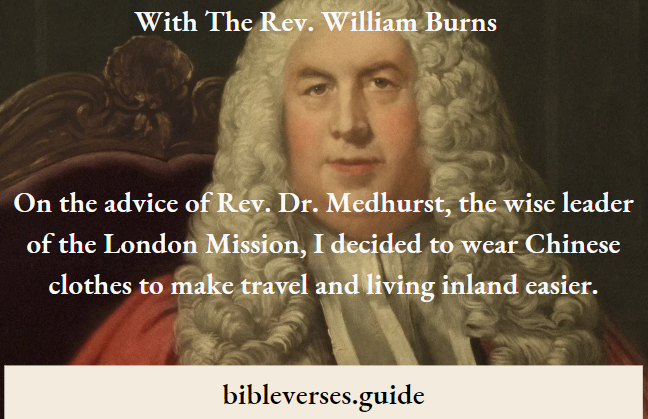
With The Rev William Burns

The Chinese had permitted a foreign company to build an asilk1 factory some distance inland.

They made the condition that the design of the building must be purely Chinese and that there should be nothing on the outside to show that it was foreign. Much good resulted from this change of clothing. I have continued to wear Chinese clothes as have others in the mission.

Starting in 1851, the Taiping rebellion had reached the limit of its short-lived victory. The great city of Nanking had fallen before the attacking army. There, within two hundred miles of Shanghai, the rebels had made their headquarters and begun to strengthen themselves for more victory.

During the summer of 1855, many attempts were made to visit the leaders of the rebellion and bring some clear Christian influence upon them. But so little result was seen, that these efforts were not continued.

A number of us had tried to reach Nanking. Finding it impossible to do so, I turned my efforts again to spreading the Gospel on the island of Tsungming. Slowly, I was able to overcome the strong feelings against me and the fears of the people.

This enabled me to rent a little house and live among them. It was a great joy and made my hope stronger. Sadly, objections were soon made by the local officials to the British Consul,2 who forced me to leave the area.

At the same time, the French Consul himself had found a property for the Roman Catholic missionaries just a short distance from the house I had to leave. Painfully disappointed by this unexpected problem, I returned to Shanghai, a little dreaming of the blessing that God had in store for me there.

The Rev. William Bums of the English Presbyterian Mission had arrived in that port on his return trip from home. Before going on to his former place of service in the southern province of Fukien, he had tried, like me to visit the Taiping rebels at Nanking.

Failing in the attempt, he made his temporary headquarters in Shanghai and worked to evangelize the nearby area that was heavily populated. In the autumn of that year, I was led by God’s providing hand to work with this beloved and honored laborer of God.

We traveled together, spreading the Good News to cities and towns in south Kiangsu and north Chekiang, living in our boats and following the canals and rivers that spread over the whole face of the rich, fertile country. Mr. Bums at that time was wearing English clothes.

He saw that while I was younger and had been in this work a shorter time, I had the quiet listeners while he was followed by the rough fellows. He also saw that I was invited to the homes of the people while he received the excuse that the following crowd was too large. After some weeks, he too began to wear the Chinese clothes and enjoyed the increased acceptance that it gave.

Those happy months were a great joy and almost like a gift to me. His love for the Word was wonderful. His holy, God-honoring life and continual visits with God made friendship with him satisfying the deep desire of my heart.

His stories of working to spread the Gospel and of mistreatment during his work in Canada, Dublin, and southern China were informative and interesting.

With true spiritual wisdom, he would often point out God’s purposes in a way that made the trials of life take on a new outlook and value. He had ideas about evangelism as the great work of the Church.

He saw the order of lay evangelists as a lost order that Scripture commands to be put back into use. These thoughts were seeds that were to prove fruitful in the design and planning of the China Inland Mission.

Still, our path was not always a smooth one. When permitted to stay in a city for any length of time, we used the chance completely. After prayer for blessing, we would leave our boats at about nine o’clock in the morning, carrying a light bamboo chair. Choosing a good place, one of us would stand on the chair and speak for twenty minutes while the other prayed for a blessing.

Then changing places, the first speaker had a rest. After an hour or two, we would move to a distant point and speak again. Usually about noon, we returned to our boats for dinner and prayer and then continued our outdoor work until sunset.

After supper and a little rest, we would go with our national helpers to some teashop, where several hours might be spent talking with the people. Many times before leaving a town, we had good reason to believe that much truth had been understood and we placed many Scriptures and books in the hands of those interested.

About this time, the following letter was written by Mr. Bums to his mother at home in Scotland:

Twenty-five Miles from Shanghai,

January 26, 1856

Making use of rainy days which keep me in my boat, I write a few lines, in addition to a letter to Dundee, containing details that I need not repeat. It is now forty-one days since I left Shanghai on this last trip.

A young English missionary, Mr. Taylor, of the Chinese Evangelisation Society,0 has been my co-worker during these weeks, he in his boat, and I in mine, and we have received much mercy, and at some times, great help in our work.

I must once more tell the story I have had to tell more than once—how four weeks ago, on December 29, 1 put on the Chinese clothes, that I am now wearing. Mr. Taylor had made this change a few months before, and I found that because of this he was so much better received by the crowd, that I decided it was my duty to follow his example.

We were at that time more than two times the distance from Shanghai that we are now, and would still have been at as great a distance had we not met at one place with a group of lawless people, who demanded money and threatened to break our boats if their demands were refused.

The boatmen were frightened and made it clear that they wanted to return to some place nearer home. Earlier, these people had violently broken into a part of Mr. Taylor’s boat, because their unreasonable demand for books was not obeyed.

We have a large, very large field of labor in this area, while it might be difficult at this time for one to live for very long in any one place; the people listen with thoughtfulness, but we need the power from on High to cause them to understand and be saved. Is there any spirit of prayer for us among God’s people in Kilsyth? or is there any effort to seek this spirit? How great the need is, and how great the arguments and reason for prayer in this case.

The fruit to be gathered here is very great, and the laborers are few, and imperfectly fitted without much grace for such a work. Yet grace can make the few and weak laborers the means of doing great things—things greater than we can even imagine.

The incident spoken of in this letter took place near the northern border of Chekiang. It led to our return to Shanghai sooner than we had at first planned. We had reached a busy market town known by the name ofWuchen, or Black Town.

We had been told the citizens were the wildest and most lawless people in that part of the country. That was just how we found them to be. The town was a refuge for salt smugglers and many other bad people.

The following is taken from my diary, written at the time:

January 8, 1856

Started our work in Wuchen this; morning by passing out a large number of tracts and some New Testaments. The people seemed very surprised, and we could not learn that any foreigner had been here before. We preached two times; once in the church house of the God of War, and after that in a space left by a fire, which had destroyed many houses.

In the afternoon we preached again to a large group that listened carefully at the same place, and in the evening moved to a teashop0 where we had a good chance of speaking until many people heard that we were there, and when too many people were coming in, we felt we should leave before our being there slowed the teashop business.

Our national helpers, Tsien and Kuei-hua, were able, however, to remain. Returning to our boats, we spoke to some people standing on a bridge and felt we had much reason to be thankful and our hearts were strengthened by the result of our first day’s labor.

January 10

First sent Tsien and Kuei-hua to pass out some tracts. After their return, we went with them, and in a space cleared by fire, we separated and spoke to two groups. On our return to the boats at noon, we found people waiting, as usual, and desiring books. Some were passed out to those who were able to read them.

Asking them kindly to excuse us while we ate, I went into my boat and shut the door. Before there was time to pour out a cup of tea a loud noise of something hitting the boat began and the roof was at once broken in. I went out at the back and found four or five men taking the large pieces of frozen dirt turned up in a field close by— weighing from seven to fourteen pounds (3 to 6 kg.) each— and throwing them at the boat.

Reasoning with them was of no use and it was not long before a considerable part of the top part of the boat was broken to pieces, and dirt covered the things inside. Finally, Tsien got a boat that was passing to take him a short distance away, and by passing out a few tracts drew away the thoughts of the men, ending the attack.

We now learned that of those who had harmed only two were from that place. The others were salt smugglers. The reason was that we had not satisfied their unreasonable demand for books.

Through God’s providing hand, no one was injured. As soon as it was quiet again, we all met in Mr. Burns’s boat and joined in thanksgiving that we had been saved from personal harm, praying also for those who caused the trouble. We prayed that this might be turned into good for us all.

We ate and left the boat, speaking to a large group that soon gathered not far away. We were especially helped by the Lord. Never were we heard with more care. Not one voice was found to side with the men who had troubled us.

In the evening the same spirit was shown at the teashops and some seemed to hear with joy the Good News of salvation through a crucified and risen Saviour. As we came home, we passed a hair-cutting shop still open. I went in and while getting my hair cut, spoke to a few people and put two tracts on the wall for others to read.

An honorable shopkeeper by the name of Yao had received parts of the New Testament and a tract, on the first or second day of our stay at Wuchen. He came yesterday when our boat was broken, to beg for some more books. At that time, we were all in disorder from the damage done and from the dirt thrown into the boat.

So we asked him to come again in a day or two when we would be happy to help him. This morning he appeared and handed in the following note:

On a former day, I begged Bums and Taylor, the two “Rabbis,” to give me good books. It happened at that time those of our town whose hearts were tricked by Satan, not knowing the Son of David, were so foolish as to “race” and “more” and injure your honored boat.

I thank you for promising after this to give the books, and beg the following: Complete New Testament, Discourse of a Good Man When Near His Death, Important Christian Doctrines, an Almanac, Principles of Christianity, Way to Make the World Happy—of each one copy. Sung and Tsien, and all teachers I hope are well. More praise is unwritten.

This note is interesting, as showing that he had been reading the New Testament thoughtfully, as the italicized words were all taken from it. His use of “race” and “moreh” for speaking roughly and unkindly, shows their meaning was not lost on him.

After bringing books to this man, we went out with Tsien and Kuei-hua to the east of the town and spoke on the road for a short time. On our return to the boats, I was visited by two Chihli6 men from the judge’s office. The Lord greatly helped me in speaking to them in the Mandarin language of a crucified Saviour.

While one of them did not show much concern, the other did and asked questions that showed the interest he was feeling. When they departed, I left the boat and spoke to the people gathered there, to whom Kuei-hua had been preaching.

The setting sun provided an example and reminded one of the words of Jesus, “Night is coming when no one can work.” I spoke of the uncertain length of this life and of the fact that we do not know the time of Christ’s return. A degree of deep seriousness settled on them that I had never before seen in China.

I began to pray and could see clearly that God was speaking to their hearts. I returned to my boat with a Buddhist priest who had been in the group. He admitted that Buddhism was a system of trickery that could give no hope in death.

January 12

In the afternoon we spoke to the people close to our boats, on one of the roads of the city, and in a teashop. Books were passed out each time we spoke. In the evening, we went as usual to speak in the teashops.

This time, we decided to go to the opposite end of the town to give the people there a better chance to meet with us. It was a long village, nearly three kilometers in length. As Mr. Bums and I usually talked together in Chinese, this plan was known to those in the boats.

After a short distance, we changed our minds. Instead, we went to the usual teashop, thinking that people might have gone there expecting to meet us. But this was not the case. We did not find such serious listeners as we had found before. Mr. Bums thought it would be good to leave earlier than usual.

We did so, telling Tsien and Kuei-hua that they might remain a little longer. Returning to the boats, we gave away a few books. It was unusual but we were left to go alone with no one going with us as they usually did.

It was no longer a clear night and we found that it had become very dark. On our way, we met the boatman who acted as if something were wrong. Without giving any reason, he blew out the light in our lamp.

We relighted it, telling him not to put it out again. To our surprise, he carefully put out the light so that it could not be relighted. Then, walking down along a low wall that went out to the river’s edge, he looked into the water.

Not knowing what the trouble was, I ran forward to hold him, afraid that he was going to drown himself. I was very thankful when he came quietly back. In answer to our repeated questions, he told us to be very quiet.

He said softly that some bad men were wanting to destroy the boats. He and his friends had moved the boats away to escape from them. He then led us to the place where one of the boats was hidden. Before long, Tsien and Kuei-hua came and got safely on the boat. Soon after, we were joined by the teacher Sung and the boat moved away.

The cause of all this trouble was then explained. A man had come to the boats while we were gone, claiming to be a policeman. He carried a written demand for ten dollars and an amount of opium.

He said that there were more than fifty country people (salt smugglers) waiting for our answer in a nearby teashop. If we gave them what they wanted and three hundred dollars to pay for their tea, we might remain in peace. But if not, they would come at once and destroy our boats.

Sung told them that we could not obey their demand because our only business was in preaching and passing out books. We had no opium and little money. The man told Sung that he did not believe him. There was nothing for him to do but to ask the man to wait for our return. Not knowing that we had changed our plans, he looked for us in the wrong direction.

While Sung was looking for us, the boatmen had been able to move off. They were very much afraid. Having so recently seen what these men would do openly in the day, they felt no desire to see what they might try by night. When they moved away, they had gone to different places, so that if one boat should be damaged the other might give us an escape.

It was after this we had, by God’s providing hand, met the boatman and been led onto the boat. As Sung passed the place where the boats had been tied up, he saw twelve or more men between the trees. He heard them asking where the boats had gone but no one could tell. Thankfully, they did not find us.

After some time, the boats joined and moved along together. It was already late. Traveling by night in that part of the country was not the way to escape from evil men. So the question came as to what should be done.

This we left for the boatmen to decide. They had moved off of their own decision. We felt that we could not ask others to remain in a position of danger because of us. We strongly asked them to do quickly whatever they planned to do.

Tomorrow was the Lord’s Day when we did not wish to travel. We told them that no matter what, we must preach the Gospel. It made little difference where we might stay. Even if we passed the night and were not seen, we were sure to be found out on the following morning.

The men decided that we might as well return to the place from which we had started. This was agreeable to all and so the boatmen turned back. But, they got into another river and pushed along for some time but seemed to have become lost. At last, it became very dark, so they tied up the boat for the night.

Calling the boatmen and our national helpers, we read Psalm 91 to them. The words expressed our needs at that time. How sweetly cheering was this part of God’s Word: “1 He who stays under the protection of the Most High will rest in the security of the Almighty. 2 I will say of the LORD, “He is my refuge and my strong house, my God, in whom I trust. ” 3 Surely he will save you from the one who wants to catch you in his trap and from deadly sickness.

He will cover you with his protection, and under his care, you will find refuge; his faithfulness will be your defense and safe place. 5 You will not fear the terror of the night, or the arrow that flies by day. . . 14 “Because he loves me, ” says the LORD, “I will rescue him; I will protect him, for he knows my name. 15 He will call upon me, and I will answer him; I will be with him in trouble, I will rescue him and honor him. 16 With long life will I satisfy him and show him my salvation. ” (Psalms 91).

With our prayer, we placed ourselves in His care and keeping. He had covered us with thick darkness and permitted us to escape from the hands of vicious men. We retired for the night, thanks to the kind protection of the Watchman of Israel who neither sleeps nor forgets His people.

We slept in quiet, and peace and were able to see more clearly, the truth of that Word which I love, “You are my hiding place and my shield.” Sunday, January 13

This morning I was awakened at about 4 a.m. by a very sharp pain in the knee joint. I had hit it so hard the day before that it turned black and blue and now was enlarged and hot. To my great surprise, I heard rain pouring down. The weather had been very nice. On looking out, we found ourselves near the place where we had tied up the boats before. If nothing had happened to stop us, we would have felt it necessary to go into the town to preach as usual.

But the rain was so great all day that no one could leave the boats. And so, we enjoyed a very wonderful day of rest, such as we had not had for some time. The weather did not allow much chance for questions to be asked about us.

Had the day been fine we would most likely have been discovered, even if we had not left the boats. As it was, we were allowed to think in peace, and with wonder and thankfulness, of the kind dealings of our God, who had in this way led us apart into “a desert place” for a little rest.

Monday, January 14

A cloudless morning. One of the national helpers went before daylight to get some clothes that had been given out for washing. He came back with the news that, even with the pouring rain of yesterday, men had been looking for us in all directions.

We had been kept, however, in peace and safety under “the shadow of the Almighty.” The boatmen were now so completely afraid that they would stay no longer and moved off at daylight. I was forced to stay in the boat with my injured knee and had no other choice but to go with them. In the afternoon we reached Pingwang, on the way to Shanghai.

The harm that God blesses is our good,
And unblessed good is harm;
And all is right that seems most wrong,
If it be His sweet will.

Called To Swatow

Called To Swatow

Leaving the village of Black Town was a real disappointment to us. We had wanted to spend some time there sharing the Gospel. Yet, these trying happenings were a necessary step leading to greater things. God does not permit trials to come without a sure reason. He was leading us in a way that we did not know, but it was His way.

Oh Lord, how happy should we be
If we would throw our care on You,
If we from self would rest;
And feel at heart that One above,
In perfect understanding, perfect love,
Is working for the best!

Called To Swatow

He explained to us what was happening there. British people were living on Double Island, doing business in drugs and working in the slave trade. Yet, there was no British missionary to preach the Gospel.

The Spirit of God gave me the urge that this was His call. But for days, I felt that I could not obey it. I had never been blessed with such a spiritual father as Mr. Bums and had never known such holy, happy times. I said to myself that it could not be God’s will that we should separate.

One evening, I was very troubled and went with Mr. Bums to take tea at the house of the minister, R. Lowrie of the American Presbyterian Mission. He lived at the South Gate of Shanghai. After tea, his wife let us hear “The Missionary Call.” Having never heard it before, it had a great effect on me.

My heart was almost broken before it was finished. In the words they sang, I said to the Lord:

And I will go.
I may no longer care to give up friends
And my plans,
And every earthly desire that fastens my heart to you,
my country.

From now on I care not
Ifstorm or sun be my earthly place, bitter or sweet my cup,
I only pray,
God make me holy and my spirit strong for the hard
hour of trouble.

When we left, I asked Mr. Bums to come home with me to the little house that was still headquarters in the city. With much crying, I told him how the Lord had been leading me and that I had been a rebel in not being willing to leave him for this new place.

He listened with surprise and happiness and answered that he had, that very night, decided to tell me that he had heard the Lord’s call to Swatow. He said that his only sorrow was the thought of leaving me. We went together and began missionary work in that part of China, which in later years has been greatly blessed.

Long before this time, the city of Swatow and the nearby area had been served by the minister, R. Lechler of the Basel Missionary Society. Chased from place to place, he did work that we did not forget and finally retired in Hong Kong.

For more than forty years, this minister of God has continued in “great labor.” Recently, he has left Hong Kong with his wife, to return inland and spend the rest of his years among the people he has so long and truly loved.

Captain Bowers was our Christian friend whom God had used to bring the needs of Swatow to Mr. Bums and me. He was full of joy when he heard our decision to give ourselves to preach to this busy, important center of the population. About to sail on his return trip, he offered us free passage on his ship, the Geelong. We accepted and left Shanghai early in March 1856.

A nice trip of six days brought us to Double Island where we found ourselves with a small but very bad group of foreign people. They took part in businesses that included the trade in illegal drugs.

We were not willing to be a part of such a group and wanted to live within the city on a part of the mainland seven kilometers away at the mouth of the Han River. We had great difficulty in our attempt to get a place among the people. It seemed as if we should fail and we knew we had to come to the Lord in prayer.

Our God soon did undertake for us. One day, we met with a Cantonese1 man, a family member ofthe high official in the town. Mr. Bums spoke to him in the Cantonese language, making him very pleased at being spoken to by a foreign person in his language.

He soon became our friend and rented us a little room in which to stay. We were thankful because it was impossible to find a better place. Our travels took us around the country. The difficulty and danger were so great that our former work in the North began to appear safe and easy by comparison.

The hate and anger of the Cantonese was very painful. We were called “foreign evil spirits,” “foreign dog,” or “foreign pigs.” But this led us to walk more closely than ever before with “Him who was not accepted of men.”

In our visits to the country, we were in danger of being taken at any time and held for ransom.2 The people often said that the whole area was “without a king and law.” Certainly, strength was the miler in those days.

At one time, we were visiting a small town and found that the people had captured a wealthy man from another tribe. A large price was asked for his release. Because he refused to pay, they used a stick to cruelly smash the bones just above his feet, one by one. Finally, they received the promise they wanted.

There was nothing but God’s protection to keep us from being hurt in the same way. Every town had a wall and would contain ten or twenty thousand people ofthe same tribe who were often at war with the people living in the next town. To be kindly received in one place was usually a reason for danger in the next. In these times, God’s power was often shown.

After a time, the local mandarin became sick and the doctor was unable to help him. Hearing ofour medical ministry, he wanted our help. God gave a blessing on the medicine given. Thankful for our help, he said we should rent a house for a hospital and a place for people to receive medical treatment.

And so, we were able to rent the whole house, one room ofwhich we had lived in before. I had left my medicine and surgery instruments with a friend, the late Mr. Wylie in Shanghai and went back at once to get them.

Mr. Bums came down to see me off from a town called Ampow that we had visited together several times. On my departure, he returned with two national evangelists sent up from Hong Kong by a minister, J. Johnson, of the American Baptist Missionary Union.

The people were willing to listen to their message and accept their books as a gift, but they would not buy them. One night, someone broke in and stole everything they had except their books which were thought to have no value.

Early the next morning, people came to buy books. By breakfast, they not only had enough money to buy food, but they also had enough money to pay for one ofthe men to take a trip to Double Island below Swatow, carrying a letter to Mr. Bums’s friend, requesting him to send some of Mr. Bums’s money.

People came to buy all day and the next day our friends needed nothing. But on the third day, they could not sell any books. Then, when the money was gone, the messenger returned with more food and things they needed.

Early in July, after about four months’ stay in Swatow, I left for Shanghai. I had planned to return in a few weeks with my medical equipment for more work with William Bums. A new field of promise seemed to be opening before us. With much hope, we looked forward to the future. A great blessing was in store for the city and area of Swatow.

But it was not the purpose of God that either of us should remain to experience the result. Soon after I left, Mr. Bums was arrested, put in prison, and sent to Canton. On his return to Swatow after the war had broken out, he was called away for another service, preventing his future return. On the other hand, my trip to Shanghai proved to be the first step leading to other areas ofwork.

The Missionary Call

1. My soul is not at rest.
There comes a different and quiet voice to my spirit
Like a dream at night,
That tells me I am on holy ground.

The voice of my risen Lord, Go teach all nations Comes on the night air and awakes my ear.

2. Why do I live here?
The command of God is on me and I may not stop to play with useless things
Or gather earthly flowers,
Until my work is done and my report is given.

3. And I will go.
I may no longer care to give up friends
And my plans,
And every earthly desire that fastens my heart to you, my country.

4. From now on I care not
Ifstorm or sun be my earthly place, bitter or sweet my cup,
I only pray,
God make me holy and my spirit strong for the hard hour of trouble.

5. And when one for whom
Satan has tried, as he has for me, and has received at last
That blessed place
Oh, how this heart will shine with thankfulness and love.

Through all the years of forever, my spirit never shall repent.
That work and pain once were mine below.

Man Proposes, God Will Put In Place

Man Proposes, God Will Put In Place

It is interesting to see the different happenings, in the direction of God, which prevented my return to Swatow and led me to settle in Ningpo. This town became the center for me in developing my future work.

On coming to Shanghai to collect the medicine and surgical instruments, my sorrow was great to find that the place had caught fire and everything had been destroyed. This was tragic and I fear I was more like faithless Jacob in believing that everything was against me!

For a time, I failed to see that “all things God works for the good of those who love him.”My trial and disappointment was very great.

Man Proposes God Will Put In Place

Medicines cost much in Shanghai, and I had limited money to buy more. I set out on an inland trip to Ningpo, hoping to receive some medicine from Dr. William Parker, who was a member of the same mission as me.

With me went the few possessions I had, including my watch, a few surgical instruments, a musical instrument, and books for the study of Chinese. I left part of my money behind in Shanghai.

The country was dry for it was the middle of summer and the water level in the canals was very low. Much water had been used for the rice fields while some had been dried up in the great heat. Deciding to make this as much of a mission trip as possible, I set out with many Christian tracts and books.

For fourteen days, our crowded boat traveled slowly while I preached and passed out books. We came to a large town called Shihmenwan, where I found that my material had all been given away. I now decided not to go slowly, but to go through the city of Haining, reaching Ningpo as quickly as possible.

August 4, 1856

There was no water beyond Shihmenwan. I paid off my boat and employed two carriers to carry my things as far as Changwan. By the time the sun came up, we were on the way. I walked on alone, leaving my helper to follow with the men who made many stops to rest. On arriving at a city through which we had to pass, I waited for them in a tea shop just outside the North Gate.

The carriers arrived slowly and seemed very tired. I soon found that they both smoked opium. They had only carried a load that one strong man would think nothing of taking three times the distance. Yet, they seemed tired.

After some rice and tea and an hour of rest—and also, I know, a smoke of the pipe — they had a little more energy. I asked them to move on so that we might get to Changwan before the sun became too hot. My helper had a friend in the city, and he wanted to spend the day there and travel the next morning. I did not like this, but wanted to reach Haining that night if possible.

We set off, entered the North Gate, and had passed through about a third ofthe city when the carriers stopped to rest and said they should be unable to carry the load on to Changwan. Finally, they agreed to take it to the South Gate, where they were to be paid for the distance they had carried it; and the helper called other carriers to come with them.

Walking ahead, I soon came to Changwan and waited for them to arrive. They seemed to be taking a long time. In the meantime, I asked for more carriers for the rest of the trip to Haining. After some time, I began to wonder at the delay. I was not happy when it became too late to finish the trip to Haining that night.

If it were not that my feet hurt and the afternoon very hot, I would have gone back to hurry them on. At last, I decided that my helper must have gone to see his friend and would not come until evening. Yet, even then, there was still no sign of them.

Feeling very troubled, I began very carefully to ask if they had been seen. At last, a man asked if I was on a visit from Shihmenwan and going to Haining. He told me that my things had gone on before me.

He said that he was sitting in a teashop when a carrier came in and took a cup of tea. Then he set off for Haining in a great hurry, saying that the box and bed were from Shihmenwan and had to be taken to Haining that night.

He was to be paid at a rate of ten yuan for each pound.” I realized that my things had gone on before me but as it was already dark and I was tired, it was impossible to follow them. All I could do was find a place to sleep for the night.

This was not an easy task. Raising my heart to God in prayer and asking for help, I went to the other end of town, hoping that the news of a foreign person in town might not have spread this far. I soon came to a small country hotel and went in.

In the dark, I hoped to pass without any question. The only food they had was cold rice and snakes cooked in lamp oil. Not wanting to be asked about my nationality, I thought it wise to order and eat. The food was not to my liking.

I asked the owner if I could spend the night. He produced a record book, advising me that in these difficult times, they were ordered by the officials to keep a record of the people who stayed. He asked for my honorable family name. I told him that my unworthy family name was Tai.

“And your honorable second name?”
“My unworthy name is Ia-Koh” (James).

He told me that it was an unusual name that he had never heard before. He asked me how I wrote it. I added that it was a common name in the place from which I had come.” “And ask from where you come and where you are going?”

“I am going from Shanghai to Ningpo, by way of Hangchow.” Then, he asked what kind ofwork I did. I told him that I cured the sick. “Oh! you are a doctor,” the owners said. To my great satisfaction, he closed the book. His wife continued talking with me.

“You are a doctor, are you?” she said; “I am happy about that, for I have a daughter who is sick with a terrible disease. If you will cure her, you shall have your supper and bed for nothing.” I asked what my supper and bed were to cost and found they were less than three halfpence of our money! The girl had leprosy for which I had no medicine.

Unable to help the girl, I would not tell her what she needed, saying that her disease was difficult to get over and that I had no way of helping her The mother brought a pen and paper, asking that I write what she needed.

She said, this would not harm, even if it does no good. But this also I would not do. I asked to be shown my bed. Led to a very terrible room on the ground floor, I passed the night without a bed or anything except my shoes to place my head on.

There was no protection from insects. Ten or eleven other people were sleeping in the same room, so I could not take anything off, for fear that someone might steal. As the night went on, I became very cold.

August 5

As may be expected, I rose with little rest and felt very far from well. It was a long time before breakfast was ready. There was another delay before I could get change for the only piece of money I had with me. I did not receive the full value for this coin, which was a serious loss to me in my trying position.

I looked through the town for news of my helper and carriers but found nothing. They might have arrived later or come on in the morning. The town was large and nearly three kilometers long. Because of tiredness and pain, I set out for Haining in the full heat of the day.

The trip of about thirteen kilometers took a long time but I was able to find a welcome place to rest and cup of tea at a village halfway along the road. A strong rain came, allowing me time to preach a little to the people. It was almost sundown when I arrived at the north area of Haining.

When I asked there, I heard no news and was told that outside the East Gate, I should be more likely to hear of them. But I did not find them. While sitting in a tea shop to rest, several people from the mandarin’s office asked who I was and where I had come from. On learning the object of my search, one of the men told me that a box and a bed were carried past here about half an hour ago.

The carrier seemed to be going towards either the Great East Gate or the South Gate. He advised me to go to the business houses there and ask. I asked him to go with me but he would not come, even though I offered to pay.

Another man offered to go with me, so we set off together. We searched both inside and outside the two gates but with no result. I asked a man to make a careful search, promising extra pay if he should find them. In the meantime, I had some dinner and preached to a group of people who had gathered.

He returned, having found nothing. By now very tired, I asked him to help me find a place to sleep for the night and then I would pay him for his trouble. We set off in search of a place to sleep.

At the first two resting houses, the people appeared willing for us to stay but later changed their minds. A government officer who followed us seemed to cause them concern. We went to a third house and found a place to stay. We were no longer followed by the government workers. Some tea was brought and I paid the man for his trouble.

Soon after he was gone, some government officials came but went away. I was now told I could not stay for the night. A young man blamed the officials for the unkindness and told me not to worry. He invited me to sleep at his house.

I went with him, but the family was not willing to receive me. Being tired, I found it difficult to stand but had again to seek a place to stay. Then they said, that because a crowd had gathered at the door, they wanted me to wait at a nearby tea shop until the people went away. Then I could return to the house.

Having no other choice, I left with the young man and waited until past the middle of the night. On returning to the house, the young man searched but could not find it. I was led to another part ofthe city where he finally left me to pass the rest ofthe night as best I could.

I was opposite a place of worship but it was closed, so I lay down on the stone steps in front. Putting my money under my head, I would soon have been asleep if I had not sensed a person coming towards me. He was a beggar, so common in China. I knew that he wanted to rob me of my money.

I lay watching his every move. I also looked to my Father not to leave me in this hour of trial. The man came up and examined me for some time to be sure that was sleeping. It was so dark that he could not see my eyes fixed on him. As he began to feel about me, I quietly asked what he wanted. He made no answer but went away.

1 was very thankful to see him go. Putting as much of my money as I could into my pocket, I hid the rest in another part of my clothes. I made a place to rest near the wall and soon began to go to sleep, but I was awakened by the quiet steps of two people coming. My body was so tired that any little noise caused me to wake. Again I asked for protection from Him who alone was my help, lay still as before.

One of them began to feel for the money under my head. I Spoke again. They sat down at my feet, telling me that they planned to stay there. I asked that they take the opposite side as there was plenty of room. I wanted them to leave this side to me, but they would not move from my feet. I raised myself and set my back against the wall.

They said I had better lie down and sleep as I would be unable to walk tomorrow. They told me that I should not be afraid as they would protect me for the rest of the night. I spoke firmly to them that I did not want their protection, nor did I need it.

I told them that I was not Chinese and did not worship their god who does not give any help. I worshiped God who is my trusted Father. I told them directly that I knew well what they were and what they wanted to do. I would be keeping my eye on them and would not sleep.

One of them went away but soon returned with a third person. I had no feeling of ease but looked to God for help. Now and then, one of them would get up to see if I were sleeping. I told him not to be mistaken as I was awake.

Sometimes, my head would fall, and this would be a signal for one of them to rise. At once, I woke up -and said something. As the night passed slowly on, I felt very tired. To keep myself awake and to cheer myself, I sang songs, said Scripture, and prayed in English. These people would have given anything for me to stop but gave me no more trouble. Shortly, before the sun rose, they left and I was able to sleep.

August 6

I was awakened by the young man who had troubled me the evening before. He was not very gentle and kept asking me to pay him for his work. He even tried to force me to do what he wanted. I defended myself quickly without any thought and took hold of his arm with unexpected strength and told him not to lay a finger on me again or get in my way. This caused him to change.

He let me quietly remain until the gun announced the opening ofthe gates ofthe city and then begged for money to buy opium.1 refused but gave him only the price of fuel that he said he had used in my company the night before. I later learned that he was connected with one of the government offices.

As soon as possible, I bought rice and tea for breakfast and made another search for my things but found nothing. I set out on the return trip and after a long, tiring, and painful walk, arrived in Changwan at about noon. 1 failed to find any of my lost things. I had some food in a tea shop, washed myself, and slept until four in the afternoon.

Feeling much better, I set off to return to the South Gate ofthe city where I had left my helper and carriers two days before. On the way, I was led to think about the goodness of God. I remembered that I had not yet prayed that I might have a place to stay that night.

I felt ashamed that I had been so concerned for my few things while many unsaved people around me had caused so little emotion. I came as a sinner and asked for forgiveness through the blood of Jesus, knowing that I was accepted in Him — free, clean, sanctified.

Oh, the love of Jesus, how great I felt it to be! I knew more than I had ever before, what it was to be turned away from and not be accepted. I was like one from whom men hid their faces with nowhere to lay my head. I felt more than ever before, the greatness of that love which caused Him to leave His home in glory and suffer this for me, even to lay down His life upon the cross.

I thought of Him as “turned away from and not accepted of men, a man of great sorrow, and One who knew sorrow.” I thought of Him at Jacob’s well, tired, hungry, and needing something to drink, yet He found His meat and drink in doing His Father’s will.

I had to compare this with my little love. I looked to Him for pardon for the past and grace and strength to do His will in the future. I needed to walk much more closely in His steps and more than ever to be completely His. I prayed for myself, for friends in England, and for my brothers in the work.

To my eyes came such sweet tears of joy mixed with sorrow. The tiredness from the road was almost forgotten. Before I knew it, I had arrived at the city. At the South Gate, I took a cup of tea, asked about my lost things, and spoke of the love of Jesus. Then I entered the city. Receiving no help with my question, I left by the North Gate.

I felt so much better both in mind and body because of my talk with the Lord on the road back to the city. I decided I would be able to finish the other six miles back to Shihmenwan that evening.

First, I went into another tea shop to buy food where I met one ofthe same carriers who had earlier carried my things. I learned that after I had left them, they had taken my things to the South Gate. There my helper told them that I had gone on, that he did not want to start at once, but would spend the day with his friend and come back to me.

They carried the things to his friend’s house and left them there. I asked him to go with me to the house and learned that my helper had spent the day and night with them. The next morning, he had called other carriers and set off for Hangchow. This was all I could learn. Unable to do anything but return to Shanghai, I left the city again. It was now too late to go to Shihmenwan.

I looked to my Father to provide all my needs and again I was reminded of His unending love and care. I was invited to sleep on a passenger boat, now dry in the bed ofthe river. The night was again very cold and insects troublesome. Still, I got a little rest. When the sun came up, I continued my trip.

August 7

I felt very sick at first. Yet, I reminded myself of the goodness of God so that I could stand the heat each day and the long cold at night. Much ofthe load was taken off my mind. I had given myself and my cares to the Lord and knew that if it was for my good and His glory, my things would be returned.

If not, all would be for the best. I hoped that the most difficult part of my trip was now coming to a close. As I walked, I was still tired and my feet hurt. On my return to Shihmenwan, I still had 810 yuan in hand.

The cost to take the boat to Kashing was 120 yuan with the trip to Shanghai costing 360, leaving me just 330 yuan for three or four days’ needs. I went at once to the boat office. To my disappointment, I found that because the river was dry, the shipment had not come down. No boat would leave that day and perhaps not even the next.

I asked if there was not a letter-boat for Kashing and was told that these had already left. All I could do was to travel with any private boat that was going. I could find no boat that was going all the way to Shanghai. If I had, my difficulty would have been at an end.

Just at this time, I saw at a turn in the river, a letter-boat going in the direction of Kashing. This must have been one of the Kashing boats that had an unexpected delay. I set off as fast as I could go. I forgot about my tired body and feet that hurt. After a chase of about two kilometers, I caught up with it.

“Are you going to Kashing?” I called out.
“No,” was the only answer.
“Are you going in that direction?”
“No.”
“Will you let me go as far as you do go that way?”
Still, “No,” and nothing more.

Completely disappointed and my strength gone, I fell to the grass and fell into a deep sleep, as if dead. On waking, I heard voices coming to my ears. They were talking about me! One said, “He speaks the pure Shanghai language.”

From their language, I knew them to be Shanghai people. Raising myself, I saw that they were on a large passenger boat on the other side of the river. After a few words, they sent their small boat to get me. They were very kind and gave me some tea. When I felt better, I was given food also.

I removed my shoes to ease my feet and I was kindly given hot water to wash. On hearing my story and seeing how bad my feet looked, they felt sorry for me. Every passing boat was stopped to see if it was going my way. They did not find one, so after a few hours’ sleep, I left the boat planning to preach in the house of worship of Kwan-ti.

I had told my new friends that I was now unable to help myself, having no strength to walk to Kashing. Unable to get a ride that day, I no longer had enough money to take me by letter boat, a costly way to travel.

I said that I did not know how my God would help me, but that I knew He would do so. My business was now to serve Him where I was. I knew that help would come and said that this would prove the truth of that which other missionaries and I had preached in Shanghai.

While visiting with the captain on the way to town, we saw a letter boat coming up. I reminded him that I no longer had the money to pay for my passage. However, he stopped it and found that it was going to a place about fifteen kilometers from Shanghai.

From there, one of the boatmen would carry the mail overland to the city. He informed them that I was a foreigner from Shanghai with no money to go back. He told them that they would take me with them and find a sedan chair for the rest of the way, I would pay them in Shanghai.

The captain pointed to his boat sitting in the mud because of the low level of water. He promised that if I did not pay on my return to Shanghai, he would do so on their return. This kindness was not asked for and made by someone I did not know.

This was unusual as Chinese people generally do not take chances with their money. Those on the letter-boat agreed to this and I was taken on as a passenger. Oh, how thankful I felt for this guidance of God and to be once more on my way to Shanghai!

This boat was built long and thin and did not have very much space inside. One has to lie down all the time as any small move would easily cause the boat to turn over. This did not concern me, as I was only too happy to be quiet. These are the fastest boats I have seen in China and are worked by two men who take turns all day and night. They use their feet and hands. If the wind is right, they work their feet and use one hand to control a small sail, guiding with the other hand.

After a nice and quick trip, I arrived safely in Shanghai on August 9, with the help of Him who said, “Never will I leave you. Never will I forsake you.” He also promised “And surely I am with you always, to the very end of the age.”

Divine Guidance

Divine Guidance

It now seemed very clear that the lost property had been stolen by my helper who had gone off with it to Hangchow.

Included was everything I had in China, except for a small amount of money left in Shanghai. The first question was how best to act for the good ofthe man who had been the cause of so much trouble.

It would not have been difficult to take steps that would have led to his punishment. Still, the chance of being repaid for the loss was very small. But my main concern was that the thief was a man for whose salvation I had worked and prayed.

I felt that to have him punished would not be a witness to the teaching of Jesus, which we had read together, “But I tell you, do not resist an evil person.”

Divine Guidance

The way I did this made my Christian friends in England thankful, one of whom was later led to send me money to replace the amount I lost. This was the first of more money received from the same kind of helper. He was Mr. George Mueller of Bristol.

After I collected the little money left in Shanghai, I set out again to Ningpo to seek help from Dr. Parker to replace the medicine I had lost by fire. When this was done, I returned to Shanghai, hoping to soon be working with my friend, Mr. Bums, in Swatow. Yet, God had a different plan and the delay caused by the robbery was just enough to keep me from starting for the South as I had wanted to do.

The government politics was not certain and there was a danger of coming war. Early in October of this year (185b) there began a most hostile situation. Very soon China was to be deeply involved in a second long hostile situation with foreign powerful nations. All missionary work had to stop for a while, especially in the South.

News of these happenings and letters from Mr. Bums, arrived just in time to meet me in Shanghai as I was leaving foreign Swatow. Since I was prevented from going, I could see that the hand of God closed the door I had so much wanted to enter.

While in Ningpo, I got to know Mr. John Jones. He, along with Dr. Parker was with the Chinese Evangelisation Society in that city. Unable to return to Swatow, I decided to join these brothers in the Lord in their Ningpo work.

I set out at once. On the afternoon of the second day, about thirty-five kilometers from Shanghai, Mr. Jones and I came near the large and important city of Sungkiang. I spoke of going to preach the Gospel to the many people who lived along the edge ofthe river and crowded the road to the city gates.

Among the passengers on the boat was one intelligent man who had been involved in much travel and had been to other nations. He had even visited England where he went by the name of Peter.

As might be expected, he had heard something ofthe Gospel but did not have a personal experience of its saving power. On the evening before, I had spoken to him about his salvation. The man was willing to listen and even moved to cry, but still, he was not saved. I was pleased when he asked to go with me and hear me preach.

I went into the cabin of the boat to prepare tracts and books to give away with my Chinese friend, when I was startled by a fall and a cry from outside. Springing to the floor ofthe boat, I took a quick look at the situation.

Peter was gone! The other men were all there on the boat, looking at the place where he had disappeared but made no effort to save him. A strong wind was taking the boat quickly forward although there was a strong current in the opposite direction. The land close by gave us no way of telling how far we had left the man who had fallen into the water.

I quickly let down the sail and jumped into the water in the hope of finding him. I looked around in frightened terror and saw a small fishing boat nearby. “Come!” I said in a loud voice, as hope came into my heart. “Come over here; a man in the water is about to die right here!” “Veh bin” was the answer. This meant that it was not a good time.

“Do not talk like that!” I said; “a man is about to die in this
water, I tell you!”
“We are busy fishing,” they said, “and cannot come.”
“Never mind trying to catch fish,” I said, “I will give you more
money than many trying to catch fish today will bring home; only
come —come at once!”
“How much money will you give us?”
“We cannot wait to discuss that now! Come, or it will be too
late. I will give you five dollars.”
“We will not do it for that,” said the men. “Give us twenty
dollars and we will try to rescue him.”
“I do not have that much. Do come quickly and I will give you
all I have!”
“How much may that be?”
“I don’t know exactly, about fourteen dollars.”

At last, the boat was slowly brought over and they worked to get the man out ofthe water.-It took less than a minute to pull his body into the boat. The men were angry.

They did not receive their money quickly because we were trying to help the man breathe again. But all was lost. He had drowned. This incident was very sad to me and full of meaning. It taught a far more terrible warning.

Were not those men in the boat guilty of this poor man’s death? They had the means to rescue him but refused to do it. And yet, let us not judge against them, because a greater than Nathan might answer, “You are the man.”

Is it so evil a thing to refuse to save the body? How much worse will be the punishment of one who would leave the soul to die, saying “Am I my brother’s keeper?” The Lord Jesus gave a command to you and me to go into the world and preach the Gospel to every person.

Shall we tell him that it is not a good time to do this? Shall we tell Him that we are busy at our work and cannot go? Shall we say we have bought an animal or have a husband or wife? Perhaps we are involved in other and more interesting things and cannot go.

Before long “we must all appear before the judgment seat of Christ, that each one may receive what is due to him for the things done while in the body, whether good or bad.” Let us remember.

Let us pray for and labor for the unsaved Chinese. Or we shall sin against our soul. Let us consider who it is that has said, “Rescue those being led away to death. Hold back those staggering towards slaughter.

If you say, ‘But we knew nothing about this,’ does not He who weighs the heart perceive it? Does not he who guards your life know it? Will he not repay each person according to what he has done?” (Proverbs 24.11-12)

Through the darkness of the night in Macedon,3
The cry of many as of one;
The silence of no hope
Is given in terrible prayer!
The soul’s great bitter cry,
“Come over and help us, or we die.”

How with sorrow it keeps on,
For half the earth is Macedon;
These brothers to their brothers call,
And by the Love which loves them all,
And by the whole earth’s Life, they cry,
“Oh you that live, look, we die!”

By other noise, the world is won
Than that which calls from Macedon;
The loud sound of gain around it rolls,
Or a man to himself will sell
And cannot listen to the foreign cry
“Oh hear and help us, or we die!”

Yet with that cry from Macedon
The cause of Christ rolls on:
“I come; who would live in My day,
In another area prepare My way;
My voice is crying in their cry,
Help you the dying, or you will die.”

Jesus, for men of Man the Son,
Yes, Your cry from Macedon;
Oh, by the kingdom and the power
And the glory of Your coming hour,
Awake heart and will to hear their cry;
Help us to help them, or we die.

Living In Ningpo

Living In Ningpo

The autumn of 1856 was well gone before I got to Ningpo, a very ancient and important city on the coast of China. Opened by the treaty1 of Nanking in 1842, to enable foreign people to live there, it had long been the place of missionary work. The many streets are full of life.

Living In Ningpo

As winter came, I rented a house in Wu-gyiao-deo or Lake Head Street. It was not a nice place in which to live.

I clearly remember writing the first letter of my name in the snow which fell on my bed in the large upstairs room. This room was now divided into four or five smaller separate rooms. The roof of a Chinese house may keep off the rain but it does not give good protection against snow which will blow up through any small opening in the wall and find its way inside.

Although it was not finished, the little house made a nice place to stay during my time of work among the people. There I thankfully lived and found plenty of ways to serve —morning, noon, and night.

During the last part of this year, my mind was greatly concerned about continuing to work with my mission because it was often in debt. I had always stayed away from debt and kept within my salary, although at times only by being very careful. Now there was no difficulty in doing this, for my income was larger. Because the country was at peace, things did not cost as much.

But the society itself was in debt. My fellow missionaries and I were told to draw money for our salaries. But, the society often had to borrow to pay us. I finally decided in the following year to stop my work with society because my heart was troubled by this problem.

The teaching of God’s Word seemed unmistakably clear: “Owe no man anything. ”(KJV) To my mind, borrowing money means a conflict with Scripture — a belief that God has not given some good thing and we decide to get this for ourselves.

Couia that which was wrong for one Christian be right for a group of Christians? Or could any number of mistakes we made before make it right to do it now? If the Word taught me anything, it was to have no connection with debt.

I could not think that God was poor, that He was short of what we needed, or not willing to provide for whatever work was truly His. It seemed that if there were any lack of money to carry on work, in that project or at that time, it could not be the work that God wanted done. To satisfy my conscience, I resigned from the society which had given me my salary.

I was happy that my friend and fellow worker, Mr. Jones, was also led to leave society for the same reason. We were both thankful that we left without any break in friendship or crosswords on either side.

We had the joy of knowing our feelings were shared by several people on the committee although the society as a whole, could not come to our position. We trusted God alone for what we needed and were able to continue a connection with the people who cared for us. We sent home reports for publication as before as long as the society continued to exist.

This step was more than a little trying to our faith. I was not at all sure of what God would have me do, or if he would meet my needs so that I could continue working as before. I had no friends from whom I expected help.

I did not know what means the Lord might use but was willing to give up all my time to the service of evangelization among the unsaved. I would be pleased if He would give me any small amount on which I could live.

If He were not pleased with this, I was prepared to do whatever work might be necessary to help myself. I would give as much time as possible to more missionary efforts. But God gave His blessing and help.

How happy and thankful I felt when I was able to leave! I could look right up into my Father’s face with a satisfied heart, ready by His grace, to follow Him. I felt very sure of His loving care. With what blessing He did lead me and provide for me I can never, never tell.

It was like some of my early home experiences. My faith was not without trial and often failed. I was so sorry and ashamed that I failed to trust such a Father. But oh, I was learning to know Him! I would not even then have chosen to be without the trial. He became so near, so real, so close to me.

Once in a while, money was short. It was not because I did not have enough for personal needs but because I gave help to the needy and dying people around me. Many trials went beyond these, causing me to look deep into my heart, and being deeper, brought much more rich fruit. How happy I am to know that what Miss Havergal said is true.

“They who trust Him completely, find Him completely true.” I have learned that when we fail to trust fully, He remains faithful and does not change. He is completely true even if we trust him or not.

“If we are faithless, he will remain faithful, for he cannot disown himself. ” (2 Timothy 2:13) But oh, how we do not please our Lord whenever we fail to trust Him. What peace, blessing, and victory we lose when we sin against the faithful One! May we never again refuse to trust Him!

The year 1.857 was a time of trouble. At the end of that year, there was an attack on Canton by the British. This marked the beginning of England’s second Chinese war. Talk of trouble was everywhere. In many places, the missionaries passed through much danger. In Ningpo, we faced a considerable threat to our lives, but God took care of us in answer to prayer.

The attack on Canton began. When the news came to the Cantonese in Ningpo, they were very angry. They immediately set to work to destroy all the foreign people living in the city. It was well known that many of the foreigners used to meet for worship every Sunday evening at the house of a missionary. The plan was to encircle the place at a certain time and kill all foreigners present. Then they would kill any who were not at the meeting.

The Tao-t’ai, or chief official of the city, easily agreed to this plan. The plan was now ready to be carried out and the foreigners knew nothing about what was to happen. A similar plot against the Portuguese people was carried out a few months later and between fifty and sixty were killed in open daylight.

It so happened, that one of those who knew about the plot had a friend who worked for the missionaries and wanted them to be safe. He was led to warn his friend of the coming danger and advise him to stop working for foreigners. The helper made this known to the missionary for whom he worked. The little group then knew about their danger.

On realizing how serious the situation was, they decided to meet at one of the missionary houses and hide under the protection of God’s care. They did this with good results. At the very time we were praying to the Lord, he led a lower public official, the Superintendent4 of Customs, to call upon the Tao-that and argue with him on the matter.

He told him that any such thing would, cause the foreigners in other places to come with an army to fight them and destroy the city. The Tao said that when the foreigners came, he should deny knowing anything of the plot and direct their anger against the Cantonese who would then be destroyed. He planned to destroy both Cantonese and foreigners with one trick.

The Superintendent of Customs let him know that all such attempts to escape punishment would not work. Finally, the Taot’ai sent a message to the Cantonese, removing his approval of the attack. This took place at the very time when we were asking protection of the Lord, although we did not know about this until some weeks later.

Here again, we were led to prove that “His arm alone, is enough and our protection is sure.” I cannot attempt to give any history of what happened during this time. When 1857 came to an end, Mr. Jones and I had the joy of many blessings. It is interesting to remember the happenings connected with the first confession of faith in Christ, which brought us new hope.

At one time I was preaching the good news of salvation through the finished work of Christ when a man of middle age stood up and gave witness of his salvation and his faith in the power of the Gospel.

“I have long looked for the truth,” he said, “as my fathers did before me, but I have never found it. I have been far and near, but without having it. I have found no rest in Confucianism, Buddhism, or Taoism; but I do find rest in what I have heard here tonight. From now on, I am a believer in Jesus.”

This man was a leading official of a group of Buddhists in Ningpo. A short time after he confesses faith, there was a meeting of the group for which he had at one time been responsible. I went with him to that meeting. To the ones who once worshiped with him, he told about the peace he had received in believing.

Soon after this, one of his friends was saved and baptized. Both are now in heaven. The first of these two continued to preach the good news of great joy. A few nights after he was saved, he asked how long this Gospel had been known in England. We told him we had known it for hundreds of years. “What!” said he, surprised.

“Is it possible that for hundreds of years, you have known about the good news and have only now come to preach it to us? My father looked for the truth for more than twenty years and died without having it. Oh, why did you not come sooner?” Many people have died since that sad question was asked.

But how many might repeat the same question today? More than two hundred million since then have gone into eternity without the hope of salvation. How long shall this continue and the words of Jesus, “to every person,” go without being obeyed?