Jeremiah & Lamentations and Work

Books 24 And 25 The Book of Jeremiah And Lamentations

Who wrote the books of Jeremiah and Lamentations: Jeremiah

When was it written: The book of Jeremiah was written sometime between 626 and 586 B.C. and Lamentations was written around 587 B.C. or shortly after that. Jeremiah prophesied during the reigns of the following kings: Josiah, Jehoahaz Jehoiakim, Jehoiachin, and Zedekiah—right up to the time of Judah’s captivity by the Babylonians.

The book of Jeremiah consists of prophecy or messages from God to Jeremiah (which he to share with the people) as well as Jeremiah’s own thoughts. Jeremiah writes to remind us of God’s holiness, the need for God to be number one in our lives, and the necessity of sincere repentance.

Read and Learn More Bible Study For Beginners

Jeremiah’s message is also one of accountability—our accountability to God for our thoughts, words, and deeds.

Jeremiah did not preach and prophecy without risking his own life. At one point he was thrown into a cistern where he sank in the mud, but was rescued before he died.

The book of Lamentations is Jeremiah’s expression of his grief over his fellow Israelites (Judah). It was written in the first year or so after Judah was taken captive by Babylon. The book focuses on the results of Judah turning away from God and reminds us of the importance of clinging to God and of being sincerely repentant when we sin.

Jeremiah’s Prophecies And Preaching

Jeremiah’s Prophecies And The Theme Of His Preaching Focus Primarily On The Following:

  • Warning the people of the consequences of their disobedience and faithlessness
  • Prophecy of God’s rejection of his children
  • The message of salvation and the coming of a Messiah—the ultimate King of Israel
  • Prophecy of Babylon’s dominance over Judah
  • Messages that encourage obedience to Babylon
  • Prophecy of Babylon’s demise to the Persian Empire
  • Deliverance of God’s people
  • Judgment and deliverance for all who believe and obey God

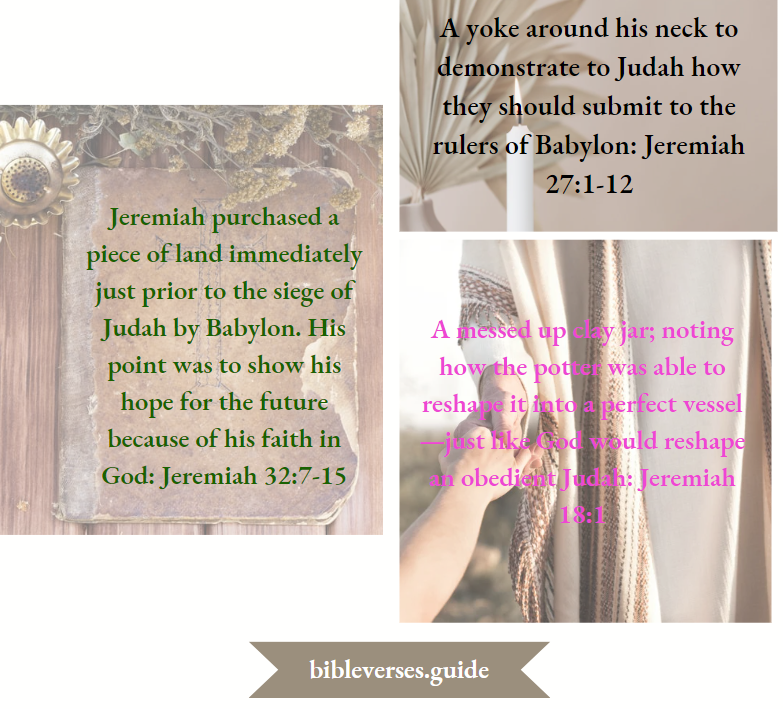
Jeremiah—A Man Who Uses Object Lessons

Jeremiah ‘spoke my language’; meaning he liked to use ordinary situations and objects to teach spiritual truths. Among the things Jeremiah uses to teach the people the truth of God’s holiness, love, and expectations for us include:

Jeremiah A Man Who Uses Object Lessons

Lamentations

The Message Of Lamentations

Jeremiah’s songs and poems he shares in the book of Lamentations are what garnered him the nickname “the weeping prophet”. In this book, he pours out his heart over the plight of the Judah because of their faithless acts of evil and disobedience. He is heartbroken over the destruction of Jerusalem and The Temple.

In the book of Lamentations, we also see the severity of God’s punishment.

In chapter four Jeremiah describes the misery and suffering of the people of Jerusalem during Babylon’s siege of the city. Starvation was so severe that they resorted to cannibalism!

The Message Of Lamentations

Lift up your hands to him for the lives of your children who faint from hunger at the head of every street.” Jeremiah knows that all that is necessary to put an end to their suffering is true repentance.

Jeremiah was a great preacher and evangelist. His words go straight to the heart of the matter but are also encouraging and hopeful. He doesn’t let us forget about our responsibility to be faithful and obedient to God, but he also doesn’t let us forget the bounty of blessings that come when we are.

Key Verses In Jeremiah And Lamentations

Every book of the Bible provides us with words of wisdom, instruction, comfort, encouragement, admonishment, warning, promise, and hope. Let’s look at some of what the books of Jeremiah and Lamentations have to offer.

“Your wickedness will punish you; your backsliding will rebuke you. Consider then and realize how evil and bitter it is for you when you forsake the Lord your God and have no awe of me,” declares the Lord, the Lord Almighty.” Jeremiah 2:19

“Discipline me, Lord, but only in due measure— not in your anger, or you will reduce me to nothing.” Jeremiah 10:24

Key Verses In Jeremiah And Lamentations

“Though he brings grief, he will show compassion, so great is his unfailing love. For he does not willingly bring affliction or grief to the children of men.” Lamentations 3:32-33

“You, O LORD, reign forever; your throne endures from generation to generation.” Lamentations 5:19

The Book Of Song Of Songs And The Book Of Isaiah

Books 22 and 23 The Book Of Song Of Songs And The Book Of Isaiah

Who wrote the book of Song of Songs: Solomon When was it written: 10th century B.C.

Why was it written: This book (also called the Song of Solomon) is a love story. The book was written to give insight as to the Israelite customs and attitudes on male-female relationships.

The book of Song of Songs is one of two books of the Bible that makes no mention of God—the other being Esther. The book has no doctrinal message, but it is a book of value to Christians nonetheless.

The value to be found in the book of Song of Songs is that God created us to be sexual beings—sexual beings with a pure heart and minds. God clearly created the institute of marriage when he created the earth and mankind.

Read and Learn More Bible Study For Beginners

He does, however, want us to enjoy our marital state and the joys that come from the romantic and sexual aspects of marriage. Song of Songs helps us free ourselves of a Puritan-like mindset; giving us ‘permission’ to delight in our sexual experiences as long as they are monogamous and within the bounds of marriage.

The Book of Isaiah

Who wrote the Book of Isaiah: Isaiah

When was it written: Most of the book was written around 700 B.C., but many things point to the last several chapters being written in the later part of Isaiah’s life—some thirty years after the first part of the book.

Why was it written: The overall message of the book can be summed up in the words judgment, salvation, restoration, and love.

Isaiah is the most ‘popular’ of the Old Testament prophets for a number of reasons including:

  • His years of serving as God’s prophet spanned four Judean kings (Uzziah, Jotham, Ahaz, and Hezekiah).
  • A great many of his prophecies were about the coming of Jesus and their fulfillment is obviously present in the New Testament as well as in more current history.

The Book of Isaiah

Isaiah’s Prophecies Regarding Israel

In spite of the fact that Isaiah lived in Judah, many of his prophecies were about the kingdom of Israel and their fall to Assyria.

He did, however, also prophecy about Judah’s exile to Babylon as well as the fall of Babylon that would come years later. Isaiah’s heart for all God’s children (Israel and Judah) was sincere.

He had weathered the battles between the two nations that should have been one. He knew their separation from one another and from God caused God great sorrow and he (Isaiah) wanted very much for the people to listen to the messages God gave him to share with the people. But they would not.

The demise of the two nations of Israelites is tempered by his prophecies of God’s promise to restore them to the land he gave them through Abraham, Isaac, and Jacob.

The restoration, however, is only for the kingdom of Judah because they found their way back to God, whereas Israel did not. Judah’s return and the rebuilding of The Temple had to have been a tremendous source of joy to Isaiah.

Isaiah’s Prophecies Regarding Judgement And Hope

While Isaiah’s warnings are definitely literal in nature, they can also be seen in a somewhat figurative, as well. The figurative nature of Isaiah’s prophecies refers to God’s kingdom here on earth—a kingdom that is spiritual in nature rather than physical.

Isaiah’s Prophecies About Jesus

Isaiah was spot-on in his prophecies regarding Jesus—his ancestry, birth, ministry, death, resurrection, and as we will one day see, his second coming.

While secular history undeniably backs up the events of Israel, Judah, Babylon, and Assyria, the fact that a man who lived hundreds of years prior to Jesus’ birth could tell us in such detail what was going to take place, well, that could only come from the Almighty God.

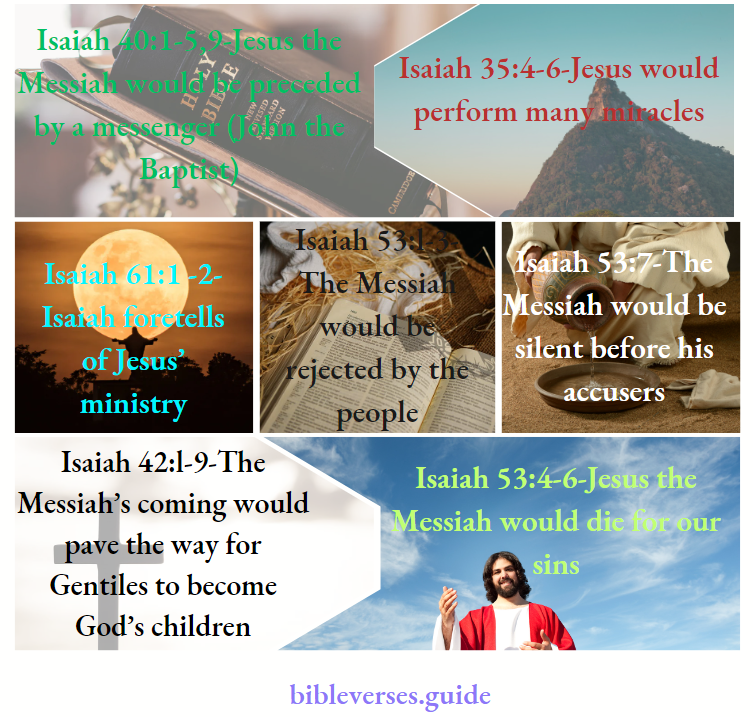
Let’s take a look at what Isaiah had to say about Jesus long before he was ever born:

Isaiah 7:14-Virgin birth of Jesus

Isaiah 9:6-7-He would be the son of God (he lists some of the names given to Jesus)

Isaiah 11:1-10-The Messiah would be a descendant of Jesse (King David)

Isaiahs Prophecies About Jesus

Isaiah 50:6-Jesus would spit on and beaten

Isaiah 53:12-The Messiah would be ‘numbered with the transgressors’ (die with criminals)

Isaiah 5 3:9-Jesus would be buried in a rich man’s tomb

Isaiah 49:6-The message of salvation through Jesus would reach the far corners of the earth

Some feel the book of Isaiah is depressing and somewhat difficult to understand. In some ways, it is depressing—to think that we cause God that much sorrow should make us feel ashamed.

And while the language or terminology can be a bit old-fashioned, it isn’t impossible to understand.

It simply takes a heart and mind open to what God has to say. Besides, in reading the book of Isaiah, one cannot help but see the hope that comes from God’s love—a love that is shown so clearly through his gift of restoration and salvation through Jesus.


Ecclesiastes Book Of The Bible

Book 21 The Book Of Ecclesiastes

Who wrote the book of Ecclesiastes: Solomon

When was it written: Around the 10th century B.C.

Why was it written: This book is an impassioned reminder that life without God as number one is completely meaningless. Life on earth and life after death is only fully complete with God.

Many see the book of Ecclesiastes as negative and depressing. They feel it is full of ‘woe is me’ and self-pity. But the truth of the matter is that nothing could be farther from the truth. Instead, the book of Ecclesiastes has several valuable life lessons we all need to hear and follow.

Read and Learn More Bible Study For Beginners

The Message That Material And Monetary Wealth Are Only Temporary

Solomon was the wealthiest person in the known world. Few, if any, have surpassed the degree of wealth enjoyed by Solomon, even today.

But by the time Solomon was nearing the end of his lie, he realized just how temporary and unimportant monetary and material wealth are. Solomon realized (and wants us to) that:

  • We really cannot take it with us when we die.
  • Our life will eventually become of no importance to those who come generations after us.
  • Spending life in a quest to accumulate and amass monetary and material wealth is a life wasted in comparison to amassing a ‘fortune’ of close, loving relationships.

The Message Of Balancing Work And Play

Solomon tells us that while work and play should be a part of life, they should be kept in check—that we need to keep them in the proper perspective. Without the proper perspective, he warns, we will live frustrated, unhappy lives.

Solomon also emphasizes that we should work at something we can find joy and take pride in rather than spend our lives working in a career we aren’t suited for or find fulfilling.

The Message Of Time

Ecclesiastes chapter three teaches and reminds us that there is a time and place for everything. From living and dying to keeping and throwing things away, there is a time for it all. There are even times when we should hate and times we should go to war.

The Message Of The Value Of Relationships

Solomon had no trouble surrounding himself with people— especially women. But someone in Solomon’s position would have trouble—lots of trouble-knowing whether the people claiming to be his friends and confidants were sincere. Were they?

Or were they after his money, a position in his court, or simply the status of being in the king’s inner circle?

Solomon undoubtedly experienced more than a few fake-friend incidents.

And underneath all that wealth and wisdom was a human heart that felt the pain of betrayal and insincerity. Solomon’s words, when taken to heart, can spare us from some of these experiences.

The Message Of God’s Sovereignty

This is the ultimate message of Solomon’s book of Ecclesiastes. By this point in Solomon’s life, he had come full circle.

He had experienced life in a state of total obedience and faith, and by living a worldly life on his own terms. He knew what worked and what didn’t and he wants us to know the same.

The book of Ecclesiastes ends with his entire message being summed up briefly and adequately:

“Now all has been heard; here is the conclusion of the matter: Fear God and keep his commandments, for this is the whole duty of man.

The Message Of God’s Sovereignty

Key Verses In Ecclesiastes

Every book of the Bible provides us with words of wisdom, instruction, comfort, encouragement, admonishment, warning, promise, and hope. Let’s look at some of what the book of Ecclesiastes has to offer.

“There is a time for everything and a season under heaven:” Ecclesiastes 3:1

Key Verses In Ecclesiastes

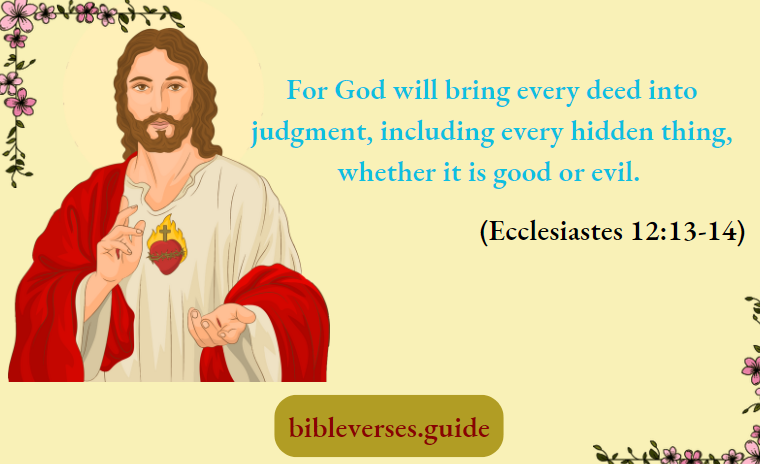
“Now all has been heard; here is the conclusion of the matter: Fear God and keep his commandments, for this is the whole duty of man.

For God will bring every deed into judgment, including every hidden thing, whether it is good or evil.” Ecclesiastes 12:13-14

The Book of Proverbs Volume 20

Book 20 The Book of Proverbs

Who wrote the book of Proverbs: Most of the proverbs were written by Solomon. Others, however, were written by ‘the wise’ and a man named Agur. The final chapter of the book of Proverbs is attributed to King Lemuel, who is most likely Solomon (but more on that later).

hen was it written: Most, if not all, were written during the reign of Solomon (10th century BC)—before the division of the Kingdom of Israel.

Why was it written: To give knowledge, wisdom, and advice to everyone.

Like the Psalms, Proverbs is not a book of events or doctrine, per se. The Psalms are a mix of praise, petition, worship, teaching, and warning. Proverbs, on the other hand, focuses on teaching, admonishment, warning, and encouragement (pleas) to grab hold of wisdom and practical knowledge and hang on to it.

Read and Learn More Bible Study For Beginners

Proverbs could easily have been written by anyone who has ‘been there, done that’ or an older person who has experienced life from all directions. Proverbs is filled with:

  • Warnings against making some of the same mistakes the writer has made
  • Truths of the results of choosing worldliness (sin) over righteousness (God)
  • Instruction on how to acquire real knowledge
  • Moral guidance—including how, what, why
  • Truths about the rewards that naturally result from making prudent and wise choices
  • Plain old common sense

Like the book of Psalms, Proverbs contains far too much to try to squeeze into a chapter of a book. So once again I will provide you with a mini-list of some of my favorite verses, but I also strongly encourage you to read the entire book.

Circle and underline the verses that speak to your heart and address your personal situation and life. Write notes in the margins of your Bible or prayer journal. Impress these words on your heart, soul, and mind. Live by them to be more of the person God made you to be.

The Book of Proverbs

Proverbs 4: A collection of verses teaching us the benefits and blessings of seeking wisdom and using it to make life choices.

“There are six things the LORD hates, seven that are detestable to him: haughty eyes, a lying tongue, hands that shed innocent blood, a heart that devises wicked schemes, feet that are quick to rush into evil, a false witness who pours out lies, and a man who stirs up dissension among brothers.” Proverbs 6:16-19

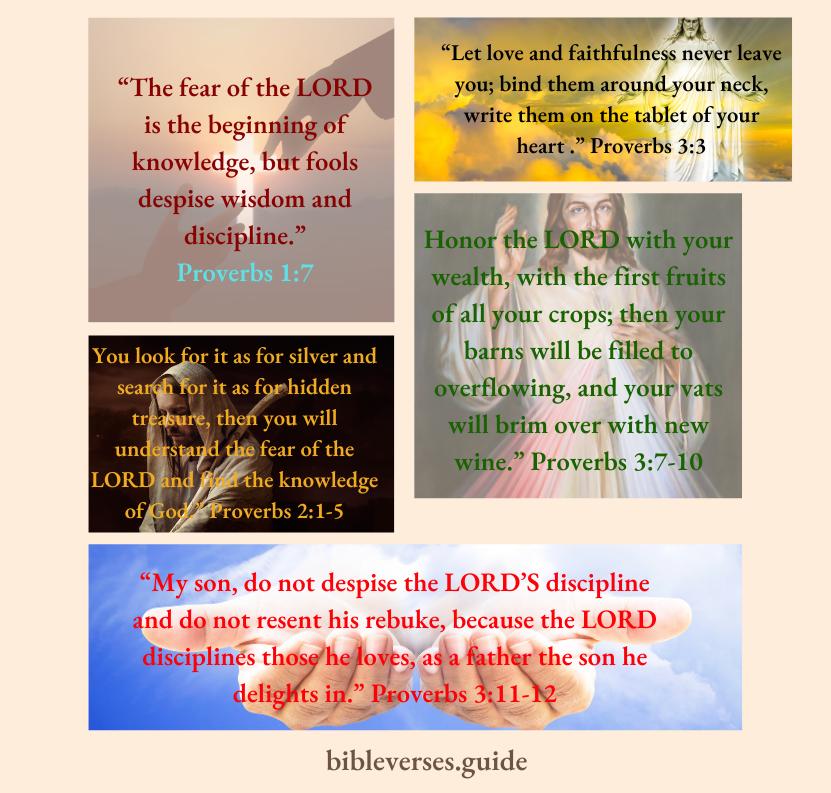
“The fear of the LORD is the beginning of wisdom and knowledge of the Holy One is understanding.” Proverbs 8:10

“The man of integrity walks securely, but he who takes crooked paths will be found out.” Proverbs 10:9

Proverbs 11: This chapter is filled with Godly and sound advice on living a life of integrity. The world would be a much better place if we followed this advice.

“Reckless words pierce like a sword, but the tongue of the wise brings healing.” Proverbs 12:18

Proverbs chapters 13, 15, and 16: These three chapters are must-reads for any Christian or anyone seeking to know how to live an upright life of honor and integrity. People whose character reflects these qualities will be respected, successful, and spiritually sound.

The Book of Proverbs Key Verses

“Keep falsehood and lies far from me; give me neither poverty nor riches, but give me only my daily bread. Otherwise, I may have too much and disown you and say, ‘Who is the LORD?’ Or I may become poor and steal, and so dishonor the name of my God.” Proverbs 30:8-9

Proverbs 31: The second half of this chapter is arguably the most popular and most often quoted from the book. The heading at the beginning of the chapter is this: “Saying of King Lemuel”, which leads us to the comment at the beginning of this chapter regarding the belief that King Lemuel and King Solomon are one and the same.

While there is no hard evidence that King Lemuel is in fact, King Solomon, the probabilities are strong. The reasons for this include:

  • There is no other reference to King Lemuel in the Bible other than in Proverbs 31.
  • The only historical record of King Lemuel is one who was descended from Ishmael. This fact would remove him from the likelihood of being a contributor to the Bible.
  • Solomon’s mother, Queen Bathsheba, would have had every reason to advise her son in this manner (considering the lifestyle choices he made later in life)
  • Solomon’s life and other writings are in line with the message of Proverbs 31—the ‘learn from my mistakes’ mentality

Regardless of who Lemuel is, the wisdom of the words is timeless and priceless.

For women, it is an encouragement and reminder that God honors women for using their intellect, heart, and physical strength to be the people he created them to be.


The Book Of Psalms

Book 19 The Book Of Psalms

Who wrote the book of Psalms: The Psalms were written by several different people as follows: David (73), Asaph (12), the sons of Korah (10), Moses (1), Solomon (2), unknown (50), Herman the Ezrahite and Ethan the Ezrahite (1 each).

When was it written: Obviously the writers of the Psalms were not all living at the same time, but their writings were put together in a collection by a psalter. A psalter is one who compiles a collection of songs or poems. The compilation of the Psalms was probably written around 300 B.C.

Why was it written: It is a book of prayer and praise; recognizing God’s holiness, awesomeness, power, and glory.

Read and Learn More Bible Study For Beginners

To try to put the Psalms in some sort of order of relevance would be both impossible and wrong. The Psalms speak to our hearts and minds depending upon the circumstances we are facing or the situations we are in.

The words that bring special meaning today may not be as comforting or empowering as others next month or next year. So rather than try to tell influence your reading of the Psalms, I am simply going to give you a mini-list of those that encompass a variety of emotions and feelings.

Don’t let this list be the extent of your exposure to the Psalms, though. Read the entire book; circling, underlining, and making notes. Let them sing to your heart, soul, and mind.

“Blessed is the man who does not walk in the counsel of the wicked or stand in the way of sinners or sit in the seat of mockers. But his delight is in the law of the LORD and on his law he meditates day and night.” Psalm 1:1-2

The Book Of Psalms

“When I consider your heavens, the work of your fingers, the moon, and the stars, which you have set in place, what is the man that you are mindful of, the son of man that you care for?” Psalm 8:3

Psalm 15: A psalm reminding us of the blessings that come from being a faithful and obedient child of God.

“LORD, you have assigned me my portion and my cup; you have made my lot secure. The boundary lines have fallen for me in pleasant places; surely I have a delightful inheritance.” Psalm 16:5-6

Psalm 18: A psalm of praise and thanksgiving for God’s protection and love

A Psalm of comfort

“Delight yourself in the LORD and he will give you the desires of your heart.” Psalm 37:4

“Create in me a pure heart, O God, and renew a steadfast spirit within me.” Psalm 51:10

“My soul finds rest in God alone; my salvation comes from him.” Psalm 62:1

“In the day of my trouble, I will call to you, for you will answer me.” Palm 86:7

“LORD, you have been our dwelling place throughout all generations. Before the mountains were born or you brought forth the earth and the world, from everlasting to everlasting you are God.” Psalm 90:1-2

A psalm of praise and worship to God

“If you, O LORD, kept a record of sins, O LORD, who could stand? But with you there is forgiveness; therefore you are feared.” Psalm 130:3-4

“How good and pleasant it is when brothers live together in unity!” Psalm 133:1

Psalm 139: A psalm that reminds us of just how personally interested God is in each detail of our lives. He longs to have a genuine and intimate relationship with each and every one of us.

“Teach me to do your will, for you are my God; may your good Spirit lead me on level ground.” Psalm 143:10

Psalm 145: A psalm to remind us of God’s faithfulness and his desire to be the LORD of our life. It is also a psalm that reminds us of the blessings we receive in having such a relationship with him.


Book of Job Chapter 18 Summary & Analysis

Book 18 The Book of Job

Who wrote the book of Job: No one knows for sure, other than the writer being an Israelite with access to the discourses of Job and his friends and between Job and God. This is not unusual in the fact that

God spoke to his people regularly at this point in history; telling them what took place and

Writing of events was commonplace for the purpose of historical documentation.

Book Of Job Chapter 18 Summary Explained

When was it written: Most likely between 1,000 and 2,000 B.C.— again God used a messenger to record the events in Job’s life.

Why was it written: To show the holiness of God, the power of God, and the fact that God is just. No one is undeserving of anything we encounter due to the fact that we are not God—we are sinful. But God’s infinite love and wisdom can bring us up and out of those times when we allow him to.

Read and Learn More Bible Study For Beginners

Who Was Job

The first verses of the book of Job tell us that Job was a very wealthy man and a man who was humble and obedient to God in all things. We also read early on that God and Satan had a couple of conversations about Job.

God was expressing his pride and pleasure with Job, while Satan insisted that Job’s faith was blessing-based. Satan said that if Job lost his wealth, health, and loved ones, he wouldn’t be so eager to please God.

God gave Satan permission to take everything Job had except his life. Satan was told he could do whatever he wanted to Job as long as Job didn’t die.

So to many, the short answer to the question, “Who was Job?” is this: Job was the object or prize to be gained in a challenge between God and Satan.

God And Satan’s Relationship

If you remember from the chapter in the book of Genesis, Satan was one of God’s angels prior to being banished from heaven.

Satan and a few other angels under his influence tried to oust God from his place of holy oneness. To punish Satan for his rebellion, God banished him to earth with the promise to punish Satan for all eternity in hell—a place of unfathomable torment. But until that time, Satan has the power to tempt us to sin and wreak havoc in our lives.

All of this took place prior to the creation of the earth as recorded in Genesis, which explains why Satan tempted Adam and Eve. Satan’s goal is to lure anyone and everyone he can away from God.

While these facts explain who Satan is and what he does, it doesn’t explain why God allowed Satan to live. Why didn’t God just do away with the rebellious being?

Analysis Of Job Chapter 18 Commentary

Job’s Choice Is Our Choice Too

The book of Job answers the question of why God allowed Satan to live and work his evil cunning in our lives. The answers can be found in Job’s circumstances, Job’s attitude and handling of his circumstances, and the end result brought about by God.

The Answers Are:

  • Satan exists to show us the difference between good and evil
  • Satan exists to give us the option to choose God over sin
  • Satan exists to show us just how dark life without the presence of God is
  • Satan exists to show the enormity of Jesus’ power over death and the victory that will be eternity with God in heaven

Job had to choose God over riches. God over self. God over anger. God over self-pity. Job had to choose to trust that God’s ways are always perfect, always good, and always right. Job choices were the same as the ones we had to make.

Job’s Test Of Faith

Satan was allowed to destroy all of Job’s wealth, kill his children and children-in-law, and inflict Job with a severe case of boils.

These calamities came in rapid succession; leaving Job to deal with more grief than most of us can imagine, knowing his fortune and livelihood had been yanked out from under him, and suffering a tremendous amount of physical anguish.

All Job had left was a wife (who was also grieving and trying to deal with everything) and friends who tried to help but didn’t know how.

Job questioned God’s reasoning in all of it. Job cried out in pain and frustration. Job had a bit of a pity party for himself. Job became discouraged and depressed; saying he wished he’d never even been born. But Job never questioned God’s right to take everything from him. Job never thought himself too righteous to be ‘messed with’.

And these attributes of his character are what make Job such a great example of how we should look at life.

Key Themes In Job Chapter 18 Breakdown

The Ultimate Message Of Truth In The Book Of Job

Job’s story is heart-wrenching, to say the least, but more than that, Job’s story is one that should serve to remind us that God is the all-knowing creator and master of the universe.

In reading Job, we should realize that we have no reason to doubt his methods, his timing, and his will because they are always perfect. Even when we don’t understand or agree with them, they are perfect and right.

Key Verses In Job

Every book of the Bible provides us with words of wisdom, instruction, comfort, encouragement, admonishment, warning, promise, and hope. Let’s look at some of what the Book of Job has to offer.

“He replied, “You are talking like a foolish woman. Shall we accept good from God, and not trouble?” Job 2:10

Biblical Perspective On Job Chapter 18

“Blessed is the man whom God corrects; so do not despise the discipline of the Almighty, for he wounds, but he also binds up; he injures, but his hands also heal.” Job 5:17-18

“What is man that you make so much of him, that you give him so much attention, that you examine him every morning and test him every moment?” Job 7:17-18

Job Chapter 18 Bible Study Guide

Key Verses In Job


Summary of the Book of Esther

Book 17 The Book Of Esther

Who wrote the Book of Esther: The author is unknown, but most definitely a Jewish person living during the time of the Persian Empire.

When was it written: 460 BC to 331 B.C.

Why was it written: The purpose of this book is to record the history surrounding the institution of the Jewish Feast of Purim and the account of the Jewish race being saved from massacre and total annihilation by an unassuming Jewish girl who rose to a position of power and prestige because it was her God-given purpose in life.

Read and Learn More Bible Study For Beginners

Who Was Esther

Esther was a Jewish orphan being raised by her cousin, Mordecai, and his family. We learn early on that Esther was a very beautiful young lady, but that her physical beauty was only a compliment to her inner beauty.

Summary Of The Book Of Esther

Through a course of events that were completely beyond her control, Esther was chosen as the winner of a ‘beauty contest’ with the grand prize being made the Queen of the Persian Empire—the wife of King Xerxes.

Events Leading To The Near-Massacre Of The Entire Jewish Race

During the course of events that led to Esther becoming Queen of the Persian Empire, she had no idea why everything was happening the way it was. What possible reason could there be for her—a Jewish girl —to become the wife of the most influential and powerful man in the world?

God, however, knew exactly why and we see his plan unfolding in the second chapter of Esther. Esther’s cousin/adopted father Mordecai loved Esther as a daughter. His love for her caused him to go to the palace courtyard each day to check on her and often times he was able to visit with her.

Book Of Esther Overview

Psalm23.infoKnowledge Of The HolyEvery Christian Should Know
Key Biblical Messianic PropheciesPower in the BloodPsalm91.infoSavior on the Cross
Pursuit of GodBible Study For BeginnersPray For Those You LoveBible Study Act

It was during one of these visits that Mordecai overheard two of the king’s officers planning to assassinate the king.

Mordecai naturally told Esther, who promptly told the king—giving credit to Mordecai for saving the king’s life. Mordecai’s regular presence around the palace, however, became a source of contention for King Xerxes’ number-one man, Haman.

Purim And The Book Of Esther

So when Mordecai refused to bow down to Haman, Haman went to the king and tricked him into signing a declaration that all Jews would be killed on a certain day because of their insubordination and disrespect for the king (a total lie).

When Mordecai heard about the law that Haman had tricked the king into making, he went to Esther and convinced her that she was the only one who could save their people from annihilation.

Esther’s Brave Actions Saved An Entire Race

Esther’s Immediate Response Was One Of Hesitancy For The Following- Reasons:

  • Her husband, the king, did not know she was Jewish
  • Approaching the king when not invited to do so could result in being sentenced to death

Mordecai, however, wasn’t going to let Esther get off that easy. Being the Godly man he was, he convinced Esther that this time was quite possibly the reason she had become queen in the first place.

Esther Bible Story Summary

Mordecai’s words to his adopted daughter when she initially refused his request to go to the king on behalf of the Jewish people are among the most quoted in the Old Testament:

“…Do not think that because you are in the king’s house you alone of all the Jews will escape. For if you remain silent at this time, relief and deliverance for the Jews will arise from another place, but you and your father’s family will perish.

The Book Of Esther

Esther musters the courage to go to her husband uninvited and after a series of events, Haman’s deception and prejudices are uncovered, he is put to death for his actions, and Mordecai becomes the king’s right-hand man.

But more importantly, King Xerxes gave the Jews permission to defend themselves against anyone who attacked them —even to the death. This was to counteract the previous decree allowing the Jews to be killed.

The Jews were victorious over all who attacked them and in order to celebrate their victories, the Feast of Purim was instituted and is still being celebrated today.

The Value And Validity Of Esther

The book of Esther has been the subject of much discussion and even controversy by some in the theological community. There are several reasons behind these discussions.

The Most Prevalent Are:

  • The fact that God is not mentioned once in the entire book
  • The name Esther is not mentioned in history books as being one of Xerxes’ wives, therefore making the account fictional

Both arguments can easily be put to rest, though.

  • While God’s name is not mentioned in the Book of Esther, his presence in the hearts and minds of the people is definitely not missing.
  • Additionally, his protection and influence over the Jewish people in giving them victory over their enemies is obvious considering the fact that they were militarily inferior to just about anyone and everyone at that time in history. Also worth noting is the fact that the book of Song of Songs does not mention God’s name, either.
  • The dates, archeological references, cultural references, and other historical data found outside the Bible are consistent with the account given to us in the Book of Esther. While the name Esther is not listed as one of Xerxes’ wives, this is not proof that she did not exist. Why?

Not everything is recorded in the ancient records we have available to us. An incident that painted an unfavorable picture of the king’s ability to select sound leadership would definitely be something secular history would not record.

Kings had multiple wives. Not to mention that some of them are completely normal. The mother of the heir to the throne is usually the only one mentioned.

“The significance of the account of Esther is spiritual and pertinent to the Jewish race. It was not relevant to the success or failure of the Persian Empire.

Key Themes In The Book Of Esther

“As more research has been done and documents unearthed, more tangible evidence of Esther’s existence and role in history. The book of Esther is historical, yes, but it is also a reminder that:

  • God’s plans and purposes for each of us might not be blatantly obvious to us or even what we think they should be, but that doesn’t mean they don’t exist. It simply means we need to ask God to reveal them to us and then be ready to listen and act.
  • We have nothing to fear when God is with us.
  • God’s heart is always ready and his arms are always open and waiting to welcome us back to him.

Queen Esther And Mordecai Story

The Value And Validity Of Esther

ALL scripture is God-breathed…

 In other words, if Esther was not real and if the events did not take place as they are recorded, it would not be part of God’s Holy Word.

The Book of 1st Chronicles And 2nd Chronicles

Book 13-14 The Book of 1st Chronicles And 2nd Chronicles

1st Chronicles

Who wrote the books of 1st Chronicles and 2nd Chronicles: Ezra is the assumed writer of Chronicles.

When was it written: Between 400 and 500 B.C.

1st And 2nd Chronicles Study Guide For Personal Growth

Why was it written: Chronicles is a historical record written for the exiles who returned after their exile to Babylon. Their captivity ended with the fall of the Babylonian Empire and the rise of the Persian Empire.

Overview Of 1st And 2nd Chronicles In The Bible

Upon their ‘release’ the Israelites, which now consisted of only the tribes of Judah and Benjamin, are wondering whether or not God’s promises and covenant still hold true since they have no king—no Davidic king, that is.

Read and Learn More Bible Study For Beginners

The book of 1st Chronicles differs, however, by opening with a ‘family tree’ of sorts. The first eight chapters list the names of the son of Jacob for which each of the twelve tribes is named, followed by their descendants and the location of the land given to them when they entered the Promised Land.

This is followed by a reprisal of the events of David’s reign as king, the death of King David, and the events that led to Solomon being recognized as the new king of Israel.

Biblical Perspective On 1st And 2nd Chronicles

2nd Chronicles

The book of 2nd Chronicles begins with the re-telling of Solomon’s reign; beginning with him choosing wisdom when God tells him he can have whatever he asks for and ending with his death.

The remainder of the 2nd Chronicles does just that—chronicles the reigns of the kings of Israel and Judah and the events that led to each kingdom’s fall from God’s grace and its demise from power and existence.

Key Themes In 1st And 2nd Chronicles Explained

The primary difference between the 2nd Chronicles and the books of the 1st and 2nd Kings is the fact that the events recorded are from a more spiritual point of view rather than a factual one. The reason for this is likely due to the writer’s (Ezra’s) mindset.

Ezra was a Godly man— one of the few who had not turned his back on God. Ezra was mindful of all God had done for his people from the time they had left Egypt and lived to honor God by obeying The Law of Moses.

Ezra wrote to let us know not only what happened governmentally to the people of Israel and Judah, but also what happened to them spiritually and emotionally. He lived it—or at least part of it. His words are to serve as a warning to us all.

1st And 2nd Chronicles Commentary

They warn us of what happens when we take God out of the equation of anything and everything we do. Ezra’s warning can best be summed up by remembering (and taking to heart) the words he recorded that were spoken by God to Solomon shortly after the completion and dedication of The Temple Solomon built:

The Book Of 2nd Chronicles

Books Of Ezra And Nehemiah

Books 15 and 16

The Book Of Ezra

Who wrote the book of Ezra: Ezra When was it written: 440 B.C.

Why was it written: The book of Ezra is a history of Judah’s return from Babylonian exile. The Persian Empire had become the dominant world power, but King Cyrus had no problem letting the Jewish people return to Jerusalem to rebuild the temple.

It is during this time that Ezra reminds the Judean people (Israelites) of the law, brings religious reform to them, and reminds the Jewish people that they are God’s chosen people.

Read and Learn More Bible Study For Beginners

After opening the book by telling us how God moved in the heart of the Persian king, King Cyrus, to allow the people to return to Jerusalem to live AND to rebuild their temple, we discover that Ezra is quite fond of lists.

In Ten Short Chapters, Ezra Includes Three Rather Lengthy Lists:

  • A list of exiles who returned to Jerusalem
  • A list of the heads of each family who returned to Jerusalem with Ezra
  • A list of members of the priests who had sinned by marrying foreign women

These lists may seem irrelevant to most people, but they are proof of God’s promise to not completely wipe out those he called his children. It is also proof that at least some of the Levites were part of the kingdom of Judah and had survived the exile.

Other Historical Events Recorded In The Book Of Ezra Include:

  • The delay in the rebuilding of The Temple was due to a decree by King Artaxerxes, followed by a decree by King Darius to allow the reconstruction to resume.
  • The completion and rededication of The Temple
  • The celebration of the Passover
  • Ezra’s return to Jerusalem with all those who had not been part of the rebuilding process.
  • Ezra’s ‘sermon’ to the people prompts them to confess their sins and turn back to God.

We also learn from reading the book of Ezra that the prophets Haggai and Zechariah were contemporaries of Ezra—part of the group of people that returned to Jerusalem following the 70-year exile of Judah.

The overall message or theme of the book of Ezra, however, is that as God’s chosen people, the Judean people were to worship only God and to keep themselves pure by living according to The Law.

The Book of Nehemiah

Who wrote the book of Nehemiah: Nehemiah When was it written: 430 B.C.

Why was it written: Regardless of who wrote the book of Nehemiah, the undeniable truth is that Nehemiah is conveying the message God gave him about the importance of prayer. The book also continues the history of the Judean people during and after the rebuilding of the temple.

Given Nehemiah’s devotion to the spiritual discipline of prayer, it is only fitting that the book opens with Nehemiah’s prayer on behalf of the exiles returning to Jerusalem. In his prayer, Nehemiah asks God to remember his promises to Moses.

The Book of Nehemiah

Nehemiah went to Jerusalem in 445 BC to take charge of rebuilding the walls of the city. The primary message in the book of Nehemiah is to remind us of the importance of prayer.

Following Nehemiah’s prayer we find that Nehemiah, who was serving as King Artaxerxes’ cupbearer, asked the king if he could return to Jerusalem to oversee the rebuilding of The Temple.

Nehemiah was allowed to go on the condition he provided a set time for his return. The king also provided Nehemiah with letters to other kings stating that he should be allowed to purchase materials to be used for the reconstruction.

Beginning in the second half of the second chapter of Nehemiah and continuing through the twelfth chapter we read about some of the events surrounding.

The Temple’s reconstruction. Many of the same events we read in Ezra are also recorded in Nehemiah, including Ezra’s reading of the Law, the people’s confession of their sins, and the lists of the people who returned to Jerusalem, a list of the Levites serving as priests, and a list of those who signed an agreement to follow the Law.

Things we see in this book that aren’t in the book of Ezra but are still part of the account of the people’s return to Jerusalem include:

  • The people are now called Jews instead of Israelites
  • Nehemiah’s going to the defense and assistance of the poor. He chastised those who had money for their practicing usury. He reminded them that they were a family—and that family should stick together and treat each other with love and respect.

The book of Nehemiah closes with his personal account of the reforms Nehemiah brought about in the lives of the Jewish people upon his second return to Jerusalem (he had returned to King Artaxerxes as promised after his first trip).

Nehemiah’s sense of responsibility in being a spiritual leader to his people is admirable and one we should seek to develop in our own selves today.

The Book of 1st Kings And 2nd Kings

Books 11 And 12 The Book of 1st Kings And 2nd Kings

1st Kings

Who wrote the books of 1st King and 2nd Kings: The author is unknown

When was it written: Between 562 and 538 B.C.

Why was it written: These two begin by providing us with the spiritual and physical history of the kingdom of Israel during the reign of Solomon—the son of David and Bathsheba. Following Solomon’s death, the kingdom of Israel became divided into two separate kingdoms—Israel and Judah.

Beginning in the twelfth chapter of 1st Kings all the way through the end of 2nd Kings we are provided with a listing of sorts of the kings, but more importantly, we are given a glimpse into the hearts of the Israelite people during these tumultuous years.

1st Kings And 2nd Kings Bible Summary

Read and Learn More Bible Study For Beginners

2nd Kings ends with the fall of both kingdoms—both being taken captive by great empires in history. But it wasn’t the strength of the Babylonians or Assyrians that ultimately caused the kingdoms to fall. It was God’s plan of discipline and yes, even punishment for Israel’s unrelenting faithless disobedience that ultimately led to their fall.

As we look deeper into these two books of the Old Testament, our primary focus will not be on the kings themselves, but rather the people of Israel under their leadership.

Solomon As king

Solomon did not come into power without a struggle. A half-brother, Adonijah, tried to put himself on the throne. But this was not God’s plan, so after a series of events Adonijah’s plans were thwarted and Solomon took the throne.

Early into his reign as king, the LORD appeared to Solomon; telling Solomon he could have whatever he asked for. Solomon, who was obviously already somewhat astute, asked for wisdom. With wisdom, he told God, he would be able to lead Israel victoriously, attain wealth, and establish himself as a man of honor. God was so pleased with Solomon’s request that he gave Solomon an abundance of everything.
Solomon As king

It was also during the early years of Solomon’s reign—the 4th year, to be exact—that Solomon began construction of The Temple. The details given about the building of The Temple are interesting and humbling.

They are interesting in the fact that it is fascinating to read and think about the degree of skill and manual labor that went into such a massive undertaking. The details are humbling because they serve as a reminder that if God is that concerned about the details of a building, how much more is his interest in each of us—the children created in his image?

The pomp and circumstance and the assembly of worship that took place in dedicating The Temple included bringing the Ark of the Covenant to its place of honor in this building consecrated to the LORD.
The Book Of 2nd Kings

Because of Solomon’s sin, God came to Solomon and told him the kingdom would not remain in the hands of his family—that it would be ripped from the hands of his son.

True to his promise, near the end of Solomon’s life, one of Solomon’s officials, whose name was Jeroboam, rebelled against Solomon. Following Solomon’s death Jeroboam led the revolt against Israel’s new king, Rehoboam (Solomon’s son).

The Book Of 1 Kings And 2 Kings KJV/NIV/ESV

The revolt resulted in the division of Israel. Ten tribes followed Jeroboam to form the kingdom of Israel, while two remained with Rehoboam to form the kingdom of Judah.

ISRAEL: Asher, Dan, Gad, Issachar, Naphtali, Ephriam/Manesseh, Reuben, Simeon, Zebulun

JUDAH: Judah, Benjamin

You might be wondering why the tribe of Levi is not mentioned. Because the tribe of Levi was not part of Israel’s fighting forces or labor forces, they are not mentioned. From all indications, the loyalties of the Levites—the priestly tribe—were split. Some went with the Northern Kingdom (Israel) and some with the Southern Kingdom (Judah).

Elijah

Elijah was a prophet and faithful man of God who lived in Israel. God used Elijah in some extraordinary and miraculous ways—primarily during the reign of King Ahab, the most evil king to ever lead Israel. Elijah’s primary purpose was to bring God’s message of hope and redemption to Israel.

God prepared Elijah for ministry by putting him in a situation that required Elijah to put his complete trust in God. Elijah had to trust God to provide for him during the severe famine by using Ravens to bring him food and to supply water from an otherwise dry creek bed. Elijah ‘passed the test’ and went on to serve God in mighty ways that included:

  • Ringing the blessing of God’s miraculous blessings into the home of a poor widow and her son, and later bringing the son back to life
  • Humiliating the prophets of Baal on Mt. Carmel by allowing God to show himself in mighty, mighty ways in order to prove he is the One True God
  • Acting as a mentor to Elisha, who would serve as God’s prophet and spiritual leader after Elijah
  • Elijah was taken up to heaven by God while he was still living. He and Enoch are the only two people in the history of mankind to enter eternity in this way.

Elisha

Elijah’s life and ministry were similar to that of Elijah’s in the fact that God used Elisha to display his (God’s) power in miraculous ways.

What Is The Purpose Of 1st And 2nd Kings?

  • Elisha also brought a widow’s son back to life
  • Elisha saved men from eating stew containing poisonous plants by adding flour to the pot
  • Elisha healed a man named Naaman from leprosy
  • Elisha was able to make an axe head made of metal float on top of the water

2nd Kings

The ‘tales’ of the kings in the 1st and 2nd Kings generally read like a ‘who’s who’ of horrendous leadership. Of the nineteen kings Israel had from the time the kingdom split until the Assyrians took them into captivity, none of them were good. All of them did evil in the eyes of the LORD. Only one, Jehu, was said to be somewhat decent.

Judah had twenty kings during from the time of the split until they were taken into captivity by the Babylonian Empire. Out of twenty, six were Godly men who led the people in the ways of the LORD, two started out on a positive note but like Solomon, were led astray. The other twelve were evil and cared nothing about God.

Three kings that are deserving of special mention are Hezekiah, Manasseh, and Josiah. All three were kings of Judah. Two were Godly kings and one was so evil that his actions took God’s anger at Judah to the breaking point. Because of this king God decided to wipe Judah out and turn them over to the hands of their enemies.

The first of the three was Hezekiah. King Hezekiah’s life is interesting in the fact that he begged God for more time on earth and got it. It happened like this…

Hezekiah became very ill and the prophet Isaiah was sent by God to tell Hezekiah that the illness he was suffering from was one he wouldn’t recover from. Hezekiah was going to die. King Hezekiah wasn’t ready to die, though.

Bible Verses From 1 Kings And 2 Kings
Hezekiah's plea takes on a bargaining tone

God granted Hezekiah the desire of his heart by telling him he would add fifteen years to his life. At the end of the fifteen years, Hezekiah died and his son Manasseh became king.
Manasseh was the most evil of all the kings of Judah.
Solomons wealth wisdom and fame took on a more worldly tone

He rebuilt all the idols his father had ordered torn down. He placed an Asherah pole (an idol of the fertility goddess) in The Temple. He ‘filled’ Jerusalem with the blood of innocent people and his depraved heart, soul, and mind committed all sorts of terrible sins against himself and others (and of course, against God).

Manasseh’s sins were so great that God’s anger could no longer be contained and his patience with Judah was gone. Because of Manasseh’s sin, God decided that when the time was right he would destroy them by handing them over to the Babylonians.

The third Judean king we want to look at is Josiah. Josiah was the grandson of Manasseh and came to power a little more than two years after Manasseh’s death and his own father’s death (who ruled after Manasseh did).

Josiah was just an eight-year-old little boy when he took the throne. He was the youngest king to lead Judah and one of the longest-serving kings (thirty-one years). King Josiah did what was right in the eyes of the LORD all the days of his life.

Historical Context Of 1 Kings And 2 Kings

He was faithfully obedient in all things. How Josiah came to know and love the LORD so intently is mind-boggling since he had no positive spiritual fraternal influence. But God had a plan and a purpose for the small king—a plan and a purpose stronger than all the sin and evil in the world.

During the eighteenth year of Josiah’s reign, he ordered and oversaw some major repairs of The Temple. In the process of getting the work done, the Book of the Law (the Mosaic Law) was found and read by Josiah’s secretary, Shaphan, to King Josiah.

When Josiah heard the Law being read, he was even more committed than ever to bringing the people’s hearts back to God… where they belonged. Josiah’s actions and heart did not go unnoticed or unappreciated by the LORD. Because of Josiah’s faithfulness, God allowed Judah to remain intact until after Josiah died.

The Fall Of Israel And The Fall Of Judah

Israel was the first of the two kingdoms to fall. While King Hoshea was king of Israel, Assyria captured the capital city of Israel, which was Samaria, and took the people captive. From there the exile took in the entire kingdom. This took place around 721-722 BC. The ten

tribes were scattered throughout the land and to this day have not been ‘found’. While there are undoubtedly scores of descendants from these ten tribes, they are not recognized

Historical Context Of 1 Kings And 2 Kings

In 605 BC Judah fell to the Babylonian Empire which was under the leadership of King Nebuchadnezzar.

The exile lasted seventy years— just as God said it would. Unlike the ten tribes of Israel, the tribes of Judah and Benjamin would survive, because from them would eventually come our LORD and Savior, Jesus Christ.