Use Me

Use Me

I Wish I could have been there to see Mary’s face the day the angel came to her and announced that she would be giving birth to the Son of God.

Did she wonder if she was losing her mind? Did she think some mischievous neighborhood children were playing a trick on her?
Luke 1-38

Like many faithful Jews, Mary had been eagerly waiting for the long-promised Messiah.

But the angel’s announcement that her womb would be the channel the Son of God would use to come into the world must have been shocking.

Luke 1-29-30

The first question Mary had concerned logistics. “How will this be, since I am a virgin?” The angel explained that “the Holy Spirit will come upon you, and the power of the Most High will overshadow you” (Luke 1:34-35).

Though confusing, this answer was good enough for Mary. “I am the Lord’s servant,” she answered. “May it be to me as you have said.”

I bet angels wish more human beings were as cooperative as Mary. The Bible is full of stories of people who resisted the call of God in their lives.

Mary’s willingness to submit to God’s will shows why Christians throughout the ages have had a special respect for her.
Luke 1-34-35

The most famous disobedient Bible character is Jonah, who turned his back on God’s call and suffered the consequences.

But Jonah isn’t alone. Old Testament figures like Moses, David, and Solomon resisted God’s demands and saw their leadership ability severely hampered.

In the Gospels, the disciples repeatedly failed to live up to Jesus’ expectations. And in Acts chapter five a couple named Ananias and Sapphira tried to cheat the church.

The couple had pledged to share all their worldly wealth with the Christian church that arose in Jerusalem after the resurrection of Christ.

But after they received a windfall from a real estate deal they tried to hide their earnings from their fellow believers. Both Ananias and Sapphira “fell down and died” after their disobedience was revealed.

Mary’s case is an unusual one. It’s not every day that God wants a human being to give birth to his Son. But her attitude is an example for us all.

What might God want to do through you? And what will your response be when his angels come knocking at your door?

Maybe there’s a sad and lonely person in your town whom God would like to reach, but he wants to reach him through you. Maybe there’s a widow weeping over her loss, and God wants to comfort her through you.

Maybe there’s a local soup kitchen that needs another pair of hands to prepare warm meals for cold and hungry people.

Maybe there’s a Sunday school class that needs a teacher, or a nursery that needs another person to attend to toddlers.

You may never know all the fulfillment God has in store for you unless you open your heart as Mary did and submit to his higher purposes for your life.

God will not call on you to give birth to the Messiah, but you might just be the warm heart and tangible physical presence God needs to express his love to someone who could use it right now.

Your deeds may not be recorded in the Bible or read by millions of people for thousands of years. But God will know what you’ve done, and that will be more than enough.

God, use me for your purposes. Show me what you want me to do.


Remembering What God Has Done

Remembering What God Has Done

The children of Israel once again crossed through waters God parted as the Jordan River opened before them. As soon as all had safely passed, the waters of the Jordan returned to flood stage.

Joshua had commanded one man from each of the twelve tribes to take a stone from the riverbed and bring it with him as he came out of the water.

They carried the stones to Gilgal on the eastern border of Jericho, where Joshua erected the stones in a memorial.

He told the Israelites to teach their descendants that this pile of ordinary river stones symbolized God’s faithfulness as the people had crossed the Jordan, just as he had demonstrated his faithfulness when they had crossed the Red Sea.

Why is it important to preserve a record of God’s dealings with us? I think we need reminders of the unchanging faithfulness of God as we live in a world that is ever-changing.

Joshua 4-3

As we read the Bible it reminds us of just how omnipotent God is. His hand stretches back through all of history and forward into all of the future.

But sometimes we forget. Or our stories of God’s faithfulness lose their focus as one generation retells them to the next.

When we go through long periods of time when God seems distant, doubts can disrupt our faith, and we may wonder how we felt when God’s power was evident.

Just as the twelve stones from the river Jordan aided the Israelites’ memories, the memorials we make enliven our memories.

One of the ways that I am trying to preserve family memories that are laced with touches from God’s hand is to make creative photo albums.

I am not a “crafty” person, but I have found great fulfillment in turning a collection of photos into a storybook that not only displays pictures but records what is happening during family times together.

I am hopeful that generations from now my descendants will look through these books and see the evidence of a family who loved God and lived in ways that acknowledged his presence in their lives.

Memorials can be journals or collections of writings or artwork— any number of things that express the reality of the presence of God in the life of an individual or family.

Whatever they are, they can be like the twelve smooth stones from the Jordan that bring us back to a time of experiencing the power of God in our lives.

Father, thank you for the ways that memories of your working in our lives can encourage us in the present moment. Help us to preserve them for future generations.


The Greatest Thing

The Greatest Thing

Musicians such as country star Alan Jackson and rocker Bruce Springsteen wrote songs about the grief and sorrow the terrorist attacks on New York’s World Trade Center caused.

Jackson’s Drive album featured the song “Where Were You (When the World Stopped Turning)?” Springsteen’s album, The Rising, a recording permeated with Christian themes, included a song called “Into the Fire,” which praised the bravery and sacrifice of those people who went into the World Trade Center buildings to save others.

Both songs quote 1 Corinthians 13, which is probably one of the most moving and famous passages of the entire Bible.

Paul wrote 1 Corinthians around A.D. 56. It was one of his many letters to the new Christian congregations that had sprung up in the decades since the death and resurrection of Jesus.

If there is such a thing as a perfect church, it doesn’t appear in the pages of the New Testament.

1 Corinthians 13-13

Sure, the Book of Acts records the dedication of early believers and the many powerful miracles they performed.

But within a few years, infighting and arguments over tiny details of faith and practice tore apart these once-dynamic congregations.

In 1 Corinthians, Paul lectured the believers in Corinth about their sexual immorality (including adultery and incest), their arguments over whether or not Christians could eat meat sacrificed to pagan gods, and the fighting that erupted over one of the most important Christian rituals—the Lord’s Supper.

As if these problems weren’t bad enough, Christians were also getting upset with each other about the use of such spiritual gifts as prophecy and speaking in tongues, which were common at the time.

They wanted to know which gifts were most important (and perhaps, which Christians were most important, too).

Paul tried to defuse their childish competitiveness.

1 Corinthians 13-1-2

“Love is patient,” he continued, spelling out the key characteristics of this most important virtue. “Love is kind. It does not envy, it does not boast, it is not proud” (v. 4).

Paul even argued that love was more important than faith and hope, two virtues that the Bible celebrates throughout its pages.

If it were not for faith, we would not be able to believe in God and see his work in our lives. If it were not for hope, we would be unable to apply this life-transforming faith to the challenges of daily life.

Even still, it is love that knits the whole package together in a way that is pleasing to God and helpful to others.

God, help me to realize that you care about not only what I do, but why I do it.


The Seasons Of Life

The Seasons Of Life

UR daughter Lisa, her husband, Chadd, their four boys, and Maggie, their Newfoundland, have been living with us for several months.

The boys, Justin, Alex, Brady, and Dylan, are eight, five, three, and eighteen months old.

Chadd and Lisa are building a new house that will be ready in early November, and they have sold their previous home. So, their interim housing is with Nana and Papa.

Steve and I have had some years of grandparenting experience and love the total of seven little ones with whom God has blessed us.

We have watched the grandchildren grow and their parents teach and train them.

Now our experience has moved from numerous visits during the year to living together for eight of us.

We are getting an up-close and firsthand look at life with young children again.

Ecclesiastes 3-1

Steve and I marvel. Our grandsons are wonderful to be around, well- behaved and loving. And they are very busy.

We become women just watching them tumble through a day Their energy seems limitless and their basic needs consume the better part of our daughter’s day.

I’d love to be more helpful to Lisa. In fact, when the first grandchild was born I imagined that I could handle as many babies as arrived, for any amount of time, no matter the number of their activities.

I even thought about getting a van so I could have all of them with me at once.

I have found this to be a fantasy. And I am shocked. I never expected to be too tired to do anything that I wanted to do. I scoffed at the idea of aging in a way that would limit my activities.

But I have found the truth of Ecclesiastes 3:1 not only to be true but to be freeing.

How wonderful of God to give us this verse and the ones that follow to free us from the guilt that seems to accom¬pany some changes in our lives.

I had a season of motherhood when I was the age of my daughters, and it was wonderful.

When I look back on those years I am amazed at my own life and how God provided all that I needed for that season.

Seasons allow us to experience God in the differing dimensions of our lives in ways that reveal his wisdom.

Because we live in a fallen world, we will age and eventually go to be with him.

That process is gradual for most of us and requires merely that we learn to live and enjoy life at a pace that matches our physical aging.

This isn’t bad news. Eternity is ahead, and God carries us all the way through on our journey there.

Father, thank you for the changing seasons of life and for your presence throughout all of our days, here and in eternity.


Inner Beauty In An Age Of Outer Image

Inner Beauty In An Age Of Outer Image

Open up a magazine, turn on the TV, watch a movie, or glance up at a highway billboard and you will be getting much more than a carefully crafted message designed to sell you the latest high-priced consumer products.

You will also be getting a not-so-subtle message about what the ideal woman looks like.

You know the type. She is tall and slender, with curvaceous hips and ample breasts. Her skin is as smooth as porcelain. She has brilliant white teeth, which shine from between lush, lipsticked lips.

Her flowing hair cascades over her majestic shoulders. She is decked out in designer duds that look as though they might require an army of maids to keep cleaned and pressed.

And she’s about twenty-five years old. This ideal woman beckons to us from commercials for toothpaste, shampoo, and all the products that promise to help us have a happier, less harried life.

1 Peter 3-3-4

Dressed up in spotless clothes and high heels, she tries to sell us jewelry or refrigerators.

Or dressed down in a bikini or sexy slacks, she tries to sell us automobiles or beer.

But no matter what she’s selling us today, this ideal woman is also promoting the so-called “good life,” which is guaranteed to be ours if we buy all the right products.

Ads help sell products, but they also serve as a constant reminder to women of all ages that they just don’t measure up to society’s lofty standard.

For young girls, this destructive message can lead not only to desperate efforts to buy all the right clothes but also to more disturbing behaviors such as eating disorders and depression.

Who knows what Peter would have thought of our high-gloss, high-pressure ads? He certainly had a different ideal of womanhood.

“Your beauty should not come from outward adornment,” he wrote, but from “your inner self, the unfading beauty of a gentle and quiet spirit, which is of great worth in God’s sight.”

Peter wasn’t one who insisted that women remain quiet unless spoken to. His letters counseled men and women to treat one another with love and respect.

But such respect doesn’t come from the outer image. Outward adornments are little more than window dressing. It’s the internal characteristics that make us who we really are.

People have tried to outdo each other ever since primitive human tribes made the first bearskin robes. Christians of Peter’s day had the same problem, even before advertising helped increase desire and spending.

Incessant advertising certainly makes it more difficult to follow Peter’s sage advice.

Every day each one of us is bombarded by TV commercials, ads in magazines and newspapers, billboards that line our roads and highways, and flashing come-ons that confront us every time we surf the Internet.

Designed to prey on our weaknesses and vulnerabilities, these advertising messages do more than sell us products.

They attempt to sell us an entire worldview that claims we are what we wear and what we look like.

In these ever-present sales pitches, the people who drive the right cars, buy the right clothes, and use the right shampoo and makeup invariably find love and happiness, while those who use Brand X are left high and dry.

Surrounded as we are by such a chorus of consumer messages, it may be hard for us to hear Peter’s simple truth that it’s what’s inside that matters most.

But Peter’s message may be just the advice we need to survive in our outward-oriented culture.

Father, help me focus my energy on inner beauty. Make my soul a beautiful thing that radiates your grace and love outward to those with whom I come in contact.


Higher Power

Higher Power

Whenever travel requires me to take an evening air flight, I make sure I reserve a window seat. That way, I can look out the window into the darkened night and watch cities and towns pass by below.

When the plane takes off the runway, I watch the airport facilities grow smaller.

As the plane picks up altitude, I can see cars stopped at traffic lights. Sometimes I can distinguish schools from churches from apartment complexes.

It’s even more fun when I can see a nighttime baseball game, bright floodlights illuminating the small diamond and the tiny players.

Once the plane has reached its cruising altitude some five miles above the earth, it’s much more difficult to pick out many details.

Still, I can see the outlines of cities and towns, along with an occasional highway.

The final twenty minutes of a flight once again reveal human civilization’s vast scope and technological achievement.

Isaiah 55-8-9

I often look out the little window of my plane, amazed at the breadth and diversity of all I see spread out below me.

Cities and streets that often look so congested and dirty when seen up close can seem awe-inspiring from a distance.

Sometimes I even say to myself, You know, we human beings are really pretty darn smart!

But God has a view of human life that’s even loftier than the one I enjoy when I’m flying.

As God looks down on the entire world from heaven, he has a slightly different perspective on things from mine.

God appreciates much of what humanity has done with the gifts and abilities he has lavished on us. At the same time, he’s less excited about some of what he sees.

He created us to live together on the earth and experience some of the love that is at the core of his nature.

But too often, competition and strife characterize human affairs—both on the global scale and in our dealings with our neighbors.

God created humans to live in a sense of balance with the natural world. But sadly, our civilizations often plunder the earth and leave portions of it uninhabitable for future generations.

God set the earth in the sky where the sun lit it by day and the moon by night. But now, our own electric lights often blot out the beauty and majesty of God’s creation.

There’s still much to admire in humanity and in what it has created. But that’s not the entire story. God stands above all we do, providing a continual reminder of what true glory is.

God, thank you for all of creation. Help me to see beyond this world to the glory and majesty of your nature.


An Audience Of One

An Audience Of One

Whenever a trash-talking pop singer or self-important movie star bad-mouths God, the American way, mother-hood, or apple pie, politicians almost trample each other in their stampede to find the nearest television news crew and declare their undying devotion to all things noble and true.

And at campaign time, when votes are on the line, candidates crawl out of the woodwork to appear at churches, parades, civic events, concerts, and workplaces to portray themselves as ten times more concerned about average guys and gals than their political opponents.

It’s not just politicians who like to be seen as being good. When billionaire philanthropists give big checks to well-known charities, they make sure photographers are there to capture the act.

And when a corporate leader opens a new plant and hires more workers, he invites the local paper to the ribbon-cutting ceremony.

Matthew 6-1

Even some church people can fall prey to the temptation to put performance over substance.

In decades past, people who spent Monday through Saturday ignoring fashion would wear their Sunday best to go to church.

While there’s less emphasis on the dress at many contemporary churches, some people still feel an overpowering need to be upfront in teaching, preaching, singing, praying, or praising the Lord.

There’s nothing wrong with doing good things. And there’s nothing wrong with being seen doing good—as long as that’s not the main reason you’re doing it.

Be careful, said Jesus. If you do things primarily to fill your own hunger for personal affirmation or public approval, that’s all the reward you will get.

Matthew 6-2,5

When we do things merely so others will see us, we short-circuit God’s eternal desire that his children would do good deeds for him.

If we perform only for the crowd’s applause, Jesus has a warning for us: “I tell you the truth, they have received their reward in full” (Matt. 6:5).

One of the most saintly people of recent years was a tiny but tireless woman named Mother Teresa.

Born into a wealthy family, she left it all behind to serve the poorest of the poor in the slums of Calcutta, India.

Her parents tried to pressure her into finding some other kind of work, but Teresa chose to remain true to her calling, even though it meant being cut off from her family and losing her share of a substantial inheritance.

We’ve all heard the phrase “upwardly mobile.” But Mother Teresa’s ministry followed the opposite trajectory: she was wholeheartedly “downwardly mobile.”

Instead of courting the favor of the famous or the powerful, she sought to do nothing more than to be a servant to impoverished people who tried to survive at the bottom of India’s highly stratified socioeconomic ladder.

Of course, the people she and her sisters helped were thankful, but Teresa deflected their praise, encouraging them to thank God rather than her.

Naturally, Mother Teresa’s work attracted plenty of attention.

Reporters from around the world repeatedly tried to interview her, but she typically turned down most of these opportunities.

Some people thought she was crazy, but unlike pop stars and politicians, she knew she wouldn’t find her true reward in the glare of the spotlights.

Instead, she made her life into a performance intended for an audience of one. And she rested in the assurance that God had accepted her sacrifice and was cheering her on from heaven.

Father, help me to do more things for only your eyes and approval.


Honoring God’s Name

Honoring God’s Name

I stood in front of the traveling Vietnam Memorial. Several dozen other people moved quietly along the granite columns filled with names.

Sam Harrell, Doug Johnson, and Paul Martindale—they were all names of young men who had been in helicopter flight school with my first husband, Jack, and all three had been killed in Vietnam.

How fitting to remember these war dead in this simple but pro¬found way. The name of each man who gave his life in Vietnam is etched in stone for all to see.

The mere mention of a person’s name can evoke a lifetime of memories in the hearts of those who knew that person. We can see the person in our mind’s eye and feel his or her presence.

Psalm 20-7

If our human names carry this much weight, how much more so the name of the Lord? His name not only identifies who he is, but it carries his power in it.

That power transcends the limitations of time and space and moves in supernatural ways on our behalf.

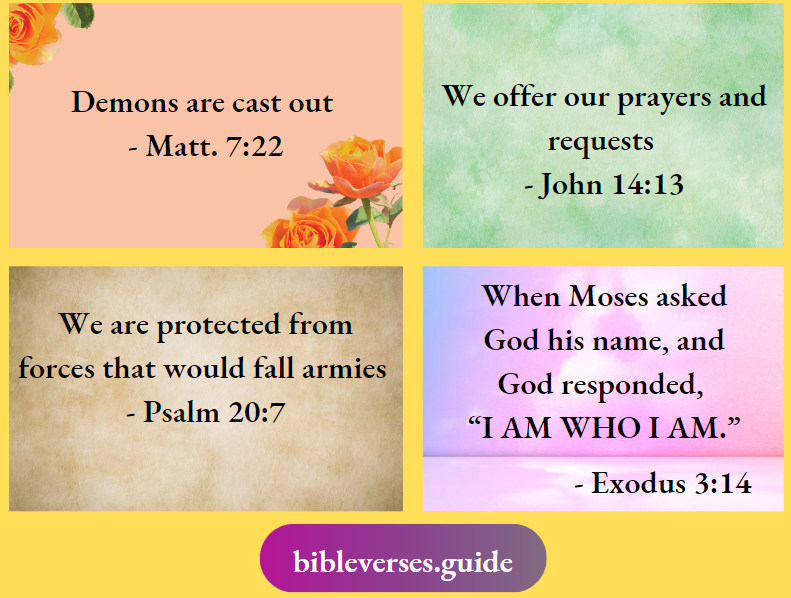
In Psalm 20:7 David compared the power of the name of the Lord with the power the military usually relied upon in times of war.

In this text, an army would have been in sorry shape without chariots and horses, and yet the name of the Lord was even more powerful than those human means.

It is challenging to communicate the importance of God’s name in Scripture, but one of God’s most declarative statements appears.

Honoring God’s Name

The verb here comes from the Hebrew word kayak, which may imply “I am he who is,” or “I am he who exists.”

The original Hebrew combination of letters that signified the name of God was YHWH. The Israelites considered this word too sacred even to pronounce.

When reading God’s name, they combined the vowels in the Hebrew word for “My Lord” and the consonants YHWH to form the word Jekovak.

In Hebrew names carried great significance and were not mere labels. So the words used for God’s name conveyed his divinity and the great importance of who he was.

His name is so powerful for us that the mention of it calls God himself to our aid.

Father, we cannot even comprehend the power your name implies. Thank you that we have full access to it to you.


Salt And Light For A Dull And Darkened World

Salt And Light For A Dull And Darkened World

You are the salt of the earth. But if the salt loses its saltiness, how can it be made salty again? It is no longer good for anything, except to be thrown out and trampled by men.

You are the light of the world. A city on a hill cannot be hidden. Neither do people light a lamp and put it under a bowl.

Salvation through Christ is the highest purpose of our entire existence. But life doesn’t end there. Instead, coming to know Christ is just the beginning of a new life we live for a higher purpose.

Matthew 5-13-16

God doesn’t give grace solely for our selfish enjoyment. It’s not something we should hoard and hide away. Rather, salvation is a divine gift we receive so that we may help give it to others.

Christ explained this concept in terms his listeners could understand stand.

Today, the compound known as sodium chloride is a readily available and inexpensive substance we use to add flavor to our food. But in the time of Christ, salt was a precious commodity that people used to preserve meat and food.

At times in the distant past, they traded an ounce of salt for an ounce of gold. Long ago, people established caravan routes that crossed the ancient world to trans¬port salt from place to place.

Sometimes, as traders were transporting salt across long distances, other substances would adulterate it, or rain or a sudden flood would ruin it.

When this happened, it no longer had any value. Its preservative value was lost, and traders would throw it away.

Today, light is always as near as the closest light switch. Thanks to plentiful electricity and the development of ever-brighter bulbs, people can illuminate their homes, businesses, and ballparks at all hours of the night or day.

But suppose you turn on a light in a closet, then close the door and forget about it. The light is still burning, but nobody can see or benefit from its light.

When Christ told his followers that they were salt and light, he meant that they were supposed to have a transforming impact on the society around them.

Like salt, they were to preserve the good in society, preventing it from rotting and going bad. Like light, they were to illuminate the darkness, enabling people to see the truth and follow it.

God’s gifts are wonderful things to enjoy, but our enjoyment is not the bottom line.

Christ saved us so that we could help him save others. Only when we act as salt and light in our world will we accomplish this urgent assignment.

Father, help me to be salt and light in this needy world.


Open The Door

Open The Door

Isaiah 59-1-2

One of the most famous paintings of Christ shows him standing in a garden facing a large, wooden door.

Jesus is dressed in flowing robes, his long, curly hair cascading over his shoulders. There’s a look of eager anticipation in his eyes.

But there’s something funny about the door. It has no handle, keyhole, or other means of opening it. That’s because the painter was trying to illustrate the message of one of the most powerful verses of the New Testament.

Revelation 3-20

This may sound like an invitation to a meal, but Jesus has more on his mind here than dinner and dessert.

The same man who used terms like living water to explain the work of the Holy Spirit also meant more by the word food than might seem obvious at first.

John, who wrote the Book of Revelation, shows us what Jesus meant in the fourth chapter of his Gospel, where Jesus tells a Samaritan woman, “My food is to do the will of him who sent me and to finish his work.”

So when Jesus says he will come and eat with us, it probably means he will be sharing more than food with us. It means he will be sharing his life, which will enable us better to do his will.

Jesus wants us to open the door and invite him into our lives, but he’s a gentleman. He’s not going to barge in if we don’t really want him there. We need to ask him in.

The Book of Isaiah explores a similar theme. It describes God’s repeated attempts to reach out to the people of Israel.

It’s a sad and depressing story. Time after time, God rescued the people from their latest blunders.

Then, after a period of soul-searching and repentance, the people asked God to forgive them.

They rededicated themselves to faith and righteous living and promised that nothing like that would ever happen again.

But within a few pages or paragraphs, they were up to their old shenanigans once again. They turned their backs on God and experienced the natural consequences of such disobedience.

This goes on for sixty-six chapters. By the time I finish reading Isaiah, I feel a mix of frustration and hope.

There’s frustration because the book powerfully shows how stupid and mule-headed human beings can be. But there’s hope because God keeps trying new things to get our attention once again.

Some people question whether or not God exists, and at least part of their rationale comes from the fact that things on planet Earth never seem to get much better.

Sure, technology improves, but human nature stays the same, embroiling the globe in conflict and wars.

But such recurring problems shouldn’t be a cause for doubting God.

Rather, we should praise God for his steadfast commitment to us in the face of so much opposition and disobedience.

God’s arm isn’t short. He isn’t deaf to our cries. The problem is us and our repeated preference for our own ways over God’s way.

Only when we realize that and open the door to Jesus will we see the face of God in all its glory?

Father, please come into my life and make yourself at home in my heart.